Chapter 1: Ash on the Testing Stone
by inkadminThe testing stone did not glow for Lin Qiye; it screamed.
The sound tore through Grayreed Village like a blade drawn across bone. It began as a thin, keening wail beneath Qiye’s palm, too high for the older villagers to hear at first, too sharp for the children not to flinch. Then it deepened. The black stone shuddered on its bronze pedestal, and the wail became a cry—ancient, furious, and afraid.
Ash stopped falling.
For one impossible breath, every gray flake hanging in the morning air remained suspended between heaven and earth, thousands upon thousands of pale motes caught in the grip of an unseen hand. The world held still. The reed roofs, the mud walls, the crooked fences. The imperial banner of the Azure Lantern Sect, embroidered with a blue flame that never seemed to flicker. The villagers kneeling in the cinder-stained square. The children in patched coats, lined up according to age and trembling hope.
Lin Qiye stood at the front of the stone with his fingers spread against its cold surface, his sleeve slipping back from a wrist too thin for a sixteen-year-old boy. He felt the scream pass through his palm and into his bones.
Not sound.
Recognition.
Then the first crack appeared.
It ran from beneath his middle finger like black lightning, splitting the testing stone’s polished face. The Azure Lantern Sect elder standing nearby had been smiling a moment earlier, the way noble men smiled when looking at pigs before slaughter—without malice, without affection, without the smallest thought that the pig might look back. That smile vanished.
“Remove your hand,” the elder said.
His voice was soft. Everyone heard the fear inside it.
Qiye tried. His arm would not obey.
Something beneath his skin had awakened. Not in his flesh, not in his meridians, not in the shattered mess where spiritual roots should have bloomed, but deeper. Beneath marrow. Beneath breath. Beneath the part of him that had learned, over sixteen ash-choked years, to endure hunger without complaint and humiliation without reply.
A seed turned in the dark.
Broken vessel.
The thought was not his. It moved through him like a mountain opening one eye.
Acceptable.
The crack widened.
And the stone screamed again.
Before that morning, before the ash froze and the sect elders reached for their swords, Lin Qiye had expected nothing more than the ordinary shape of disgrace.
He had woken before dawn to the sound of cinders tapping against the roof.
In Grayreed, ash was weather, ash was season, ash was fate. It drifted from the northern ravines where the old war had burned three hundred years and no rain had ever fully quenched it. It settled in bowls, in bedding, in the wrinkles of old faces. Children were born coughing gray and learned to spit before they learned to sing. The village reeds grew colorless and brittle along the marsh, and even the fish pulled from the muddy water tasted faintly of smoke.
Qiye sat up on his pallet, careful not to wake the old woman snoring behind the hanging mat. Granny Wen’s breath rattled like pebbles in a clay jar. She had taken him in fourteen years ago when the winter flood coughed up a basket near the collapsed bridge, with a blue-lipped infant inside and a strip of silk tied around his wrist bearing only one word: Lin.
That strip of silk had long since been sold for medicine.
“If you die today, don’t haunt me,” Granny Wen muttered from behind the mat.
Qiye paused with one foot in his straw shoe. “I wasn’t planning to die.”
“No one plans to die. That’s why death has such a good business.” She coughed, spat into a cracked cup, and added, “Wear the coat without holes.”
“It has fewer holes,” Qiye said.
“Then wear it with confidence.”
He smiled faintly in the dark. Granny Wen could hardly see past the end of her nose, but she could still hear a smile.
“Don’t make that face,” she said. “Makes you look like someone put sorrow in a pot and boiled it too long.”
Qiye tied his belt. His fingers were steady. They were always steady, even when his lungs burned, even when boys threw clods of frozen mud at his back, even when the village physician shook his head and told Granny Wen the child’s spiritual roots were not merely weak but broken into pieces too fine to mend.
Shattered roots.
The phrase had followed him through childhood like a dog with ribs showing. In the Ninefold Firmament, a person’s spiritual roots were the bridge between mortal breath and heaven’s qi. With good roots, one could draw spiritual energy, temper the body, extend life, fly on swords, command thunder, split mountains, join sects, overturn dynasties. With poor roots, one might still live as a farmer, soldier, merchant, servant.
With shattered roots, one’s body leaked qi like a cracked jar leaked water.
No sect accepted shattered roots. No family invested in them. No master taught them. They were considered heaven’s discarded drafts—lives begun and abandoned.
Qiye lifted the patched coat from its peg. It had belonged to a dead fisherman and still smelled of river mold when the rain came. He put it on anyway.
Behind the mat, Granny Wen’s voice softened. “If they laugh, let them laugh. Laughter is wind. It passes.”
He looked toward the doorway, where dawn pressed dim and gray through the hide curtain. “What if they don’t laugh?”
“Then check your pockets. Silence from villagers usually means they’re stealing.”
This time he did laugh, barely.
Her tone changed again, sharpened by the old iron of a woman who had buried children, husband, and fear. “Qiye.”
He turned.
The mat stirred. A withered hand pushed through, holding a small bundle wrapped in faded cloth. “Take this.”
He accepted it. Inside lay half a steamed yam, a pinch of salt folded in a leaf, and a little bone charm carved into the shape of a foot.
“The yam is for eating,” she said. “The salt is for when your heart feels empty. The charm is useless, but your grandfather believed useless things offended ghosts.”
“You told me you didn’t have a husband.”
“I told many men many things. Don’t be nosy.”
Qiye tucked the bundle into his coat. “I’ll come back after the test.”
“Of course you will,” Granny Wen said. “Who else will fix the roof?”
Outside, the village was already awake.
Ash lay knee-deep in the corners where walls blocked the wind. Men swept paths with reed brooms, more from habit than hope. Women scrubbed children’s faces with snowmelt until their cheeks reddened beneath the soot. The air smelled of smoke, wet earth, boiled millet, and anxious sweat. Every household had brought out its best: blue cloth faded almost white, wooden hairpins polished with oil, shoes stuffed with straw to hide holes.
Above the square, three flying boats hovered like pieces of carved jade stolen from a richer sky.
They had arrived at sunrise without sound, their hulls lacquered deep blue and hung with lanterns burning pale azure flames. Runes shimmered along their sides. Each boat could have held all of Grayreed and its goats besides, yet only nine people had descended: six young disciples in blue-and-white robes, two middle-aged cultivators with sword cases on their backs, and one elder whose hair was black at the roots and silver at the tips, as if age had climbed down from heaven and changed its mind halfway.
The Azure Lantern Sect.
Even the name made villagers lower their eyes.
It was not one of the great immortal sects that ruled entire provinces from cloud peaks, but it was still a true cultivation power. To Grayreed, whose tallest building was the shrine with the broken roof tile, the Azure Lantern Sect might as well have been a palace in the moon. Its outer disciples could leap over walls, crush stone with bare hands, and live to one hundred if they did not get themselves killed seeking opportunities in cursed ruins. Its inner disciples were said to ride sword light and drink dew refined from starlight.
Once every ten years, the sect sent envoys through the ash border to test children between ten and sixteen. Those with spiritual roots were taken away. Their families received silver, grain, and the right to boast until death. Most children failed. A few glowed faintly. One every several visits might possess roots worthy of training.
That was enough to keep hope alive, and hope made people cruel.
“Look, the cracked jar came.”
The voice belonged to Zhao Huan, the miller’s son, broad-shouldered at fifteen and already dressed like someone expecting to be admired by immortals. His mother had tied a red sash around his waist, and his father stood behind him with both hands clasped, grinning at anyone who glanced their way.
Qiye walked past without answering.
Zhao Huan stepped into his path. “Did Granny Wen send you to carry water for the sect? The line for testing is over there. The line for useless people is everywhere else.”
A few children laughed because Zhao Huan was strong and his father owned the millstone. Others looked away because they had laughed before and later found Qiye silently helping their mothers patch nets, which made mockery taste bad in the mouth.
Qiye met Zhao Huan’s eyes. “You’re blocking the path.”
“And?”
“And if the elders see you delaying the test, they may think you’re afraid.”
The laughter shifted. Zhao Huan’s face darkened.
“Afraid? My roots will light the stone blue. Maybe even green. My uncle said our Zhao blood has produced cultivators before.”
“Your uncle also said the moon was an egg laid by a sky chicken.”
Someone choked.
Zhao Huan raised a fist.
“Enough.”
The word did not come loudly, but it landed with weight.
A young Azure Lantern disciple stood nearby, a girl of perhaps eighteen with a sword at her hip and a lantern-shaped jade token hanging from her belt. Her eyes were narrow and bright, the kind of eyes that missed little and forgave less. Unlike the other disciples, who looked at the villagers as if observing insects arrange themselves, she seemed faintly irritated by everyone equally.
Zhao Huan’s fist dropped. “Immortal sister, I was only—”
“You were only wasting time.” She looked at Qiye. “Name?”
“Lin Qiye.”
Her gaze dipped briefly to his wrist, his throat, his chest, as if reading signs written under his skin. “You’re sixteen?”
“Yes.”
“Last chance, then.”
There was no mockery in it. That made it worse.
Qiye inclined his head and joined the line.
The testing stone stood in the center of the square where the village usually dried fish. It was taller than a man’s waist, oval and black, veined with faint silver threads that resembled frozen rivers beneath glass. Three bronze rings encircled its base, each carved with tiny characters. Qiye could not read them, but looking too long made his eyes ache.
The silver-haired elder stood beside it with hands folded inside wide sleeves. The villagers called him Elder Immortal in whispers, though one of the disciples had addressed him as Elder Mo. His face was smooth except for the faint lines at the corners of his mouth, and his eyes held the weary patience of someone who had seen a thousand villages produce a thousand disappointments.
Village Head Meng bowed so low his forehead nearly touched ash. “Honored Elder Mo, Grayreed is blessed beyond measure by the Azure Lantern Sect’s radiance. Our children are coarse reeds, but perhaps among them—”
“Begin,” Elder Mo said.
Village Head Meng’s mouth shut.
One by one, the children stepped forward.
A ten-year-old girl named Shuan placed both hands on the stone. Nothing happened. She bit her lip, bowed, and ran to her mother, who hugged her too tightly.
A boy with a missing front tooth produced a faint brown shimmer. The villagers gasped. Elder Mo glanced once and said, “Low-grade earth root. Barely formed. Record him for servant selection.”
The boy’s father collapsed to his knees weeping with joy.
Servant selection meant no true discipleship, no immortal arts beyond the most basic breathing methods, but it also meant food, shelter, and perhaps a position sweeping courtyards under a mountain where qi was thick. In Grayreed, that was still ascension.
More children tested. No glow. No glow. A muddy yellow flicker. Nothing. A pale red spark that made a disciple raise one eyebrow. Each result changed a family’s fate in a heartbeat. Mothers trembled. Fathers stared. Children learned whether heaven had written their names in ink or ash.
Qiye watched quietly.
He felt no envy when the stone lit. Envy required believing something had been stolen from him. Qiye had never possessed such a thing. His body had been a locked door since birth. Sometimes, during storms, he felt qi moving in the air like cool water beyond a wall. Other children with roots had described it as warmth entering their palms, as breath answering breath. For Qiye, it was always outside. Always elsewhere.
He had once spent an entire winter trying to cultivate from a tattered breathing manual bought from a traveling peddler. He sat beneath the eaves every dawn, inhaling until his ribs hurt, visualizing qi entering his dantian as the manual instructed. Nothing entered. Or if it did, it leaked away instantly, leaving only pain.
Granny Wen found him fainted in the snow on the seventh day and beat him with a broom after he woke.
“If stubbornness were a spiritual root,” she had said, crying while she cursed, “you would have ascended and come back to annoy me as a god.”
“Zhao Huan,” called a disciple.
The miller’s son strode forward, chest lifted. His parents clasped hands. Half the village leaned in.
Zhao Huan placed his palm on the stone.
For a moment, nothing.
Then light bloomed—yellow at first, then deepening toward green. It rose through the silver veins like spring pushing through dead soil. The stone hummed. Not loudly, but enough that villagers cried out.
Elder Mo’s expression finally shifted. “Mid-grade wood-earth dual root. Acceptable.”
Zhao Huan’s face went red with triumph. His mother sobbed. His father shouted, “My son! My son will be an immortal!”
One of the middle-aged cultivators corrected blandly, “Outer disciple candidate.”
No one heard him.
Zhao Huan turned from the stone, and his eyes found Qiye in the line. He smiled slowly.
It was a small smile, but it carried years.
Years of shoulder checks at the well. Years of “cracked jar.” Years of Qiye eating alone behind the shrine because other children’s parents did not want his bad fate rubbing off. Years of village physicians shaking their heads as if Qiye had chosen to be born wrong.
Qiye looked back without expression.
Good for you, he thought, and was surprised to find he meant it.
Not because Zhao Huan deserved kindness. Because leaving Grayreed, even for someone cruel, was still leaving Grayreed. The world was vast. Perhaps vastness could make small people larger.
Or perhaps it only gave them higher places from which to look down.
The line shortened.
The ash resumed falling thicker as the morning wore on. It gathered on shoulders and hair until children looked prematurely old. The sect disciples did not accumulate a single flake; invisible qi slid the ash aside before it touched their robes.
Qiye wondered what that felt like, to be separate from the dirt of the world. To have the air itself decide you were not to be soiled.
“Lin Qiye,” called the narrow-eyed young disciple.
The square changed.
Not visibly. No one stepped forward, no one shouted. Yet attention tilted like a field of reeds under wind.
Granny Wen had come after all. Qiye saw her near the back, leaning on a stick, hair wrapped in a gray cloth, face as wrinkled and stubborn as dried fruit. She had claimed she would not waste her knees watching old men insult children. But there she stood, glaring at the testing stone as if daring it to misbehave.
Village Head Meng cleared his throat. “Honored Elder, this child’s roots were examined years ago by Physician Gao. They are… impaired. Perhaps there is no need to trouble the immortal instrument.”
Elder Mo looked at Qiye. “All eligible children are tested.”
The village head bowed quickly. “Of course, of course.”
Zhao Huan snickered from beside his parents. “Careful. If he touches it, maybe the stone will catch his bad luck.”
The narrow-eyed disciple’s gaze flicked toward him. Zhao Huan swallowed the rest.
Qiye walked to the stone.
Each step seemed too loud. Ash crunched beneath his straw shoes. The air near the testing stone felt colder, carrying a mineral scent like rain on deep caves. Up close, Qiye saw that the black surface was not smooth. It contained depths—layers within layers, as if the stone had swallowed night and pressed it flat.
Elder Mo studied him. “You are aware of your condition?”
“Yes.”
“Shattered roots rarely produce a reaction. If there is pain, withdraw.”
Qiye almost smiled. Pain was not a stranger who needed introduction.
“Yes, Elder.”
He raised his hand.
For a heartbeat, he hesitated.
Not because he hoped. Hope had been carefully buried years ago, wrapped and tied like a corpse too beloved to burn. He hesitated because touching the stone felt like agreeing to let the world speak his sentence aloud.
Cracked jar. Broken reed. Useless thing.
Behind him, Granny Wen struck her stick against the ground once.
The sound was small. It reached him anyway.
Qiye placed his palm on the stone.
Cold surged into him.
It was not the clean cold of winter air or river water. It was the cold of something buried beneath mountains, untouched by sun since the beginning of ages. It climbed through his palm, entered his wrist, and struck the ruined channels of his body.
Agony flashed white.
Qiye’s knees nearly buckled.
He saw—no, felt—the map of himself as the testing stone read it. Meridians thin and scarred. Qi channels twisted, some ending abruptly like roads broken by landslides. Spiritual roots at the base of his inner being not as roots at all, but shards. Splinters of pale glass embedded in mud. A cultivation body ruined before it had ever been used.
The stone pressed deeper.
The cold became a question.
What are you?
Qiye gritted his teeth.
Nothing glowed.
Of course nothing glowed.
A murmur rose behind him. Someone sighed. Someone else whispered that at least it was over quickly. Zhao Huan gave a theatrical cough.
Elder Mo’s sleeve rustled as he made a dismissive motion. “No spiritual response. Next—”
Then the stone screamed.
The sound entered every skull in the square. Babies wailed. Dogs bolted beneath carts. A flock of ash-crows exploded from the shrine roof, wings beating black holes through gray air. The bronze rings around the pedestal flared with characters Qiye could suddenly almost read, each one twisting away as his mind reached for it.
His hand stuck fast.
Not to the surface. To what lay beneath the surface.
The testing stone’s cold had gone from question to terror.
Qiye felt something inside him answer.
It was small at first. Smaller than a grain of millet. Smaller than the seed of a reed. It had slept in a place without dreams, hidden under broken roots and scarred meridians, wrapped in the silence of his own bones. The stone’s probing touch brushed it, and the thing stirred.
A pulse moved through Qiye.
The square vanished.
For an instant, he stood under a sky that was not the sky.
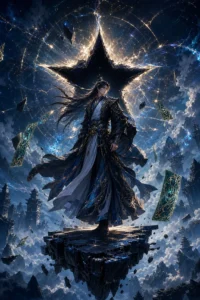
It hung too low, cracked by rivers of gold fire. Mountains floated upside down, their roots dangling like the beards of drowned giants. Seas burned without smoke. Palaces the size of provinces lay shattered across plains of white bone. In the distance, nine suns circled a black wound where heaven had been torn open.
Something vast moved behind the wound.
0 Comments