Chapter 6: Dungeon Core, Meet Spreadsheet
by inkadminThe treasury had been buried so long that the castle above it had forgotten it existed.
Owen followed Seraphine through a crack in the earth where an audience chamber had once been, then down a staircase that looked as if an angry god had tried to fold it in half. Dust furred every step. The air tasted of old coins, damp stone, and the dry metallic bite of sealed magic. Behind them, a trio of goblin laborers hauled lantern-poles and muttered to one another in nasal complaints about cave-ins, cursed vaults, and whether demon gold could technically be considered hazard pay.
“I’m just saying,” Owen said, ducking under a slab of fractured masonry, “when people say ‘hidden treasury,’ they never mention the part where it’s under twelve tons of murder architecture.”
“That is because legends are written by the survivors,” Seraphine replied.
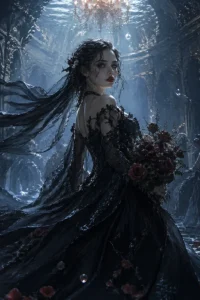
She floated the words over one shoulder without breaking stride. Even in a half-collapsed undercroft, she moved like the place had been built to flatter her. Her dress today was not court silk but something practical by her standards: dark fitted sleeves, split skirt, soft boots, gloves the color of wine. A thin chain of silver rested at her throat. It caught the lanternlight whenever she glanced back, and each glimmer made Owen remember, in inconvenient detail, that this woman was supposed to be his fiancée in public and a smiling political catastrophe in private.
Or possibly vice versa.
Further ahead, a pale blue wisp bobbed in and out of the darkness. Nia—the sleepy archmage fiancée—had refused to walk and was instead drifting horizontal three feet off the floor, wrapped in blankets like an irritable burrito. She had announced that if a legendary demon treasury intended to explode, petrify, or invert gravity, she preferred to meet it while conserving energy.
At the rear came Valka, the battle maniac, carrying two collapsed support beams on one shoulder because the goblins had “looked tired.” She looked almost cheerful, which on her usually meant there was a seventy percent chance of violence before lunch.
“Something’s wrong,” Valka said.
Her voice rolled through the corridor like a drumbeat. Everyone stopped.
Owen peered into the dark. “Wrong how? Trap wrong? Monster wrong? Cursed inheritance wrong?”
Valka sniffed once, then twice. “Clean.”
“Clean?”
“Too clean.”
Seraphine’s lips curved. “I hate when she’s right. It’s so bad for morale.”
Owen raised his lantern higher. She was right. The corridor walls were still choked with dust and spider silk, but the floor ahead had a broad strip where the grime thinned into a faint, smooth sheen. Not polished. Worn.
As if something had passed through here, again and again, for centuries after the treasury was supposedly sealed.
His skin tightened.
“Tell me there isn’t a self-walking murder Roomba in demon castles,” he said.
“I can tell you that,” Seraphine said. “It simply won’t be true.”
Owen sighed. “I miss Earth. On Earth, the hostile autonomous objects were mostly software.”
The corridor bent left and ended in a door the size of a city gate.
It had no hinges. No handles. No visible seam except a black line tracing a perfect rectangle through dark metal veined with red crystal. Reliefs had been worked into its face so finely they looked wet in the lanternlight: roads crossing plains, towers crowned with horns, rivers lit from within, processions of monsters and merchants entering the same walls. The whole door was a map and a promise. Beneath it, half-buried in rubble, crouched three stone figures with broken halberds and blank masks.
Golems.
One of them moved its head.
The goblins shrieked in harmonic terror.
Valka grinned, delighted. “Finally.”
She dropped the beams. They hit the floor hard enough to kick dust into the air. Before Owen could say wait, she was already moving. One step, two, and she exploded forward with a crack of stone underfoot. The first golem raised its halberd. Valka punched through its chest. Not metaphorically. Her fist vanished into granite and came out the back in a spray of shards.
The other two came awake with a grinding chorus. Red lines ignited in their joints.
Seraphine lifted one hand. Silk-thin cords of shadow snapped from her fingertips and wrapped the second golem’s legs. It chopped downward, severing the first line, but not the second. Nia opened one sleepy eye from inside her blanket cocoon and mumbled something that sounded like a yawn in an ancient language. Frost burst across the third golem’s mask. Its head split cleanly in half.
Owen stood very still in the center of all this and had the familiar, surreal thought that his domestic life had become indistinguishable from a raid party.
The second golem lurched free of Seraphine’s last binding line. Its faceless gaze locked on him.
“Why always me?” he said.
It charged.
Instinct and panic made him reach for the humming network under his skin—the broken miracle of Shared Destiny. Since arriving in this world, the skill had behaved like a drunk systems designer’s apology. It copied fragments of the abilities of those bound to him through party, oath, and, through a legal loophole he still resented on spiritual grounds, household bonds that apparently included fiancées with world-ending bloodlines.
Usually it flared when he fought beside them. Sometimes it fused things that absolutely should not fuse. Today, with Seraphine near, Valka blazing at his flank, and Nia half asleep and horrifying in the back line, he felt the skill unfold inside him like pages turning.
Shared Destiny resonates.
Detected linked talents: Martial Drive / Court Ledger / Arcane Calculation.
Temporary composite available: Tactical Appraisal.
The world stuttered.
Not slowed—sorted.
Hairline fractures flashed white across the golem’s torso. Weight distribution marked itself in instinctive diagrams. Its next three movements arrived in his mind with absurd, spreadsheet-like clarity: forward slash, off-balance recovery, exposed left knee. He sidestepped almost before the halberd moved, snatched a loose iron pry-bar from the rubble, and slammed it into the glowing seam behind the monster’s kneecap.
There was a crack like a snapped axle.
The golem folded. Valka, laughing, brought her heel down on its neck and drove the head into gravel.
Silence rolled back through the corridor, broken only by the goblins’ ragged breathing and the distant drip of underground water.
Owen stared at the pry-bar in his hand.
“Okay,” he said faintly. “That was new.”
Seraphine looked at him more sharply than before. Not surprised—she seemed fundamentally incapable of being surprised—but interested in a way that made him feel like a puzzle box she intended to open with expensive tools.
“You saw the structural weakness before impact,” she said.
“Apparently I unionized my skill with an accountant, a berserker, and a walking natural disaster.”
Nia drifted closer, blanket trailing. “Mm. Efficient.”
Valka planted a boot on the ruined golem. “Can it tell us how to open the door?”
Owen turned to the giant slab. The same sensation still lingered at the edge of his thoughts—a lattice of possibilities, costs, functions. His gaze snagged on the relief carving and then, very suddenly, the map on the door didn’t look decorative at all.
It looked like an interface.
He approached slowly.
On the lower right corner, almost invisible under soot, sat a handprint worked in black crystal. Nearby, a line of script curled through the metal in a language he had never studied and somehow half understood anyway. Maybe the summoning had done that. Maybe the broken contract in his soul was translating. Maybe fate had decided his life would be impossible in every available tongue.
He read aloud.
“Administrative access. Civic core vault. Authorized bloodline, contracted regent, or designated steward.”
Seraphine’s smile went still.
“That,” she said softly, “is not a treasury door.”
“No,” Owen said. “It’s city hall.”
For the first time since he had met her, a flash of naked hunger crossed her face. Not greed for gold. Not even power in the simple sense. Recognition. Possibility. Seraphine looked at the sealed gate as if she were staring at a loaded crossbow left unattended in a nursery full of aristocrats.
“Open it,” she said.
“You say that like I own the place.”
She turned to him. “Darling, if that inscription says what you think it says, we are about to find out whether you do.”
He pressed his palm to the black crystal.
It was warm.
Not room warm. Skin warm. Alive warm.
Red light threaded outward under his hand and raced through the door’s carved roads and rivers. The whole slab drank in the glow, then exhaled it in a deep, resonant hum that shook dust from the ceiling. One by one, lines of script ignited across the metal.
Contact recognized.
Contract irregularity detected.
Bloodline key: absent.
Regency key: contested.
Stewardship clause invoked.
Welcome, Acting Administrator.
“That,” Owen said, “feels like the magical equivalent of finding a company laptop and accidentally becoming regional manager.”
The door split soundlessly down the center.
Cold, dry air washed over them, carrying the smell of dormant enchantment—ozone, old parchment, and the sweet mineral scent of crystal reservoirs. Lanternlight spilled into a chamber vast enough to swallow a cathedral choir. Tiered shelves descended in concentric circles, each packed not with gold but with tablets, sealed cylinders, lacquered chests, and crystal rods stacked in regimented ranks. Bridges of black metal crossed the open central void. At the bottom of that void sat a sphere the size of a carriage, dark as midnight, suspended over a nest of silver roots that disappeared into the floor.
The city-core pulsed once.
Every lantern in the room went out.
Blue light bloomed from the sphere and ran through the silver roots like moonlight flooding veins. The shelves gleamed. Runes woke in sheets across the walls. A transparent image rose above the central orb: a miniature city, incomplete and fractured, with districts outlined in ghostly wireframe. Roads spread from it like threads vanishing into dark.
Owen forgot to breathe.
“Holy,” he whispered, and then because there were demons present and words mattered here, “—holy infrastructure.”
Seraphine descended the first stair with a reverence he had not thought her capable of. “Evernight did not bury its treasury,” she said. “It buried its skeleton.”
Valka looked around, unimpressed by lack of immediate combat. “Can the skeleton hit people?”
“Cities usually do,” Seraphine murmured. “Just slowly.”
They moved deeper.
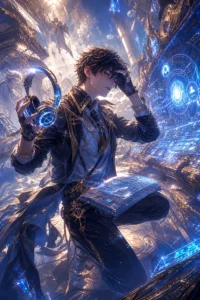
The miniature city overhead sharpened as Owen approached the orb. Towers rose like blue glass needles. Defensive walls traced glowing rings. Sections flickered in and out where collapse or disuse had severed them. He saw icons suspended over districts—storehouses, barracks, foundries, cisterns, market halls—most dark, some amber, a handful blood-red.
On one bridge, set into a pedestal, lay a broad plate of smoky crystal with silver edging. A control surface. A keyboard for emperors.
He laid his fingers on it.
The crystal lit under each touch. Columns of text cascaded upward in the air, transparent and precise.
EVERNIGHT CITADEL MUNICIPAL CORE
Status: Dormant / Emergency Reserve
Population Registry: 0 confirmed residents
Defense Grid: 12% functional
Road Array: 18% recoverable
Waterworks: 41% subterranean integrity
Outer Wards: Compromised
Contract Kennels: Suspended
Authorized Monster Pacts: 0 active
Treasury Liquid Reserve: inadequate
Recommended Action: Reestablish governance
Owen made a strangled sound.
Seraphine turned. “What?”
He pointed at the floating text with the expression of a starving man seeing a buffet. “It’s a dashboard.”
“A what?”
“A beautiful, terrible dashboard. It has categories. It has percentages. Seraphine, it has a municipal status screen.”
She studied the shifting lines, and then her eyes widened with a predator’s delight. “Can it sort by district?”
Owen pressed one glowing symbol and watched the city model rearrange itself into color-coded sectors. “Yes.”
“Revenue streams?”
“There’s a tab called taxable throughput.”
“Gods,” she breathed.
Valka glanced between them. “Why are you both making that face?”
Nia yawned. “They found a puzzle they can weaponize.”
That was exactly it. Owen could feel Shared Destiny tugging again, attracted not to battle this time but to structure. Seraphine stepped beside him, one gloved finger hovering over the crystal. Up close, she smelled faintly of jasmine, paper ink, and something sharp beneath both—venom or perfume or both, with her it was honestly impossible to tell.
“May I?” she asked.
“Please. Before I accidentally set property taxes to apocalypse.”
Her fingers touched the plate.
Shared Destiny ignited.
Shared Destiny resonates.
Link strengthened: Seraphine Vey.
Talent copied: Court Ledger.
Synergy condition met.
Derived function unlocked: Civic Administration.
The world snapped into focus so hard it almost hurt.
Not physical focus. Process focus. Information arranged itself in his head in nested branches, dependencies, labor needs, bottlenecks, political risk factors. The city model stopped being an impossible magical relic and became, somehow, a solvable problem. A giant, cursed, probably war-crime-adjacent city-planning spreadsheet.
And Owen Mercer, who had once optimized grocery delivery routes across three apps while surviving on spite and energy drinks, felt something inside him sit upright and crack its knuckles.
“Oh no,” he said.
Seraphine heard the note in his voice and smiled without looking at him. “What kind of oh no?”
“The kind where this is exactly my nonsense.”
Together they began to work.

0 Comments