Chapter 37: Exile Beyond the Border March
by inkadminThe first thing Ren Xiyan tasted after escaping the tomb realm was rust.
It coated his tongue, thick and metallic, as if he had bitten through a sword. His breath came in shallow pulls that scraped his throat raw. Every inhale dragged splinters of cold qi through his chest; every exhale steamed red in the dawn air.
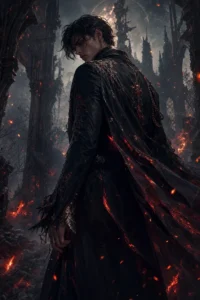
He lay half-submerged in a ditch beside a road that had once been imperial stone and was now only a spine of broken slabs crawling through winter grass. Mud sucked at his robes. The hems were burned black. One sleeve was gone entirely, exposing skin webbed with fine cracks that glowed faintly beneath the surface like dying embers trapped in porcelain.
Above him, the sky was the color of old iron.
For a long while, he did not move.
Movement meant remembering the shape of his body. Remembering that his meridians were not rivers anymore but collapsed tunnels. Remembering that the Empty Crucible had opened wider than it ever had before, not to refine a pill or swallow an impurity, but to devour the shattered laws of a collapsing tomb-realm and spit him somewhere heaven had not bothered to guard.
He listened instead.
Wind combed the dead grass. Somewhere distant, a crow gave a hoarse cry. Beneath the soil, tiny burrowing things scratched through frozen roots. Farther away, iron wheels groaned, accompanied by the uneven clatter of hooves and the murmur of men who had learned to speak softly on dangerous roads.
Xiyan’s eyelids trembled open.
At the edge of his vision, a boundary marker rose from the weeds. It had been carved from black basalt, taller than a man, its face split by old lightning. Moss grew in the grooves of ancient characters.
END OF THE JADE PROVINCES.
Beneath that, newer words had been hacked with a soldier’s blade, crude and deep.
NO LAW PAST THIS STONE.
Ren Xiyan stared at it until the meaning settled in his mind like ash.
The Border March.
Not a kingdom. Not a sect territory. Not even truly a wilderness. It was the scar between maps, the strip of broken land where defeated clans fled with their ancestral tablets, where rogue cultivators founded markets that lasted three nights before burning, where beast-blooded tribes kept pacts older than dynasties, where every warlord called himself a king until someone stronger nailed his skull over a gate.
Beyond the Border March lay the western badlands and the Howling Red Sands. Behind him—if direction had any mercy left—lay the ordered cruelty of sects, ancestral halls, examination stones, punishment terraces, pill furnaces, spirit registries, and smiling elders who sharpened knives with etiquette.
Xiyan tried to laugh.
Blood came out instead.
Still alive.
The thought did not feel triumphant. It felt like a debt collector knocking on a burned door.
He pressed his palm into the mud and pushed.
Pain detonated along his arms. His vision whitened. The cracked glow beneath his skin flared once, and something inside his abdomen twisted with a hollow, hungry pulse. Qi from the ditch—thin, filthy, mixed with rot, insect breath, horse urine, and old battlefield resentment—rushed toward him.
His Hollow Root stirred.
Not eagerly. Not smoothly.
It convulsed.
The qi entered his body in ragged streams and immediately scraped against his damaged meridians. Xiyan choked, fingers clawing furrows into the mud. The Empty Crucible, once a silent abyss beneath his dantian, now felt like a cracked bronze vessel suspended over endless darkness. It drank, but what it drank leaked through fissures of pain.
He clenched his teeth until one molar shifted.
Do not cultivate. Do not circulate. Breathe only.
Master Sun’s voice rose from memory, not as warmth but as instruction. The old furnace keeper had said those words in the caverns under Iron Mountain when Xiyan’s first stolen breath of ruined pill-smoke had nearly killed him.
Xiyan obeyed the dead.
He let the qi pass no further than his lungs. He did not pull it into a cycle. He did not guide it along the ruined pathways. He simply breathed until the hunger retreated, sulking, into the dark place beneath his navel.
By the time the cart reached him, he had managed to sit with his back against the boundary stone.
Three mules came first, shaggy and mud-legged, with bone charms tied into their manes. Behind them rolled a covered wagon patched with hide, bronze sheets, and the lacquered door of what had once been a noble carriage. Two men walked beside it carrying spears. A woman sat on the driver’s bench with a crossbow across her knees and a pipe clenched between her teeth.
All four saw him.
All four stopped.
The mules snorted and backed away, rolling their eyes.
The woman removed her pipe from her mouth. Her hair was iron-gray, braided tight against her skull. A long scar ran from the corner of her left eye to her jaw, pale as fish belly. She wore boiled leather over a quilted robe, and three talismans hung at her throat: one for warding ghosts, one for detecting poison, and one Xiyan did not recognize, made from a child’s tooth wrapped in red thread.
“That,” she said, “is either a corpse too stubborn to finish dying, or trouble pretending to be one.”
One of the spear-men spat to the side. “Leave him, Auntie Ma.”
“I wasn’t asking your permission, Gou.”
“He’s glowing.”
“So do mushrooms, and you still eat those when we’re poor.”
The second spear-man, younger, narrow-eyed, leaned forward. “Those cracks… Looks like backlash from a secret art.”
Auntie Ma’s gaze sharpened. “Or lightning tribulation.”
“No thunder last night.”
“Not any thunder you heard.”
Xiyan raised his eyes to them. He could feel how he looked: bloodless, filthy, wrapped in ruined sect robes whose insignia had burned away but whose cut still betrayed cultivation origins. His hair had come loose, strands plastered to his cheeks. The right side of his face throbbed where tomb-light had seared a line from brow to chin.
He needed water. Medicine. Distance. Silence.
He had none of those things to offer in exchange.
“How far,” he asked, voice rasping, “to the nearest market?”
The younger spear-man laughed. “Listen to him. Half-dead and asking directions.”
Auntie Ma studied him over the curve of her crossbow. “Depends which market you want. The kind that sells food? The kind that sells people? The kind that sells names?”
“Food first.”
“Sensible.” She tapped ash from her pipe. “Can you pay?”
Xiyan’s fingers brushed the storage pouch at his waist. For one terrible instant, he felt only torn cloth.
Then his thumb found the pouch cord, fused partly to his robe by heat but intact.
He had lost most of the tomb spoils in the collapse. The inheritance jade was hidden beneath his breastbone, where the Empty Crucible had swallowed it long ago. The black furnace shard remained wrapped in his inner sleeve. A few pills. Some spirit stones. Broken talismans. A bronze mask taken from an automaton and cracked down the middle.
Enough to tempt murder.
Not enough to prevent it.
He drew out a single low-grade spirit stone, clouded and imperfect, and flicked it toward the mud between them.
It landed with a wet sound.
Gou’s eyes brightened.
Auntie Ma did not look down. That, more than anything, made Xiyan revise his first impression of her.
“Food and a place on the wagon until the next market,” Xiyan said.
“Name?”
Wind moved across the road. Somewhere behind them, beyond distance and ruin, the sects would already be speaking his name in halls bright with spirit lamps. Ren Xiyan. Hollow Root. Heretic. Tomb-thief. Murderer of disciples whose deaths had been arranged before he ever entered the tomb. Thief of celestial relics. Defiler of orthodox inheritance. Vessel wanted by Mo Qu’s hidden masters, though no proclamation would say that part aloud.
Names were chains.
He looked at the boundary stone.
“Yan,” he said.
Auntie Ma’s scar twitched as if she almost smiled. “Just Yan?”
“Just Yan.”
“Conveniently poor name.”
“I am a conveniently poor man.”
“You’re a conveniently dying man.” She finally glanced down at the spirit stone. “Gou, pick that up. If it explodes, try not to bleed on the mules.”
Gou grumbled but obeyed, prodding the stone first with his spear haft. When it failed to detonate, curse, scream, or sprout teeth, he snatched it and tucked it into his belt.
Auntie Ma jerked her chin toward the wagon. “Get in if you can. If we have to lift you, price doubles.”
Xiyan placed one hand against the boundary stone and rose.
For a breath, the world folded inward.
His knees nearly vanished beneath him. The cracked glow under his skin pulsed through his veins, and he heard—not with ears, but with the part of him that had been hollow since birth—the faint grinding of his own meridians fraying. The road tilted. Mud rushed up.
A hand caught his elbow.
The younger spear-man had moved without making sound. Up close, he smelled of mint leaves and old blood. His cultivation was shallow, perhaps second level Qi Condensation, but steady.
“Don’t drip on the grain sacks,” he muttered.
Xiyan nodded once. “Your kindness is overwhelming.”
The young man blinked, then barked a startled laugh.
“Hear that, Gou? Corpse has teeth.”
Gou scowled. “Corpse can walk behind us if he’s so lively.”
Auntie Ma cracked the reins. “Everyone shut up before the road hears we’re cheerful.”
The wagon interior was cramped and smelled of dried fish, medicinal roots, sweat, and fear packed away carefully like contraband. Xiyan crawled between baskets of turnips and bundles of cured hides, found a corner where the canvas sagged low, and lowered himself with the dignity of a collapsing wall.
As the wagon lurched forward, the boundary stone slipped behind them.
The Jade Provinces ended without ceremony.
The Border March swallowed him in increments.
First came the road, or what remained of it. Stones gave way to packed dirt rutted by wheels and claw marks. Charred watchtowers leaned on distant hills, their imperial banners long since stripped, replaced by crow nests and prayer rags. Twice, the wagon passed fields where no one harvested the winter millet because the farmers had been hung from scarecrow poles as warnings. Their bodies were gone. Their hats remained, turning slowly in the wind.
Then came the shrines.
Not the clean ancestral shrines of sect mountains, with incense regulated by rank and merit. These were border shrines: jawbones nailed to trees, red cloth tied around stones, clay bowls filled with liquor for whatever local spirit might keep wolves away and bandits uncertain. At one crossroads, an entire ox skull had been gilded and set atop a spear. Someone had stuffed its eye sockets with spirit coins.
Gou bowed to it.
The younger spear-man spat three times.
Auntie Ma offered smoke from her pipe.
Xiyan watched through a slit in the canvas and felt the Empty Crucible twitch at each shrine, tasting residue: fear, bargain, blood, gratitude, hunger. The Border March was filthy with unrefined karmic threads. They hung from places, objects, bones, names. In sect territory, karma was hidden under ritual. Here it lay in the open, raw as meat in a butcher’s stall.
His Hollow Root wanted all of it.
His body could not survive a mouthful.
Weakness is not absence. Weakness is a shape not yet understood.
The nameless ascendant’s words surfaced in him like bubbles from a drowned chamber. Once, the inheritance had spoken with the calm certainty of a mountain watching seasons pass. Now even memory sounded cracked.
Xiyan pressed his palm over his dantian.
“Not now,” he whispered.
Auntie Ma’s voice floated back through the canvas. “Talking to ghosts, Yan?”
“Negotiating with bad habits.”
“Same thing.”
The younger man’s face appeared at the flap. “Auntie says to drink this.”
He tossed in a clay bottle sealed with wax.
Xiyan caught it by instinct. Pain lanced from wrist to shoulder, but he did not let the bottle fall. He sniffed the mouth after breaking the wax.
Bitter ginseng. Willow bark. Ground centipede shell. A trace of copperleaf to thicken blood. No obvious poison.
There was, however, a sedative hidden under the bitterness.
He looked at the young man.
The young man looked back, expression blank.
“Strong medicine?” Xiyan asked.
“Strong enough.”
“Your aunt worries I will rob you?”
“Auntie worries everyone will rob everyone. She’s usually right.”
“And you?”
“I worry you’ll die before we reach Bitter Gate and leave a curse in the wagon.”
“Your honesty is refreshing.”
The young man hesitated, then said, “Name’s Lu Shen.”
Xiyan raised the bottle slightly. “Yan.”
“Just Yan.”
“Apparently.”
Lu Shen’s mouth quirked. “Don’t drink all at once unless you want to sleep through your own murder.”
He let the flap drop.
Xiyan waited until footsteps moved away. Then he touched one finger to the medicine, drew a thin thread of it into the Hollow Root, and let the Empty Crucible breathe over it.
Before, such a refinement would have been effortless. The impurities would separate like dust from clear water. The sedative would blacken, curl, vanish. The medicinal essence would brighten.
Now the process dragged jagged edges through him.
The Crucible shuddered. A hairline fissure of pain opened from his dantian to his spine. Sweat broke across his forehead. The medicine in the bottle trembled, released a faint gray vapor, and settled into something sharper, cleaner, less abundant.
Xiyan took one careful swallow.
Warmth spread through his stomach. The pain did not lessen, but it stepped back half a pace, enough for thought to stand upright.
He closed his eyes.
Images struck him in fragments.
The tomb realm collapsing in rings of golden ruin. The celestial coffin splitting open not to reveal a corpse but an absence shaped like a person. Mo Qu’s face lit by upper-realm script, smiling with regret that had never touched his eyes.
Little Hollow, do you think Iron Mountain was the mountain? It was only a pebble at the foot of the gate.
Then hands—his own—forming the seal of the Empty Crucible beyond its safe limit. Allies shouting. Lian Yuer’s blue scarf vanishing behind a wall of broken space. Old Huang dragging two unconscious disciples toward a fissure. The beast girl A’Qing laughing as she punched a tomb guardian into fragments, then turning as white light swallowed her.
Scattered.
Not dead. He refused that word. Scattered meant paths could cross again. Dead was a door heaven liked to close too loudly.
He held onto scattered.
The wagon traveled until midday, when the iron sky split and snow began to fall.
It was not clean snow. Each flake carried soot, drifting down gray, melting on the canvas in streaks. Auntie Ma cursed the weather, the road, three warlords by name, and one local river god whose parentage she questioned in detail. The mules endured with philosophical misery.
Near sunset, the road descended into a shallow valley where smoke rose from behind a palisade of mismatched timber, wagon wheels, rib bones, and scavenged stone. Lanterns burned green along the top, fueled by ghost oil. A gate made of iron bars stood open beneath a signboard painted with flaking characters.
BITTER GATE MARKET — NO KILLING WITHOUT DEPOSIT.
Below that, in smaller script:
NO REFUNDS FOR CURSES, BLOOD FEUDS, OR DIVINE RETRIBUTION.
Xiyan read it twice.
For the first time since waking in the ditch, something like amusement touched him.
The wagon rolled into noise.
Bitter Gate Market did not sleep; it simmered. Stalls crowded the muddy lanes beneath awnings patched with flags of fallen sects. Men with sword scars haggled beside women wearing bone armor. A fox-eared child darted between legs carrying skewers of roasted lizard. Three monks in yellow robes sat in a circle gambling with finger bones. A pill vendor shouted praises for a virility elixir while his assistant quietly treated a customer vomiting purple foam behind the stall.
Qi signatures pressed from every side—ragged, mixed, unstable. Rogue cultivators with incomplete manuals. Beast-blooded warriors whose meridians branched around ancestral mutations. War veterans who had swallowed battlefield pills until their organs glowed. Spirit mediums carrying ghosts like second shadows.
In sect territory, Xiyan had been defective because he did not fit the measured channels of orthodox cultivation.
Here, almost no one fit.
That should have comforted him.
Instead, it made the hunger under his skin open one blind eye.

0 Comments