Chapter 16 The Lower District
by inkadminThe Lower District woke before dawn and never truly slept.
Shen Wei had lived here his entire life. It was only now, moving through its streets with new eyes, new purpose, and a new understanding of the systems that shaped it that he saw the district for what it truly was: a machine designed to extract labor from people who had no leverage to refuse.
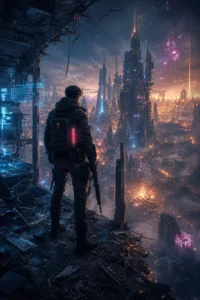
The architecture told the story. The Lower District occupied the outermost ring of Yongcheng’s concentric urban design, pressed against the city’s outer wall. It was a massive formation-reinforced barrier built three centuries ago to contain wild beast incursions from the surrounding wasteland. Inside the wall, buildings rose in dense, irregular clusters: residential towers of twenty to forty floors, most built during the Expansion Era and maintained only enough to prevent collapse.
The streets between them were narrow, shaded, and organized not by city planning but by the organic accretion of decades of informal construction. Stalls, shacks, bridges, and passageways connecting buildings at every level from ground to roof.
The Qi environment was the worst in the city. The Lower District sat at the end of Yongcheng’s Qi distribution grid. The network of underground formations that circulated refined spiritual energy from the city’s central processor to every district, powering everything from transit pods to residential recyclers. By the time the Qi reached the Lower District, it had been drawn on by every higher-tier district first. What remained was thin, degraded, barely sufficient for basic cultivation support. A cultivator meditating in the Lower District absorbed Qi at roughly one-third the rate of someone in the Middle District and one-tenth the rate of someone in the Upper District.
This was not an accident. It was policy. The Qi grid’s allocation was determined by the Cultivation Council, and the Council allocated based on “cultivation density”—the number of high-level cultivators per capita in each district. Since the Lower District had the fewest high-level cultivators, it received the least Qi. Since it received the least Qi, its cultivators advanced the slowest. Since they advanced the slowest, the cultivation density remained low. The cycle was self-reinforcing, and everyone who understood it knew that it was designed to be.
The markets were the district’s lifeblood. Three major market streets ran through the Lower District, each serving a different function.
The First Market was food. Stalls selling synthetic nutrient packs, Qi-infused street food priced for local wages, and the occasional vendor of actual fresh produce from the rural provinces. The Second Market was goods. Clothing, household items, electronics, cultivation tools, and the endless variety of products that a population of two million needed to survive.
The Third Market was cultivation. Materials, pills, talismans, techniques, and services, ranging from legitimate budget suppliers to outright scam artists selling “guaranteed breakthrough pills” that were colored sugar in a formation-stamped bottle. This was where Old Chen’s store sat and where he brought his breakthrough catalysis.
Shen Wei walked through the Third Market on a Saturday morning, weaving between stalls and shoppers with the fluid autopilot of someone who had navigated these crowds since childhood. But his perception was different now—sharpened by Stage 4 senses and informed by a perspective that straddled two worlds. He saw things he had always seen but never truly looked at.
He saw the desperation: a young woman at a discount pill stall, counting coins to afford a single Grade 2 Qi Condensation pill that might—might—give her the push she needed to reach Stage 3. Her hands were shaking. Not with illness but with the particular tremor of someone performing an act of faith with resources they could not afford to lose. She was betting a week’s food budget on a twenty-percent improvement in her next cultivation session, because without that improvement, she would remain at Stage 2 for another year, and another year at Stage 2 meant another year at the bottom of every hierarchy that mattered.
He saw the exploitation: a slick-voiced vendor selling “natural-grade” Spirit Grass that Shen Wei’s trained eye identified instantly as synthetic with a cosmetic coating designed to mimic natural luminescence. The coating was clever—a thin layer of Qi-reactive varnish applied to the leaf surfaces that glowed faintly under ambient light, imitating the genuine luminescence of naturally grown herbs. The vendor was charging four times the synthetic rate for a product that was worth exactly the synthetic rate. His customers didn’t know the difference because they had never seen real natural Spirit Grass.
Shen Wei had. He carried it in his backpack. And the knowledge of the difference.
He saw the power dynamics: a group of young men in matching black jackets lounging at the intersection of the Second and Third Markets, their posture casual, their eyes watchful. The faint Qi signatures of Stages 5 through 7 marked them as Iron Fang Gang enforcers—the street-level operators of the Lower District’s dominant criminal organization. They weren’t doing anything overtly threatening. They didn’t need to. Their presence was the message: this territory belongs to someone, and that someone isn’t you.
The Iron Fang Gang controlled roughly forty percent of the Lower District’s informal economy. Their business model was simple and ancient: protection fees, market stall licensing, dispute resolution, and the quiet monopolization of supply chains.
They didn’t manufacture or sell cultivation materials themselves. That required expertise and connections they generally lacked. They taxed everyone who did. A stall selling pills in the Third Market paid between eight and fifteen percent of revenue to the Iron Fang Gang, depending on location, volume, and the owner’s willingness to negotiate. Those who refused to pay found their stalls vandalized, their supplies stolen, or their customers intimidated.
This story has been stolen from Royal Road. If you read it on Amazon, please report it
The gang’s leader was Bao Zhen. Even Shen Wei, who had spent most of his life deliberately avoiding the district’s power structures, knew the name. Bao Zhen had reached Foundation Establishment through what local legend described as “sheer bloody-mindedness”—fighting, stealing, and clawing his way from mortal-born to the Lower District’s apex predator over two decades. He was respected and feared in equal measure, and the rumors about him ranged from the plausible to the mythic. What everyone agreed on was that Bao Zhen was practical. He didn’t hurt people for pleasure or power or principle. He hurt people when it made economic sense, and he stopped hurting them when it didn’t. This made him, in the Lower District’s grim calculus, the best kind of criminal: predictable.
Shen Wei had never met Bao Zhen. He had never wanted to. Their orbits didn’t cross—the gang operated in the world of physical territory and social dominance, while Shen Wei operated in the world of employment, routine, and invisible ambition.
Until now.
He was passing Old Chen’s apothecary. A routine check, he told himself, though he had no sales to make today. That’s when he saw the enforcer. Intuitively, he knew that Old Chen would need to deal with the enforcer at some point, but he had never seen it in person.

0 Comments