Chapter 2: Triage at the End of the World
by inkadminThe emergency department had always sounded like the end of the world if you listened wrong.
Monitors screamed. People begged. Wheels rattled over cracked linoleum. Someone retched into a biohazard bin. Somewhere behind curtain six, an old man prayed in Spanish with the steady rhythm of a priest tolling a bell, while three beds over a toddler wailed so hard she had gone soundless, mouth open, face purple, her mother rocking her with both arms slick to the elbow in someone else’s blood.
Mara Voss stood in the middle of it all with a trauma shears clenched in her fist and tried to make the ruined shape of St. Bartholomew’s Emergency Department obey her.
The lights were gone. The backup generator had coughed twice and died five minutes after the sky cracked open. Now the ED lived by the red pulse of emergency strips, phone flashlights, and the eerie blue-white glow of the impossible notifications still hanging in the air for anyone too panicked or too stubborn to dismiss them. They hovered over beds and bodies like judgmental angels.
SYSTEM INTEGRATION: PHASE ONE UNDERWAY
Probationary Species: Human
Region: Greater Cleveland Impact Zone
Status: CondemnedSurvive.
The word had burned itself behind Mara’s eyes.
Survive.
As if that had ever been simple.
“Mara!”
She turned. Elliot Chan was half-carrying, half-dragging a security guard through the swinging doors from the waiting room. Elliot was an ER resident on hour twenty-six of his shift, narrow-faced and clever and normally too fond of sarcasm. Now his glasses were cracked, one lens spiderwebbed white, and his scrub top was soaked through with arterial red.
The guard’s left shoulder was wrong. Not dislocated wrong. Not mangled-by-glass wrong. Changed wrong. His deltoid had swollen into a dark, glistening mass, skin stretched tight over pulsing veins that moved like worms. Something beneath the flesh pressed outward in slow, exploratory bumps.
“He was fine,” Elliot said, voice too high. “He got cut by one of the—by Mr. Belman’s teeth, I think. Then this started.”
Mr. Belman had been the mutating diabetic in bed nine. Mara had watched his jaw split at the hinge and grow second-row teeth while his wife screamed his name until he tore out a chunk of her throat. Mara had put an oxygen tank through Mr. Belman’s skull because there had been no one else close enough and no time to be kind.
The guard shuddered. His eyes rolled toward Mara, pupils blown black.
“It itches,” he whispered. “Please. It itches inside.”
Mara’s grip tightened around the shears. “Put him in decon.”
Elliot stared at her. “Decon? Mara, we don’t know if—”
“Exactly.” She pointed with the shears toward the double glass doors of the decontamination room. “Negative pressure, drain in the floor, one way in. Move.”
The guard’s lips peeled back from his teeth. “No,” he said.
It wasn’t the guard’s voice anymore.
Elliot flinched, and the thing in the guard’s shoulder burst.
Not exploded. Bloomed.
Four wet tendrils punched through skin and uniform, each tipped with a small hooked claw. One snapped toward Elliot’s face. Mara moved before thought, before fear, before her own breath caught up. The trauma shears opened and closed with a heavy crunch, slicing through rubbery flesh. Black fluid sprayed across her cheek, hot as fever.
The guard shrieked. The tendrils thrashed. One hooked into Mara’s sleeve and tore cloth from elbow to wrist. Elliot slammed his weight sideways, driving the guard into the decon doors. They hit with a crack, stumbled through, and Mara was there to kick the door shut behind them.
“Lock it!” she shouted.
Nurse Keisha Brant, forty-eight years old, built like a church bell and twice as loud, lunged for the manual override. The bolt slammed home just as the guard hit the inside of the glass.
The first impact starred the reinforced pane.
The second left a smear of black and red.
The third was quieter because the guard’s skull had softened.
For one terrible second, everyone in the ED stopped moving.
Every head turned toward decon. Every breath snagged.
Inside, the thing that had been a hospital security guard pressed its face to the glass and opened its mouth too wide. A new tongue pushed out from behind the old one, thin and pale and questing. It tasted the crack in the pane.
“No one touches the bitten,” Mara said.
Her voice was flat enough to cut. It carried. It had to carry.
“No one touches the scratched. No one hides a wound. If you’re bleeding because something bit you, you tell us now or you kill all of us later.”
A man in a Browns hoodie rose from a chair in the waiting area, cradling a bleeding forearm to his chest. “You can’t just lock people up.”
Mara looked at him. He took one step back.
“I can,” she said. “And I will.”
Keisha wiped blood from her chin with the back of her wrist. “You heard her. Triage tags. Now. Green to the far wall, yellow by imaging, red to trauma one through four. Black—”
Her voice broke on the word. Only for an instant.
Mara heard it anyway.
Black tags meant expectant. Dying. Not dead yet, but close enough that the living needed their resources. The cold arithmetic of mass casualty medicine. The kind they taught with laminated cards and calm instructors in conference rooms that smelled like burnt coffee.
Not like this.
Not with the building groaning around them and the morgue elevator chiming over and over down the hall as if something below kept pressing the button.
“Black tags go to observation,” Mara said.
Keisha’s eyes snapped to her. “Observation’s on the morgue corridor.”
“I know.”
“Mara.”
“We need the beds.”
Keisha’s jaw flexed. She wanted to argue. She wanted to say names, not categories. She wanted to remind Mara that the old woman with the crushed pelvis had given Keisha a butterscotch from her purse two hours ago, that the teenage boy with the open skull fracture still had his prom ticket folded in his wallet, that black tags were not trash.
Instead, Keisha turned away and started shouting orders.
That was why Mara trusted her.
The ED convulsed back into motion.
Mara moved through it like a blade dragged through meat.
She cut away clothing. She packed wounds. She snapped at volunteers, lied to children, slapped a panicking intern hard enough to bring him back to himself, and used a rolling IV pole to barricade one of the hall doors after a man with half his face missing tried to crawl through it giggling in a voice like broken radio static.
The System messages came in pulses.
LOCAL EVENT: MASS CASUALTY NODE ESTABLISHED
Participants: 417
Unclaimed Dead: 38
Unstable Entities: 12Triage Integrity: 21%
“Oh, that’s helpful,” Elliot muttered, pressing both hands into a woman’s abdomen while Mara tightened a tourniquet around her thigh. “Triage integrity. Thank God the magic death screen is tracking our customer satisfaction.”
“Less talking,” Mara said.
“Talking is how I process trauma.”
“Process faster.”
The woman on the gurney laughed once, a wet bubbling sound, then screamed as Mara twisted the windlass tight.
“Sorry,” Mara said.
“Don’t be sorry,” the woman gasped. “Be good.”
Mara looked at her for half a second. Mid-thirties, warehouse hands, wedding ring, eyes clear despite the shock. Then Mara moved on because if she stayed, she would start seeing people instead of injuries, and people killed triage.
In trauma two, her brother was dying.
Ben lay under a foil blanket that reflected the red emergency lights in shivering fragments. Twenty-three years old. Too thin from the chemo that had not worked. Too pale beneath the bruising blooms on his skin. A nasal cannula hissed under his nose, fed by one of their last portable tanks. His phone lay on his chest, screen cracked, still displaying the notification he had not had the strength to wave away.
He was awake.
Of course he was awake.
Ben had always been awake when he shouldn’t be. Sneaking downstairs at six years old to watch horror movies through the banister. Sitting up after bone marrow biopsies to ask the nurses if they wanted to see a card trick. Grinning at Mara from passenger seats and hospital beds and every bad decision he had ever made.
Now he looked at her through lashes damp with fever and pain.
“You look terrible,” he whispered.
Mara stopped beside his bed. For three breaths, the noise of the ED receded until all she heard was the oxygen hiss and the failing rattle in her brother’s lungs.
“You should see the other guy,” she said.
“Did you win?”
“I used a tank.”
Ben’s mouth twitched. “Classic Mara. Subtle. Elegant.”
She checked his pulse though she did not need to. Fast, thready, running away from her. His blood pressure had been a rumor fifteen minutes ago. The old bruises from leukemia had darkened since the sky split. New ones crept under his skin in branching lines, black-purple and faintly luminous.
Not mutation, she told herself.
Not yet.
“Any pain?” she asked.
“Everywhere. Which is efficient.” His eyes shifted past her to the chaos. “How bad?”
“Bad.”
“Scale of one to Afghanistan?”
Her hand froze on the blanket.
Ben winced. “Sorry.”
“Don’t.”
He swallowed with effort. “You doing the voice?”
“What voice?”
“The one where everyone does what you say because you sound like you already buried them if they don’t.”
“It works.”
“Yeah,” he whispered. “It does.”
A crash rolled through the floor.
Not from the ED.
Below.
The kind of impact that traveled up walls and bones. Ceiling dust sifted down in a soft gray veil. Someone screamed near radiology. The morgue elevator chimed again, bright and cheerful.
Ben turned his head toward the sound. “That’s not good.”
“Astute.”
“You should go.”
“I am not leaving you.”
His gaze came back to hers, sharper than his voice. “You already are. Every time you walk away to save someone else.”
Mara’s throat closed.
He reached for her hand, fingers cold against her glove. “That wasn’t a complaint.”
She wanted to say something that would keep him alive. She had spent half her life learning the names of drugs, rhythms, wounds, protocols. She knew how to push blood through a body, how to make a heart remember its job, how to breathe for someone when their lungs failed.
None of that helped when death had already set up camp in the marrow.
“Mara!” Keisha shouted from the ambulance bay doors. “We got movement outside!”
Mara leaned down and pressed her forehead to Ben’s for half a second. He smelled like antiseptic, sweat, and the peppermint gum he chewed to hide nausea.
“Stay alive,” she said.
“Bossy.”
“Promise.”
His smile was small and ruined. “I’ll try to disappoint death.”
She left before her face could betray her.
The ambulance bay had become a mouth.
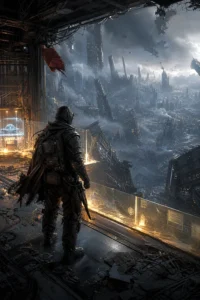
Three ambulances sat crooked beyond the glass doors, their light bars still flashing red and white over the rain-slick concrete. One had jumped the curb and plowed into the oxygen cage. Another burned at the rear, flames crawling up the open doors, painting the bay in orange. Beyond them, Cleveland was wrong.
The city skyline should have been a jagged line of office towers and hospital buildings against night. Instead, pieces of it shimmered behind vertical curtains of impossible color. A block east, Euclid Avenue dipped into a swamp where cattails taller than streetlights swayed though there was no wind. To the west, snow fell upward around the blackened ribs of a parking garage. Above it all, the split in the sky glowed like a wound held open by invisible hands.
And something moved between the ambulances.
At first Mara thought dogs.
Then one stepped into the flashing lights and unfolded too many limbs.
It was the size of a large man but crawled low on six jointed legs, its skin gray and pebbled like soaked concrete. Its head had no eyes. Where a face should have been, a vertical seam opened and closed, tasting the air with red threads. Bone hooks curved from its forelimbs, scraping sparks from the pavement.
Another dropped from the roof of the burning ambulance.
Then three more came out of the rain.
Behind Mara, someone whispered, “Jesus Christ.”
The creatures turned toward the voice.
ENCOUNTER DETECTED
Fear-Eaters: Juvenile Carrion Grade
Wave: 1 of 3Objective: Protect Mass Casualty Node
Optional Objective: Preserve Noncombatants Above 60%Reward scales with sacrifice.
Mara read the last line twice.
Reward scales with sacrifice.
“No,” she said under her breath.
Elliot stood beside her with a fire axe he must have taken from the wall cabinet. He held it like a man who had seen axes in movies but never expected one to become part of his career path. “Please tell me you see the nightmare dogs too.”
“I see them.”
“Good. Bad. Both.”
Keisha shoved a crash cart sideways to reinforce the door. “Those doors won’t hold.”
The first creature hit the glass.
The doors bowed inward with a metallic shriek.
Everyone jumped. The patients closest to the bay began to scream. The fear hit the room like a pressure wave, hot and sour, and the creatures outside reacted instantly. Their seams split wider. Red threads lashed the air. Their bodies swelled as if they were inhaling the sound.
“Stop screaming!” Mara shouted.
No one stopped. Of course they didn’t. A blind monster with hooks for arms was clawing through the ambulance doors.
Mara grabbed the nearest metal basin and hurled it against the wall. The clang cracked through the panic.
“Listen to me!” she roared.
The old battlefield voice ripped out of her, the one born under mortar fire and rotor wash, the one that made soldiers with their legs blown open look her in the eye and breathe when she told them to breathe.
“They’re feeding on fear. You scream, they get stronger. You run, you die tired. You want to live, shut your mouths and move when I point.”
Silence did not fall.
But the panic thinned. It became sobbing, whimpering, prayers bitten behind hands.
The creatures shrank a fraction.
Elliot stared at her. “That was terrifyingly effective.”
“Barricade,” Mara said. “Everything heavy. Gurneys locked sideways. Cabinets. Vending machines if you can move them. Keisha, get security’s shotguns.”
Keisha barked a humorless laugh. “You think St. Bart’s let us keep shotguns?”



0 Comments