Chapter 4: Safe Zone of Liars
by inkadminDawn never truly came to the Ruined Realm.
The black sky only thinned from pitch to bruised charcoal, and the stars faded not with grace but with the look of embers choking under ash. Elias crossed a ridge of broken stone beneath that false morning, his new bone weapon slung across his back in a strip of torn cloth. The thing rode there like an accusation.
It had once been pale.
Now hairline veins of dull red pulsed through the carved bone whenever his fingers brushed the haft, as if something inside it still remembered the elite creature that had died to make it stronger. Each pulse answered the Graveclass in his chest—a cold, hollow beat where fear should have lived and where, more and more often, hunger answered instead.
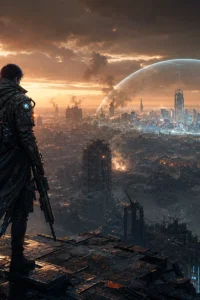
Below the ridge, the land dipped into the corpse-colored plain he had spent the night crossing. Dead grass lay in mats between shattered roads. Skeletal trees leaned at impossible angles. Far off, ruined towers speared upward from the mist like broken teeth. Somewhere to his left, something large bellowed from the fog and was answered by shrill, many-throated screams. Elias did not look that way.
His body still felt like borrowed property. He was less starved than he had been yesterday, less naked, marginally less likely to die to the first thing with claws, but every movement reminded him that survival here had edges. His ribs ached. One shoulder throbbed from where the chapel monster had slammed him into a wall. Dried blood tightened on his forearm in dark flaking bands. He smelled like sweat, old dust, and crypt rot.
Then he saw the lanterns.
At first he mistook them for low stars fallen to earth. Tiny amber points winked in a ring in the hollow ahead, warm and impossibly domestic amid all that ruin. As he descended, details surfaced from the haze: a crescent wall of scavenged wagons, sharpened stakes hammered into earth, patchwork canvas stretched over frames of bent iron. The lanterns hung from poles at the perimeter and glowed with a steady yellow light that looked too rich to be ordinary flame.
Smoke drifted upward from cookfires. Human voices carried faintly. Laughter, even.
Elias slowed on instinct.
A camp meant water, food, answers.
A camp also meant people, and people had always been the fastest way for things to get complicated.
He crouched behind a slab of toppled masonry and watched.
There were guards at the gate, if the gap in the wagon wall counted as one. Four of them. Leather armor pieced together from different sets. Spears on two. Short blades on the others. They stood in loose, practiced boredom, but Elias noticed what their eyes did—constantly measuring approach angles, hands, weapons, shoes, posture. Predators wearing the mannerisms of tired workers.
Above the gate hung a painted board scavenged from somewhere cleaner than this place had any right to be. The letters had been carefully repainted in bright white:
LANTERN REST
Trade. Shelter. Second Chances.
Elias stared at the last line until a humorless laugh nearly escaped him.
Second chances. That one had already cost him a subway platform, a crushed spine, and a class that felt like grave dirt stitched into his soul.
Movement flickered to the right. He shifted lower.
A group was approaching the camp from another slope—five people, all in rough starter clothes, all moving with the stunned, brittle gait he recognized. New arrivals. One man still wore a scorched office shirt under a stolen leather vest. A teenage girl clutched a kitchen knife in both hands like she expected the world to leap at her. A heavyset woman limped badly. They looked exactly like Elias must have looked yesterday: recently ripped out of one life and dropped screaming into another.
The guards straightened. Smiles bloomed as if pulled into place by strings.
“Travelers!” one called. He spread his arms wide. “You made it. Come on in. You’re safe now.”
Safe.
The word carried across the hollow as smoothly as oil.
The newcomers almost sagged with relief. The office-shirt man laughed too loudly. The teenage girl began to cry in quick, embarrassed little breaths. One of the guards stepped forward and draped a blanket over the limping woman’s shoulders with a gentleness so perfect it looked rehearsed.
Elias watched them ushered inside.
He almost turned away.
Then the smell of cooking stew hit him on the wind, rich with onion and animal fat, and his stomach cramped so hard he nearly doubled over. That decided it.
He rose, adjusted the strip of cloth around the bone weapon so it looked less like a prize and more like scrap, and walked toward Lantern Rest.
The guards clocked him at fifty paces. Their expressions shifted for half a heartbeat—not fear, exactly, but sharp interest. He knew what they saw. Blood. Dirt. A weapon worth stealing. The posture of someone who had already had to kill to reach their gate.
Then the smiles returned.
“Hell of a morning,” said the tallest guard as Elias approached. He had a blunt jaw, a shaved head, and the kind of friendly voice bartenders used right before cutting someone off. “You alone?”
“For the moment,” Elias said.
The guard’s eyes flicked over him. “You bleed on the way in, or you planning to do that later?”
“Depends how welcoming the place is.”
A snort came from one of the spear carriers. The bald guard grinned wider, amused rather than offended.
“Fair answer. Lantern Rest welcomes everybody who can behave.” His gaze dropped to the wrapped weapon on Elias’s back. “We check names, classes, and equipment at entry. Keeps trouble down.”
Elias’s pulse gave one hard kick.
The Graveclass felt suddenly loud inside him, like chains dragged over stone.
He kept his face blank. “Names, I’ve got. Equipment, visible enough. Class is private.”
That landed. Tiny thing, but it landed.
The second guard, a woman with a scar splitting one eyebrow, shifted her grip on her spear. “Private classes don’t stay private long if they cause problems.”
“I didn’t say I’d cause any.”
The bald man lifted a placating hand. “Easy. First day nerves, yeah? We’re not tax collectors.” He leaned against the wagon side as if this were casual. “Just a practical matter. Camp runs on contribution. Some classes can’t pull weight. Some can. Helps us know where to place people so nobody gets themselves eaten.”
Place people.
Elias looked past them into the camp.
At first glance it was almost convincing. Fires in iron drums. Rows of tents. A water barrel station near the center. Traders with salvaged goods laid on blankets: boots, rusted cutlery, chipped charms, strips of dried meat, coils of rope. People moved with purpose. No one screamed. No monster prowled the lanes.
Then his eye caught the details the smiles were meant to hide.
A cluster of newcomers sat on crates by the inner fence, each wearing a rough cord bracelet dyed blue. None of them looked up. Their faces had that emptied-out expression of people who had already learned a rule by being punished with it. A broad man in patched mail stood over them with a tally board tucked beneath one arm. Across the camp, a woman was haggling for a waterskin while a pair of armed toughs watched from close enough to intervene if she forgot who owned the ground under her feet. Near one cookfire, a boy no older than twelve scrubbed blood from someone else’s boots while two older men rolled dice over his bent back.
No screaming. No monsters.
Just a hierarchy wearing civility like perfume.
“What if I’m just passing through?” Elias asked.
“Then you can pay transit.”
“With what?”
The guard smiled. “Something useful.”
Elias let a beat pass. “I’ve got a name, then. Elias.”
“Good start.”
“And I fight.”
The bald guard waited. When no class followed, he chuckled through his nose and stepped aside. “Fine. Elias who fights. First day’s cheap. No theft, no brawls, no stepping into officer tents. Water’s rationed. Food line at the center drum. If you want longer stay, speak to a recruiter.”
“Recruiter?”
“Don’t look so nervous. Means work assignment.” He tapped the painted sign overhead. “Second chances, friend.”
Elias walked through the gate.
The warmth hit him first. Not real warmth—this world seemed incapable of producing enough of that—but the relative closeness of bodies, flame, and tarped walls after open wasteland. It smelled of broth, smoke, wet canvas, mildew, lamp oil, and old unwashed fear. The camp hummed with low conversation. Somewhere a hammer rang against metal in a quick, steady beat.
Heads turned as he passed. Some curious. Some assessing. One or two openly hostile. His hands stayed loose at his sides.
A woman ladled stew from a blackened pot into wooden bowls. Elias joined the line, received one after a skeptical look from her, and wolfed the contents standing up. It was thin, greasy, and mostly root vegetable, but the broth was hot enough to make his eyes sting. He scraped the bowl clean with two fingers.
“First one always tastes like salvation,” said a voice beside him.
Elias turned.
The speaker was sitting on an overturned crate near the cookfire, a narrow woman in a dark coat several grades better than anything else in camp. Her hair was braided close to the scalp on one side and left to spill silver-blond over the other. A pair of round spectacles perched on her nose despite one cracked lens. She held a cup of steaming something in both hands and watched him over the rim with amused, deliberate patience.
She did not look afraid of anything here.
That made her dangerous immediately.
“Does the second one taste like extortion?” Elias asked.
Her mouth quirked. “Depends who bought it for you.” She tipped her chin toward the empty bowl. “Sit. You’re making everyone nervous by standing there armed and difficult.”
“I’m difficult sitting too.”
“Good. I hate one-sided conversations.”
Elias sat on the edge of a broken crate opposite her, keeping enough distance to move if he needed to. Up close he noticed the coat had been expertly mended at the sleeves, and the gloves she wore were too fine for this place. On the back of one hand, a crescent scar curved pale against olive skin.
“You recruit for Lantern Rest?” he asked.
“Sometimes. Sometimes I rescue fools from bad contracts. Sometimes I sell maps to people too desperate to know they’re fake.” Her smile flashed. “Today I’m in a generous mood, so let’s call me a consultant. Mara.”
He gave her only, “Elias.”
“Naturally.” She sipped from her cup. “You came in alone. That means you either got lucky, or your starter class isn’t complete garbage.”
“There a third option where I just don’t die easily?”
“Not for long.”
Her tone stayed light, but there was iron under it. Elias glanced around the camp again. The limping woman from earlier was being led toward a tent marked with a strip of blue cloth. The office-shirt man was speaking animatedly to a broad-shouldered recruiter in clean leather, nodding too much, smiling too hard. A skinny boy with soot-black hair hurried past carrying three bundles of firewood, eyes down.
“You said bad contracts,” Elias said. “How bad?”
Mara looked at him over her cup. “How attached are you to your freedom?”
“Reasonably.”
“Then don’t sign anything before dusk. Better yet, don’t sign anything at all.” She turned the cup in her hands. “Lantern Rest survives by being useful. Newcomers stagger in. Newcomers need food, shelter, gear, guidance. Newcomers also tend to have weak classes, no resources, and no idea what dungeon debt is.”
The phrase chilled him more than the black sky had.
“Explain.”
“The camp fronts you supplies. Blade, boots, healing cloth, passage with a team into a low-tier dungeon. In exchange, you owe a percentage of all drops until the debt is repaid.” She gave a delicate shrug. “But prices are set by the same people keeping the ledger. Repairs add fees. Rations add fees. Failure adds fees. If someone on your team dies and the run loses value, guess who absorbs the loss?”
“The weakest.”
“Very good.”
Elias watched the blue-bracelet group by the fence. One of them, a gaunt older man with shaking hands, looked up just long enough for Elias to see raw skin rubbed around his wrist beneath the cord. The tally-board overseer smacked the back of his head without even looking at him. The man stared back down at his boots.
“And if they can’t pay?” Elias asked.
Mara’s cracked lens caught the lantern light. “Then they work. Camp labor. Scavenging runs. Bait duty, if somebody’s especially unlucky.”
“Bait duty.”
“Throw a weak class at a dungeon trigger, learn what wakes up, decide whether stronger people want the room.”
The bowl in Elias’s hand creaked faintly as his grip tightened.
Second chances.
“Why tell me?” he asked.
“Because you don’t have the look of someone born to obey.” Mara set down her cup. “And because if Harlan gets to you first, he’ll smell value and start smiling.”
“Harlan.”
“Tall, broad, polished teeth, voice like warm bread. He runs intake. Half this camp thinks he saved their lives. The other half owes him for it.”
“And you?”
“I owe him money,” she said cheerfully. “Which is different.”
Elias almost smiled despite himself.
A shadow fell across them.
“Talking business without me, Mara? You do know that hurts.”
The man who stopped beside the crate wore authority as neatly as his fitted leather coat. He was tall indeed, with dark hair combed back from a high forehead and a smile so easy it looked practiced in mirrors. A silver lantern pin gleamed at his collar. Two armed escorts lingered a few steps behind him.
Harlan.
Mara leaned back, unbothered. “I was warning him about your poetry.”
“Cruel.” Harlan’s gaze settled on Elias, and warmth poured into his expression with almost frightening precision. “You’re new. Welcome to Lantern Rest. I’m told you came in alone, which either means you’re capable or catastrophically stupid. Both can be useful.”
“You always open negotiations by insulting people?” Elias asked.
“Only the ones I expect to survive them.” Harlan extended a hand. “We keep order here. We help people find footing. The Realm eats the soft-hearted and the disorganized. We prefer structure.”
Elias looked at the hand, then at Harlan’s face, and finally shook it. Harlan’s grip was dry and firm.
“What kind of structure?” Elias said.
“The kind that turns panicked arrivals into productive members of camp.” Harlan released him. “You’ve probably heard ugly versions already. Debt. Tiers. Assignments. People love ugly stories when they resent necessity.”
Mara made a tiny coughing sound suspiciously like laughter.
Harlan ignored her. “Here’s the simpler truth. Everyone pays for survival somehow. Food costs effort. Safety costs labor. Equipment costs risk. We pool what we can, and those with more strength carry more burden.”
“Do they?” Elias said.
“Until they earn the right not to.” Harlan spread his hands. “That is civilization, Elias. It may offend people freshly dropped into this world, but offense doesn’t keep the monsters out.”



0 Comments