Chapter 1: The Root That Was Not There
by inkadminThe testing jade drank Liang Chen’s blood, turned black as a moonless well, and made every elder in the hall take one frightened step back.
For a breath, the Azure Lotus Sect forgot how to breathe.
Incense smoke hung motionless beneath the carved rafters of the Root Awakening Hall, white coils frozen around beams painted with lotus petals and sword clouds. The bronze braziers along the walls hissed softly, their blue flames bowing inward as if a wind had passed through the chamber, though every door stood closed. Outside, thousands of sect disciples filled the terraces and stone bridges, waiting to cheer the new generation’s colors. Inside, thirteen-year-old children knelt in three neat rows upon prayer mats of woven reed, each child wearing washed gray robes, each face polished with fear and hope.
Liang Chen stood alone before the altar.
His hand was still stretched over the testing jade.
A red line crossed his thumb where Elder Mo had pricked him with the silver thorn. Blood should have blossomed on the jade’s surface, sunk into the crystal veins, and called forth a color: white for mortal-spirit, yellow for earth-vein, green for wood-heart, blue for water-bone, red for fire-pulse, violet for storm-soul, gold for heavenly root. All children in the Nine Falling Stars Empire knew the colors before they knew their parents’ names. Even gutter orphans whispered them in sleep.
But Liang Chen’s blood did not stain the jade.
It vanished.
Not soaked. Not absorbed.
Vanished, as though something beneath the crystal had opened a mouth.
Then the jade turned black.
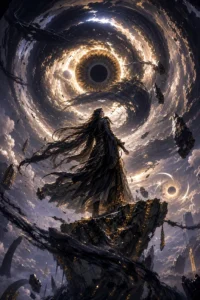
Not the glossy black of ink, nor the deep luster of obsidian talismans, nor the dignified darkness of elder robes worn at funerals. This black had no surface. It was a hole cut into the world. The silver stand beneath the jade trembled. The lotus-carved altar groaned. A thread of cold spread outward across the flagstones, frosting the carved array lines until they shone like bones under moonlight.
Liang Chen stared at it.
He had copied the sect’s root-records for three years in the eastern archive. His fingers had memorized the brushstrokes for ten thousand names and ten thousand fates. Children with yellow roots became outer disciples. Green roots were placed in herb gardens. Blue roots drew instructors of breath refinement. Red roots were sent to martial courtyards, where their fists learned the language of thunder. Violet roots made elders smile like merchants finding buried jade. Gold roots caused bells to ring and rivals to send assassins before the first winter.
There was no black.
No black in any scroll he had copied.
No black in the murals where immortals rose from mountains.
No black in the songs peddlers sang beneath the sect gates.
Yet there it was, cradling his blood in absence.
Elder Mo’s beard quivered. He was a narrow old man whose shoulders had been bent by a century of authority rather than labor. His fingers still held the silver thorn, but his hand had retreated into his sleeve like a frightened animal.
“Again,” Elder Mo said.
No one moved.
His voice cracked across the hall. “Again!”
A deacon hurried forward, face pale beneath his black cap. He lifted another silver thorn from the lacquer tray. It rang against the porcelain bowl once, twice, three times before he managed to hold it steady.
Liang Chen turned his gaze from the black jade to the elders seated upon the high platform. Seven chairs of bluewood, seven lotus backrests, seven masters who had looked upon him all his life without seeing him. Now they saw him too clearly.
At the center sat Sect Master Yun Qinghe, robes white as first snow, hair bound with a jade crown. His eyes had always seemed kind from a distance. From where Liang Chen stood, they looked like polished river stones sunk in winter water.
“Child,” the sect master said softly, “give your hand.”
Liang Chen obeyed because obedience was the first lesson an orphan learned if he wished to eat.
The deacon took his wrist. The man’s fingers were warm and damp. He pierced Liang Chen’s thumb a second time. Pain came sharp, honest, almost comforting. Blood welled up red. Human red. Mortal red. Liang Chen watched it with an absurd hunger, as though that single drop might argue on his behalf.
The deacon guided his thumb toward the jade.
Before blood even touched crystal, the blackness inside the jade stirred.
It pulled.
Liang Chen felt the tug through his bones. Not on his skin, not on his blood—on something deeper and unnamed, the quiet inner map that every child was told would awaken today. His chest hollowed. His breath fell inward. The hall stretched away from him in long blue-white lines. Somewhere beyond the walls, beyond the terraces, beyond the sect mountain itself, he sensed the vast body of Heaven turning one blind eye toward him.
The blood leapt from his thumb.
It crossed the air in a thin red thread and disappeared into the jade without wetting its surface.
The black deepened.
A sound rose from it.
Not loud. Not even a sound, perhaps. A silence with edges. The silence of a well after a stone falls and never strikes water.
One of the children behind Liang Chen began to sob.
“Hollow,” whispered Elder Xu, the sect’s keeper of root genealogies.
The word passed through the elders like rot through fruit.
“Impossible,” said another elder.
“He has no retention pattern.”
“No, look at the meridian shadow—there are channels.”
“Channels to where?”
“Seal the hall.”
“Do not alarm the disciples.”
“The jade is flawed.”
“The imperial records—”
“Silence,” Sect Master Yun said.
The word landed softly, but every flame in the braziers bent lower.
Liang Chen stood with his bleeding thumb at his side. He wanted to wipe it on his robe. He did not dare. A drop slid down the line of his knuckle, bright against skin scrubbed clean for the ceremony.
He had washed before dawn at the orphan dormitory’s cold basin. He had rubbed his wrists until the smell of old ink was gone. He had mended the small tear at his sleeve with thread pulled from the hem, though the stitch was crooked. Senior Scribe Han had lent him a belt clasp of tarnished bronze and said, gruffly, “Stand straight. If your root is decent, they may forget you came from nowhere.”
Liang Chen had carried those words in his chest like a coal.
If his root was decent, he could leave the archive’s dust. He could stop sleeping beside stacks of worm-eaten ledgers. He could stop being the boy who ground ink until his fingers turned blue-black. He could earn a name listed in cultivation records not as “foundling, approximate age,” but as disciple. Outer. Inner. Core. Anything that meant the world had measured him and found weight.
Now the testing jade held his fate like an open grave.
“Liang Chen,” Elder Mo said, voice scraping back into ritual shape. “Age thirteen. Registered orphan of the western famine year. Archive scribe, lower service hall.”
His eyes flicked toward Sect Master Yun.
The sect master did not nod. He merely continued to look at Liang Chen, and under that gaze Liang Chen felt smaller than the dust motes trapped in incense smoke.
Elder Xu rose from his chair. He was a heavy man with a round scholar’s face and hands stained by cinnabar from endless genealogy seals. He descended the platform one step at a time. His breathing was audible in the silent hall.
“Place your palm upon the jade,” he said.
Liang Chen hesitated.
A murmur ran through the children behind him.
“Do it,” snapped a boy in the first row.
Liang Chen knew that voice. Shen Yu, nephew of an inner elder, hair oiled bright, robe cuffs embroidered though service children were forbidden adornment. Moments before Liang Chen’s test, Shen Yu had awakened a green wood-heart root with a streak of blue water-bone. The jade had glowed like a spring pond. Elders had nodded. A deacon had written his name on silk instead of paper.
Now Shen Yu looked at Liang Chen as if a rat had climbed onto the ancestor altar.
Liang Chen set his palm on the jade.
Cold bit through him.
The hall vanished.
For one instant, he saw himself from within.
Children were taught that spiritual roots resembled trees. Roots below, trunk through the spine, branches into the meridians, leaves opening to Heaven’s qi. Liang Chen had imagined his root a hidden sapling beneath mud, pale and patient, waiting for blood to wake it.
But inside him there was no tree.
There was a lattice.
Empty channels intersected in impossible angles, each line thin as a hairline crack in porcelain, each junction shaped like a small dark mouth. They did not grow from a center. They circled absences. They curved around spaces where something should have been. Qi from the hall seeped toward him—faint threads shed by elders, spilled from braziers, lingering in the array beneath the floor—and the lattice opened.
It devoured everything.
Nothing remained.
No warmth. No spark. No drop stored in a dantian reservoir. The qi passed into him and became unfindable, like rain falling into sand that had no bottom.
The vision ended.
Liang Chen gasped. His knees nearly buckled.
Elder Xu snatched his wrist and pressed two fingers against his pulse gate. The old man’s spiritual sense entered like a needle of winter light. Liang Chen clenched his teeth as it moved through him, prodding, measuring, recoiling from places that offered no echo.
Elder Xu withdrew as if burned.
His face had gone gray.
“Announce it,” Sect Master Yun said.
The genealogist swallowed. “Root structure present.” His voice had become the dry rasp of a brush across old paper. “Meridian channels numerous. Retention capacity…” He looked at Liang Chen, and for a heartbeat there was not fear in his eyes, but pity. “None.”
Shen Yu laughed once. It was a small, sharp sound.
Elder Xu closed his eyes. “Classification: Hollow Root.”
The hall erupted.
Not into shouting. Azure Lotus discipline ran too deep for that. It erupted into whispers that cut harder than screams.
“Hollow?”
“That is a corpse-root.”
“Worse. Corpses don’t swallow qi.”
“My grandmother told a story…”
“He’ll drain a spirit stone to dust and gain nothing.”
“Can Hollow Roots survive?”
“Not if they cultivate.”
“He was in the archive. What if he copied manuals?”
“He has read breathing methods?”
Liang Chen heard every word. His memory, praised only when it saved others labor, caught each whisper and pinned it inside him with cruel precision. Hollow. Corpse-root. Worse than mortal. Drain. Useless. Dangerous.
He looked down at his hand on the black jade. For the first time since he was old enough to understand hunger, he felt anger.
It came slowly, like ink spreading through water.
He had never stolen spirit rice from the kitchens. He had never hidden scrolls. He had never complained when the archive roof leaked and winter froze his blanket stiff. He had copied cultivation methods he was forbidden to practice, recording the graceful logic of breath and meridian flow while his own lungs ached from lamp smoke. He had watched boys with surnames waste talismans on pranks and girls from noble clans step over servants as though they were floor cracks. He had bowed. He had endured. He had believed the testing jade would be impartial.
Heaven measures all roots, the instructors said.
But Heaven had measured him and found a hole.
“Remove his hand,” said Elder Mo. “The jade—”
A sharp crack split the hall.
Black lines crawled across the testing jade.
The elders surged back another step. Even Sect Master Yun’s sleeve stirred as his fingers tightened on the armrest.
Liang Chen lifted his hand at once.
The jade did not release him.
The blackness clung to his palm, not like liquid but like absence refusing to be separated. His skin tingled. The lattice inside him shivered open. Qi rushed from the altar array, a current invisible to the children but visible to Liang Chen now in the way pressure was visible to bones before a storm.
The lotus array beneath the altar dimmed.
A collective hiss rose from the elders.
“Cut the connection!” Elder Xu barked.
Three deacons hurled paper talismans. Yellow slips struck the altar and flared with vermilion characters: sever, still, suppress. The air filled with the burnt-pepper smell of activated cinnabar.
For an instant, Liang Chen saw the talismans as more than paper.
He saw intention wrapped in strokes. Each character formed a little cage, each cage built around a gap through which qi was meant to pass. The talismans did not create power; they persuaded it. They leaned on absence and called that leaning law.
The thought came whole, cold, impossible.
The spaces matter more than the strokes.
The talismans struck the blackness.
They crumbled into ash.
Liang Chen staggered backward as the jade finally released him. A spiderweb of cracks flashed across its surface. Then the imperial-grade testing jade, carved from a vein beneath Fallen Star the Third and consecrated by three Core Formation elders, collapsed inward without a sound.
One moment, it existed.
The next, the silver stand held a bowl-shaped heap of fine black dust.
Outside the sealed doors, the crowd on the terraces roared in confusion. They had seen the hall’s roof-light darken. They had felt the tremor through the mountain. Young disciples shouted questions. Someone struck a ceremonial bell by mistake, and a single bronze note rolled across the peaks, solemn as a funeral.
Liang Chen stood amid the black dust, palm numb, blood dried on his thumb.
No one touched him.
Not the deacons. Not the elders. Not even the boys who had shoved him in dormitory corridors for sport. They all kept distance, and that distance built a wall higher than any prison.
Sect Master Yun rose.
The hall bowed as one. Children pressed foreheads to mats. Deacons dropped to one knee. Elders inclined themselves, stiff with age and unease.
Liang Chen was late to bow. He bent awkwardly, because his legs had gone hollow too.
“Liang Chen,” said the sect master.
His voice carried no anger. That made it worse.
“Yes, Sect Master.”
“Did you practice any method from the archives without permission?”
The question entered Liang Chen’s chest like a blade. To lie to a Nascent Soul cultivator was like spitting at lightning.
“No, Sect Master.”
“Did anyone instruct you in devouring arts, demonic breath, corpse-nurturing, void scriptures, or forbidden sutras?”
A child whimpered at the list.
“No, Sect Master.”
“Have you experienced black dreams, voices during meditation, hunger when near spirit stones, or pain beneath the navel during full moons?”
Liang Chen opened his mouth, then closed it.
Sect Master Yun’s gaze sharpened.
“Answer.”
“I…” Liang Chen’s throat clicked. “I dream of falling sometimes.”
Shen Yu muttered, “Orphans dream of rice. Is that forbidden too?”
Elder Mo snapped, “Silence.”
Liang Chen kept his eyes on the floor. “Not falling from somewhere. Falling through something. There is no bottom. When I wake, I remember… wind, but there is no wind. I thought everyone had such dreams.”
No one laughed now.
Elder Xu made a sign with two fingers and whispered a warding phrase from the old empire.
Sect Master Yun descended from the platform.
His steps made no sound. His white robes did not brush the floor. As he approached, the air changed. The incense smoke fled him in delicate streams. Liang Chen felt the sect master’s cultivation pressing outward—not as force, but as order. Yun Qinghe’s presence arranged the world around him. Dust settled. Flames steadied. Heartbeats submitted to rhythm.
He stopped three paces away.
“Look at me.”
Liang Chen raised his head.
Up close, the sect master looked younger than Elder Mo by sixty years and older than the mountain by a thousand. His skin was smooth, but his eyes carried the weariness of someone who had buried many geniuses and compromised with many monsters.
“You are not at fault for the root Heaven placed within you,” Yun Qinghe said.
Something hot rose behind Liang Chen’s eyes. He crushed it before it could become tears.
Then the sect master continued.
“But fault and danger are different measures.”
The heat vanished.
Yun Qinghe lifted one hand. A lotus of pale light unfolded above his palm, each petal a rotating seal-script character. It drifted toward Liang Chen’s chest and hovered there, humming.
“A Hollow Root cannot cultivate by ordinary means. Qi entering your meridians will not remain. Spirit medicines will vanish. Stones will dim. Pills will be wasted. Worse, in unstable environments your root may draw upon surrounding qi without your intent. In a sect, that is a threat to arrays, furnaces, gardens, and disciples in closed meditation.”
Each word was calm. Each word buried him deeper.
“Sect Master,” Liang Chen said, surprising himself with the sound of his own voice, “I can still serve in the archive. I have never damaged a scroll. I can copy without touching spirit ink. I can—”
“The archive contains techniques.”

0 Comments