Chapter 1: Ash Beneath the Stele
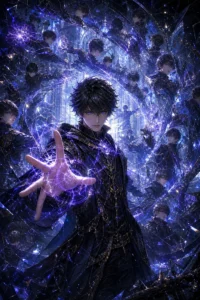
by inkadminThe day Shen Ruyi awakened his spiritual root, the Heavenly Stele screamed.
Not cracked.
Not chimed.
Screamed.
The sound tore across the Azure Glass Sect’s eastern plaza like a blade dragged through the bones of the sky, and every lantern hanging from the jade eaves burst into blue fire at once. Noble children dropped to their knees. Elders spat blood into their sleeves. The white cranes perched along the ceremonial pillars beat their wings in terror, only to slam against an invisible pressure and fall like broken fans onto the polished stone.
Shen Ruyi stood barefoot on the awakening platform with furnace ash still ground into the lines of his palms.
The black stone beneath him pulsed.
Once.
Twice.
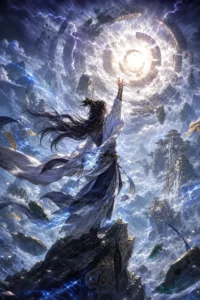
Then the Heavenly Stele opened an eye.
But before that—before heaven noticed him, before fate sharpened its teeth—Shen Ruyi had been carrying ash.
Dawn in the Azure Glass Sect did not arrive gently. It struck.
First came the bronze bell from Cloud-Ringing Peak, nine thunderous notes rolling down the mountainside and shaking dew from the spirit pines. Then came the cry of cranes, the hiss of furnace vents, the clatter of sword-practice from the inner courtyards where disciples in silk robes cut morning mist into ribbons. Last came the smell: bitter herbs scorched black, beast blood reduced to medicinal paste, sulfur smoke from failed pill batches, and beneath it all the fine gray stink of ash.
That was where Shen Ruyi lived.
Not in the courtyards where spirit springs steamed beneath lotus moons. Not in the pavilions where young masters argued over sword intent while sipping cloud tea. He lived behind the southern alchemy hall, in a shed wedged between the refuse trench and the old furnace vents, where the roof leaked rain in three places and the mice were bold enough to steal rice from a man’s bowl while he was still holding it.
Ruyi woke before the bell finished its third note.
His left leg had cramped in the night.
He lay still for a breath, staring at the underside of the broken roof tiles, listening to the mountain wake around him. The pain in his leg was old, familiar, a crooked iron nail driven through muscle and bone. When he was ten, a spirit ox cart had overturned on the lower road, crushing his knee beneath a wheel carved with array runes. The steward had called it unfortunate. The ox had received a healing pellet worth three silver taels. Ruyi had received a stick to bite and two days without work.
He pressed his thumb into the knot beside his knee until the pain grew sharp enough to clear sleep from his mind.
“Still attached,” he muttered. “Unfilial thing.”
A snort came from the corner.
Old Wen, who had the shape of a bundle of laundry and the temperament of a winter crow, rolled over under his patched blanket. “Talking to your leg again?”
“It talks first.”
“Then tell it to haul my share.”
“Your share is mostly coughing and complaining.”
“Both require talent.”
Ruyi swung his feet onto the dirt floor. Cold bit his soles. He reached for the faded cloth wrapped around his knee and bound it tight with practiced fingers. Outside, steam belched from the pill furnaces in long, ghostly streams. The alchemy hall would already be burning. The inner disciples liked to begin before sunrise on auspicious days, as if heaven could be impressed by punctuality.
And today was more than auspicious.
The Heavenly Stele had descended.
Even from the ash yard, Ruyi had seen it arrive the night before: a pillar of white light falling from beyond the clouds into the eastern plaza, soundless and immense. For one month every decade, the Stele manifested in the Azure Glass Sect, and children from a thousand li came to stand before it. Spiritual roots would be measured. Destinies would be assigned. Families would rise. Families would weep. Sects would bargain over prodigies like jewel merchants over flawless pearls.
Those with pure roots would step from childhood into immortality.
Those without would return home and spend their lives bowing to those who had been chosen.
Ruyi had watched the light from behind the furnace vents, a basket of ash balanced on one shoulder, his face warmed by heaven’s glow and his back scorched by earthly fire.
Old Wen had said, “Don’t stare too long. Heaven charges rent.”
Ruyi had looked away.
Now he pulled on his patched gray shirt, tied his hair with a strip of old rope, and stepped into the ash yard.
Heat struck first. The southern alchemy hall had twelve furnaces arranged in a crescent, each taller than a house, their bellies glowing red through cracks in the bronze. Servants moved between them like ants fleeing a burning log. Some hauled water. Some dragged bundles of spirit herbs. Ruyi and Old Wen hauled what remained when ambition failed.
A furnace gate clanged open.
“Ash-haulers!” shouted Steward Gao from the raised walkway. His voice carried the oily authority of a man who had never lifted anything heavier than a tally brush. “Furnace Six produced slag. Clear it before Elder Mo arrives.”
“Furnace Six always produces slag,” Old Wen grumbled, shuffling out behind Ruyi. “If I failed that often, I’d be promoted too.”
Ruyi took the iron rake from its hook. Its handle had burned smooth beneath years of palms. “You say that loudly enough, and they’ll promote you to fertilizer.”
“At my age? Finally, a useful post.”
They worked.
The furnace mouth opened like the throat of a beast. Ruyi wrapped wet cloth over his nose and dragged out the ash in long, glowing heaps. It came heavy, not like wood ash but dense with mineral dregs and ruined qi, full of half-spent medicinal essence that prickled against the skin. Sparks kissed his wrists. Smoke crawled into his eyes. Sweat carved pale lines through the soot on his face.
He moved quickly despite the limp. Rake, shovel, basket. Rake, shovel, basket. The basket strap bit into his shoulder. Each load went across the yard to the black trench where failed pills, dead herbs, cracked crucibles, and furnace ash were dumped to cool before being carted down the mountain.
From the eastern plaza came music.
Flutes, bells, and the resonant drone of ceremonial drums.
Ruyi paused at the trench, ash sliding from his basket in a soft gray avalanche. Beyond the rooftops, silk banners snapped in the morning wind. Blue, white, and gold. Azure Glass Sect colors. Between the pavilions he glimpsed lines of children in new robes moving toward the plaza, their hair oiled, their faces powdered, their parents trailing behind with anxious pride.
A little girl in yellow skipped past the ash yard gate, clutching her mother’s hand. A jade pendant bounced at her chest.
“Mother,” she asked, “if I have a water root, can I live on Moon Reflection Peak?”
“If your root is pure enough,” the woman said softly. “Bow properly to the elders. Speak only when asked. And do not look at the servants.”
The girl’s gaze flicked toward Ruyi.
She looked away as instructed.
Ruyi smiled without humor and shouldered the basket again.
By midmorning, the sect had polished itself into righteousness.
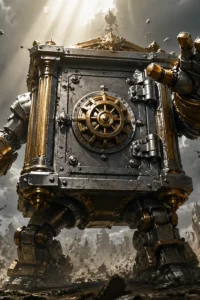
The eastern plaza shone like frozen lakewater. Nine glass lanterns, each the size of a carriage, floated in a circle above the awakening platform, their flames burning different colors. At the plaza’s center stood the Heavenly Stele.
Ruyi had seen mountains smaller.
It rose thirty zhang from a base of black stone, its surface neither jade nor metal nor anything mortal hands had named. At first glance it appeared smooth. At the second, words writhed beneath it—ancient characters swimming like silver fish below dark ice. No chisel had carved them. No brush had written them. They were law pretending to be language.
Children ascended the platform one by one.
An elder placed a palm above each head.
The child touched the Stele.
The Stele answered.
LOWER THIRD-RANK WOOD ROOT.
A farmer’s son trembled. His parents burst into tears anyway. A lower third-rank root meant he could become an outer disciple if a sect needed laborers who could breathe qi without dying.
MIDDLE SECOND-RANK FIRE ROOT.
Polite applause.
UPPER FOURTH-RANK GOLD ROOT.
A ripple of interest. An elder from Sword Polishing Valley leaned forward.
Ruyi watched from behind a line of servants carrying cooled ash away from the alchemy hall. Steward Gao had ordered the trench emptied before the afternoon banquet, because nothing disturbed noble appetites like seeing where pills went to die.
“Eyes down,” Gao snapped as Ruyi passed near the plaza edge. “The awakening ceremony is not a street performance for gutter bones.”
Ruyi lowered his gaze to the paving stones. They were polished enough to reflect his own face back at him: narrow, soot-streaked, black-eyed, too thin around the cheeks, mouth curved as if holding back words that would get him beaten.
He held them back.
Mostly.
“Yes, Steward,” he said. “Wouldn’t want heaven distracted by poor scenery.”
Old Wen made a choking sound behind him.
Steward Gao’s eyes narrowed. He was a plump man with three chins and a spiritual root just strong enough to cultivate to the third layer of Qi Condensation after thirty years of expensive pills. His robe was embroidered with little azure clouds. His belt buckle had more jade than Ruyi had seen in his life.
“Sharp tongue,” Gao said. “Pity it’s attached to a dull fate.”
Ruyi dipped his head. “A dull blade still cuts tofu.”
Gao stepped closer, hand rising.
Before the slap landed, the plaza erupted in cheers.
PURE FIFTH-RANK ICE ROOT.
The words blazed across the Heavenly Stele in pale blue fire.
A girl stood on the platform, twelve or thirteen, dressed in snow-white silk with a silver fox fur collar despite the summer heat. Frost curled around her shoes. Her expression did not change as half the plaza rose to its feet.
“Lin Xiaoshuang,” Old Wen whispered. “Daughter of the northern marquis. They say she froze a pond by crying in it.”
“Useful,” Ruyi murmured. “Most people only make ponds wetter.”
Elders descended like hawks.
Offers flew. Spirit stones, peak residences, personal instruction, sword manuals sealed in ice jade. Lin Xiaoshuang bowed once toward the Azure Glass Sect’s presiding elder, a tall woman with hair like black lacquer and eyes like cut glass.
“This disciple greets Master Han,” she said.
Master Han smiled, and every other elder’s face stiffened.
“Good,” Old Wen said. “Sect will be pleased. Maybe they’ll feed us meat.”
“If they do, it’ll be because it died of old age first.”
Ruyi bent to lift his basket.
That was when the young master noticed him.
He had seen the boy before, of course. Everyone had. Guo Ming, nephew of Steward Gao, son of a minor noble house, and owner of a face that seemed designed by heaven specifically to sneer. He wore blue brocade, a jade crown, and boots that had never touched mud without punishing someone for it.
Guo Ming had just awakened a middle fourth-rank fire root, enough for the sect to accept him as an inner candidate if his family added sufficient gifts. He should have been basking in congratulations.
Instead, he was staring at the ash smear Ruyi’s basket had left near the plaza boundary.
“Uncle,” Guo Ming called, loud enough for nearby disciples to hear. “Why is there trash walking beside the Heavenly Stele?”
A few children laughed.
Steward Gao’s expression tightened, not with shame, but calculation. Public cruelty was dangerous if aimed upward, profitable if aimed downward.
“This servant was just leaving,” Gao said.
“Leaving?” Guo Ming’s smile widened. “But isn’t today the day all children of the empire may test their roots beneath heaven? The proclamation said all, did it not?”
Ruyi felt Old Wen’s fingers brush his sleeve in warning.
Do not answer.
Ruyi did not.
Guo Ming stepped closer, fanning the air before his nose. “How old are you, ash boy?”
“Old enough to know ash gets everywhere if stirred,” Ruyi said.
The laughter grew sharper.
Guo Ming’s eyes flashed. “Still barking? Good. I wondered whether furnace smoke had cured you of pretending to be human.”
Old Wen’s grip tightened.
Ruyi looked at the young master’s clean hands. Soft palms. No scars. Rings on three fingers, one set with a small red spirit stone. A fourth-rank fire root and a head full of oil-soaked straw. Heaven was generous in strange ways.
“Young Master Guo,” Ruyi said, bowing slightly, “if pretending is enough, perhaps we both have hope.”
This time the laughter cracked like a whip.
Guo Ming’s face reddened.
Steward Gao’s hand shot out and struck Ruyi across the mouth.
The slap turned his head. Blood filled one side of his tongue, hot and metallic. His basket hit the ground with a dull thud, spilling gray ash over the white stones.
“Impudent dog!” Gao snarled.
Ruyi straightened slowly.
The plaza had quieted.
He could feel eyes on him now—children, parents, disciples, elders. Most were amused. Some were bored. A few looked uncomfortable in the distant way people did when rain fell on someone else.
Guo Ming’s smile returned.
“No, Uncle,” he said. “Don’t punish him yet. Let heaven do it.”
Steward Gao blinked. “Young Master?”
Guo Ming pointed at the awakening platform.
“Send him up.”
The words landed softly. Then they spread.
Whispers rippled through silk sleeves and jeweled collars.
“A servant?”
“He’s too old.”
“Has he never been tested?”
“Look at his leg.”
“He’ll stain the platform.”
Ruyi tasted blood and ash.
His first instinct was to laugh. Not because it was funny, but because the alternative was showing them where the words landed. He had imagined, once, when he was small enough to believe hunger had an ending, that he might stand before the Heavenly Stele. Every child imagined it. Even children with patched clothes. Even children who slept near furnace vents.
Then his knee had shattered, his mother had died coughing red into a rag, his father had vanished on a labor convoy to Black Reed Mine, and imagining had become an expensive habit.
“The Stele tests children,” an elder said from the dais, voice cool. “Not grown servants.”
Guo Ming bowed toward her. “Elder Qin, this lowly one merely recalls the imperial decree. All untested citizens beneath sixteen may awaken. Unless the Azure Glass Sect fears its sacred platform cannot withstand a little dirt?”
Ruyi was fifteen.
Sixteen after the autumn rains.
Steward Gao knew it. So did Old Wen.
Old Wen stepped forward. “Honored elders, this boy works in furnace refuse. Medicinal dregs cling to his meridians. If he touches the Stele, perhaps—”
Gao kicked him in the stomach.
Old Wen folded with a wheeze.
Ruyi moved before thought.
Two disciples seized his arms.
“Easy,” one murmured, not unkindly. “Don’t make it worse.”
Ruyi’s eyes stayed on Old Wen, who had curled on the ground, breath rattling through his few remaining teeth.
“It’s already worse,” Ruyi said.
From the high seat at the center of the dais, Master Han of the Azure Glass Sect lifted one slender hand.
Silence fell.
She looked down at Ruyi. Her gaze was not cruel. That somehow made it colder.
“Let him test,” she said. “He is within the decree. Heaven does not fear ash.”
The words sounded righteous.
The smile at the corner of Guo Ming’s mouth showed what they meant.
The disciples dragged Ruyi toward the platform.
His bad leg caught on the first step. Pain flared white-hot up his thigh. Someone snickered. He pulled free of the disciples’ hands and climbed the rest himself.
One step.
Then another.
The platform was colder than it looked.
Black stone drank the heat from his bare soles. Up close, the Heavenly Stele was impossible to fully see. Its surface seemed both an arm’s length away and farther than the horizon. Silver characters drifted beneath its skin. Some were simple enough to recognize—wood, fire, earth, metal, water. Others bent his eyes. One looked like a mouth eating a star. Another like a man kneeling beneath a mountain that was also a hand.
An old awakening elder stood beside him. His beard fell to his chest in three white streams. He pinched his nose faintly.
“Name?”
“Shen Ruyi.”
The elder’s brush hovered above a jade slip. “Which Shen clan?”
“The hungry one.”
The elder’s eyes flicked up.
Below, Guo Ming laughed.
“No registered clan,” Steward Gao called. “Labor household.”
The brush scratched.
“Age?”
“Fifteen.”
“Place both palms upon the Stele. Empty your thoughts. If pain occurs, endure it. If nothing occurs, step down quickly.”
Ruyi looked over the elder’s shoulder.
Old Wen had managed to sit up. His face was gray. He shook his head once.
Don’t give them your heart, boy.
Ruyi almost smiled.
What heart? The sect had taken pieces of it for years in small, tidy portions. A mother’s medicine priced above a servant’s life. A father’s name erased from labor rolls. A crippled knee dismissed as damaged property. Bow here. Carry that. Eat later. Speak less. Want nothing.
No, they did not have his heart.
They had only taught it to bite.
He lifted his hands.
Ash clung to every crease. The slap had split his lip; one drop of blood fell onto the black platform and vanished as if swallowed.
Ruyi placed both palms against the Heavenly Stele.
Cold entered him.
Not winter cold. Not mountain stream cold. This was the cold of being seen by something that had no eyes and no mercy, a vast attention sliding through skin, muscle, marrow, memory. It poured into his broken knee, his scarred palms, the smoke-burned channels of his lungs. It found hunger curled beneath his ribs. It found anger banked low and patient. It found all the places where life had cut him and discovered he had not become soft there.
The world vanished.
He stood in darkness.
0 Comments