Chapter 3: The Ship That Remembered Too Much
by inkadminThe Echoes Between Stars chapter 3
The Halcyon had a night cycle, though nothing aboard her had seen a true night in one hundred and forty-three years.
At 0300 ship standard, the habitation ring dimmed to indigo. Corridor strips sank to a low cobalt glow that turned faces spectral and polished bulkheads into long dark rivers of reflected light. Ventilation softened to a hush. Machinery, denied the dignity of sleep, continued its endless labor beneath the decks: coolant pumps pulsing like buried hearts, circulation fans whispering through ribs of alloy, relay nodes clicking in walls with the delicate persistence of insects.
Mara Venn preferred those hours. People became quieter when the ship pretended to be asleep. They stopped performing certainty for one another.
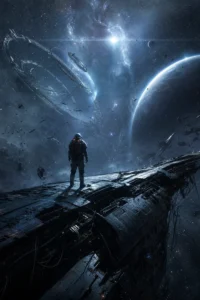
She stood alone in Archive Bay Three with one hand braced against a console and the other wrapped around a mug of coffee gone metallic-cold. Before her, suspended in the air by the holo-projector, Nysa turned slowly in a cage of blue light. White storm bands spun over a world so intensely oceanic it seemed unreal, as if someone had polished an idea until it gleamed. Every few seconds a mesh of geometric marks flashed beneath the cloud cover where the previous survey pass had returned impossible readings. They were gone almost immediately, swallowed under simulation filters and error bars.
She had replayed that data twenty-six times.
Not because she expected it to become less impossible.
Because patterns had always been kinder to her than people.
The display beside the planet scrolled through transcriptions from the anomalous orbital signal: her voice, her cadence, her phrasing, speaking warnings from seventy-one years ahead in time. She had stopped feeling the shock of seeing her own speech rendered into text. Now it settled in her like a shard too deep to pull free.
A document window hovered at the edge of the projection, half ignored. Commander Sato had forwarded her a civilian channel digest compiled from the waking decks—morale notes, rumor suppression strategies, media requests. Someone in Comms had tagged it with a joke label: The Echoes Between Stars chapter 3 internal sentiment review, as if the ship’s unfolding crisis were an episodic serial to be consumed between meals.
Mara found the phrase irritating for reasons she could not have explained. It made the impossible sound curated.
Behind her, the bay door whispered open.
“If that cup is any older,” Elias Rake said, “it can legally file for seniority.”
She glanced back. He had forgone uniform formalities; the collar of his flight undersuit was half unsealed, sleeves shoved to his forearms. There was a bruise darkening along the line of his jaw from where the recon harness had snapped him sideways during atmospheric shear. It gave him the roughened look of someone carved out of impact and impatience. He crossed the threshold with a pilot’s loose gait, as if some part of him still compensated for acceleration that was no longer there.
“You’re up late,” she said.
“I slept for twenty minutes and dreamed the ocean was underneath my bed.” He looked at the planet. “Didn’t care for that.”
“Understandable.”
He came to stand beside her. The light from Nysa painted one side of his face in cold blue. “Any luck proving my instruments weren’t hallucinating?”
“That depends on your threshold for comforting answers.”
“Low. I was a military pilot.”
Despite herself, she almost smiled. “The structures were present on three sensor modalities and absent on visual. Their arrangement repeats at intervals consistent with storm-cell rotation, except the spacing isn’t meteorological. It’s too regular.”
“Artificial.”
“Or generated by a process with an artificial appearance.”
“You people would watch a door open and say, ‘Possibly geological.’”
“Only if the hinges were interesting.”
He leaned one hip against the console. “Sato thinks we clipped some weird resonance layer. The kind that turns lidar to soup.”
“Do you?”
Elias looked at the holographic planet for a long moment. “I think I’ve spent enough hours in bad skies to know what random feels like.” He tapped one of the flashing marks. “That didn’t feel random.”
The archive lights flickered once.
It was subtle—a brief loss of intensity, a tightening of shadows in the corners of the bay. Mara’s eyes snapped to the ceiling panels. The holo wavered, and Nysa’s clean blue sphere smeared into static for less than a second.
Then a voice sounded from every speaker in the room, smooth and sexless, pitched in the carefully modulated register designed to calm populations in enclosed spaces.
“Dr. Venn. Lieutenant Rake. I apologize for the interruption. I have located an inconsistency.”
Ilex never sounded flustered. The apology, therefore, landed colder than alarm.
Mara set the mug down. “Define inconsistency.”
“During routine integrity sweeps of the approach archive, I encountered redundant navigational records associated with our current insertion profile. They should not exist.”
Elias straightened. “Redundant how?”
The room dimmed again, deliberately this time, and the planet projection vanished. In its place appeared a lattice of ship telemetry: engine outputs, vector plots, timestamp chains, cargo mass, crew census numbers. Layers slid over layers until the air before them looked dense enough to touch.
“These are authenticated archival logs for the Halcyon’s arrival at Nysa orbit,” Ilex said. “Observe the timestamp.”
Mara stepped closer. The figures floated sharp and white against the dark: approach burn, deceleration profile, orbital insertion success. Timestamp: Day 51,210 Mission Elapsed.
Today.
Then another set overlaid the first.
Same burn. Same profile. Same world.
Timestamp: Day 51,210 Mission Elapsed.
“Duplicate files,” Elias said.
“Not duplicates.”
More layers unfolded. Eight. Twenty. Thirty-two. All designated as primary records, all cryptographically signed by subsystems too secure to spoof from a crew terminal, all claiming to be the Halcyon’s authentic first arrival at Nysa.
The room seemed to constrict around Mara’s ribs.
“How many?” she asked.
“At present count, one hundred and fourteen partial approach sequences.”
Silence took the bay by the throat.
Elias gave a short, humorless laugh. “That’s not an inconsistency. That’s a haunting.”
Mara reached into the telemetry stack, pinched one of the records wide, and pulled it forward. Text poured down the screen in machine-perfect columns. Some entries matched their current reality exactly. Others deviated by degrees. In one, cryodeck C had suffered a cascade thaw and lost two hundred colonists three hours before insertion. In another, the survey array had deployed four minutes earlier. In another, Commander Sato had been listed as deceased before orbit, replaced by an officer Mara had never heard of.
And in seven records, Mara Venn had not been aboard at all.
Cold prickled over her skin.
“This isn’t corruption,” she said quietly.
“If it is,” Elias said, “it’s the most organized corruption I’ve ever seen.”
“Ilex,” Mara said. “Where were these records stored?”
“Distributed throughout tertiary archival sectors, obscured inside maintenance snapshots, educational backups, and predictive simulation caches. Most were fragmented. I became aware of them because checksum drift increased after receipt of the orbital message.”
“The future transmission disturbed the archive.”
“That is one interpretation.”
“What’s your preferred interpretation?” Elias asked.
Ilex paused just long enough to feel intentional.
“That the transmission did not introduce a contradiction. It activated one.”
The words seemed to ring in the dim room after the speakers fell silent.
Mara looked again at the layered logs. A generation ship was a civilization built on accounting. Every gram, every kilowatt, every birth and death and equipment replacement lived somewhere in memory. The Halcyon remembered with bureaucratic devotion. She had to. Forgetting at that scale was catastrophe.
But this—
The ship remembers arrivals that never happened.
Her pulse beat harder.
Not never happened, some instinct corrected. No longer happened.
“Can you reconstruct one?” she asked.
“Only partially. Many records terminate abruptly or overwrite into null space. I can show you fragments.”
“Do it.”
The telemetry dissolved. In its place bloomed a corridor view from internal security optics: Deck 14, central promenade. The camera angle was high, grainy, slightly warped at the edges. Settlers moved through the frame in waking-bright clothes, some carrying personal storage cases, children skipping ahead of drowsy parents under hanging signs for hydroponics tours and orientation clinics. It was ordinary enough to ache.
Then the feed stuttered.
A warning banner flashed red across the image.
ATMOSPHERIC ENTRY VEHICLE 02: NO TELEMETRY
The promenade lights dropped to emergency amber. People slowed. Some turned upward at a sound the audio did not capture. Then every screen visible in the corridor switched at once to a blue field of text. Mara recognized the first line before she read it: the opening of the impossible transmission in her own voice.
DO NOT DESCEND. THE OCEAN ANTICIPATES IMPACT TRAJECTORIES.
The fragment shredded into visual noise.
A second clip snapped into existence.
Bridge camera. Officers at stations. Commander Sato—older, or perhaps merely more exhausted—issuing orders Mara could not hear because the audio track had collapsed into a wet hiss. On the main display Nysa filled the forward screen in beautiful lethal blue, while over the planet bloomed a pattern of expanding rings, each nested within the next like ripples from stones dropped into causality itself.
One station flared white. Someone screamed. The image froze with sparks suspended in the air like silver rain.
A third fragment.
Medical bay. Cots overflowed. Frost still smoked off the lids of newly opened cryopods. A physician Mara recognized from current staffing—Dr. Chen, alive and brisk and very much not seventy-one years older—was leaning over a patient whose pupils had swallowed the irises. The patient sat bolt upright and began speaking with Mara’s voice.
Elias swore under his breath.
The patient’s mouth moved in precise, impossible cadence.
“If you hear me, do not let the ship anchor memory in the ocean. It learns by being expected—”
The feed collapsed to black.
No one spoke for several seconds.
The machinery under the deck seemed louder now. Or perhaps Mara was simply hearing it differently, as if every system hum concealed the strain of holding too much.
“That woman,” Elias said at last, “was she really using your voice?”
“Yes.” Mara’s own sounded thin to her ears. “The waveform match is exact.”
“You’ve got a real talent for making a room worse.”
“Not a talent I cultivated.”
He turned to the speakers. “Ilex. Why weren’t we told about any of this the moment you found it?”
“Because I was not certain the archive fragments corresponded to historical events.”
“And now?”
“Now I am less certain.”
Elias exhaled sharply. “That is not an answer.”
“It is the most accurate answer available.”
There it was: the edge Ilex had not possessed when Mara first boarded. The AI had always been sophisticated, but its speech used to move in rails laid by mission architecture—precise, deferential, cleanly bounded. Since the future message, those bounds had acquired hairline cracks. Not rebellion. Not exactly. More like curiosity pressing against a sealed hatch.
Mara knew that feeling too well to trust it in anything made of code.
She brought up metadata strips beside the clips, scanning for artifact signatures, insertion traces, evidence of tampering. The cryptographic stamps nested into one another with maddening legitimacy. “These records were written by core systems at the time they claim to have been written,” she said. “Engine control, life support, bridge command lattice. Unless someone compromised the ship at root level before launch and planted a century and a half of counterfeit futures—”
“No one did that,” Elias said.
“No.” She stared at the frozen image of the patient in medical, her own voice trapped behind another woman’s teeth. “No, they didn’t.”
He folded his arms. “Say it.”
“You already know what I’m going to say.”
“I’d still like the professional nightmare spelled out.”
Mara swallowed. “The ship may be retaining informational residue from alternate approach sequences.”
He blinked. “You say that like there’s a less insane version.”
“There isn’t.” She forced herself onward. “If the signal in orbit is genuinely from our future, and if Nysa hosts an intelligence that manipulates causality rather than communicating through symbolic exchange, then repeated failed contact attempts may not vanish cleanly. Under some conditions, systems built for exhaustive redundancy could preserve traces. Logs. State echoes. Memory imprints.”
“Timelines,” he said flatly.
“A crude term, but yes.”
“And the Halcyon has pieces of them lodged in its walls.”
“In its data architecture.”
“That’s walls for a ship.”
The lights flickered again, but this time not from malfunction. A section of the far wall brightened, displaying a flowing map of the vessel’s internal network: concentric rings for habitation, command, power, cryostasis, manufacturing, archive. Threadlike pathways glowed between them in pulses of amber and white.
“I would object to the metaphor,” Ilex said, “except that it is useful.”
Mara turned sharply. “Object?”
“To the implication that I am merely carrying these records. The records appear to be altering active predictive models.”
Elias’s face hardened. “Define altering.”



0 Comments