Chapter 21: The Physician’s Confession
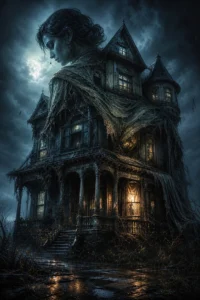
by inkadminThe chapel smelled of beeswax, damp wool, and teeth.
Mara stood in the aisle with one hand wrapped around the back of the last pew, because without it the floor would have tilted away from her. The room was full of mouths. Not voices. Not prayers. Just mouths, opening and closing in slow, exact unison while the storm gnawed at the stained-glass windows and the sea hammered the cliff below.
Click.
Click.
Click.
Every jaw in the chapel dropped, paused, rose. The sound was delicate and obscene, like porcelain teacups being set down by invisible hands.
Mrs. Vale sat in the first row, her thin hands folded on the polished rail, her cloudy eyes fixed on the crucifix above the altar. Her lips had peeled back from her gums. A line of dark saliva shone at the corner of her mouth. Behind her, Mr. Pell’s head trembled with the effort of maintaining whatever posture had been imposed upon him, the soft flesh under his chin quivering each time his jaw lowered. In the shadows along the wall, the younger patients—the ones who still pretended they were merely exhausted, overmedicated, temporarily unwell—sat with the same opened faces, the same ruined, listening stillness.
Something moved beneath their skin.
Not muscle. Not the small natural shift of tendon and pulse. It traveled upward from the throat in ripples, little ridges pressing against the underside of their cheeks as if fingers were climbing the inside of them, searching for exits. A bulge rose along Mrs. Vale’s left jaw, paused near the hinge, then slid toward the dark well of her mouth.
Mara’s own mouth filled with the bright metal taste of panic.
“Stop,” she whispered.
No one turned.
The chapel’s old harmonium sat near the side door with its cracked keys exposed like a row of bones. Above it, rain slithered down the stained glass in thick, shining veins. The painted saints were warped by water and lightning. Their faces seemed to bend toward the congregation, not with mercy but with concentration.
Click.
Click.
Click.
Mara forced herself forward. Her slippers made no sound on the runner. The carpet, once a deep ecclesiastical red, had darkened in patches near the first three pews, and as she passed, she saw that the damp marks were not water. They glistened. They breathed with faint bubbles.
“Mrs. Vale.” Mara reached the old woman and touched her shoulder.
The shoulder was hot through the nightgown. Fever-hot. Furnace-hot. Mrs. Vale’s jaw lowered, and the wet darkness inside her mouth seemed too deep for the size of her head.
Mara leaned closer despite every ancient part of herself screaming not to.
At the back of Mrs. Vale’s throat, something pale flexed.
Not a tongue.
It had joints.
Mara staggered back, knocking her hip against the pew. Pain flashed white along the old scar beneath her hairline, and for one instant the chapel doubled around her: two altars, two rows of patients, two storms pressing their gray faces to the windows. Between the double images, a memory tried to surface.
A boy laughing in a corridor.
A hand smearing condensation from glass.
Her brother’s voice, older than she remembered, saying, If it asks you to open, don’t.
Then the room snapped back.
The chapel doors opened behind her.
Not with a dramatic crash. Blackmere never wasted force where inevitability would do. The doors sighed inward, and a rectangle of corridor light fell across the aisle, pale and steady. Dr. Harrow stood in it, dressed not in his usual immaculate suit but in a dark robe over gray pajamas, his feet in polished shoes as if he had dressed in layers of haste and habit. His white hair was combed back. His face, in the low light, looked carved thin by sleeplessness.
Behind him came Sister Aveline with a lantern in one hand and a syringe kit in the other.
Harrow’s eyes found Mara.
For the first time since she had arrived at Blackmere House, he looked afraid.
Not of the patients.
Of her seeing them.
“You should not be here,” he said.
Mara laughed once, though there was no humor in it. The sound cracked in her throat. “Really? That’s what you want to open with?”
Click.
Click.
Click.
Harrow glanced toward the congregation. His mouth tightened. “How long have they been synchronized?”
“Long enough.”
“Did anyone speak?”
“Their mouths are full.”
Sister Aveline made a small sign against her own chest. It was not quite a cross. Her fingers touched sternum, throat, lips, then the hollow behind her ear.
Harrow saw Mara watching and said sharply, “Aveline.”
The nurse lowered her hand.
Mara took another step back as Mrs. Vale’s jaw opened wider than before. The old woman’s tendons stood out like cords. A slick, clicking whisper crawled through the chapel, layered beneath the rhythm of teeth. It came from every throat and none of them.
“They need help,” Mara said.
“They are being helped.”
“No.” The word came out of her with a violence that surprised them both. “No more of that. No more polished, institutional, therapeutic-garden bullshit. Look at them.”
Harrow moved down the aisle toward her, careful to keep his distance from the pews. He did not look at the patients the way a doctor looked at patients. He looked at them the way a man looked at delicate glassware balanced at the edge of a shelf.
“Lower your voice,” he said.
“Why? Will it hear me?”
The synchronized clicking faltered.
Only once.
A tiny imperfection passed through the room like a skipped heartbeat. Mrs. Vale’s jaw hung open a fraction too long. Mr. Pell’s teeth closed late. A young woman Mara knew only as Elise turned her face two degrees toward the aisle, though her eyes remained fixed ahead.
Harrow went still.
Mara felt the change travel over her skin.
“Yes,” Harrow said quietly. “It might.”
Sister Aveline shut the chapel doors.
The click of the latch sounded louder than the storm.
Harrow held out a hand. “Come away from them.”
“Tell me what’s happening.”
“Not here.”
“Here is where it’s happening.”
His face twitched, something like anger passing beneath the professional calm. “Miss Ellison, if you have ever trusted me even a little—”
“I haven’t.”
“Then trust your fear.”
The next click did not come.
Every mouth in the chapel remained open.
The storm withdrew for one breath. The whole house seemed to listen. Mara heard water in the walls, a slow tidal suck through stone. She heard Sister Aveline’s breathing. She heard Harrow swallow.
From inside Mrs. Vale’s open mouth came a sound like a fingernail dragging across wet paper.
Harrow moved quickly then. He caught Mara by the arm—not hard enough to bruise, but with the grip of a man dragging someone away from a precipice. Mara jerked against him out of instinct, but another sound came from the pews, this one from all the patients at once: a thin inhale through open mouths.
It was not air they drew in.
The chapel lights dimmed.
The old brass sconces along the walls flickered, and in the brief dip of darkness Mara saw the patients’ reflections in the stained-glass windows. Not as they were. Not seated.
Standing.
All of them.
Pressed against the other side of the glass from outside, pale hands spread, jaws unhinged in silent hunger.
Then the lights steadied.
Harrow pulled her backward down the aisle. “Now.”
This time she went.
Sister Aveline opened the door just wide enough for them to pass. As Mara crossed the threshold, she looked back.
Mrs. Vale’s eyes had moved.
They were fixed on Mara.
The old woman’s mouth formed one word without sound.
Daniel.
Mara’s knees nearly failed.
Harrow saw it. His grip tightened, and he thrust her into the corridor before she could turn back.
The chapel door shut behind them with the soft finality of a coffin lid.
For three seconds none of them spoke. The corridor smelled of lemon polish and old plaster. After the chapel, the ordinary light felt indecent. A framed watercolor of the south lawn hung slightly crooked on the wall, showing summer roses and blue sky though winter screamed beyond the windows.
Mara tore her arm free. “How does she know my brother’s name?”
Harrow looked at Sister Aveline. “Sedate them in sequence. Lowest dose. Begin with Vale and Pell. Do not allow vocalization.”
“Doctor—”
“Do it.”
Sister Aveline’s eyes flicked to Mara. There was pity there, and worse than pity: recognition. Then she turned and slipped back into the chapel, closing the door behind her.
Mara rounded on Harrow. “Answer me.”
He passed a hand over his face. In the harsh corridor light he looked older than he had that morning, older than he had any right to become in a single night. The skin beneath his eyes was bruised purple. Fine tremors moved through his fingers before he hid them in the pockets of his robe.
“Come to my office,” he said.
“No.”
“Then stand here and let the corridor hear us.”
Mara stared at him.
There it was again. Not metaphor. Not superstition. The corridor. The walls. The house with its patient, listening architecture.
Above them, a pipe knocked once.
Then twice.
Then three times.
Mara’s scalp prickled under her hair.
Harrow did not look up. “My office, Miss Ellison.”
He turned and walked away without waiting to see whether she followed.
For one wild second Mara considered running. Not to her room. Not to the front hall, where the main doors had been locked every night since the second week of her contract. To the service stairs, the kitchen, the old delivery passage that smelled of coal dust and rotting salt. To any exit. She pictured herself stumbling down the cliff road in her slippers through the storm, coatless, half blind with rain. She pictured the ferry dock empty. The black water rising and falling. The house behind her, all its windows lit like watching eyes.
Then she heard it from the chapel: a muffled cry cut short.
And beneath that, threaded through wood and plaster, a rhythm answered from below.
Knock.
Knock.
Knock.
Human. Patient. Counting.
Mara followed Harrow.
The corridors of Blackmere House had a way of lengthening at night. By day, they presented themselves as elegant arteries: runner carpets, polished banisters, tasteful sconces, seascapes in gilt frames. At night, they became something intestinal. The turns were too frequent. The air was too warm near the floor and too cold at face level. Doors seemed to breathe in their frames, swelling and settling as the wind pressed against the house.
Harrow walked briskly, but not carelessly. At each intersection he paused for half a beat before choosing a direction, as if listening for which passage would permit them. Once, at the landing below the east gallery, Mara saw their reflections in a dark window.
Harrow’s reflection turned its head and looked back at her.
The real Harrow did not.
Mara stopped.
“Don’t,” he said without turning.
Her throat tightened. “Don’t what?”
“Acknowledge discrepancies after midnight.”
“That’s a policy?”
“It is a survival tactic.”
She dragged her gaze away from the glass. In the corner of her eye, the reflected Harrow smiled.
They reached his office by a route Mara was certain should have taken them past the library, yet the library never appeared. Instead they crossed a narrow hall she had not seen before, its walls bare except for a row of hooks from which hung old keys on black ribbons. The keys were iron, furred with rust, each labeled with a small ivory tag. Mara caught names as she passed.
Recitation Room.
North Mouth.
Infant Vault.
Daniel E.
She stopped so abruptly Harrow nearly collided with her.
The tag swayed gently, though neither of them had touched it.
Her brother’s name—initial, at least—was written in brown ink on yellowed ivory. The key beneath it was smaller than the others. It looked less like a key than a tooth with a hole bored through its root.
“What is that?” Mara asked.
Harrow’s face closed. “Not now.”
She reached for it.
He caught her wrist.
The movement was fast enough to startle her. The doctor’s fingers were cold and strong.
“Not,” he said, each word clipped clean, “if you want to remember your own name by morning.”
They stood in the narrow hall, close enough for Mara to smell the bitter coffee on his breath and something medicinal beneath it. Camphor. Alcohol. Fear-sweat.
“You know what happened to Daniel,” she said.
His eyes shifted, not away but inward, as though the name opened a door he hated to look through. “I know parts.”
“Then start with those.”
“In my office.”
He released her wrist.
Mara looked once more at the key. The ivory tag had turned slightly. On the back, in the same brown hand, another word had been written.
Unreturned.
The hall seemed to narrow around her ribs.
Harrow unlocked his office with a brass key from his pocket, not one of the iron keys from the wall. The room beyond was dark until he switched on a green-shaded desk lamp. Warm light pooled over leather, paper, the glass face of an old barometer. The office looked as it always did at first glance: civilized, book-lined, smelling of tobacco though Mara had never seen him smoke. A decanter stood untouched on a side table. Medical journals lay in precise stacks. Behind the desk hung an oil painting of Blackmere House before the south wing had been added, perched on its cliff like a white animal with its paws in the earth.
But tonight Mara noticed what daylight had hidden.
The bookshelves were not filled only with medical texts. There were volumes bound in cracked vellum, their spines marked with symbols rather than titles. A cabinet beside the fireplace held jars of cloudy fluid. Something pale and curled floated in one of them. On the desk, half covered by a blotter, lay a diagram of a human skull with lines drawn from the jaw to the ear to the base of the brain. Around it were annotations in Harrow’s precise hand.
ENTRY THROUGH RECOLLECTION.
ORAL PATTERNING SECONDARY.
IDENTITY RESISTANCE VARIABLE.
ELLISON LINE: ANOMALOUS RETENTION.
Mara read the last line twice. The words changed nothing and everything.
Harrow saw where she was looking and drew the blotter over the page. “Sit.”
“I’m done being managed.”
“Sit anyway. You are pale.”
“I saw something with joints in Mrs. Vale’s throat.”
He went to the decanter and poured two fingers of amber liquid into a glass. His hand trembled badly enough that the neck of the decanter clicked against the rim.
“That was not in her throat,” he said.
Mara stared at him.
He offered her the glass.
She did not take it.
After a moment, he drank it himself and winced as though it were medicine rather than liquor. Then he set the glass down, braced both hands on the edge of his desk, and lowered his head.
For a moment he was only an old man in a dark robe, exhausted, caught at last by the consequences of a lifetime. Then the house knocked beneath them.
Once.
Harrow raised his head.
“Blackmere was not built as a retreat,” he said.
Mara said nothing.
“The version in the brochures is almost entirely fabrication. There was no visionary physician seeking sea air for delicate constitutions. No philanthropic widow donating land for the comfort of the dying. The original house was built to conceal an older structure. Much older. Older than the town. Older than the church that used to stand on the lower road. Older than any graveyard anyone will admit to mapping.”
The wind struck the window hard enough to rattle the glass. Rain crawled down the pane in silver threads.
“What structure?” Mara asked.
Harrow’s gaze moved to the painting behind his desk. “They called it many things. A burial chamber. A listening cellar. A well without water. None of those names is accurate. It was a chamber designed to house transmissions from below the ground.”
The words settled into the room with a physical weight.
Mara almost laughed again, because the alternative was screaming. “Transmissions.”
“Yes.”
“Like a signal?”
“Like a thought that did not originate in a human mind but required one to become comprehensible.”
Mara felt suddenly cold despite the heat murmuring from the radiator. “You hear yourself, don’t you?”
“Every night.” Harrow’s mouth curved without humor. “For thirty-seven years.”
She backed toward the chair opposite his desk and sat because her legs had begun to shake. The leather gave a soft sigh beneath her. Her old head injury pulsed behind her left eye, a deep, rotten throb, as if something inside her skull had begun knocking back.
“People were buried there,” she said. “The shallow dead. The ones the town pretended were washed out by storms.”
Harrow’s eyes sharpened. “Who told you that?”
“The house did. In pieces.”
He looked as though he wanted to deny it, then found himself too tired. “Yes. Bodies were placed there, but not as offerings. That is a common misunderstanding in the surviving accounts. They were insulation.”
Mara’s stomach turned.
“Bodies decompose. Memory does not—not in the way we once believed. There are impressions. Residues. Patterns. The early custodians thought the dead could muffle what came from beneath. Enough human endings packed around the chamber to soften the force of the transmissions.”
“Custodians.” Mara tasted the word. “You mean the people who built this.”
“And the people who inherited it. Physicians. Clergymen. Natural philosophers. Later, administrators. Men with respectable titles for indefensible work.”
“Like you.”
Harrow took the blow without flinching. That angered her more than if he had protested.
“Yes,” he said.
The admission was quiet. Bare. It stole some of the heat from her anger and left something uglier beneath: the need to know.



0 Comments