Chapter 6: A Voice in the Pipes
by inkadminThe paper strip had not stopped moving.
It should have. The dream monitor in the abandoned sleep ward was a carcass of Bakelite and corroded brass, its innards furred green with salt, its vacuum tubes long dead. Yet the strip continued to inch from the slot in the machine’s face with the stubborn patience of a tongue. It rasped over the metal lip and spilled down the front, gathering in soft white coils at Mara’s boots.
Blue-black ink needled across it in twitching peaks.
Her brainwaves.
From last night.
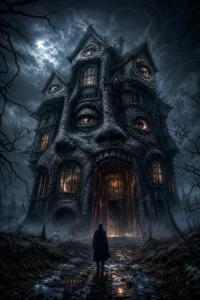
Mara stood between the rusted beds and watched the stylus keep writing what her skull had done while she slept in the caretaker’s room on the opposite side of Halcyon House, behind two locked doors and a chair wedged under the knob. The ward smelled of old sweat, iodine, salt rot, and the faint waxy odor of a extinguished candle though she had brought no flame. Restraint straps hung from the bedframes like shed skins. The rain outside worked at the boarded windows with fingernails.
The machine gave a soft internal cluck.
The stylus shifted.
Instead of peaks, it began to draw letters.
Mara’s gloved hand shot out and seized the paper. The strip tore with a small, intimate scream. The machine shuddered once, as if offended, and went dark. The sudden silence was worse than the noise. It opened around her. She realized she had been holding her breath only when her lungs convulsed.
She lifted the torn paper.
The letters were jagged, formed by the same needle that had mapped alpha, beta, delta. Medical shorthand unraveling into language.
DO NOT LISTEN THROUGH THE WALLS.
A groan rolled through the ward.
It did not come from the storm. It rose from the pipes under the floor, a deep metallic complaint, travelling from bed to bed like a thing dragging chains through the basement. The iron radiators trembled. The straps on the nearest cot twitched, buckles tapping the frame in nervous little ticks.
Mara backed away from the monitor.
The groan sharpened. In the hollow veins of Halcyon House, pressure built and released. Pipes knocked. Something burbled behind the wall near the sinks. It was only plumbing, she told herself. Ancient pipes in a winter storm. Thermal expansion. Water hammer. Air trapped in lines. Every house had a vocabulary of complaint.
But this house had begun to develop grammar.
The knocking came in three beats.
Pause.
Two beats.
Pause.
Three again.
Mara looked toward the line of sinks at the far end of the ward. Their porcelain bowls were stained in brown fans beneath each faucet. The mirrors above them had gone black with age, reflecting only smears of movement and the jaundiced beam of her flashlight.
The pipes groaned again, and beneath the iron cry came a wet consonant.
Mmm.
Mara’s throat tightened.
No. Pipes did not shape lips around sound. Pipes had no lips.
Maa.
The flashlight dipped. Its beam skittered over the cot legs, over the peeling green paint, over the paper coils at her feet. She heard it again, drawn thin through rust and water and the bones of the building.
Mara.
She turned and fled.
The ward door stuck for one panicked second, swollen in its frame. Mara slammed her shoulder into it hard enough to jar her teeth. It gave with a gasp and spat her into the corridor. The hallway beyond stretched longer than she remembered, a narrow throat paneled in varnished wood that had blistered from damp. Her boots struck the runner carpet, sending up dust that tasted of mouse droppings and paper ash.
Behind her, the pipes continued.
Not words now. Almost words. Syllables rubbing together. A wet chorus rehearsing speech.
The corridor lights were dead. She had no reason to glance back, but the old animal part of her insisted. The open doorway of the sleep ward framed a row of beds, each with its straps hanging. In the far mirror over the sinks, for the span of a heartbeat, she saw several shapes standing behind her reflection.
Patients in white gowns.
Heads bowed.
Then her flashlight guttered, and they were gone.
Mara kept moving.
She did not run all the way to the caretaker’s quarters. Running invited pursuit; it let the house know she believed in what followed. She walked fast, one hand against the wall to steady herself when Halcyon shifted underfoot. The building groaned with the storm, timbers creaking like teeth under pressure. Somewhere below, water moved in pipes that had not carried a living patient’s bath in decades.
At the junction by the linen room, the wallpaper had sagged loose from the plaster in a broad flap. Yesterday it had been a pattern of blue irises. Now the backing beneath glistened pink-gray, ridged faintly like the underside of a tongue. It pulsed once as she passed.
Mara looked away so quickly pain lanced down the side of her neck.
“Old paste,” she whispered. Her voice sounded like a stranger walking beside her. “Moisture. Mold bloom. Nothing more exotic than water damage.”
The house answered with a knock from inside the wall.
Three beats.
Two.
Three.
Her hand closed around the torn paper strip in her coat pocket until it crumpled. She wanted to throw it away. She wanted to press it between glass slides and label it as evidence. Both impulses arrived with equal force, and between them opened the familiar black gap where certainty should have been.
Six months ago, she had been certain too.
Certain that controlled sleep deprivation under neurochemical monitoring could map trauma response in ways no one had done before. Certain that her safeguards were sufficient. Certain that the three volunteers in the fifth phase—Elias Kerr, June Patel, and Thomas Ivers—understood the risks because she had explained them in language anyone could understand.
Certain until morning came and they were dead.
Certain until she found dried blood under her own fingernails and seven hours missing from her memory.
Halcyon’s service stairs exhaled cold air when she opened the door. She descended two flights, boots ringing on iron treads, flashlight held low. The caretaker’s wing had once housed junior nurses; its narrow rooms lay along the western side of the sanatorium where the sea gnawed at the cliffs. Mara had chosen the least mildewed bedroom, the one with the working stove and a window that looked over the causeway. At high tide, the road vanished beneath black water. Tonight the tide had swallowed it completely. The island was a fist clenched in storm.
Her room looked untouched when she reached it. The chair still jammed under the knob from the inside. Which meant nothing, because she had not come through that door last night and the dream monitor had still printed her sleep.
She shoved the chair aside, entered, and locked herself in.
The little stove ticked in the corner, orange light breathing through its grated belly. Her cot sat beneath the window, blankets twisted in the exact shape of a body that had risen too fast. Her notebooks were stacked on the desk by subject: site observations, personal sleep log, archive inventory, and the red leather journal she had begun after the trial because her therapist had insisted memory could be rebuilt through ritual.
Mara removed her wet coat and hung it on the chair. Her fingers shook. She disliked that more than fear itself. Tremor was data. Tremor meant the body had already decided what the mind was still litigating.
She took the torn printout from her pocket and smoothed it on the desk.
DO NOT LISTEN THROUGH THE WALLS.
“Advice noted,” she said.
Her voice broke on the second word.
She opened the personal sleep log to a fresh page and wrote the time, though the desk clock had stopped at 3:17 two days ago and every watch she wore in Halcyon lost or gained minutes depending on which hallway she crossed. Her hand steadied as it moved. That was always how she had survived panic: convert it into record.
21 January. Approx. 11:40 p.m. Dream monitor in Ward C active despite no power source. Printed waveform consistent with last night’s sleep architecture? Must compare to prior recordings if available. Machine produced written warning. Auditory phenomenon in pipes: rhythmic knocking, phoneme-like vocalization approximating my name.
She paused, pen tip bleeding into the paper.
Then added:
No visual confirmation. Possible stress response. Possible infrasound. Possible gas exposure. Possible sleep deprivation effects.
The pipes in the wall beside the cot knocked once.
Mara stared at them.
The caretaker’s room had an exposed radiator beneath the window, flaking paint curled along its ribs. Copper pipes ran from it down through the floor, disappearing into a dark circular cut. Another pipe climbed the wall near the ceiling and vanished behind plaster. When she had arrived at Halcyon, the caretaker instructions—typed on onion-skin paper and left by a man named Bell who had ferried her over without once setting foot inside—claimed the heating system was “temperamental but reliable.”
At the time she had thought that charming. New England euphemism. A way to describe anything from a furnace to a husband.
Now the pipe knocked again.
Once.
Then silence.
“No,” Mara said softly.
The pipe knocked twice.
She pushed away from the desk so abruptly the chair legs barked against the floorboards. The room seemed to lean toward her, listening.
“You are not an interlocutor,” she told the wall. “You are plumbing.”
From somewhere below came a long, amused groan.
Mara laughed before she could stop herself. It was too sharp and too high, and when it ended the silence crowded close again.
She needed proof that existed outside the trembling theater of her own skull. Not another handwritten note she might have composed in fugue. Not a memory she might later doubt. A recording. Something with a time stamp, a waveform, a file. Evidence.
Her phone had no signal on the island, but its recorder still worked when the battery permitted. She dug it from the pocket of her coat, wiped condensation from the screen, and saw it had forty-two percent charge. The sanatorium’s generator came alive at random, and the solar battery in the kitchen charged only when the winter sky remembered the sun. Forty-two percent was a luxury.
She opened the voice memo app.
The red circle waited beneath her thumb.
For a moment she saw another red circle: the recording indicator above the observation room at the university lab, the night of Phase Five. Elias Kerr behind glass, smiling despite twenty-nine hours without sleep. June Patel humming tunelessly into her electrodes. Thomas Ivers asking if dreams could leave bruises.
Then the memory snagged and tore. After that came only flashes: a floor wet under her knees, an alarm shrieking, her own voice repeating, Wake them up, wake them up, wake them up, while no one moved.
Mara pressed record.
“Audio log,” she said, keeping her mouth close to the microphone. “Dr. Mara Vale. Halcyon House caretaker’s quarters. Approximate time—unknown, late evening. Recording suspected pipe-borne auditory phenomenon.”
The room held its breath.
She set the phone on the floor beside the radiator and sat cross-legged a few feet away with her back against the cot. The boards were cold through her jeans. Rain needled the window. In the stove, a log shifted and collapsed in a spray of sparks.
For nearly three minutes, nothing happened.
Mara watched the little waveform crawl flat across the screen. The absurdity of it began to seep in. Here she was, a woman with a doctorate, sitting on a floor in an abandoned sanatorium, waiting for a pipe to speak. If the board that revoked her funding could see her now, they would add a footnote.
Then the radiator clicked.
The waveform leapt.
Mara’s skin tightened along her arms.
A vibration passed through the floorboards into her body, deep enough to make her molars ache. The copper pipe near the wall trembled. A rush of air—or water, or something thicker than either—moved through it with a congested wheeze.
Three knocks.
Two.
Three.
The pattern was clearer here. Deliberate. Not quite code, but insistence.
“I hear you,” Mara whispered.
The pipe shrieked.
It was brief and high, a kettle’s cry cut open. Mara flinched so hard her shoulder struck the cot frame. The phone rattled on the boards. The waveform spiked crimson.
Under the shriek came voices.
Not one voice. Several, braided by metal and distance. They slid through each other, emerging and sinking before words could fully form.
Doctor.
Mara’s eyes filled with sudden heat.
No. No, no, no.
Doctor Vale.
The first voice was male, hoarse, with a faint rasp she knew from hours of post-session interviews. Elias Kerr had smoked clove cigarettes though her intake forms said no nicotine. He had always sounded half amused by his own misery.
You said if I saw the door again I should tell you.
Mara pressed a fist to her mouth.
The radiator hissed, and another voice surfaced, softer, clipped with the consonants of someone trying to remain polite while terrified.
Please stop the lights. They’re looking through my eyes.
June Patel.
“This isn’t real,” Mara said, but she said it like a plea and the house was not merciful.
The pipe above the window thudded. Water surged. A third voice seeped from the wall so close to Thomas Ivers that Mara could almost see the scar through his eyebrow, the way he worried the edge of a paper cup with his thumb.
I didn’t sleep, Dr. Vale. Something else did.
The phone lay between her and the radiator, recording every second. Its red dot pulsed like a wound.
“Who is doing this?” Mara demanded.
The pipes groaned in answer. The voices collapsed into a wet churn of syllables. She caught fragments, or thought she did: below, warm, open, not us. The radiator began to ping rapidly, too rapidly, each rib ticking in sequence from left to right as if something tapped along inside it with a fingernail.
Then June’s voice rose above the others.
You wrote it down. You wrote all of it down.
“Where?” Mara crawled toward the phone, toward the radiator, toward the source despite every nerve urging retreat. “June, where?”
The room dropped ten degrees.
Frost feathered across the inside of the window, erasing the black sea beyond. The stove’s glow shrank. Mara’s breath smoked in front of her face.
From the pipe came a sound like lips parting against her ear.
Subject Zero.
The phone died.
Its screen went black. The red dot vanished.
For a second Mara remained crouched on hands and knees, staring at her own reflection in the blank glass. Her face looked gaunt and unfamiliar, eyes too wide, mouth half open. Behind her reflection, the room seemed deeper than it should, the corners receding into dark passages that had not existed when she came in.
She snatched up the phone and pressed the power button. Nothing. Again. Nothing.
“Come on.”
The device warmed in her palm, then flashed the empty battery symbol despite its forty-two percent minutes ago. She held the button until her thumb hurt. The screen stayed dead.
Something knocked under the floor.
Once.
Her gaze slid to the red leather journal on the desk.
The journals were the worst part.
Halcyon’s impossible rooms could be blamed on architecture warped by stress, on misremembered corridors, on the way loneliness made a maze of any large house. The wallpaper sloughing from the walls could be blamed on damp, fungus, old paste. The dream monitor printing last night’s sleep from a dead ward—no, that could not be blamed on anything sensible, but it was machinery. Machinery failed in dramatic ways.
But the journals were her hand.


0 Comments