Chapter 6: Faces in the Coal
by inkadminThe blood beneath the broken mirror had dried wrong.
By morning it had not clotted into rust-dark flakes or soaked into the floorboards as any honest liquid would have done. It had drawn itself inward, vein by vein, until what remained was a thin red outline of a hand pressed against the wood from below. Five fingers. Palm. The faint crescent of a thumbnail. Not Mara’s hand, though she had spent too long before dawn matching her own fingers to it, hovering above the stain without touching.
It was smaller than hers.
A child’s hand.
The house ticked and settled around her with the exhausted patience of something pretending to sleep.
Mara stood in the upstairs hall with a strip of sheet wrapped around her right hand, dried blood stiff between her knuckles where the glass had opened her. Every reflective thing had been turned to the wall. The gilt-framed mirror in her bedroom lay under a blanket. The silver-backed brushes in the vanity drawer had been shoved beneath folded linens. Even the cracked face of her wristwatch was hidden in her coat pocket, ticking against her thigh like a second pulse.
Still, she felt it behind her.
Not a body. Not exactly. A pressure in the air, cold and intimate, the way a person standing too close warmed the back of your neck. Each time Mara stopped, it stopped. Each time she moved, the floorboards behind her answered with no sound at all.
She did not turn around.
Downstairs, someone struck the kitchen table hard enough to make crockery jump.
“You don’t go down there,” Silas Pike said. “Not today. Not after last night.”
Mara tightened the scarf around her throat and kept descending.
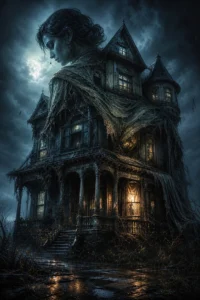
The main staircase of Black Hollow House had changed again. Yesterday it had fallen in a single graceful sweep into the entrance hall, walnut banisters carved with grapevines and fox faces. This morning there was a landing halfway down that had not existed before, with a narrow window looking out over the back slope. The window showed the coal tipple standing against the white morning like a gallows, though from this side of the house it should have been impossible to see.
The house wanted her to look.
She did, because not looking had never saved anyone.
Beyond the glass, snow worried at the world in restless sheets. The mountain hunched over Black Hollow, its pines black with ice, its ridgelines erased. Down in the hollow, the town lay mostly hidden under drifts and chimney smoke. The church steeple rose like a bone. Beyond it, a road that no plow could keep open twisted toward nowhere.
And beneath the house—beneath the frozen yard, beneath the roots, beneath all the generations of Vosses who had eaten and slept and died under this roof—the sealed seam waited.
Forty-seven men went into the earth.
None came out.
Only their faces remained.
Mara’s stomach tightened the way it had when she was eight years old and hiding under the parlor table while adults whispered overhead. She could not remember the words. Only the smell of coal smoke, hymnbook paper, and her mother’s hand crushing her wrist hard enough to bruise.
Don’t look at them, Mara.
The memory dissolved before she could grab it.
In the kitchen, Silas stood at the table with both hands planted on the scarred oak, his shoulders bowed beneath a threadbare flannel coat. He looked as if he had been carved from something harder than meat and less forgiving than bone. Snowmelt glistened in his beard. His cap lay beside an untouched mug of coffee, and the old rifle that had hung above the mudroom door rested within reach of his right hand.
Father Bell sat near the stove, wrapped in a black coat shiny with age. His white collar was slightly crooked. He had a rosary twisted through his fingers, though he was not praying so much as worrying the beads as if they might splinter and give him something sharp. At the sight of Mara, he looked up too quickly.
“Dr. Voss,” he said. “Your hand.”
“It’s fine.”
Silas barked a humorless laugh. “That’s what she says about everything bleeding in this place.”
Mara’s gaze dropped to his boots. Wet. Caked black at the soles. Not mud. Coal dust.
“You went already,” she said.
The kitchen changed temperature. Not much. Enough that the window over the sink clouded with a fresh skin of frost, delicate white veins spreading across the glass.
Silas’s jaw flexed.
Father Bell stopped moving the beads.
Mara stepped fully into the room. The air smelled of burnt coffee, damp wool, wood ash, and beneath all of it the copper tang that had followed her down from the hall.
“You went to the mine,” she said. “This morning.”
Silas looked at Father Bell, then back at her. “Had to check the lower fence. Storm took a pine down over the cut.”
“The sealed entrance isn’t near the lower fence.”
His eyes narrowed. “You remember that, do you?”
She didn’t. Not exactly. But her body did. Somewhere behind her ribs a compass needle swung toward the mountain and quivered.
Mara pulled out the chair opposite him and sat. The wood creaked under her. “What did you see?”
“Nothing that concerns you.”
“Then you wouldn’t mind telling me.”
Silas straightened. He was not tall, but he carried himself like a man who had spent a lifetime making doorways give way first. “I mind plenty.”
Father Bell’s voice was soft. “Silas.”
“No.” The word snapped like kindling. “You don’t get to use that voice on me, Father. You used it enough thirty years ago.”
The priest flinched as if struck. The rosary beads clicked once, then stilled.
Mara watched them both. The lie people told themselves had a sound. Not in the ear—not a hallucination, not exactly—but in the pattern of breath before speech, in the place where a sentence was cut away and replaced with something survivable. Silas’s silence said, If I don’t name it, it hasn’t begun again. Father Bell’s said, If God did not stop it, it must not have been mine to stop.
And beneath both, Black Hollow House listened.
A soft tap came from under the table.
Mara froze.
Tap.
Tap.
Tap.
Not from the floorboards. From inside the table itself.
Silas’s face hardened until it looked old enough to crack. “Don’t answer it.”
Mara slowly lowered her gaze.
The table’s underside was darkness and old gum and carved initials. Nothing moved there. Yet the tapping continued, patient and deliberate, as if a finger rapped from within the wood.
Three taps. Pause. Two taps. Pause. Three again.
Father Bell whispered, “Miners’ code.”
Silas rounded on him. “Shut your mouth.”
“What does it mean?” Mara asked.
The priest swallowed. His throat bobbed above the white collar. “Alive.”
The tapping stopped.
In the sudden quiet, the house exhaled through the walls.
Silas snatched his cap from the table. “Get your coat.”
Mara looked at him. “Why the change of heart?”
He slung the rifle over his shoulder. “Because whatever’s down there already knows you’re here. And if you’re going to go digging with that sharp little doctor’s spoon of yours, you ought to see what the earth does to people who think they can heal it.”
Father Bell rose. “I’m coming.”
“No,” Silas said.
“Silas—”
“I said no.” He did not raise his voice. He did not need to. “You stood at that gate once and prayed while men screamed. Stay here and pray at the walls if you’ve got the stomach for it.”
The priest’s face drained of what little color it had. His hand went to the back of a chair as if his knees had forgotten their purpose.
Mara waited for him to defend himself, to flare with clerical outrage, to wrap himself in the authority men used when guilt left them naked.
He only whispered, “They weren’t screaming by then.”
Silas turned away.
The mudroom smelled of cold iron and mouse droppings. Mara pulled on her boots, each movement tugging at the cuts across her knuckles. Silas handed her a lantern without ceremony. The glass chimney was smoky; inside, the wick already burned with a small blue-hearted flame.
“Flashlights die near the entrance,” he said. “Phones too. Don’t trust anything with a battery, a screen, or a memory.”
Mara slipped her phone from her pocket. No service. The battery icon showed eighty-one percent, then flickered to nine, then to a symbol she had never seen: a black circle with a pale vertical slit, like an eye opening.
She powered it off and shoved it deep into her coat.
At the back door, Silas paused without looking at her. “If you hear your name from the mine, don’t answer.”
“I know.”
“No, you don’t.” His hand rested on the latch. “You hear me call, you don’t answer. You hear your mother call, you don’t answer. You hear yourself crying down there, you put your hands over your ears and keep walking away.”
Mara’s breath fogged between them. “Have you heard me crying down there?”
Silas opened the door.
Wind and snow shouldered into the mudroom, carrying the smell of pine resin, chimney soot, and something mineral underneath, like wet pennies left in a grave.
“Not yet,” he said.
They crossed the yard in silence.
Black Hollow House loomed behind them, its windows blind with frost. From the outside it looked almost ordinary in the storm-light: a decaying mountain estate with sagging gables and porches crouched under snow. But as Mara descended the path toward the tree line, she felt the weight of its gaze between her shoulder blades. The house had too many windows. More than it had rooms. More than any architect could have built. Some were narrow as eyes. Some were large, dark mouths rimed with ice. In an upper window, a pale shape stood watching.
Mara stopped.
Silas did not. “Keep moving.”
The shape in the window lifted one bandaged hand.
Mara looked down at her own wrapped hand. Her fingers had not moved.
When she looked up again, the window was empty.
The path behind the house dropped steeply through pines and black locust trees, then curled along a ravine where ice crusted the creek in milky plates. Snow muffled every sound except the crunch of their boots and the occasional groan of burdened branches. The lantern in Mara’s hand cast a weak amber sphere that made the falling snow look like ash.
Silas walked ahead with the sure-footed irritation of a man who knew every root under the drifts and resented them anyway. He had cut this path himself, Mara realized. Maintained it for years. Not to the fence. Not to the lower pasture. To the mine.
“How often do you check it?” she asked.
“Often enough.”
“That isn’t an answer.”
“It’s the one you get.”
They pushed through a stand of rhododendron, glossy leaves rattling under their snow caps. Beyond, the land opened abruptly.
The mine yard lay in a white basin bitten into the mountain’s flank. Rotting timbers jutted from the snow. A collapsed shed leaned against a rusted cart, its wheels half-buried. The old tipple rose on spidery legs near the slope, black wood silvered by frost. Coal dust stained the snow in long gray smears where the wind had uncovered ground that had never healed.
And at the far end, set into the mountain like a wound stitched shut, was the sealed entrance.
Mara had expected a tunnel mouth boarded up and forgotten. What she saw instead was a wall.
Concrete had been poured across the opening decades ago, thick and brutal, reinforced with steel beams that rust had gnawed into orange tears. Over it ran chains as thick as her wrist, padlocked to iron anchors sunk into stone. A sign hung crookedly from one chain, its lettering nearly lost beneath ice.
BLACK HOLLOW NO. 3 — CLOSED BY ORDER OF THE STATE — ENTRY PROHIBITED
Someone had scratched through the last word and carved another beneath it.
PRAY
Mara stood very still.
The concrete wall was not smooth.
It had faces.
At first her mind refused to make sense of them. The surface was blackened in places, slick with coal seep and mineral stains, and the faces emerged from it in fragments: a nose, an open mouth, the ridge of a brow. Then the lanternlight shifted, and they became impossible to deny.
Dozens of human faces pressed out from the sealed entrance and the surrounding coal-dark stone as if men had been trapped just behind the surface and pushed forward in their final seconds. Cheeks flattened. Lips parted. Eyelids squeezed shut or stretched wide. Some faces were bearded. Some young enough that the softness had not yet left them. One had a broken front tooth. One had laugh lines cut deep around a mouth now frozen in an O of permanent surprise.
They were not carvings.
Mara knew faces. The thousand small asymmetries. The way skin pulled at the corners of fear. The involuntary lift of brows when a mind sees death arrive before the body can move. No sculptor had made these. No memorial committee had commissioned grief so intimate.
They were casts.
Perfect impressions in coal and concrete and something darker than either.
The vanished miners of Black Hollow.
Forty-seven men.
No bodies.
Only the last thing the mountain chose to keep.
Her lantern trembled. The flame guttered, recovering in a thin hiss.
Silas stood beside her, cap pulled low, eyes on the wall with the bitterness of old obedience. “Don’t touch them.”
Mara’s hand had already risen. She curled her fingers into her palm, pain flashing bright where the cuts split under the bandage.
“They came through the concrete?” she asked.
“They were there before the concrete.”
“That’s not possible.”
“No.” His voice was flat. “It isn’t.”
Snow fell onto the faces and did not stick. Flakes landed on the coal-black cheeks, shivered, and melted as if the stone held a fever.
Mara stepped closer despite herself.
Each face was turned outward, but not all faced the same direction. Some looked upward, toward the house hidden beyond the trees. Some downward, as if ashamed. One near the bottom had its mouth stretched wide enough for Mara to see individual teeth pressed into black stone.
“They found this after the collapse?” she asked.
Silas spat into the snow. The spittle landed gray. “Wasn’t a collapse.”
“The records said—”
“Records say what living men need them to say.”
Mara glanced at him. “Then what happened?”
He took a long time answering. Wind dragged across the mine yard, moaning through the broken tipple. The sound raised the hair along Mara’s arms because for an instant it was not wind at all but a crowd inhaling behind closed teeth.
“They broke into something,” Silas said at last. “That’s what my daddy said. Deep in No. 3, past the old survey line. Company had them cutting where they shouldn’t. Men heard knocking two days before. Not from ahead. From under. Foreman told them it was settling rock.”
“And your father?”
“Worked second shift. Came up sick that morning. Fever, black spit. My mother made him stay home. Saved his life, if you can call the years after living.” Silas’s eyes moved over the wall, stopping on a broad, square face near the rusted beam. “His brother was down there.”
Mara followed his gaze. The face had a heavy brow and deep-set eyes. Its mouth was closed, but the cheeks were hollowed inward, as if it had been caught not screaming but listening.
“What was his name?”
“Jonah Pike.”
The wind passed over the wall.
Somewhere inside the sealed mine, faint and far, three taps answered.
Mara’s blood thudded once in her ears.
Silas lifted the rifle. Not toward the wall. Toward the dark line where concrete met mountain, as if expecting something to push its way through.
“You said one changed,” Mara said.
He shot her a look sharp enough to cut. “I didn’t say that.”
“You didn’t have to.”
For a second, rage transformed his face. Not at her. At being known. At having his inner machinery exposed by a woman he had decided to dislike.
“Doctors,” he said. “Always sniffing around wounds like dogs.”
“Wounds tell you how someone was hurt.”
“Or they get infected from too much handling.”
Mara turned back to the faces. “Which one?”
Silas didn’t move.
“If you dragged me down here to frighten me, congratulations. If you brought me because something changed, then stop wasting time.”
His laugh was low and ugly. “You always talk like that when you’re scared?”
“Mostly when men mistake fear for obedience.”
That earned the briefest flicker at the corner of his mouth. Not amusement, exactly. Recognition of a blade.
He stepped past her and raised one gloved hand, pointing toward the left side of the entrance where coal rock shouldered out from behind the concrete. “There.”
Mara lifted the lantern.
At first she saw only a cluster of faces overlapping like the impressions of people crowded against glass. A man with a flattened nose. Another with one eye squinted shut. A third turned in profile, lips peeled back from his teeth.
Then she saw the one Silas meant.
It was fresher than the others.
Not physically. The stone had the same black sheen, the same mineral depth, the same impossible texture of skin transmuted into coal. But the expression had not settled into old horror. It looked immediate. Wet, almost. The mouth trembled at the edge of speech. The eyelids were half-lowered, not in death but in recognition.
And Mara knew that face.
Elias Creed stared out of the mine wall.
Not as he had looked in the last photograph his sister had sent to Mara months ago, smiling thinly in a hospital garden with his hands folded around a paper cup of tea. Not as he had looked in her office, gaunt and sweating through his shirt while he insisted the rooms in his dreams had begun following him home.
This was Elias at the end.
Elias on the night he died.
Elias screaming her name until his throat tore, according to the nurse who found him.
His lips were parted around a word the stone refused to release.
Mara’s lantern dipped.
Silas caught her elbow before she stumbled. His fingers clamped hard, then released as if contact burned him.
“That wasn’t there at sunrise,” he said.
Her own voice sounded far away. “You’re sure?”
“I’ve looked at these bastards near every day for thirty years. I know every tooth.”
Snow whispered down between them.
Mara moved closer. Elias’s features emerged with unbearable precision: the slight hook in the bridge of his nose from a childhood break; the small scar cutting through his left eyebrow; the soft fullness of his lower lip that had made him look younger than his forty-two years when he was silent, older when he spoke.
She remembered his voice on their last call.
You don’t understand, Dr. Voss. It doesn’t want me dead. Dead is too simple. It wants to know what my face feels like from the inside.
She had written the phrase in her clinical notes under somatic delusional imagery.
The shame struck so hard she almost made a sound.
Silas watched her from the corner of his eye. “Someone you knew.”
“A patient.”
“The one left you the house?”
She did not answer.


0 Comments