Chapter 2: Ash on the Tongue
by inkadminCael woke with ash on his tongue and a dead woman’s scream stitched to the back of his eyes.
He came up swinging.
His knuckles cracked against rotten wood. Pain flashed clean and white through the fog, blessedly his own. The cot beneath him lurched, one leg shorter than the others, and the mildew-stained ceiling of his room swam into focus by inches: dangling net charms, a spider fat as a thumbnail, the brown leak mark shaped like an imperial crown. Rain tapped somewhere above, finding every weakness in the tenement roof before dripping through pipes and boards to join the canal stink below.
For three heartbeats he was Cael Veyr again.
Then he blinked, and he was dying in velvet.
The vision struck without mercy. Marble under his cheek, cool and veined with gold. Blood running hot between his fingers. A gloved hand gripping his jaw. Blue fire reflected in a polished mask. Someone whispered a spell in a language that tasted like coins and old bones. The noblewoman—Lady Orienna Vale, if the signet ring had not lied—had tried to laugh through the blood bubbling from her mouth.
Tell no one. Burn it. Burn me with it.
Cael gagged so hard his ribs clenched.
He rolled off the cot and hit the floorboards on his hands and knees. The room tilted. A clay basin waited under the window, half full of cloudy washwater, and he crawled to it like a drunkard, spat, coughed, spat again. Gray flecks freckled the water. Not bile. Not blood.
Ash.
He stared at it, breathing through his teeth.
Memories burned for magic. Everyone knew that. A mage offered up a recollection, the spell consumed it, and what remained was nothing. Not a smudge. Not a bruise. A clean absence. That was the bargain the empire had been built upon, from the emperor’s first conquest to the last fisherwife’s candle-charm.
Last night, Cael had held a forbidden working in his mind and watched it ignite.
It should have taken something. His mother’s voice, perhaps. The shape of his own name. The first time he had stolen bread and found he liked survival more than shame.
Instead, the spell had burned.
And then, impossibly, it had come back.
Not merely back. Preserved. Whole as a coin hidden under the tongue. Nestled behind his thoughts, bright and terrible, along with Lady Vale’s final moments.
Cael gripped the basin until his fingers went numb.
“No,” he whispered.
The room did not answer.
It was hardly a room. More a wedge of space stolen between a dyer’s attic and the back wall of a fish-salting house, rented for three bits a week to anyone desperate enough not to ask whether it had once been a chimney. His desk occupied most of it: a plank on crates, scarred by ink knives and candle burns. Beside it sat his tools in their usual precise disorder—brass nibs, bone stylus, a vial of squid-black ink, three slivers of mnemonic glass wrapped in oilcloth, two counterfeit noble seals, and a chipped cup holding yesterday’s rain.
Normal things. Safe things. Criminal things, yes, but familiar.
Cael pushed himself upright, swaying.
The forbidden spell pulsed.
It was not made of words exactly. Words were the costume magic wore for people too frightened to look at its bones. The spell had structure, angles, weights of intention pressed into memory. He sensed it as a knot of silver-black thread tied around a hollow point. A witness-killing charm, Lady Vale had called it with her dying mouth. No, not called. He remembered what she had known: Vow of Cinders. An imperial erasure working, illegal outside the private hands of the throne. Designed to consume the memory of anyone who had seen a particular truth.
Cael had seen too much.
Cael had copied too quickly.
Cael had lived.
He laughed once, a brittle sound.
“Well,” he said to the spider on the ceiling, “that’s inconvenient.”
The spider remained loyal to silence.
A bell rang far above the canal district, deep and bronze, tolling the sixth hour of morning from Saint Liora’s drowned chapel. Its sound came warped through wet alleys and pipework, broken into shivers by the water. Luminor was waking reluctantly. Bargemen cursed. Gulls screamed like unpaid creditors. Somewhere below, a woman yelled that if Jasso touched her eels again she’d feed him to them.
Cael wiped his mouth with the back of his hand and regretted it when ash smeared across his skin.
He needed to think.
Thinking required food.
Food required coin.
Coin required not being dead.
He stood, dragged on his shirt, and checked the door charm. A thread of cheap blue wool crossed the gap between frame and latch, tied in Cael’s particular knot. Unbroken. No one had entered while he slept. Or while he had collapsed, shaking, after stumbling home through the undercanals with another person’s murder blooming in his skull.
He remembered the route in fragments. Slime-slick stairs. A blind boatman asking if he needed passage. His own hand pressed to the wall because the city kept sliding sideways. Above him, noble towers glowing with dawn-milk lanterns, careless as stars. Behind him, the warehouse chamber where Lady Vale had died and three men in lacquer masks had turned their heads as the erasure spell failed to swallow him.
He should have run farther.
He should have thrown himself into a different district, changed his face with cheap pigment, sold his tools, bribed a river captain, vanished into the reed towns.
Instead he had come home.
Habit killed more gutter rats than blades.
A knock rattled the door.
Cael froze.
Three taps. Pause. Two taps. One tap. The last one impatient enough to be a signature.
He exhaled through his nose. “If you’re here to murder me, Nia, use the window. The door’s sentimental.”
“If I were here to murder you,” said a girl’s voice from the hall, “you’d already be composing a very clever apology to whatever gutter saint takes liars.”
Cael opened the door a finger’s width.
Nia Quell stood outside with her hood up, rain glittering on her lashes. She was sixteen, narrow as a knife, and twice as likely to be found somewhere she did not belong. Her hair had been cut blunt at her chin with what appeared to have been a kitchen blade, and a smudge of grease striped one cheek. One hand rested inside her coat near the spring-dagger she pretended Cael didn’t know about.
Her sharp face softened when she saw him.
Then sharpened again immediately, because softness was expensive in the undercanals.
“You look dead,” she said.
“Flattery before breakfast?”
“You missed bell-four. Old Marn sent me.”
“Old Marn can send flowers next time.”
Nia’s gaze dropped to the ash on his hand.
Cael curled his fingers.
Too late.
“What did you do?” she asked.
“Good morning to you as well.”
She shouldered past him and shut the door. The room immediately had too many elbows in it. Nia took one look at the basin, the desk, the unlit candle burned down to a drowning stump, and the small smear of blood on Cael’s cuff.
“That isn’t ink.”
“I’ve been experimenting with a more dramatic color.”
“Cael.”
There were not many people in Luminor who said his name like an accusation and a handhold at once. Nia was one. Old Marn, when drunk enough to remember kindness, was another.
Cael gave her his best liar’s smile.
It was a fine thing, that smile. Polished in mirrors of black canal water, tested on debt collectors, constables, lonely widows, and one bored viscount who had once tried to buy the memory of a sunset he’d never seen. It said: trust me, I have already survived the worst part.
Nia hated it.
“Don’t,” she said.
The smile thinned.
Outside, a barge horn moaned.
Cael crossed to the desk and began gathering his mnemonic glass. Each sliver looked harmless: cloudy, opalescent, no larger than a fingernail. In the right hands, it could hold a memory long enough to sell, steal, alter, or bury. In Cael’s hands, it could be convinced to hold a lie so lovingly crafted the buyer’s mind embraced it as blood kin.
“There was a commission,” he said. “It soured.”
“Commissions sour when nobles decide they don’t like paying. This looks like a corpse crawled out of your mouth.”
“Poetic.”
“True?”
He slipped the glass into a belt pouch. “Potentially.”
Nia moved between him and the door. “Marn heard bells in the east sluice after midnight. Not chapel bells. Alarm brass. Then half the Marsh Gate got sealed by men in white cloaks. People are saying an imperial skiff came down under cloud cover.”
The dead woman’s memory convulsed behind his eyes.
White cloaks. Polished masks. Blue fire.
Cael’s fingers missed the buckle.
Nia saw that too.
“Oh, rot and saints,” she whispered. “Imperials?”
“Lots of people wear white.”
“Priests, brides, corpses, and imperial seekers. Which one killed your client?”
Cael did not answer.
Nia’s face lost its color in the gray light.
“You stupid, ink-fingered, bargain-bin genius.”
“That’s a crowded insult.”
“Did you forge for a seeker?”
“No.”
“Did you steal from one?”
“Not intentionally.”
“Cael.”
The spell pulsed again, and the room became marble.
Lady Vale’s vision overlaid Nia’s face: a high hall drenched in broken moonlight, a man with a sunburst pin at his throat, Lady Vale’s own hand clutching a sealed folio. The Spire is not a school, she had thought, terror sharp as glass. It is a mouth.
Cael staggered and caught the desk.
Nia grabbed his arm. “What’s happening?”
His skin crawled where her fingers touched. Not from her, but from the awareness of memory as fuel. Any mage could turn a moment like this into power: Nia’s hand warm through damp cloth, the smell of rain in her hair, her worry hidden behind anger. Burn it and get a spark. Burn enough, and the world bent.
He had never hated magic more than in that instant.
“I have something,” he said, voice scraped raw. “In my head.”
Nia’s grip tightened.
“A memory?”
“A spell.”
Silence fell so hard even the rain seemed to hesitate.
Nia released him and stepped back as if he had sprouted plague flowers. In the undercanals, memory crimes were common as fleas. Spell crimes were different. Spells belonged to houses, guilds, shrines, and throne-sanctioned academies. A gutter scribe possessing one without bondmarks or license was not a thief.
He was contraband with a pulse.
“What kind?” Nia asked.
Cael almost said nothing important. The lie rose by reflex, smooth and eager.
Then another memory cut through him: Lady Vale on the marble floor, eyes wide, using the last of her strength to shove the folio toward him.
If they reclaim it, everyone who knows will vanish.
He swallowed ash.
“The kind imperial seekers want buried,” he said.
Nia stared at him, then looked at the ceiling as if petitioning whichever saint handled hopeless idiots. “We’re leaving.”
“Excellent suggestion. I was considering a holiday.”
“Not joking.”
“Neither am I. I hear the ash deserts are lovely if you enjoy scorpions and theological despair.”
“Pack.”
Cael lifted his pouch. “Done.”
She blinked at the pathetic sum of his life. “That’s it?”
“I’m emotionally rich.”
“You are going to die poor and annoying.”
“Many have tried to separate me from at least one of those.”
A shout rose from the alley below.
Not the usual morning quarrel. This one had edges.
Boots thundered over a nearby bridge. Another shout answered from farther off, then a whistle shrilled twice, high and official. Cael and Nia looked at the window together.
His room’s single window was a warped rectangle of bubbled glass overlooking a slot alley between leaning tenements. Nia wiped condensation with her sleeve and peered down.
Cael watched her expression harden.
“White cloaks,” she said.
The dead woman’s fear slammed into him so strongly his knees nearly folded.
He shoved Nia aside just enough to see.
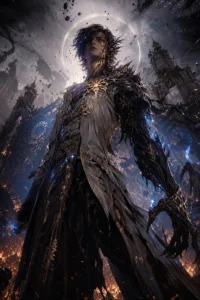
Five figures moved through the alley below, impossibly clean amid the canal muck. Their cloaks were not cloth but memory-silk, pale as bone and dry despite the rain. Masks covered the upper halves of their faces, smooth porcelain marked with thin gold lines that traced from brow to cheek like weeping suns. Each wore a short blade at the hip and a glass cylinder strapped to one forearm, filled with a slow-turning smoke the color of bruised pearls.
Seekers.
Behind them shuffled Brindle Tam, the landlord, bare feet in the filth, eyes vacant. A seeker held one gloved hand over Tam’s head without touching him. Threads of light ran from the old man’s temples to the seeker’s fingers.
Tam was talking.
“Third floor,” he mumbled. “Back wedge. Boy with black hair. Writes fancy. Owes me two weeks.”
“One week,” Cael hissed.
Nia gave him a look of homicidal disbelief.
The seeker lifted his hand. Tam sagged against the wall, smiling dreamily.
“He’ll forget he told them,” Nia whispered.
Cael knew the technique. A small extraction. Take the last minute of memory as payment for obedience. Clean. Efficient. Illegal unless one wore the emperor’s sun.
The seeker at the front turned his masked face upward.
Cael jerked back from the window, heart hammering.
Too late? Had the man seen him? Masks made faces into questions.
“Roof,” Nia said.
“Hall’s faster.”
“Hall is stairs. Stairs are where people with swords go when they have legs.”
“A compelling architectural critique.”
She kicked his cot aside, revealing a square of floorboard darker than the rest. Cael had hidden it himself three years ago after a debt collector demonstrated enthusiasm with a hammer. He hooked two fingers into the knothole and hauled. The board came up with a damp groan, releasing a breath of cold air and rat musk.
Below, the seekers entered the tenement.
The whole building seemed to flinch.
Cael dropped first into the crawlspace between walls, landing badly on a beam slick with condensation. Nia followed like a shadow poured through a crack, replacing the board above them just as footsteps reached the hallway outside his room.
Darkness swallowed them.
The crawlspace was barely wide enough for shoulders. Pipes ran along one side, sweating warm water from the dyer’s vats. Old charms scratched by previous tenants glimmered faintly on the beams: luck knots, rat wards, a lover’s initials burned with candle flame. Cael knew the path by bruises. Left hand forward until the broken nail, duck under pipe, turn where the wall smelled of vinegar, then climb.
Behind them, his door opened.
No crash. No splintering. The latch simply clicked, persuaded by magic or authority. Same thing, dressed differently.
A voice spoke inside his room. Male. Soft. Bored.
“Recently vacated.”
Another voice answered, this one a woman’s, crisp as folded paper. “Residue?”
A pause.
Cael held his breath. Nia’s boot pressed against his shin. Somewhere in the wall, a rat skittered.
“Ash trace,” said the man. “Cognitive combustion. Unsanctioned.”
“The spell discharged here?”
“No. It followed him home.”
Those words wormed through the boards and into Cael’s gut.
Nia mouthed, Move.
They moved.
Every inch scraped sound from the building. Cael heard the seekers in his room overturning his life with surgical politeness. The desk drawer. The cup. The basin.
“Ash expectorate,” said the woman. “Survivor confirmed.”
The man inhaled sharply. “Impossible.”
“Evidently not.”
Cael reached the vertical shaft where drainage pipes climbed toward the roof. A rusted ladder had once existed there. Now only three rungs remained, each more tetanus than metal. Nia sprang upward, caught a pipe, and climbed using toes, elbows, and spite. Cael followed less elegantly. His shoulder slammed the wall. Rotten plaster crumbled into his collar.
Below, a seeker said, “Search above.”
Light bloomed.
Not lantern light. This was pearl-gray and hungry, seeping through cracks as if brightness had learned to crawl. It touched Cael’s ankle, and his skin went numb.
A memory tugged loose.
He was seven, crouched beneath a fish stall while rain hammered the canvas roof. His mother’s hand pushed half a sweet bun into his palm. Her nails were ink-stained like his would become. She smiled and said—
Cael bit his tongue hard enough to taste blood.
The memory snapped back.
The light recoiled like a hooked eel.
In his mind, something inverted.
For an instant he saw the seeker’s spell as a net of tiny hooks cast through the building, each hook baited with absence. It sought loose recollections, recent fear, the glow of forbidden contact. His own memory should have snagged. It had begun to tear free.
Instead, something behind his eyes turned inside out.
The hook came back carrying not his memory, but the seeker’s.
A flash: a boy in white novice robes kneeling on black stone. A tutor’s hand holding his head still. “Again, Ilyon. Sacrifice without flinching.” The boy offered the memory of his sister’s laugh. The spell sparked. The tutor smiled. The boy began to cry, confused, no longer knowing why his chest hurt.
Cael gasped.
The pearl light winked out below.
“Contact,” the male seeker snapped.
Nia twisted at the top of the shaft. “What did you do?”
“I have no idea,” Cael said, which was becoming an increasingly unpleasant theme.
“Do it quieter.”
She shoved open the roof hatch.
Rain slapped Cael’s face as he hauled himself out into Luminor’s gray morning. The canal district sprawled beneath a low ceiling of cloud, all leaning roofs and rope bridges and chimney smoke smeared flat by weather. Waterways cut the streets into islands of brick and rot. Laundry lines sagged between buildings like surrender flags. Above, separated by wealth and altitude, the noble terraces of High Luminor gleamed with glass domes and memory-lanterns, their foundations rooted in the suffering below.
Cael had always thought the city looked like a drowned man wearing jewels.
Today it looked like a trap.
Nia ran.
Cael followed across slippery tiles, his boots skidding near the edge where three stories dropped into an alley full of rain barrels and sharp things. Behind them, the roof hatch exploded outward. A seeker rose without climbing, cloak billowing as if lifted by invisible hands. The gold lines on his mask caught the light.
“Cael Veyr,” he called.
Cael did not slow. “I’ve always hated when strangers know my name.”
“By authority of the Aurelian Throne, you will submit for mnemonic inspection.”
“Tempting, but I don’t submit before breakfast.”
The seeker lifted his arm. The glass cylinder strapped there spun, smoke inside tightening into a bright coil.
Nia shouted, “Down!”
Cael dropped flat as a ribbon of blue-white flame sliced the air where his head had been. It struck a chimney stack. Brick did not explode; it forgot how to remain solid. The chimney collapsed into powder that drifted upward for a breath before rain remembered gravity on its behalf.
Cael stared.
“That seems excessive!”
“Run now, complain later!” Nia yelled.
They cleared the gap to the next roof. Nia landed and rolled. Cael landed badly, ankle barking pain, but momentum dragged him onward. The roofs of the undercanals formed a second city for those with light feet and unpaid debts. He had used them for years. He knew which tiles held, which bridges were decorative lies, which chimney vents could hide a body if the body was flexible and not too proud.



0 Comments