Chapter 6: The First Stolen Breath
by inkadminThe servant quarters of Skygrave Sect did not sleep.
It merely lowered its voice.
After midnight, when the bronze bells on Black Crow Peak had tolled three times and the disciples with actual futures had sealed themselves in meditation chambers carved into warm jade, the lowest terraces still murmured with human misery. Someone coughed blood into a basin behind a paper wall. Someone whispered multiplication tables for herb weights, terrified of failing a steward’s morning test. Rats scratched in the grain jars beneath the kitchens, bold as nobles. Farther down the mountain, beyond the crooked line of servant huts, the night wind dragged itself through the punishment bamboo and made the stalks clack together like old bones counting debts.
Shen Vey sat cross-legged on his mat and listened to all of it.
The mat was more reed than cloth. Its broken fibers bit through his thin trousers and left a lattice of dents on his skin. The room was small enough that he could stretch one arm and touch the wall, and cold enough that his breath came pale whenever the wind pried through the cracked window frame. A clay lamp burned on the floor before him, its bean-sized flame trembling over the booklet he had propped against a chipped bowl.
Basic Mist-Gathering Method.
On the first page, an illustrated boy with an expression of noble serenity sat beneath a painted moon, his limbs arranged in a posture more comfortable for ink than flesh. Silver lines showed the proper route of spiritual energy: drawn through the pores, refined by the lungs, led down the central channel, and finally stored in the lower dantian. Beneath the diagram, the text promised that even a lowly Iron root could sense qi within seven nights if disciplined.
The booklet made no mention of Hollow roots.
Vey had read it eleven times anyway.
He lowered his eyes to the page and traced the characters with his gaze, not his finger. Ink wore away from borrowed manuals, and the steward who controlled the servant library had a fondness for charging damages in kneeling hours.
Empty the mind. Receive heaven and earth. Do not grasp. Do not resist. Let the breath become a bridge.
He almost smiled.
He had been empty all his life. Heaven and earth had never shown any interest in crossing him.
A bruise the color of spoiled plums spread over his ribs where Lin Chao’s heel had landed yesterday morning. The pain had faded from sharp to sullen, but when Vey inhaled too deeply, it pressed inward like a thumb. His left forearm still bore a dark puncture from the discarded bone needle, though the venom had vanished. Not faded. Not been survived. Vanished.
He remembered the poison crawling through his veins like a nest of icy centipedes. He remembered falling behind the washing shed, staring at the sky between laundry poles, waiting for his heart to forget its duty. He remembered the thing inside him opening.
Not a root. Not the pale, useless absence the testing altar had shown when he was seven and again when he was seventeen. Something beneath the absence. A hunger without teeth. A darkness that did not spread but listened.
It had swallowed the poison.
And when the venom was gone, it had left behind a thread of heat that strengthened his hands for the span of a single breath. Enough for him to drag himself upright. Enough to know that the emptiness inside him was not empty.
Since then, fear had become his second shadow.
He had told no one. Not Old Wen, whose crooked kindness had earned him two cracked teeth and a lifetime of lowered eyes. Not little Miao from the kitchen fires, who smuggled him burnt dumplings and news with the same furtive pride. Not even the quiet ceiling above his mat, which had listened to more prayers from the servant quarters than any god.
Secrets, Vey knew, were not kept by silence alone. They were kept by behavior. A dog that finds a bone must not wag its tail when hunters pass.
So he swept stairs. Carried water. Accepted ration pills with lowered hands. Let Lin Chao call him Hollow Rat while other servant-disciples laughed because laughter was cheaper than courage. And at night, when the mountain thinned and the stars sharpened above Skygrave Sect’s rooftops, he studied the Mist-Gathering Method and pretended he was not trying to awaken a monster.
Vey closed the booklet.
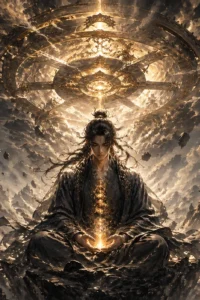
The room dimmed without its pale pages catching light. He cupped his hands before his abdomen, thumb tips touching, palms forming an oval. He straightened his spine one segment at a time. Outside, wind rattled the shutters. Somewhere near the well, a bucket rope creaked though no one should have been drawing water.
Empty the mind.
He let the sounds come and go. Cough. Scratch. Bamboo clack. Flame hiss. His own heartbeat.
Receive heaven and earth.
At first there was nothing.
There was always nothing.
The booklet described qi as mist against skin, as warmth drawn from dawn, as a faint sweetness on the tongue. Vey tasted lamp smoke and stale millet. He felt cold climbing through the floor. His breath moved in and out, and the world remained stubbornly itself.
He held the posture until his knees screamed. Until sweat gathered beneath his collar despite the cold. Until the candle flame sank lower and turned blue at the base.
Nothing.
He opened his eyes.
The painted boy on the manual seemed to look serene out of spite.
“Congratulations,” Vey murmured to it. His voice was low enough not to carry. “You have defeated me again.”
A soft snort came from the other side of the wall.
Vey stilled.
The servant huts shared thin partitions of woven reed plastered with mud. A determined sneeze could travel through three rooms and embarrass five people. He had grown used to other lives pressing close around his own: arguments, snores, sobs muffled into blankets. But this sound was different. Not laughter. Not sleep.
Breath.
Fast, harsh, uneven breath.
Vey turned his head toward the wall.
On the other side lived Han Shuo, a broad-shouldered outer servant with an Iron root and a face like unbaked clay. He was nineteen, perhaps twenty, though hunger aged the lowly and pills preserved the favored, making years unreliable. Han Shuo worked in the beast pens and smelled permanently of wet fur and medicinal grass. He rarely spoke except to curse, and he guarded his ration pills with the devotion of a temple lion.
For six months, rumor said, Han Shuo had hoarded half his pills. Starved himself on watery gruel. Sold three winter blankets. Scrubbed latrines for a steward with wandering hands. All for one chance to break from the first level of Body Tempering into the second.
The sect named such things cultivation. In the servant quarters, they called it buying another inch away from the mud.
Through the wall came a wet groan.
Vey’s fingers tightened on his knees.
He should not interfere. Breakthroughs were dangerous. Failed breakthroughs were uglier. If Han Shuo damaged his meridians and someone found Vey near him, blame would need no evidence. Hollow roots made convenient buckets for every spilled misfortune.
Another sound followed: a dull thump, as if a body had struck the floor.
Then a whisper forced through clenched teeth.
“Hold… hold… damn you, hold…”
The air changed.
At first Vey thought the lamp had smoked. A faint metallic tang slid over his tongue, like rainwater collected from a rusty gutter. Then the hairs along his arms lifted. The room’s cold thickened, not colder but denser, pressing against his skin from every direction.
He had felt something like it once before.
At the testing altar.
When the children had placed their hands on ancient stone and the elders called colors into existence. Gold like sunrise. Jade like spring leaves. Iron like old blood. And when Vey touched it, the altar’s light had guttered as if a bowl had been placed over a flame.
Now that same sense of unseen pressure seeped through the wall.
Qi.
Not his. Not gathered by him. Han Shuo had drawn it from the night, from ration pills, from months of bitterness stored in flesh. It churned beyond the partition in a rough, unstable cloud. Vey could not see it with his eyes, but some part of him turned toward it the way a starving man turned toward the smell of meat.
His lower abdomen tightened.
No. Not abdomen.
Deeper.
Beneath blood. Beneath bone. Beneath the imagined place where roots were said to grow.
The void opened one eyelid.
Vey stopped breathing.
Instantly, the presence inside him grew sharper.
Not larger. It had no size. It was a hole remembering the shape of everything it had ever lacked.
Through the wall, Han Shuo cried out. Something cracked—not wood, not clay. A sound from inside a human body, small and final. The qi pressure shuddered violently.
Vey should have stood. Should have knocked. Should have shouted for the night steward. Instead he remained frozen, palms damp on his knees, as a thin strand of unseen force leaked through the wall and brushed his skin.
The moment it touched him, the world went silent.
No wind. No rats. No coughs.
Only a single silver thread hanging in darkness.
Vey did not see it, yet he knew its color. He did not smell it, yet it carried the scent of rain on stone, old sweat, crushed bitter pills, and Han Shuo’s desperation. It drifted near his chest, fraying, looking for anywhere to settle before it dispersed into the night.
The Mist-Gathering Method said to welcome qi like mist.
Vey did not welcome it.
Something inside him took.
The thread snapped into his body.
He doubled over.
Cold fire lanced through his pores. His back bowed, teeth clacking shut hard enough to bite his tongue. The stolen wisp did not flow along the careful silver paths illustrated in the manual. It was dragged screaming downward, past lungs, past heart, past the ordinary map of meridians, into the black hollow beneath his navel.
For one heartbeat, Vey felt Han Shuo.
Not thoughts. Not clear memories. Impressions struck him like sparks from a hammer.
A boy with muddy knees watching older brothers leave for a city wall post. A mother’s hands wrapping a steamed bun in cloth and pretending not to be hungry. The stink of spirit goats. Lin Chao laughing while taking two ration pills from Han Shuo’s sleeve. Six months of counting breaths while others slept. A single savage conviction: If I reach second level, they will stop stepping on my neck.
Then the impressions shattered.
The void swallowed the wisp whole.
Heat bloomed.
It began as a coal beneath Vey’s abdomen, no larger than a sesame seed. Then it unfolded, delicate and terrible, spreading warmth through channels that had never carried anything but blood and pain. His fingers twitched. His spine straightened without command. The bruise along his ribs throbbed once, twice, and the ache dulled as if wrapped in warm cloth.
Vey gasped.
The world returned all at once.
Han Shuo was screaming.
“No! No, no, no—come back!”
Vey scrambled backward, nearly kicking over the lamp. His shoulder struck the wall behind him. The flame jumped, casting frantic shadows across the room. His breath tore in and out. Beneath his skin, the tiny coal remained.
A wisp.
His first qi.
Not sensed. Not gathered. Stolen.
Beyond the partition, Han Shuo sobbed like an animal with its leg in a trap. Wood scraped. A bowl broke. The unstable cloud of qi that had filled the air collapsed in ragged waves. Each wave brushed the wall and frayed into strands.
The void stirred again.
Vey clamped both hands over his lower abdomen, as if he could hold it shut by force.
No.
Another strand slipped through.
He felt it before it reached him. A thin pulse of energy, weaker than the first but still bright against the night. It came from Han Shuo’s failed breakthrough, from the qi he could not contain, from months of effort bleeding away into useless air.
Vey pressed his forehead to the floor.
No.
The strand touched his shoulder.
The void drank.
This time he managed not to cry out. His nails dug crescents into his palms as the energy plunged inward. Another flash of Han Shuo’s life burst behind his eyes: a steward’s boot grinding his hand into gravel; the taste of raw stolen radish; a whispered vow made to a dead father; shame so old it had become bone.
The coal beneath Vey’s abdomen brightened.
His skin tingled. A faint current coiled there, restless, alive. It was not much. The booklet described the first wisp of qi as a candle in a vast cavern. Vey’s was less than that. A firefly trapped in a jar.
But it was real.
And it had come from another man’s ruin.
Vey lurched to his feet.
His knees, numb from meditation, nearly failed him. He caught the windowsill and shoved the shutter open. Cold mountain air knifed into the room. Moonlight spilled over his hands, pale and merciless.
For a moment he expected to see something monstrous written on his skin. Black veins. Strange runes. Evidence.
His hands looked the same. Thin. Callused. Scarred at the knuckles from carrying stone buckets in winter.
The coal inside him pulsed again.
Vey bit down on his sleeve.
Not from pain.
From hunger.
It was not his stomach. He had known bodily hunger so long he could name its moods: the hollow gnaw after missed meals, the sour twist after spoiled millet, the dizzy sweetness when fasting went too far. This was cleaner. Vast. Patient. The hunger did not demand food.
It demanded more.
Through the wall, Han Shuo’s sobbing had turned to ragged curses.
“Almost… I was almost there… who took it? Who—”
Vey’s blood iced.
He moved without thinking. The manual went under his sleeping mat. The lamp was pinched dark between two damp fingers. Smoke curled upward, carrying the smell of burnt bean oil. He lay down fully clothed, back to the wall, and forced his breathing into the slow rhythm of sleep.
Footsteps pounded outside.
Doors slid open. Voices hissed from neighboring rooms.
“What happened?”
“Han Shuo tried tonight?”
“Idiot. He only had three Meridian-Warming Pills.”
“Three more than me.”
Someone laughed nervously, then stopped when another scream burst from Han Shuo’s room.
A staff struck wood.
“Silence!”
The night steward’s voice cut through the quarters like a whip through wet cloth. Steward Qian was a narrow man with a narrow beard and eyes that loved ledgers more than people. His cultivation sat at the third level of Body Tempering, which in the outer servant terraces made him a minor mountain god. His authority was stitched into his blue-gray robe and reinforced by the bamboo rod he carried everywhere.
His footsteps stopped outside Han Shuo’s door.
“Open.”
No answer.
The bamboo rod struck again.
“Open, or I record resistance during a cultivation accident.”
A latch fumbled. The door creaked.
Vey stared at the dark wall inches from his face. Every muscle in his body wanted to curl around the new warmth and hide it. Instead he loosened himself piece by piece. A sleeping man did not clench his jaw. A sleeping man did not hold his breath.
Light seeped under his door from the corridor lantern.
Han Shuo was speaking, words tumbling over one another.
“Steward, I had it. I swear by the sect tablets, I drew the qi clean. It entered the first channel, I guided it to the second gate, then it—then something pulled—”
“Pulled?” Steward Qian said.
The single word was worse than mockery. It was interest.
Vey’s heartbeat slowed in terror.
“Yes. Like a hook. No, like a mouth. It tore away. I felt it leave me.”
A murmur spread through the open doors nearby.
“Qi deviation,” someone whispered.
“He cracked his head.”
“Maybe a ghost.”
Steward Qian snapped, “All mouths shut unless you want them registered.”
Silence fell.
A rustle of cloth. Perhaps the steward crouching. Perhaps Han Shuo being examined like a cracked pot.
“Your meridians are inflamed,” Qian said after a moment. “Second gate bruised. No complete rupture. You failed because you were impatient and underprepared.”
“No, Steward, I—”
The bamboo rod cracked against flesh.
Han Shuo grunted.
“You failed,” Qian repeated, voice flat. “Do you understand the difference? Failure is your burden. Theft is my paperwork. Do not make me do paperwork.”
Han Shuo’s breathing shook.
“Yes, Steward.”
“What did you consume?”
“Three Meridian-Warming Pills. One marrow broth. Half a strip of dried spirit eel.”
“You earned an eel strip?”
A pause.
“I… traded.”
“With whom?”
Silence.
The rod tapped the floor.
“Keep your secrets, then. They have clearly served you well.”
A few disciples laughed from safe distances. The sound was thin and eager.
Vey closed his eyes. The coal of qi in his abdomen pulsed with each word, as if listening.
Steward Qian continued, “You are barred from attempting breakthrough for one month. Report to the infirmary at dawn and pay two contribution chips for salve.”
“I don’t have two chips.”
“Then limp.”
The steward stood. His footsteps turned toward the corridor.
Vey’s door slid open.
Moonlight and lanternlight crossed over his face.
He did not move.
Steward Qian stood in the doorway for three breaths.
Vey counted them by the thud of his heart.
One.
The new qi stirred, warm and bright. He imagined it shining through his skin like contraband gold.
Two.
Qian’s robe smelled faintly of camphor and old ink. The bamboo rod creaked under his fingers.
Three.
“Shen Vey,” the steward said.
Vey let his body twitch as if dragged from sleep. He opened his eyes halfway, unfocused them, and pushed himself up on one elbow with the sluggish confusion of someone who had not spent the last several breaths measuring death.
“Steward?” His voice came rough. “Is it morning?”
Qian’s gaze moved across the room. Sleeping mat. Water bowl. Folded servant robe. Bare shelf. Cracked window. No lamp flame. No manual in sight.
“Did you hear anything?”
Vey blinked toward the corridor, then winced as if the light pained him. “Han Shuo shouting. I thought he was dreaming.”
“Dreaming?”
“He curses spirit goats in his sleep sometimes.” Vey rubbed his eyes. “Once he promised to marry one if it stopped biting him.”
A snicker escaped from a nearby room and was quickly strangled.
Steward Qian’s expression did not change, but his eyes sharpened a fraction. Humor was dangerous before men who owned rods.
“You share a wall,” Qian said. “Did you feel spiritual energy?”
Vey allowed a small, embarrassed silence.
Then he lowered his eyes.
“Steward, I am Hollow.”
The word sat between them like a dead insect.
Qian looked at him for a long moment. Contempt softened suspicion. Not kindness; never that. Only the relief of a man remembering a locked chest was empty.
“True,” he said.
He slid the door closed.
Vey remained propped on one elbow until the steward’s footsteps receded and the corridor returned to whispers. Only when doors shut one by one and Han Shuo’s room quieted into muffled weeping did he lower himself back to the mat.
His sleeve was wet where he had bitten it.
The cold night pressed around him. Inside, the stolen warmth remained.
Vey did not sleep.
He waited until the fourth bell, when even fear grew tired, then pulled the manual from beneath his mat. The room was too dark to read, but he knew the diagram by memory. Pores. Lungs. Central channel. Dantian.
He placed one hand over his lower abdomen.
“Are you mine?” he whispered.
The wisp did not answer.
Of course it did not. Qi was not a pet or servant. It was energy refined by root and will. The foundation of cultivation. The first rung of a ladder whose top pierced clouds, courts, stars, and perhaps heaven itself.
But it moved when he focused on it.
Not far. Not well. When he tried to guide it upward according to the manual, it resisted like a drop of mercury under a clumsy finger. The thread trembled, slid sideways, and sank back toward the void. He tried again, slower. It rose a finger-width.
Pain flashed.
Vey’s breath hissed through his teeth.
His meridian—if he truly had one—felt like a frozen ditch forced to carry molten iron. The wisp scraped along channels unused to passage. It left behind warmth, then ache, then a strange clarity that spread to his fingertips.
He stopped before greed could become stupidity.
The wisp settled again.
A laugh tried to climb out of him. He crushed it in his throat.
Seventeen years of being told he was a sealed jar. Seventeen years of elders pressing fingers to his wrist and withdrawing as if from dirt. Seventeen years of sweeping steps beneath boys half his age who could make sparks dance between their palms.
Now, in the dark of a servant hut, with another disciple’s failure still wet on the walls, Shen Vey held a wisp of qi.
It should have tasted like triumph.
Instead, it tasted like Han Shuo’s memory of a mother lying about hunger.
Vey leaned forward and pressed his forehead to his knees.


0 Comments