Chapter 3: The Bride Price
by inkadminThe rain had not stopped since Elara left Saint Orison’s.
It had followed her down the cathedral steps like a living thing, needling through her coat, collecting in the hollow of her throat where her mother’s pendant lay hidden beneath wool and skin. It tapped at the roof of Adrian Blackthorne’s car with the patience of someone who knew all the secrets inside. It blurred Bellhaven into a city of smeared gold and wet stone, where saints leaned from cathedral niches with eroded faces and gargoyles spat black water into gutters already choked with rot.
Adrian sat across from her in the back of the car rather than beside her, his long body folded with infuriating ease into the leather shadows. The privacy partition was raised. The windows were tinted. The car smelled of rain-damp wool, polished wood, and the faint mineral bite of his cologne, clean and cold as winter iron.
He had not spoken in eleven minutes.
Elara knew because she had been counting.
It was a habit from restoration work. When chemicals were applied to old paint, when solvents touched gilding, when fragile plaster breathed beneath a careful brush, time became the difference between revelation and ruin. Eleven minutes since Adrian had looked at the pendant around her neck and something had moved behind his eyes—a flicker quick as candlelight in a crypt.
He knew her mother’s name.
He knew, and he had folded that knowledge away as if it were a knife he intended to use later.
Outside, the city slid by in fractured reflections. The black ribs of scaffolding clung to Saint Orison’s western façade behind them. The fish market at Low Quay huddled beneath canvas awnings. Men in oilskins dragged crates across slick cobbles while gulls screamed overhead, pale and vicious against the storm. Bellhaven wore rain like mourning. It darkened the old limestone, glazed the brass plaques on private clubs, polished the marble steps where men with family crests above their doors decided the fate of people who would never be invited inside.
Elara watched Adrian through the ghost of her own reflection. “Are we going to sit in silence until one of us develops mold?”
His gaze lifted from the phone in his hand. Not startled. Never startled. “I thought you preferred silence to threats.”
“I prefer answers.”
“Most people do. Few are prepared for them.”
“That line works better in mausoleums.”
Something almost like amusement touched the corner of his mouth. It vanished before it could become human. “You spend enough time in them to judge?”
“I restore cathedrals. Mausoleums are just arrogant chapels with fewer hymns.”
His eyes, that impossible shade between smoke and pewter, rested on her face. “And Blackthorne House?”
“I haven’t decided yet.”
“You will.”
The promise in his voice unsettled her more than a threat would have. Threats had edges. Promises could become cages.
Elara pushed a damp strand of hair from her cheek. The ruined chapel still clung to her—the scent of fallen stone, wet ash, old incense trapped in fractures. Adrian’s words clung harder.
The marriage will be legal, public, and absolute.
Absolute. A word men used when they wanted the world to mistake their desire for law.
Her fingers moved of their own accord to the pendant beneath her collar. It was small, no larger than a saint’s medal, though no saint had ever been engraved on it. Black enamel framed a pale stone etched with a symbol Elara had never found in any archive: three thorned stems crossing beneath a crescent blade. Her mother had worn it in the only photograph Elara owned of her, smiling beside an open window as if she’d heard music no one else could hear.
Adrian’s gaze dropped to the movement of her hand.
She stopped touching it.
“If you have something to say about my mother,” she said, “say it.”
The rain thickened, drumming over them. For a moment, the city disappeared, and there was only the dark car, the leather seats, and the man opposite her with the composure of a confessor who had buried his own sins beneath the altar.
“Not here.”
Elara laughed once. It came out sharp. “Of course not. Wrong setting for honesty?”
“Wrong audience.”
She glanced toward the privacy partition. “Your driver?”
“The city.”
“The city doesn’t care about me.”
“That,” Adrian said softly, “is where you’re wrong.”
Before she could press him, the car slowed.
Elara turned toward the window and saw the sign first: Bellhaven Central Magistrate Court, carved into blackened granite above a flight of steps slick with rain. Two bronze lions flanked the entrance, their faces rubbed smooth by decades of weather and bribery. Police vans idled near the curb. Umbrellas bobbed like dark mushrooms. Reporters smoked beneath the awning, their cameras sheltered against their chests.
Her stomach tightened.
“Why are we here?”
Adrian slipped his phone into his coat. “Your brother is being released.”
The words struck harder than any threat.
For one impossible second, Elara forgot how to breathe.
“What?”
“Milo Voss. Twenty-two. Arrested on charges of theft, forgery, and unlawful possession of restricted restoration materials. Held in Eastgate pending arraignment.” Adrian recited it like he was reading weather. “The charges have been withdrawn.”
Her hand closed around the edge of the seat. “Withdrawn how?”
“Efficiently.”
“That isn’t an answer.”
“It is the only one you need at the moment.”
Anger rushed in to fill the space where relief had nearly undone her. “You paid someone.”
“Several someones.”
“You bribed the court?”
“Do you want moral clarity or your brother outside those doors?”
She hated him then. Hated the calm precision of him, the way he could place a miracle on the table and make it look like a weapon. Her brother was inside that building. Milo, who had once filled their kitchen sink with tadpoles because he believed they looked lonely in puddles. Milo, who had stolen altar wine at fifteen and thrown up in a confessional. Milo, who had forged acquisition papers because desperation made fools of bright boys and because debt collectors did not care if someone’s hands were made for art instead of crime.
“I want to know the cost,” she said.
Adrian’s eyes did not leave hers. “You already do.”
The car door opened. Cold air knifed in.
A man in a black overcoat stood outside, holding a wide umbrella. He was older than Adrian by perhaps twenty years, with iron-gray hair cropped close to his skull and a face built from discipline rather than softness. A scar split one eyebrow into two severe halves.
“Mr. Blackthorne,” he said.
“Thank you, Graves.” Adrian stepped out, then looked back at Elara. “Come.”
It was not a request. It should have made her refuse.
Instead, she climbed out into the rain.
The umbrella shifted to cover her as well, though Graves did not look at her. Water raced along the curb in silver ropes, carrying cigarette ends and petals torn from some expensive arrangement. The courthouse doors opened and closed, breathing out stale warmth and the smell of wet wool, old paper, and fear.
They waited beneath the awning.
Elara’s pulse beat in her fingertips. She scanned every face emerging from the court: a woman crying into a handkerchief, a man with a bruised cheek and a lawyer whispering furiously at his side, two constables laughing too loudly. Then the doors opened again.
Milo came out in yesterday’s clothes.
He looked smaller than she remembered.
His brown hair was flattened by damp and sleeplessness, his lower lip split, one cheek shadowed purple near the bone. He held a clear plastic bag against his chest with his belt and shoelaces inside. When he saw Elara, his face crumpled with a relief so raw it nearly dropped her where she stood.
“El.”
She ran to him.
He smelled of disinfectant, sweat, and the metal tang of holding cells. She wrapped her arms around him, and for a moment he was twelve again, all elbows and apologies, shaking against her shoulder after Father’s temper had broken a plate against the wall.
“You idiot,” she whispered into his wet hair. “You absolute catastrophic idiot.”
He laughed, then winced. “Good to see you too.”
She pulled back and touched his bruised cheek. “Who did this?”
“A misunderstanding with a charming man named Cutter.” He tried for a grin. It failed when his eyes slid past her.
Adrian stood beneath the umbrella, rain silvering the shoulders of his black coat. The world seemed to give him room without being asked.
Milo went pale. “Oh.”
Elara felt it—the way her brother’s body changed, the way mischief and bravado drained from him, leaving only a young man who knew exactly what kind of monster wore a tailored suit in Bellhaven.
“Milo,” she said slowly, “what aren’t you telling me?”
His throat moved. “El—”
“What did you do?”
Adrian approached with the measured grace of a man entering a room he already owned. “He did what desperate men do. Borrowed from worse men, lied to better ones, and assumed talent could outrun consequence.”
Milo flinched.
Elara turned on Adrian. “Don’t speak about him like he’s not standing here.”
“Then he may answer for himself.”
Milo looked at her, rain sliding down his face like tears he refused to shed. “I was trying to fix it.”
“Fix what?”
He stared at the courthouse steps. “The loans. Father’s loans.”
The rain seemed to go quiet around her.
Their father had died with paint beneath his nails and lies beneath his tongue. He had left behind unpaid rent, broken promises, and the slow starvation of respect. Elara had known about the creditors. She had known about the pawned tools, the missing silver, the funeral bill paid in installments.
She had not known the debts were still alive.
“How much?” she asked.
Milo did not answer.
Adrian did. “One hundred and eighty-six thousand crowns, before interest. Two hundred and forty-nine thousand as of this morning.”
Elara stared at him.
That number did not belong in her life. It belonged in ledgers, in the velvet-draped rooms of men who bought paintings to match the color of their mistresses’ eyes. It belonged in a world above hers, where debt was strategy instead of hunger.
“No,” she said.
Milo’s face twisted. “El, I’m sorry.”
“No. Father couldn’t have—”
“He did,” Adrian said. “And he pledged collateral.”
She turned very slowly. “What collateral?”
Adrian held her gaze.
Something cold opened beneath her ribs.
“Me,” she said.
Milo’s head snapped up. “What?”
Adrian’s voice was quiet. “Her hand in marriage was named as settlement if the debt defaulted.”
Milo stared at Elara as if she had been struck in front of him. “No. No, that’s not legal.”
“Many things are not legal,” Adrian said. “Most of Bellhaven runs on them.”
“You can’t just—she’s not property!” Milo lunged a step forward, and Graves moved before Elara even saw him decide to. The older man appeared between Milo and Adrian with one hand beneath his coat.
“Don’t,” Elara snapped.
All three men stilled.
Her voice had come out sharper than the rain.
She looked at Milo, at his bruised cheek and frightened eyes, and forced herself to place one hand against his chest. “Don’t be brave now. You’ve been stupid enough for one day.”
“Elara.” His voice broke around her name. “Tell me you didn’t agree to this.”
Her silence answered before she could.
Milo stumbled back as if he had been shoved. “No.”
“You’re free,” she said.
“Not like this.”
“Yes,” she said, because if she did not make the word hard, she would shatter. “Like this.”
He shook his head again and again. “I’ll run. We’ll run. Tonight. We’ll take the ferry to Carroway, disappear inland—”
“Milo.”
“I know people.”
“You know criminals with bad tattoos and worse impulse control.”
“Better than him.”
Adrian’s expression did not change, but the air around him sharpened.
Elara stepped closer to her brother. “Listen to me. You will go home. You will pack what you need. You will not contact anyone from whatever hole you crawled into. You will not borrow money. You will not forge signatures. You will not attempt some heroic escape that gets both of us buried in shallow graves behind a warehouse.”
“You sound just like him.”
The words hit before Milo seemed to realize he had thrown them.
Their father stood between them for one ugly heartbeat: Tomas Voss with his saint’s hands and sinner’s mouth, promising every ruin could be mended while he broke everything within reach.
Elara dropped her hand.
Milo’s face crumpled again. “El, I didn’t mean—”
“Yes, you did.” Her voice was very soft. “And maybe you’re right. Someone has to sound like the person who knows what happens when you keep gambling with consequences.”
He looked down, shoulders shaking.
She wanted to hold him. She wanted to slap him. She wanted to drag him by the ear all the way home and lock him in the pantry until the world stopped wanting pieces of him.
Instead, she turned to Adrian. “The debt is paid?”
He inclined his head. “In full.”
“The charges?”
“Gone.”
“His record?”
“Clean enough to pass inspection by any institution less thorough than mine.”
She swallowed. “And the men he borrowed from?”
Adrian’s eyes went colder. “They will not trouble him.”
Milo let out a humorless laugh. “What does that mean?”
“It means,” Graves said for the first time, his voice like gravel under a boot, “you should send flowers to whatever saint your sister prays to.”
Elara did not pray to saints. Saints had never answered in her house. Only creditors had.
Adrian extended a cream envelope toward Milo. “Inside is an address. A driver will take you there. You will stay for forty-eight hours. Food and clothing will be provided.”
Milo stared at the envelope as though it might bite. “A safe house?”
“A place where people who want to test my patience cannot find you.”
“I’m not taking charity from you.”
Adrian’s smile was faint and merciless. “Then consider it self-preservation. Yours.”
Milo looked at Elara.
She nodded once, though every part of her rebelled. “Go.”
“What about you?”
The courthouse doors opened again. A group of lawyers spilled out laughing, their umbrellas blooming black against the rain. One of them saw Adrian and fell silent. The silence spread through the group like spilled ink.
Elara noticed. Milo noticed too.
Adrian Blackthorne did not need to raise his voice. His name did it for him.
“I’m going to Blackthorne House,” Elara said.
Milo’s mouth tightened. “El—”
“For tonight.”
Adrian said nothing.
It was the kind of nothing that made clear there would be many nights.
Milo grabbed her hand. His fingers were cold. “I’ll fix this.”
She squeezed once. “Don’t. That’s an order.”
“Since when do I listen to you?”
“Since you got arrested wearing shoes without laces.”
A broken laugh escaped him, and for one fragile second, he was her brother again. Not a debt. Not leverage. Not the weakness that had been used to bind her.
Then Graves signaled to a waiting car. Milo was guided toward it, glancing back every few steps, his face pale behind the rain-streaked window as the vehicle pulled away.
Elara stood until its taillights vanished into the wet traffic.
Only then did she realize Adrian had removed his umbrella from above himself and was holding it entirely over her.
Rain soaked his hair black.
She looked at him. “Do you enjoy this?”
“Which part?”
“Owning people’s gratitude before they’ve had a chance to refuse it.”
“Gratitude is rarely useful.”
“What is?”
His gaze moved over her face, and she hated the way her skin warmed beneath it despite the cold. “Understanding what someone will do for love.”
“And now you understand me?”
“I understood you the moment you walked into the west chapel with dust on your cheek and fury in your spine.”
She stepped closer, refusing to let him use height and silence as weapons. “Then understand this. I may go to your house. I may sign whatever document your lawyers dress up as fate. But I am not yours.”
Adrian lowered his head until his voice belonged only to her and the rain. “No, Elara. Not yet.”
Her breath caught.
He turned before she could answer, leaving the words between them like a lit match dropped onto oil.
By the time the car crossed the northern bridge, daylight had begun to fail.
Bellhaven thinned at its edges. The packed tenements and shopfronts gave way to private roads, iron gates, estates hidden behind yew hedges tall enough to shame prison walls. The sea appeared in glimpses beyond the cliffs, a dark animal throwing itself against stone. Fog crawled low over the ground, snagging on black trees stripped bare by wind.
Elara sat with her arms folded, refusing the warmth of the car though her clothes were damp through. Adrian reviewed documents on a tablet, silver light grazing the planes of his face. He had changed since the courthouse—not in expression, but in atmosphere. In the cathedral, he had seemed like a shadow trespassing in holy ruins. At the court, a blade in a gentleman’s glove.
Here, approaching his ancestral territory, he became something worse.
He became inevitable.
The road curved along a cliffside and descended into a hollow where old oaks leaned inward, their branches woven so tightly overhead that evening arrived all at once. Iron fencing appeared beyond them, black spears rising from ivy. At intervals, stone pillars bore lanterns burning with cold white flame. Between two pillars stood gates tall enough for giants, their ironwork twisted into thorned vines and ravens with open beaks.
At the center, worked into the metal, bloomed a rose.
Not the soft romantic shape sold in florist windows. This rose had petals like flames and thorns like hooks.
The gates opened without a sound.
Blackthorne House waited beyond.
Elara had seen old estates in restoration surveys. She had catalogued cracked frescoes in merchant villas and cleaned soot from the ceilings of noble townhouses whose owners spoke of heritage while avoiding taxes on inherited cruelty. But Blackthorne House was not merely old.
It was hungry.
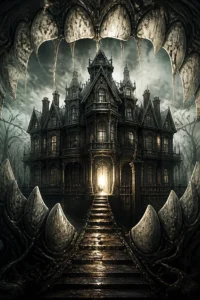
It crowned the cliff like a dark cathedral built for a god no one should worship. Towers rose at uneven heights, their slate roofs steep and wet, their windows narrow and glowing faintly behind rain-veiled glass. Flying buttresses joined wings of blackened stone. Chimneys exhaled smoke into the fog. The central façade was all carved arches and watchful statues—angels without faces, beasts with human hands, saints whose eyes had been gouged hollow by time or intention.
And around it, stretching in disciplined beds across the grounds, bloomed thousands of black roses.
They should not have looked real. No flower owned that depth of darkness. Their petals held a sheen of purple where the lanterns struck them, like bruises on velvet. Rain gathered on them in silver beads and slipped down thorned stems into soil so dark it might have been ash.
Elara leaned toward the window despite herself.
“They’re alive,” she murmured.
Adrian’s gaze lifted. “Usually.”
She glanced at him. “Usually?”
“Some things only appear to bloom.”
“Do all rich men practice sounding ominous in mirrors, or is that a Blackthorne family tradition?”
“We hire tutors.”
She did not want to smile. A treacherous part of her almost did.
The car stopped before a set of wide steps. Two footmen emerged with umbrellas before the engine had fully quieted. The front doors opened inward, spilling amber light across wet stone.
A woman stood framed in the entrance.
She was tall and narrow, perhaps in her late fifties, with silver hair pulled into a severe knot and a black dress buttoned to the throat. A string of pearls glowed at her collar like small moons. Her face held the calm of someone who had survived every storm by becoming colder than weather.
“Mrs. Vale,” Adrian said as he climbed out.
The woman’s eyes shifted to Elara. Not openly hostile. Worse. Assessing.
“Miss Voss.” Her voice carried the faint rasp of old smoke. “Welcome to Blackthorne House.”
Welcome, Elara thought, was a generous word for the way the house seemed to inhale as she crossed the threshold.
The entrance hall soared three stories high, ribbed by dark beams and overlooked by carved galleries. A chandelier of antlers and crystal hung above a floor of black-and-white marble arranged in a pattern that made her eyes want to follow it toward the center, where a circular crest had been set into the stone.
Three thorns. A raven. A crown.
The Blackthorne crest appeared everywhere once she noticed it: in the ironwork of the stair rail, embossed on leather chairs, carved into the mantel of a fireplace large enough to roast a saint. Portraits lined the walls, generations of pale faces in dark clothing. Their painted eyes followed with the smug patience of the dead who had never paid for what they’d done.
The air smelled of woodsmoke, beeswax, roses, and beneath that something older—stone after rain, locked rooms, secrets shut away too long.
Mrs. Vale stepped forward. “Your coat, miss.”
Elara hesitated.
Adrian removed his own and handed it to a waiting servant without looking. The gesture was effortless. Habit born from being served since birth.
Elara shrugged out of her damp coat herself and passed it to Mrs. Vale, who received it as if Elara had handed over evidence.
“Tea has been sent to the blue sitting room,” Mrs. Vale said. “Mr. Hale is waiting with the final papers.”
“In a moment,” Adrian replied. “Miss Voss needs to be shown her rooms.”
“Of course.”
Elara’s chin lifted. “I can sign papers before being installed in a tower.”
Adrian looked at her. “You look ready to collapse.”
“I look wet and irritated. Collapse is far more theatrical.”
“Your brother is free. Your creditors are paid. You have been threatened, rained on, and brought to a house you already hate.” His voice lowered. “Do not mistake endurance for invulnerability.”
The gentleness of the words was so unexpected that she distrusted it instantly.
“Do not mistake observation for kindness,” she returned.
His eyes held hers for one charged second. Then he said to Mrs. Vale, “The west suite.”
Something passed over the housekeeper’s face.
Small. Almost nothing.
But Elara had spent years studying damaged frescoes, learning to spot where paint had been altered, where a saint’s hand had been repainted to hide a dagger, where a patron’s face had been scraped away and replaced. Mrs. Vale’s composure cracked for less than a breath.
Adrian saw it too.
“Is there a problem?” he asked.
“No, sir.”
“Then see it done.”
Mrs. Vale inclined her head. “This way, Miss Voss.”
Elara followed her up the grand staircase. The runner was deep red beneath her shoes, worn in the center by generations of footsteps. At the first landing, a tall window overlooked the rose gardens. Rain streaked the glass. Beyond it, the black roses swayed in the wind, their heads bowed as if listening.
The corridors of Blackthorne House seemed designed to unsettle. They turned where they should have continued. Niches held marble busts draped in shadow. Doors appeared at odd intervals, some polished from use, others sealed by dust and disinterest. Gas lamps flickered within glass sconces, casting light that trembled over old wallpaper patterned with thorned vines.
Mrs. Vale moved silently despite the keys at her waist.
“How long have you worked here?” Elara asked.
“Long enough.”
“That seems to be the favored unit of measurement in this house.”
“Time is unreliable at Blackthorne House.”
Elara slowed. “That was nearly a sense of humor.”
Mrs. Vale did not look back. “No, miss. It was a warning.”
They passed beneath an archway where the temperature dropped so abruptly Elara’s damp blouse chilled against her skin. To the right, a long corridor stretched into darkness, its lamps unlit. A velvet rope had been hooked across the entrance, more symbolic than secure. At the far end, barely visible, stood a pair of double doors banded in iron.
Elara stopped.
On the wall beside the corridor hung a portrait.
A woman in a white dress sat in a garden of black roses, her hands folded over her lap. Her hair was dark, her mouth unsmiling, her gaze turned slightly away from the painter as if she had heard someone call her name from beyond the frame. Around her neck hung a pendant.
Elara’s hand flew to her own throat.
Not identical. The painted pendant was larger, set with a black stone rather than pale, but the design was unmistakable.


0 Comments