Chapter 8: Blood Beneath the Floorboards
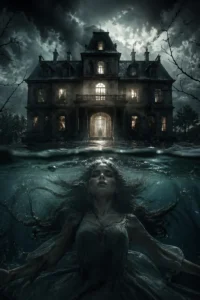
by inkadminVows Beneath Blackwater Hall chapter 8
Morning came to Blackwater Hall in bruised colors.
The storm had not fully passed. It lingered over the sea like a threat reconsidering itself, low clouds pressed flat against the horizon, rain tapping at the long windows with the patient persistence of fingernails. The house breathed damp and salt. Somewhere deep in its walls, old pipes knocked like a pulse.
Evelyn woke tangled in sheets that smelled faintly of cedar smoke and Adrian’s skin. For one disorienting second, warmth held her. Then memory returned in sharp, glittering pieces—the sea road drowned beneath black water, his hand locked around her wrist, the violence of their words, the violence of everything after.
She turned her head.
The bed beside her was empty.
The indentation his body had left in the mattress was already cooling.
On the chair near the fireplace lay the dress she had worn the night before, still damp at the hem with seawater and mud. Beside it, folded with infuriating precision, was a fresh gown in dark green silk. A kind gesture, if one ignored that it looked suspiciously like arrangement. Provision. Ownership.
On the small writing table by the window, a tray waited with tea, toast untouched, and a silver bell she had never been given reason to use. Under the cup, tucked deliberately beneath the saucer, was a card in Adrian’s hand.
The lower wing is flooded. Do not go there. I will return before luncheon.
Not good morning. Not how do you feel. Not even a lie clothed as tenderness.
Just an order.
Evelyn stared at the note until her jaw ached from clenching. Then she laughed once under her breath—a brittle, disbelieving sound that vanished into the vast room.
“Of course,” she murmured to no one. “How romantic.”
When she lifted the teacup, her hand shook only slightly.
By the time she had dressed, pinned her hair, and paced the length of the bedchamber three times, the silence of Blackwater had become intolerable. Last night had changed something between them; she felt it like a bruise beneath the skin. Adrian had looked at her as if he wanted to devour and shield her in the same breath. He had spoken truths with his mouth against her throat and hidden others behind his teeth.
Evelyn knew enough of men to understand that confession offered in darkness often retreated by daylight.
She also knew enough of Blackwater Hall to distrust any warning that came too plainly.
The phrase from one of those serialized online posts her school friend used to devour drifted absurdly through her mind—Vows Beneath Blackwater Hall chapter 8, she thought, with the sort of grim private humor people developed on battlefields and at weddings. The heroine ignores the warning. The house punishes her for it.
She set the card down and left the room.
The corridor outside Adrian’s chambers was lined with portraits gone dim in the weather. Ancestral faces watched from gilt frames darkened by age and sea-salt. Men with hard mouths. Women arranged in silk and pearls, their beauty lacquered into obedience. Some paintings had been restored lovingly. Others bore old damage—scratches through the eyes, a knife-slice across a painted throat, one woman’s face entirely cut away so that only her jeweled body remained.
At this hour the servants moved like shadows at the far end of the hall, soft-footed and watchful. Mrs. Wren emerged from a side passage carrying a ring of keys. Her narrow face did not alter at the sight of Evelyn, but something in her gaze sharpened.
“Good morning, madam.”
“Is it?” Evelyn asked.
Mrs. Wren inclined her head. “The worst of the storm has passed.”
“Has Mr. Vale taken breakfast?”
“He has not.”
“Then where is he?”
The housekeeper’s fingers tightened once around the keys. “Attending to estate matters.”
“How vague.”
“How sufficient.”
Evelyn smiled with all her teeth. “I find I have developed a dislike for sufficiency.”
Mrs. Wren’s gaze flicked to the note still in Evelyn’s hand. “His instructions were clear.”
“That is generally how instructions work.”
“You should heed them.”
There it was again—that note beneath the politeness, the one all the servants in Blackwater carried like concealed blades. Not fear exactly. Not loyalty either. Something older. Conditioned. Complicit.
Evelyn stepped closer. “Did you know my mother?”
It was a guess thrown like a stone into dark water.
The effect was immediate.
Mrs. Wren’s expression did not change, but all color drained from her already pale face. The keys at her side chimed faintly as her hand trembled.
“I do not discuss the dead,” she said.
“Then discuss the living. Why does everyone in this house look at me as if they’ve seen a ghost?”
“Because Blackwater is full of them, madam.”
Mrs. Wren moved to pass her. Evelyn caught the woman’s wrist.
The keys bit cold into Evelyn’s palm.
For one suspended second they stared at one another—mistress and servant, liar and liar, each measuring what the other might dare.
Then a door banged somewhere below them. A male voice called for the housekeeper. Mrs. Wren wrenched free and descended the stairs without another word, but in the struggle one of the keys had torn loose from the ring.
It lay on the runner at Evelyn’s feet. Long, blackened iron, old-fashioned and heavy as a sin.
Evelyn bent and picked it up.
It was impossible not to take that as invitation.
The lower wing smelled of tidewater and rot.
Adrian had not lied about the flooding. Water had seeped beneath doors and pooled in depressions of the stone floor, reflecting the windows in broken strips of gray light. The air was colder here. Unused. Forgotten by central heating and human affection alike.
Evelyn lifted her skirts and moved carefully past shrouded furniture and niches full of cracked marble. She did not know exactly what she was seeking, only that Blackwater kept its truths in layers, and last night Adrian’s half-spoken warnings had peeled one back.
Your mother was here, he had said.
Not I think. Not perhaps. Certainty.
And then he had kissed her as if the answer itself could be drowned between them.
At the end of the corridor stood a door unlike the others: oak gone nearly black with age, iron-banded, its lock newer than the wood around it. The key in Evelyn’s hand was old. The lock, newer. Incompatible.
But the door stood not quite shut.
Someone had used it recently and not fully closed it behind them.
Evelyn pressed her fingers to the edge and eased it open.
The room beyond had once been a schoolroom or nursery. The faded remains of painted vines climbed the walls above warped paneling. A rusted cradle frame leaned on its side near the hearth. There were shelves, mostly empty, and a long table covered with oilcloth that had stiffened into cracks. Rain drummed overhead. The windows had been boarded from the inside.
It took her a moment to understand what made the room feel wrong.
It was not disuse.
It was disturbance.
Dust lay everywhere except in a narrow strip near the far wall where marks scored the floorboards—fresh scrapes, rectangular, as if something heavy had been dragged aside and then roughly pushed back.
Evelyn crossed the room slowly. Her pulse climbed.
The wardrobe standing against the wall was not part of the nursery’s original furnishings. It was too large, too severe, and the wood at its feet had left bright pressure marks on the floor where it had shifted recently.
She braced herself and pushed.
It resisted with the stubborn weight of old oak. Then, inch by inch, it gave, grinding across the floorboards with a sound that made the hairs rise at the back of her neck.
Beneath it, half concealed by a rug edge, was a square cut into the floor.
A hidden hatch.
Evelyn dropped to her knees. The iron ring set into the panel was rust-streaked, but recently handled. She hooked her fingers beneath it and pulled.
The hatch lifted with a groan of swollen wood, releasing a breath of air so stale and metallic it turned her stomach.
Blood.
Not fresh. Not clean. Old blood had a smell like rust and pennies and butcher’s drains.
Below the hatch, narrow steps descended into a space between the foundation walls. Darkness pooled there, thick and waiting.
Evelyn should have gone back. She knew it. Any sensible woman would have. But sensible women did not get sold into mansions built on secrets, and they did not wake in the beds of men who kissed like confession and caged like prison bars.
She found an oil lamp on the nursery table, struck a match from a tin nearby, and lit the wick.
Then she went down.
The chamber beneath the floorboards was no larger than a priest hole, but deeper, stone-lined, and dry despite the storm. Shelves had been carved into the wall. Tin boxes sat upon them in disciplined rows. There was a chair too, straight-backed and bolted to the floor, its armrests darkly stained.
Evelyn stopped breathing.
Leather straps hung from the chair. One had cracked with age. Another looked newer.
The lamplight trembled in her hand, and shadows leapt over the walls like frantic things.
On the floor beside the chair lay a thin silver bracelet, broken at the clasp.
She crouched and picked it up.
Its surface was tarnished, but the engraving inside remained legible.
L. H.
Evelyn’s fingers spasmed so violently she nearly dropped it.
Her mother’s initials had been Louisa Hart.
The room swayed around her.
For a terrible second she was no longer in Blackwater but ten years old in a London townhouse, standing outside her father’s study while muffled voices rose within. Her mother, white-faced and shaking. Her father saying, You will do as I tell you if you care at all for the girl. The next morning Louisa had gone away “for her health.” She had never come back.
Not dead, they had said at first. Resting. Traveling. Delicate. Then, eventually, dead enough to stop asking questions.
Evelyn forced air into her lungs and turned to the shelves.
The first tin box held correspondence tied in bundles with black ribbon. The paper had yellowed. Some letters bore seals broken long ago; others remained untouched. She opened one at random and found not affection, nor family account, but a list of names and dates.
Miss Clara Bell — settlement secured upon marriage to G.A. — father deceased under unfortunate circumstances.
Lady Henrietta Snow — letters retained — husband compliant.
Beatrice Leigh — issue illegitimate — transfer executed.
Evelyn reached for another file. Then another. The handwriting changed over decades, but the pattern did not. Dossiers. Leverage. Illicit births, unpaid gambling debts, affairs, forged signatures, vanished rivals, land transfers signed under duress. The fortune of the Vales had not merely been inherited or cleverly invested. It had been cultivated through rot—through secrets pried from weak places and pressed until families split, women disappeared, men signed what they must to make scandal vanish.
In one ledger, columns of names were marked with symbols in red ink. Beside several women’s names was the word married. Beside others, placed. Beside a smaller number, written with chilling neatness: removed.
Evelyn turned the page with fingers gone numb.
There, halfway down a later list, was her mother’s name.
Louisa Hart, née Mercer.
Beside it, an old annotation in brown ink had been crossed through so many times it was nearly obliterated. Underneath, added later in a sharper hand:
Bloodline confirmed. Child retained outside house until maturity. Mother became unstable. Removed before disclosure.
Retained.
Outside house.
The words thudded through her with sickening force.
She was not merely connected to Blackwater by marriage, nor by some old social acquaintance. She had been accounted for. Tracked. Catalogued before she was old enough to form memories.
Her lamp cast light across the next page.
At the top was written a heading in elegant script:
On the Continuance of the Vale Line Through Allied Branches
Evelyn read three lines and had to brace herself against the shelf.
It was genealogy disguised as strategy. Illegitimate daughters hidden, married off, brought back when useful. Branches severed publicly and cultivated privately. Property protected through coercion. Bloodline maintained not by nobility, but by captivity dressed as arrangement.
And her mother’s family name—Mercer—appeared connected to the Vales not once, but twice.
“No,” Evelyn whispered.
Another paper slipped from the bundle and fluttered to the floor.
She snatched it up.
A marriage contract. Modern enough to include typed clauses, old enough in spirit to reek of coercion. It concerned a woman named Isolde Mercer and a Vale heir three generations prior. Attached was a notation about failure to produce issue, subsequent seclusion, and death by misadventure on the cliffs.
Mercer. Her mother’s line.
Forced marriages. Disappearances. Payments. Silence.
Blackwater’s wealth was a mausoleum built from women traded between signatures.
A floorboard creaked above her.
Evelyn froze.
Another sound followed—footsteps crossing the nursery floor, measured and unmistakable.
She extinguished the lamp by instinct, plunging the chamber into blackness. Her heart slammed against her ribs hard enough to hurt. Through the crack of the hatch above, a line of gray light sliced the dark.
Someone stood over it.
She saw the shadow before she heard the voice.
“If you had the slightest instinct for self-preservation,” Adrian said quietly, “you would have stayed in bed.”
Evelyn let out a breath that was almost a laugh and almost a sob. She relit the lamp with clumsy hands and climbed the steps, papers clutched against her chest.



0 Comments