Chapter 1: The Will Read at Midnight
by inkadminBy the time the will was read, Seraphina Vale’s father had been dead for three days, and her future husband was already standing in the shadows with her engagement ring.
She did not know that yet.
What she knew was rain.
Rain on the carriage roof, hard as thrown gravel. Rain in the cracked gutters of Blackthorne, spilling in silver ropes over carved gargoyles and broken cornices. Rain dragging the city’s filth into the streets until the cobbles shone black beneath the gas lamps and every alley smelled of salt, smoke, and old rot.
Seraphina sat rigid on the worn leather seat, gloved fingers closed around the handle of her violin case until the stitching bit through kid skin. The instrument had traveled farther than she had—Paris, Vienna, Prague, rooms glittering with chandeliers and cruel applause—but somehow it seemed to shrink in Blackthorne, to become a child’s thing clutched against a nightmare.
Outside the carriage window, the city rose like a drowned cathedral.
Blackthorne had always been taller than she remembered. Its houses leaned over the streets, shoulder to shoulder, their windows narrow and watchful, their iron balconies webbed in rain. The old families had built upward centuries ago to escape the floods, stacking mansions on hills of stone and bone, linking them with bridges high above the poorer wards. Even now, as the carriage climbed through the Westgate district, Seraphina glimpsed those bridges between buildings like dark veins, lacquered carriages rattling across them while below, men in oilskins dragged carts through water up to their knees.
Home.
The word felt like a splinter under the tongue.
She had left Blackthorne at seventeen with one suitcase, a scholarship letter, and her brother’s blood dried beneath her fingernails from where he had laughed too hard and coughed into his handkerchief. She had sworn she would return famous enough to make the city choke on her name.
Instead she had returned in mourning black, with a cracked bow case and creditors waiting at the docks.
The carriage wheels struck a flooded rut. Seraphina’s shoulder hit the wall. Across from her, Aunt Isolde clicked her tongue without looking up from the black lace veil she was repairing with a needle so thin it seemed meant for surgery.
“Do try not to break your neck before the funeral,” Isolde said. “It would be inconvenient to bury two Vales in one week.”
Seraphina turned from the window. Her aunt had been widowed three times and had mourned each husband with increasing refinement. At sixty-two, Isolde Vale wore grief like perfume—expensive, bitter, and applied in public. Her silver hair was coiled beneath a hat sprouting black feathers. Her mouth, painted plum-dark, held the permanent shape of a secret.
“I thought inconvenience was the family talent,” Seraphina said.
Isolde’s needle paused. “No. Ruin is the family talent. Inconvenience is merely what we offer our friends.”
“Have we any left?”
“Friends? No.” Isolde bit through the thread. “But enemies, darling. We are rich in enemies.”
The carriage passed beneath the arch of Saint Orison’s Bridge, and the bells began to toll.
Seraphina felt the sound in her ribs before she heard it. Deep bronze notes rolled through the rain, one after another, across the drowned streets and up the hill toward Vale House. The same bells had marked marriages, executions, verdicts, fires. The same bells had tolled when her mother died. When her brother was carried home shaking and smiling from the Ravenscroft Club with a debt note in his pocket and poison in his veins.
Not poison, her father had said then, though his hands had trembled so badly he could not light his cigar. Consumption. Weak lungs. Bad luck.
But Julian Vale had been nineteen and strong as a summer storm. He had gone into the Ravenscroft Club with a violinist’s hands and a gambler’s grin. He had come out ruined.
Seraphina closed her eyes.
Lucian Ravenscroft’s name had reached her in every city, though she had never met him properly. Whispered in drawing rooms. Murmured behind opera fans. Spoken by men who lowered their voices as if the syllables might summon him.
Beautiful. Monstrous. Untouchable.
He had bought magistrates before he had turned twenty-five. He had inherited half of Blackthorne’s shipping routes and all its grudges. He owned judges, papers, dock captains, priests. He collected debts the way other men collected art. Some said he had shot a man in the throat during a duel at dawn and sent flowers to the widow before breakfast. Others claimed the foundations beneath Saint Orison’s Cathedral were not filled with stone alone.
And Julian had owed him money.
Seraphina opened her eyes as the carriage slowed.
Vale House emerged through the rain at the top of the hill, black against a sky the color of bruised pewter. The estate had once been one of the city’s jewels: four stories of soot-dark stone, pointed windows, a conservatory glittering with glass, and a west wing designed for music, all overlooking the iron-gray sea. Now ivy strangled the chimneys. One turret had collapsed inward. The marble lions at the gate were green with moss, their faces worn into blind snarls.
Someone had hung black crepe across the doors.
It sagged in the rain like drowned hair.
Seraphina did not move when the footman opened the carriage door. The smell of wet earth and salt rushed in, mingled with the faint sweetness of lilies.
Funeral flowers.
Her stomach clenched.
Isolde stepped down first, accepting the footman’s hand as if descending into a ballroom rather than grief. She turned back, eyes sharp beneath her veil.
“Whatever you feel,” she said softly, “do not show it where the house can see.”
“The house?”
“The servants. The walls. The portraits. In Blackthorne, they are all the same thing.”
Then she swept toward the entrance, skirts hissing over wet stone.
Seraphina followed with her violin case in hand.
Inside, Vale House smelled of candle wax, damp plaster, and extinguished fires. The foyer’s great chandelier had lost half its crystals. The floor tiles were cracked in a spiderweb pattern that led toward the grand staircase, where ancestral portraits climbed the walls in dark gilded frames. Vales with pale faces and colder eyes looked down at Seraphina as though she were late for an appointment with a curse.
At the foot of the stairs stood the coffin.
It was closed.
Seraphina stopped so abruptly that the footman behind her nearly stumbled.
Her father had hated enclosed spaces. As a child, she had once hidden in a cedar wardrobe during a game and fallen asleep. Theodore Vale had torn the house apart looking for her. When he found her, he did not scold. He sank to the floor, dragging her into his lap, shaking so hard she had thought he was cold.
Never shut yourself away from the air, little nightingale, he had whispered into her hair. The dark gets hungry.
Now they had locked him in polished mahogany, brass handles gleaming, lilies piled on the lid.
“Why is it closed?” Seraphina asked.
No one answered.
The housekeeper, Mrs. Crane, emerged from the corridor in a black dress too tight at the throat. She had been old when Seraphina left; now she looked carved from gray tallow, her cheeks hollow, her knuckles swollen. She gave a curtsy that barely dipped.
“Miss Vale.” Her voice scraped. “You’ve come.”
“Why is the coffin closed?”
Mrs. Crane’s eyes flicked to Isolde.
Aunt Isolde began removing her gloves finger by finger. “There was damage.”
The words fell softly. They destroyed something.
“Damage,” Seraphina repeated.
“The cliffs are not kind.”
“He fell?”
“So the report states.”
Seraphina looked at the coffin. At the seam where the lid met the box. At one brass screw set slightly crooked.
“My father did not walk near the cliffs in rain.”
Mrs. Crane’s mouth tightened.
Isolde said, “Your father did many things in recent months that made little sense.”
“Such as?”
“Borrowing money from men who do not write receipts. Dismissing loyal staff. Locking himself in the library until dawn.” Isolde’s gaze moved to the violin case. “Writing to his daughter only after he was dead.”
Seraphina’s fingers went numb.
In her coat pocket lay the letter that had reached her in Vienna two nights ago, delivered by a boy who vanished before dawn.
Seraphina, if this reaches you, then I have failed to outrun the consequences of what I uncovered. Come home. Trust no one who offers comfort. Burn anything marked with black velvet.
Forgive me. I thought I could save you from Blackthorne by sending you away. I fear I only taught the city patience.
Your loving father,
T.V.
There had been no mention of cliffs. No mention of accident. Only the familiar slant of his handwriting, frantic enough that the ink had blotted through the paper.
Seraphina walked toward the coffin.
“Miss Vale,” Mrs. Crane said sharply.
Seraphina ignored her.
The lilies were cold and wet beneath her fingers as she pushed them aside. Their perfume clung to her gloves, sweet as rot. She found the edge of the lid and slid her hand along it.
Locked.
“Who sealed it?” she asked.
Mrs. Crane’s eyes shone with something like fear. “The undertaker.”
“At whose instruction?”
No one spoke.
A floorboard creaked above.
Seraphina looked up.
For one breath, she thought she saw a figure standing on the second-floor gallery—a man’s silhouette, tall and still, one gloved hand resting on the banister. Then lightning flashed behind the high windows, turning the glass white, and the gallery was empty.
The thunder that followed seemed to move through the house like a body.
Isolde’s voice cut through it. “Do not start chasing ghosts before the funeral, Seraphina. You will exhaust yourself, and ghosts in this house have excellent endurance.”
Seraphina turned from the coffin. “Where is his study?”
“Locked.”
“By whom?”
“By your father before he died.”
“Then I want the key.”
“So did several men yesterday.”
Seraphina looked at her aunt.
Isolde slid her gloves off and handed them to Mrs. Crane. “Creditors. Lawyers. One unpleasant gentleman who smelled of cloves and carried a cane with a silver wolf’s head. They all asked to see Theodore’s papers.”
“Did you let them?”
“I am old, dear, not suicidal.”
Mrs. Crane crossed herself. A strange gesture in a house where the Vales had never been especially devout.
Seraphina noticed. “What aren’t you saying?”
“Many things,” Isolde said. “Most of them to preserve the illusion that this family still has dignity.”
Before Seraphina could answer, the front doors groaned open behind her.
Wind swept in first, snuffing three candles along the wall. Rain followed, blown across the threshold in a glittering sheet. A man stepped inside and removed his hat.
Not Lucian Ravenscroft.
Seraphina knew it before she had reason to be relieved.
The newcomer was older, thick through the shoulders, with a reddish beard trimmed close to his jaw and a solicitor’s black coat stretched over an expensive waistcoat. Water streamed from the brim of his hat onto the floor. His face, though arranged into professional mourning, had the pinched eagerness of a crow discovering an open window.
“Miss Vale,” he said, bowing. “Mr. Ambrose Flint. Your father’s solicitor.”
“My father’s solicitor was Mr. Harrow.”
“Mr. Harrow drowned in March.”
“How convenient for you.”
Aunt Isolde made a small sound, possibly amusement, possibly warning.
Ambrose Flint’s smile did not falter, but his eyes sharpened. “Blackthorne is a coastal city. Drownings happen.”
“So do falls from cliffs, apparently.”
“Tragedy has a flair for repetition.”
Seraphina disliked him immediately.
He handed his wet hat to the footman without looking at him. “The funeral service is scheduled for six. The reading, per your father’s final instruction, will occur at midnight in the library. All named parties must be present.”
“Named parties?” Seraphina asked.
Flint’s gaze slid toward the darkening windows. “You. Lady Isolde. Myself. And Lord Ravenscroft.”
The name moved through the foyer like a draft under a door.
Mrs. Crane lowered her eyes.
Seraphina’s pulse struck once, hard. “Lucian Ravenscroft has no place at my father’s will.”
“Nevertheless, he has one.”
“Why?”
“Midnight, Miss Vale.” Flint brushed rain from his sleeve. “Your father was very precise.”
“My father was terrified.”
Something changed in Flint’s expression. A subtle tightening at the corner of the mouth. There, and gone.
“Grief can make letters appear more dramatic than intended.”
Seraphina went still.
She had not mentioned a letter.
Aunt Isolde’s needle-sharp gaze cut to the solicitor.
Flint smiled again, too late. “I assume, of course. Men in fear often write to daughters. Men in debt even more so.”
Seraphina stepped closer. “Did my father write to you?”
“Frequently.”
“About black velvet?”
The question struck the room silent.
Outside, the rain hammered the steps. Somewhere deep in the house, a door sighed shut.
Flint’s eyes did not blink. “I handle wills, not fabrics.”
“Then you should have no trouble sleeping tonight.”
“I never do.” He bowed again, shallowly. “Until midnight.”
He left the foyer with Mrs. Crane leading him toward the guest rooms, his boots leaving dark prints across the marble.
Seraphina watched him go until the corridor swallowed him.
“You should have lied,” Isolde murmured.
“About the letter?”
“About everything. It is the first rule of returning home.”
Seraphina looked back at her father’s coffin. “He knew he was going to die.”
“Many people know. Few are correct on the date.”
“You don’t believe he fell.”
Isolde was quiet long enough that the storm seemed to lean closer.
“Your father was found at the base of Widow’s Stair,” she said at last. “A place he had not visited since your mother’s funeral. His pocket watch was stopped at twelve minutes past midnight. His hands were torn. Not scraped from stone—torn. As if he had been holding on to something while someone pried him loose.”
Seraphina felt the foyer tilt.
“Why didn’t you tell me?”
“Because I preferred you furious to shattered.”
“Who saw the body?”
“The constable. The undertaker. Mrs. Crane.”
“And?”
Isolde’s eyes lifted toward the upper gallery again. “Ravenscroft’s physician.”
Seraphina’s breath thinned.
“Why would Lucian Ravenscroft’s physician examine my father?”
“That,” Isolde said, “is one of the questions I have survived three days by not asking aloud.”
The funeral began at six under a sky so dark the lamps had to be lit before the first mourner arrived.
They came in lacquered carriages and mourning veils, the old families of Blackthorne drawn by curiosity sharpened as grief. The Ashcrofts in silver-trimmed black. The Merricks smelling of opium smoke and orange blossom. The pale Fairchild twins, identical widows whose husbands had died in the same hunting accident on different continents. They filled Saint Orison’s Cathedral with whispers that fluttered among the candles like moths.
Seraphina sat in the front pew beside Aunt Isolde and did not cry.
Her father’s coffin rested before the altar beneath a fall of lilies and black roses. Above it, saints carved from white stone peered down with empty eyes. Rain ran along the stained glass in wavering streams, distorting scenes of martyrdom into bleeding color.
The priest spoke of Theodore Vale’s generosity. His devotion to family. His contributions to the arts. Every sentence was polished so smooth it bore no resemblance to the man Seraphina remembered—the man who had smelled of tobacco and ink, who had taught her to hear the difference between sorrow and longing in a minor key, who had sold her mother’s emeralds to send her to Vienna and then pretended the necklace had been misplaced.
Behind her, whispers gathered.
“She looks like her mother.”
“Thinner.”
“Did you hear? Debts in every ward.”
“Ravenscroft has a claim, they say.”
“Ravenscroft has claims on everyone.”
Seraphina kept her hands folded in her lap.
When the priest invited mourners to offer final prayers, Ambrose Flint rose from the second pew and bowed his head over the coffin. His lips moved. No sound emerged. He touched the lid with two fingers, then stepped away.
Mrs. Crane went next, shaking so badly that Isolde had to help her stand. The old housekeeper pressed something small against the coffin seam before drawing back. A medal perhaps. Or a folded scrap of paper. Her face was gray as ash when she returned to her seat.
Then the cathedral doors opened.
No one announced him.
No one needed to.
The whispers died as if a hand had closed over every throat.
Lucian Ravenscroft walked into Saint Orison’s with the rain behind him and the entire city holding its breath.
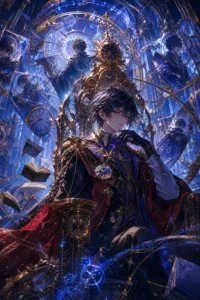
He was dressed in black, but on him the color did not signify mourning. It seemed like ownership. His coat was cut with severe elegance, his gloves dark leather, his hair black and rain-slicked away from a face too beautiful to be trusted. Not pretty. Not soft. Beautiful the way a blade was beautiful under candlelight—clean, cold, and made for harm.
He moved down the aisle without haste, passing between rows of people who looked away too quickly. A faint scar ran from the edge of his left eyebrow toward his temple, silver against pale skin. His eyes were not black as rumor claimed. They were a deep gray, the color of the sea beneath storm clouds, and when they settled on Seraphina, she felt the contact like fingers closing around her wrist.
She did not look away.
He reached the coffin and stopped.
For a moment, Lucian Ravenscroft simply stood over Theodore Vale’s closed casket, expression unreadable. Then he removed one glove, slowly, finger by finger. His bare hand was long-boned, elegant, marked with a thin line of fresh red across the palm.
He laid that hand on the coffin lid.
Aunt Isolde inhaled beside Seraphina.
Lucian bent his head. His mouth moved close to the polished wood.
Seraphina could not hear the words, but she saw them.
Three syllables.
Then he turned and came toward her.
Her body wanted to rise. To step back. To strike him. Instead she remained seated, spine straight, chin lifted. Her pulse beat in her throat like trapped wings.
Lucian stopped at the end of her pew. Up close, he smelled faintly of rain, cedar, and something darker—smoke after extinguished candles.
“Miss Vale,” he said.
His voice was low and controlled, every syllable placed with surgical care.
“Lord Ravenscroft.”
His gaze flicked over her face, not lingering where other men did, not making the insult of admiration. He looked as if he were reading damage.
“Your father was a difficult man to kill,” he said.
The cathedral disappeared.
Seraphina heard the rain. The bells. Her own blood.
“An interesting condolence,” she said.
“It was not condolence.”
“Then what was it?”
Lucian’s eyes lowered briefly to her gloved hands. “A warning.”
Aunt Isolde leaned forward, smile thin as wire. “How thoughtful. We were nearly short of warnings.”
Lucian did not look at her. “Lady Isolde.”
“Lord Ravenscroft. You’ve grown into your reputation.”
“And you have outlived yours.”
“Practice.”
A faint, dangerous curve touched his mouth. It was gone before it became a smile.
Seraphina stood. The movement brought her nearly chest to chest with him. He was taller than she expected. Most men used height as a threat. Lucian seemed unaware of it, which made it worse.
“Did you kill him?” she asked.
The question cracked across the pews. Several heads turned. Someone gasped.
Lucian’s expression did not change.
“No.”
“Did you have him killed?”
“If I had, Miss Vale, he would not have been found.”
A chill slid beneath her skin.
“Is that supposed to frighten me?”
“No.” He leaned closer, just enough that the space between them became intimate and airless. “If I intended to frighten you, I would tell you what was carved into his chest.”
Seraphina’s breath caught.
Aunt Isolde’s hand closed around the edge of the pew.
Lucian’s gaze held Seraphina’s, mercilessly steady. “Midnight,” he said. “Do not be late.”
Then he walked away.
Seraphina remained standing long after the cathedral doors closed behind him and the whispers rose again, hungrier than before.
What was carved into his chest?
The question followed her through the burial, through the mud sucking at the mourners’ shoes in the family plot behind Saint Orison’s, through the final prayer as rain filled the open grave and the gravediggers lowered Theodore Vale into water-dark earth.
She did not throw a rose. She had no interest in beautiful gestures performed for people who had come to enjoy the spectacle of another family’s collapse.
Instead, while the crowd drifted toward their carriages, Seraphina slipped away.
Widow’s Stair lay below the cemetery, a path cut into the black cliffside where the city met the sea. It had earned its name from wives who came there to watch ships vanish, and later from bodies recovered on the rocks beneath. The steps were slick with moss and seawater, bordered by a rusted iron rail that groaned beneath the wind.
By the time Seraphina reached the place where her father had fallen, her hem was soaked to the knee and her fingers were stiff with cold.
The cliff dropped sharply beyond the railing. Below, the sea hurled itself against jagged rocks, foaming white in the storm-dusk. A constable’s rope still hung from one post, frayed and fluttering. Mud churned beneath her boots. She crouched, ignoring the cold water seeping through her gloves, and studied the ground.
Scratches marked the stone near the railing. Deep gouges, too regular to be made by a fall. The iron rail itself was bent outward.
As if someone had been pushed against it.
As if someone had held on.
Seraphina’s throat tightened.
Near the base of the post, half-buried in mud, something black clung to a jagged edge of iron.
Fabric.
She pinched it free.
Velvet.
Black velvet, soaked through, soft even with rain and grit. A torn strip no longer than her smallest finger.
The world seemed to narrow to that small dark scrap in her palm.
Burn anything marked with black velvet.
A sound rose behind her.
Not the sea. Not the rain.
Boots on stone.
Seraphina stood too fast, slipping. A hand caught her wrist before she could go over the rail.
Strong fingers. Dark leather glove.
She looked up into Lucian Ravenscroft’s face.
“You have poor instincts for self-preservation,” he said.
She ripped her wrist free. “Were you following me?”
“Yes.”
The honesty struck harder than a lie.
“Why?”
His gaze dropped to her closed fist. “Because you ask questions in the open.”
“And you prefer people ask them where? Locked rooms? Coffins?”
“I prefer people survive long enough to regret the answers.”
Wind whipped rain across his face. He did not flinch.
Seraphina opened her fist. The velvet lay in her palm like a dead moth. “What is this?”
For the first time, something moved behind Lucian’s eyes.



0 Comments