Chapter 4: White Dress, Black Veil
by inkadminThe rain began before the bells.
It came slanting off the black Atlantic in silver knives, hissing against the stone steps of Saint Orison’s Cathedral, drumming on the roofs of idling cars, turning the city’s old-money district into a watercolor of gas lamps and wet marble. The church rose above it all like a judgment carved in bone: twin spires spearing low clouds, gargoyles crouched along the gutters with water spilling from their mouths, stained-glass saints staring down with jeweled eyes.
Armed men stood beneath those saints.
They lined the cathedral doors in black coats cut fine enough to pass for mourning attire, earpieces tucked against their necks, hands folded with reverence over concealed weapons. Marrow men on the left. Vale men on the right. No one crossed the invisible seam between them. Even the rain seemed to hesitate there, splitting down the center of the stairs and running in two separate streams.
Inside, the city had come to watch Seraphina Vale be traded.
Judges sat shoulder to shoulder with smugglers. Councilmen bowed their heads beside men who had ordered bodies buried under council buildings. Women in pearls whispered behind gloved fingers, their perfume heavy with tuberose and venom. At the front pews, beneath a window depicting Saint Orison lifting a drowned child from storm-black waters, Seraphina’s family waited.
Her father did not turn when the cathedral doors opened.
August Vale sat as if carved from the same cold stone as the pillars, his silver hair combed back, his profile stern and untouched by grief or pride. Beside him, her brother Dominic adjusted the cuff of his suit and smiled at nothing. Her younger sister Livia kept her eyes fixed on the bouquet in her lap, pale fingers worrying one white rose until its petals bruised.
Seraphina stood at the threshold in a dress made to look like innocence.
White silk clung to her body like moonlight poured over a blade. The bodice was fitted with a severity her mother would have called elegant and Seraphina called expensive restraint. Long sleeves of lace covered her arms to the wrist, threaded with tiny pearls that caught the candlelight. Over her face fell a black veil so fine it made the world seem drowned, every candle a blurred star, every enemy softened into shadow.
It was her one concession to honesty.
The dress could lie. The veil did not.
Behind her, her aunt Margot leaned close enough that Seraphina smelled mint pastilles and old champagne. “Chin up, darling. They’re all watching.”
“I know,” Seraphina murmured. “That’s what makes it tedious.”
Margot’s hand tightened at the small of her back. Not comfort. Warning. “Do not make a scene.”
Seraphina looked down the long aisle.
Lucian Marrow waited at the altar.
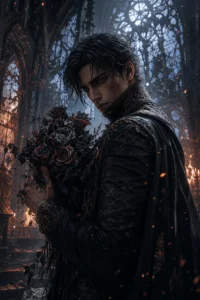
He wore black, of course. Not the soft black of mourning, but the deep, lightless black of a sealed coffin. His suit was cut with merciless precision across broad shoulders, his white shirt severe at the throat, a silver tie pin glinting like a needle. Candlelight slid along his dark hair and vanished there. His face, beautiful in the way winter cliffs were beautiful, revealed nothing.
Except his eyes.
They found her through the veil. Held.
Seraphina’s gloved fingers tightened around the bouquet of white anemones and black calla lilies. Their stems were wet against her palm. Someone had wrapped them too tightly with ribbon, each pearl-headed pin biting beneath the silk. She welcomed the small pain. It kept her from thinking about the file she had opened at three in the morning, alone in her room with rain against the glass and a stolen Marrow server trembling under her fingertips.
VALE_MARIANNE_ARCHIVE
STATUS: RESTRICTED
LAST ACCESSED: 17 YEARS AGO
Her mother’s name had stared back at her from Lucian’s hidden system like a ghost with a hand pressed to the screen.
Marianne Vale.
Dead twelve years. Buried in the family mausoleum beneath an angel with no face. According to August, she had died of fever after a winter spent too long grieving politics and betrayals. According to the house staff, she had cried behind locked doors. According to Seraphina’s memory, she had smelled of bergamot, ink, and smoke.
Lucian had a file on her.
Lucian had hidden it behind three layers of encryption and an obsolete government firewall no one used unless they wanted something forgotten by design.
Lucian stood at the altar now, watching Seraphina approach him like he already knew she had seen the name.
The organ swelled. The guests rose.
Seraphina walked.
Every step down the aisle felt measured for execution. Her shoes whispered over ancient flagstones worn smooth by centuries of brides, mourners, and men pretending God could not smell blood on their hands. Above her, the stained-glass saints burned in blue and red and gold. Rain streaked their faces from outside, making them weep.
On the left, a Marrow lieutenant with a broken nose tracked her movement. On the right, one of her father’s old captains watched Lucian instead, jaw clenched. Half the city’s underworld sat in pews pretending not to reach for weapons.
This was not a wedding.
It was a ceasefire with flowers.
Seraphina reached the front. Her father rose at last, his expression composed, his hand offered with the chill ceremony of a banker sliding over a deed.
“You look like your mother,” August said quietly.
It was the first kind thing he had said to her in days.
Seraphina smiled behind the veil. “Then you must be terribly uncomfortable.”
A muscle jumped in his jaw.
He placed her hand in Lucian’s.
Lucian’s fingers closed around hers.
Warm.
That was the first betrayal. She had expected his touch to be cold. Men like him should have carried winter in their skin. Instead heat seeped through her glove, steady and unsettling, his grip neither bruising nor gentle. Controlled. Always controlled.
August stepped back.
For one strange second, Seraphina felt the seam of the world shift. Her father’s hand vanished. Lucian’s remained.
The priest began to speak.
His voice traveled poorly in the cavernous cathedral, swallowed by rain and stone, but Seraphina caught enough. Covenant. Duty. Before God and witnesses. Sacred union. She wondered if the old man knew he was blessing an arrangement drafted by lawyers, killers, and men who thought daughters were more useful when signed away.
Lucian did not look at the priest.
He looked at her.
“You’re shaking,” he said under the murmur of scripture.
Seraphina kept her eyes forward. “Don’t flatter yourself. It’s the draft.”
“The cathedral is sealed.”
“Then perhaps it’s revulsion.”
The corner of his mouth moved. Not quite a smile. Something sharper, fleeting as a knife under cloth. “Better.”
Her gaze cut to him through the veil. “Better?”
“I was afraid they’d drugged you into obedience.”
“They tried.”
His eyes darkened. “Who?”
It was too quick. Too quiet. Not concern, she told herself. Possession. A man objecting to another hand touching property already sold.
“Disappointed?” she whispered. “You wanted a sleeping bride?”
“I wanted you conscious when you chose your enemies.”
The priest cleared his throat, his smile strained. “Mr. Marrow.”
Lucian turned his head just enough to acknowledge God’s employee.
Seraphina should have been listening to the vows. Instead she was aware of everything in fragments: the candle wax melting down iron stands; the whisper of rain against leaded windows; the faint metallic scent from the guard closest to the altar, as though he had cleaned his gun too recently; Lucian’s thumb resting against her knuckles like a threat he had not yet decided to make.
The priest asked Lucian if he would take her.
Lucian’s answer came without hesitation.
“I will.”
Not I do. Not soft. Not ceremonial. A vow shaped like an order given to the future.
The priest turned to her. “Seraphina Marianne Vale, will you take Lucian Elias Marrow to be your husband, to honor and keep him, forsaking all others, in sickness and in health, for as long as you both shall live?”
Her mother’s name struck like a match in a dark room.
Marianne.
Lucian’s fingers flexed once around hers.
Seraphina lifted her chin. Beneath the black veil, no one could see the way her lips parted around the bitterness gathering there. Her gaze moved past Lucian’s shoulder to the stained-glass saint lifting the drowned child. The child’s tiny glass hand reached upward, forever almost saved.
She thought of the file.
She thought of the server she had breached, the trapdoor still open in his system under her ghost-name.
She thought of the delicate worm she had left sleeping there, waiting for her command.
Then she looked at Lucian Marrow and smiled.
“I will.”
His eyes narrowed slightly, as if he heard all the lies beneath it and appreciated their architecture.
The rings came next.
A boy from the choir carried them on a velvet pillow, his face pale with the terror of having two dynasties watching his hands. Lucian took the ring meant for Seraphina. It was not delicate. A band of platinum set with black diamonds around a central white stone so clear it looked frozen. Beautiful, expensive, and heavy enough to feel like a shackle when he slid it onto her finger.
His thumb brushed the inside of her wrist.
Seraphina’s pulse betrayed her, leaping against him.
“Careful,” he murmured. “People will think you’re moved.”
“People think all kinds of foolish things before they die.”
“Are you threatening the congregation on our wedding day?”
“Only the boring ones.”
This time, his smile almost lived.
She took his ring from the pillow. Plain black metal, matte as ash. When she touched his hand, she saw the scars more clearly. They climbed from beneath his cuff in pale, uneven ridges, disappearing under the immaculate sleeve. Burns. Old ones. The skin at his wrist tightened as she slid the ring on.
A memory surfaced from the rumors whispered over champagne the night before: orphanage fire, trapped doors, a boy pulled screaming from smoke. Marrow’s heir not by blood, but by survival. A child who had learned early that locked rooms could become ovens.
Lucian’s gaze sharpened as if he saw the thought cross her face.
“Ask,” he said very softly.
“Not here.”
“Afraid of the answer?”
“Afraid of giving you the satisfaction of being interesting.”
The priest pronounced them husband and wife.
The cathedral held its breath.
Lucian lifted the black veil.
The world cleared at once, too bright, too cruel. Candlelight gilded his cheekbones. Rain-shadow moved across his face from the window behind him. Seraphina stared up at him and understood, with a sudden coldness in her stomach, that he was not merely handsome. He was compelling in a way that felt engineered for ruin. A face women might follow into the dark and men might underestimate once, briefly, before regretting it forever.
He bent toward her.
“If you bite me,” he said, low enough only she could hear, “do it hard enough to draw blood.”
Her smile was all teeth. “Romantic.”
Then he kissed her.
It should have been a performance. A seal on a contract. A mouth on a mouth beneath holy glass.
It was not.
Lucian kissed like he did everything else: with absolute attention. No fumbling tenderness, no public vulgarity. His hand came to her jaw, fingers spreading beneath her ear, tilting her face as if he had the right. His lips were warm, controlled, almost chaste for the space of one heartbeat.
Then Seraphina made the mistake of inhaling.
He smelled of cedar, rain, and something darker beneath, like smoke trapped in wool. Her hand tightened involuntarily around his sleeve. His mouth changed against hers, pressure deepening just enough to drag heat from her throat to her stomach. Not a claim, not exactly. A warning wrapped in velvet.
The cathedral erupted in applause.
Some of it sounded sincere. Most of it sounded like gunfire politely restrained.
Lucian drew back first. His thumb brushed the corner of her mouth, slow enough to be seen by everyone and understood by no one.
“Wife,” he said.
Seraphina hated the shiver that word placed along her spine.
“Husband,” she returned, and made it sound like a verdict.
The reception occupied the Marrow Conservatory, a glass palace clinging to the cliff road above the city. It had once belonged to a shipping magnate who vanished with his mistress and four million in bearer bonds. Lucian had acquired it after the man’s widow lost a private auction no one admitted had taken place. Now its vaulted panes looked out over the churning sea, and rain crawled down the glass in trembling rivulets as though the night itself wanted in.
White orchids hung from iron trellises. Black candles burned on long tables dressed in silk. Champagne flowed. Violins played something too mournful for celebration. Beyond the glass walls, guards moved through the garden with umbrellas and rifles, their silhouettes appearing and disappearing between cypress trees twisted by salt wind.
Seraphina stood beside Lucian beneath a canopy of flowers and received congratulations from people who would have sold either of them for safer weather.
“A magnificent union,” said Judge Pell, who owed Lucian three acquittals and August two favors.
“Let’s hope it lasts longer than your last conviction,” Seraphina replied.
The judge’s smile faltered.
Lucian’s hand rested at the small of her back. To anyone watching, it looked possessive. To Seraphina, it felt strategic. He used the lightest pressure to steer her through conversations, away from certain guests, toward others. When Councilman Reeve leaned too close, Lucian’s fingers pressed once against her spine and a Marrow man appeared at Reeve’s elbow with the suddenness of a blade.
“You handle them like chess pieces,” Seraphina said after the councilman retreated, pale and sweating.
Lucian accepted a glass of champagne and did not drink. “Chess pieces have rules.”
“And people?”
“People have appetites. Easier to predict.”
She took champagne from a passing tray. “What’s mine?”
His gaze lowered to her mouth for half a second. “Escape.”
The answer landed too close to truth.
Seraphina drank. The champagne tasted expensive and dead.
Across the room, August Vale laughed with a Marrow elder as if he had not handed over his daughter like collateral that morning. Dominic watched Lucian with that bright, empty smile Seraphina had never trusted. Livia stood alone near the dessert table, untouched by conversation, looking younger than twenty in her pale blue dress.
Seraphina slipped away from Lucian’s hand.
He let her.
That annoyed her more than if he had tightened his grip.
Livia saw her coming and straightened. “Sera.”
“You look like a hostage at a debutante ball.”
“So do you.”
“Yes, but I accessorized.” Seraphina lifted her ring. The diamonds caught candlelight and returned it black. “See? Captivity, but couture.”
Livia’s mouth trembled. “Don’t joke.”
Seraphina’s expression softened despite herself. “If I stop joking, I start stabbing. Margot said it ruins photographs.”
“Father says you’ll be safe with him.”
Seraphina looked over her shoulder.
Lucian stood surrounded by men twice his age and half his danger, listening to something her father said. He did not appear to be watching her. But she had the unnerving sense that if she moved one step toward a door, he would know.
“Father says many things,” Seraphina said.
Livia leaned closer. Her voice dropped to a thread. “Dominic told me not to visit you at the Marrow house.”
A chill passed through Seraphina sharper than the rain. “When?”
“This morning.”
“What exactly did he say?”
Livia swallowed. “That after tonight, you belonged to Lucian, and family doors don’t open both ways.”
Seraphina’s fingers tightened around the champagne flute until the stem creaked.
Livia grabbed her wrist. “Sera, please. Don’t make him angry. Not tonight.”
“Which him?”
Her sister’s silence answered.
Before Seraphina could press further, Dominic appeared at Livia’s shoulder, handsome in the polished, bloodless way of a silver knife on white linen.
“There you are,” he said. “The bride shouldn’t hide by the pastries.”
“Why? Afraid someone will mistake me for something sweet?”
Dominic smiled wider. “Still performing courage. Charming.”
Seraphina stepped between him and Livia without seeming to. “Still mistaking cruelty for personality. Less charming.”
His eyes flicked toward her ring. “Enjoy the honeymoon while it lasts.”
“That sounds ominous.”
“Marriage often is.” He plucked a blackberry tart from the table and did not eat it. “Especially when one enters it with secrets.”
For one violent second, Seraphina thought of the laptop hidden in the false bottom of her bridal trunk. The encrypted drive sewn into the hem of her travel cloak. The ghost account still lodged in Lucian’s network like a splinter under skin.
Dominic watched her too carefully.
“Everyone has secrets,” she said. “Yours just bore me.”
“Careful, sister.” His voice softened. “You don’t know which walls have ears now.”
“And you don’t know which ears are mine.”
Something flickered in his eyes.
Then Lucian was there.
Not rushing. Not looming. Simply occupying the space beside Seraphina with such quiet force that Dominic’s posture changed before his expression did.
“Vale,” Lucian said.
“Marrow.” Dominic dipped his head. “Congratulations. I was just telling my sister how happy we are to see her settled.”
“Were you.”
Lucian’s hand settled on Seraphina’s waist. The gesture should have irritated her. Instead she felt the heat of it through silk and found herself grateful, which irritated her more.
Dominic glanced at that hand. “Take care of her. She’s more fragile than she pretends.”
Seraphina laughed. “I once broke your nose with a billiard cue.”
“You were twelve.”
“I peaked early.”
Lucian’s thumb moved once against her waist, barely there. Approval, perhaps. Or warning. With him, the two seemed carved from the same bone.
“Your concern is noted,” Lucian said to Dominic. “And unnecessary.”
Dominic’s smile thinned. “Everything is necessary in our line of work.”
“Then learn when to stop speaking.”



0 Comments