Chapter 34: Wave Four: Skinless Rain
by inkadminThe rain began with a sound like applause from a stadium full of bones.
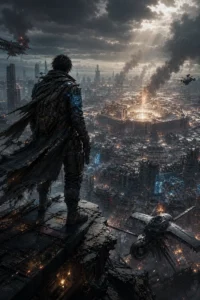
Evan Ward heard it before he saw it. He had been standing in the old neonatal ward on the seventh floor, one hand pressed against the cracked glass, watching dawn fail to happen over the rust-belt skyline. The city beyond St. Mercy Hospital had become a black relief map of flooded streets, leaning apartment blocks, and red-lit dungeon seams pulsing in the gutters like infected veins. Smoke crawled between the buildings. Somewhere east, near the collapsed expressway, a siren tower had been screaming for six minutes without rhythm, without words, just one long electronic animal shriek.
Then the clouds lowered.
Not gray. Not black.
Pink.
A swollen, wet, butcher’s pink ceiling rolled in from the north, dragging streamers of darker red behind it. It moved too low, scraping antennae off rooftops, swallowing the tops of office towers. Lightning flickered inside it without thunder, illuminating bulges and folds that looked less like vapor than tissue pressed against glass.
Beside him, Mara Velez muttered, “Tell me that’s not weather.”
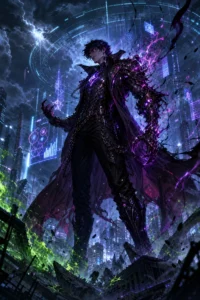
Evan’s reflection stared back from the window: hollow cheeks, three days of beard, dried black blood at the collar of his paramedic shirt beneath the scavenged ballistic vest. His eyes had changed again after the hidden layer. The whites were threaded with faint silver capillaries, and when he blinked, the room seemed to lag half a second behind the motion.
He had watched gods—or something close enough to wear the word as a mask—count human deaths in glowing streams.
He had watched one of them laugh.
Now the sky looked like an opened mouth.
“It’s weather,” Evan said. “System weather.”
Mara looked at him sidelong. She had a fire axe over one shoulder and a strip of gauze taped over the gouge across her brow. She had been a nurse once, then a floor captain, then the closest thing St. Mercy had to a war leader whenever Evan’s class dragged him into stranger corners of the apocalypse. “That distinction is not helping my blood pressure.”
The first drops struck the roof.
Not the soft patter of rain. Not even the hard chatter of hail. Each impact made a wet slap, thick and heavy, like handfuls of meat thrown onto tile.
St. Mercy answered with a thousand tiny noises: frightened voices rising from the stairwells, metal shutters rattling, plastic tarps snapping over broken windows, the low moan of patients waking in the dim wards below. Evan felt the hospital through the dead threaded into its bones—the preserved sentries in the stairwells, the corpse-laborers sandbagging the south entrance, the restless spirits nesting in the morgue freezers. Their awareness touched his like cold fingers.
Unease. Hunger. Recognition.
Whatever was falling outside, the dead did not like it.
A translucent pane cracked open in Evan’s vision.
TRIAL ZERO: URBAN SURVIVAL SEQUENCE
WAVE FOUR COMMENCING
Atmospheric Hazard Deployed: Skinless Rain
Exposure Effects: Dermal Dissolution | Coagulation Failure | Pain Amplification | Aquatic Corruption
Safety Advisory: Shelter Integrity Recommended
Bonus Objective: Maintain Functional Population Above 41%
Failure Condition: Sanctuary Collapse
Below the block of words, another line blinked in smaller type, pale and almost shy.
Observer Interest: Elevated.
Evan’s jaw locked so hard his molars creaked.
Mara read whatever showed on her own interface. Her mouth lost color. “Skinless Rain. That is the stupidest horror-movie name I’ve ever heard.”
“Get everyone away from exterior windows,” Evan said. “No one goes outside. No one touches runoff. Close every intake we still control. Cover the roof cisterns.”
“We covered them after the bone moths.”
“Cover them again.”
A scream cut through the ward from the hallway.
They ran.
Two scavengers from the east access team had come up through the fire stairs carrying a third man between them. They were all shouting over one another. The third man, Felix, had been outside on the roof greenhouse watch. Evan recognized him by the green bandanna he always wore around his neck and the tattoo of a playing card joker on his wrist.
Now the bandanna was gone. So was most of the skin on the left side of his face.
Rainwater smoked on him in glossy streaks. Wherever it touched, flesh softened and sloughed as if boiled too long. His cheek sagged in ropes. One eyelid had melted into a red crescent, exposing an eye rolling white with shock. Blood did not spurt; it sheeted, thin and watery, refusing to clot. Felix’s hands clawed at the air, fingers leaving red smears on the walls.
“He slipped!” one of the scavengers yelled. “He was under the awning, then the wind—Jesus, Evan, it got under his coat!”
Felix made a sound that was not a word. It rose and rose, a raw wire pulled through his throat.
Evan was moving before thought caught up. “Room seven-twelve. Mara, sterile sheets. Jace!”
A skinny teenage boy with a shaved head and too-large firefighter turnout coat stumbled out of a side room clutching a coil of tubing. “Here!”
“Boiled water, not tap. Pain kit. The black case.”
Jace blanched. Everyone knew the black case. It held the good drugs, the ones Evan had rationed like holy relics since the pharmacies were picked clean and the System started rewarding agony as a currency. “On it.”
They got Felix onto a crib warmer stripped of its mattress and repurposed as an exam table. The neonatal ward still smelled faintly of antiseptic beneath the stronger odors of mildew, smoke, rot, and too many bodies breathing the same bad air. Someone had painted saints on the walls years ago, soft pastel figures watching over impossible small beds. Rain hammered above them, obscene and steady.
Felix thrashed when Evan cut away his coat.
“Hold him.”
“I am holding him!” the scavenger snapped, tears streaking grime down his face.
“Hold him better.”
Evan caught Felix’s wrist. Skin slid under his glove.
For half a second, he was back on I-77 twelve years ago, kneeling beside a woman pinned beneath a rolled van, her arm degloved from elbow to knuckle, the smell of gasoline and rain and hot copper filling his mask. He had told her she would be okay because that was what you said when the truth had no use. She had died staring at him like he had stolen something from her.
Not now.
His class stirred.
Mortuary Saint did not heal like Priests did in the stories people still wished they lived in. It did not knit flesh with golden light or erase pain with a prayer. It dealt in thresholds. Last breaths. Borrowed stillness. The mercy of slowing the body’s rush toward the dark.
Evan placed one bloody palm over Felix’s sternum and the other above the ruined cheek without touching it.
“Felix,” he said, voice low and hard enough to cut through the screams. “Listen to me. You’re not dying yet.”
Felix’s good eye fixed on him, huge and animal-bright.
“Breathe when I tell you.”
Skill Activated: Pallbearer’s Pause
Target condition: catastrophic dermal loss, hemorrhagic dissolution, acute pain cascade
Cost: 4 Last Breaths | 11% Saint’s Reserve
Effect: Decline delayed for 180 seconds
The air went cold.
Frost ghosted across the metal rails of the warmer. Felix’s scream strangled down to a gasping sob. The blood slowed, not stopping, but thickening as black threads of Evan’s power stitched through it like sutures made of shadow.
“Now,” Evan said. “I need clean saline. Sheets. Wrap, don’t rub. Do not use the hospital tap.”
Mara’s hands were already moving. “You heard him! Boiled stores only. If any of you geniuses even look at a faucet, I will personally throw you into the gift shop and let the vending machine mimic eat your ankles.”
The joke landed badly but steadied people anyway. Hands found tasks. Gauze tore. Buckets clattered. Someone vomited in the corner and apologized while vomiting again.
Evan leaned close to Felix. “Who else was exposed?”
Felix’s lips moved. No sound.
“Roof team,” Evan said. “How many?”
The scavenger at Felix’s legs swallowed. “Nessa and Old Paul were at the cisterns. Couldn’t see them after the first gust. Door jammed behind us. We—we left them.”
Mara stopped wrapping for one heartbeat.
The rain beat harder.
From the west, beyond the taped windows, came a chorus of screams so numerous they blurred into one enormous voice.
Evan looked toward the stairwell. “Seal the roof access.”
“Nessa’s up there,” Jace said from the doorway, black case clutched to his chest.
“I know.”
“Old Paul too.”
“I know.”
Jace’s face twisted. He was sixteen, maybe seventeen, and had learned to sleep beside corpses before he had learned to shave. “So we just leave them?”
Evan met his eyes. The hidden layer flashed behind them—the faceless things reclining over humanity’s suffering, making sport of which neighborhoods broke first. He wanted to say no. He wanted to say he had not become the kind of man who calculated skin against shelter integrity.
Instead he heard himself ask, “Can you open that roof door without letting the rain into the stairwell?”
Jace flinched as if slapped.
Mara’s voice softened. “Kid.”
“Don’t kid me.” Jace shoved the black case at her. “Don’t do that. Not when you’re making it sound kind.”
He ran.
Mara cursed under her breath.
Evan could not chase him. Felix’s pulse was slipping under his palm, shuddering against the borrowed pause. “Mara.”
“I’ll send Rook after him.”
“No. Rook’s at the east barricade.”
“Then who?”
Evan closed his eyes and reached down through the hospital.
In the morgue, eight floors below, the dead waited in refrigerated dark and flooded tile. Not sleeping. Never sleeping. They existed in the space between his command and whatever old instinct made corpses want to answer the living with teeth. His first raised had been clumsy things, all jerking limbs and wrong angles. Now the Dead Quarter’s corpse guard moved with dreadful purpose, each one marked with ash crosses and copper wire, each one bound to tasks Evan pretended were tactical instead of obscene.
“Calder,” Evan whispered.
Far below, a dead man opened clouded eyes.
Calder had been a security guard before a spine-hound split him from hip to shoulder in the ambulance bay. In undeath, he was broad, silent, obedient, and still wore his laminated badge though the picture had peeled away. Evan sent the command with a pulse of cold intent.
Find Jace. Stop him from reaching the roof. Do not harm him unless he tries to breach.
The answer came as pressure behind Evan’s teeth.
Compliance.
Felix convulsed.
“Focus,” Mara snapped, not unkindly.
They worked until the sheets turned red and the room smelled like iron, melted fat, and chemical rain. Evan burned two more Last Breaths sealing Felix against the worst of the shock. Not saving. Preserving. There was a difference, and it had teeth.
When Felix finally lay still, wrapped from scalp to chest in white that was already blooming pink, his good eye tracked Evan.
“Am I dead?” he rasped.
“No.”
“Feels like I should be.”
“File a complaint with management.”
A wet laugh leaked out of him and became a whimper.
Mara stepped back, gloves dripping. “He needs fluids. A lot. And antibiotics if those words still mean anything.”
“They mean something,” Evan said. “Less than yesterday.”
From the hallway, a bell began to ring.
Not a System chime. Not an alarm. An actual brass handbell, frantic and uneven.
Evan stripped off his gloves and walked out into chaos.
The seventh-floor corridor was packed with people. Families from the sealed apartment wings. Scavengers. The elderly from the dialysis unit. Children carrying stuffed animals gone gray from ash. Everyone had their interface panes open or eyes unfocused from reading them. Questions slapped the air from every direction.
“Is the water bad?”
“My room’s leaking.”
“The rain got through the ventilation in pediatrics!”
“Pastor Mullen says the System is washing the unclean—”
“Shut up about Mullen!”
“My baby touched condensation, her hand is swelling, please—”
The bell-ringer was Mrs. Okafor, who had run the hospital cafeteria before Trial Zero and now ran ration distribution with the authority of a field marshal and the patience of a guillotine. She stood on a supply crate in a yellow rain poncho, gray braids tucked under a hairnet out of pure stubborn habit.
“Quiet!” she shouted, ringing the bell again. “You panic in lines or you panic outside. Choose.”
The corridor dimmed as the lights flickered. St. Mercy’s generator coughed somewhere beneath their feet, a beast with bad lungs.
Evan climbed onto the crate beside her.
The crowd surged toward him. Not physically. Emotionally. Hope had weight when too many desperate people threw it at one man.
He hated it.
“Listen,” he said.
The word carried farther than it should have. A ripple of Mortuary Saint authority passed through the hall, not domination, not exactly, but the hush of a funeral home when the family first sees the casket.
People quieted.
“The rain is corrosive. It attacks skin and contaminates open water. No one goes outside. No one drinks from roof catchment, buckets, puddles, taps connected to compromised lines, or anything that wasn’t sealed before the wave started.”
A man near the front shouted, “We got maybe two days of sealed water!”
“Then we make it last three.”
“And after that?”
Evan looked at him. “After that, we’re alive enough to solve after that.”
Murmurs. Fear fermenting into anger.
Pastor Mullen pushed through near the nurses’ station, Bible in one hand, System-issued bone charm around his neck. He had been a soft-voiced hospice chaplain before the countdown. Since the third wave, when a swarm of glass locusts ignored his prayer circle and ate only the people outside it, he had grown into a sharper shape. His followers called themselves the Washed. They wore strips of white sheet tied around their wrists and looked at Evan’s undead laborers with open loathing.
“Perhaps,” Mullen said, voice carrying with practiced warmth, “the answer is not hoarding, but repentance.”
Mrs. Okafor’s eyes narrowed. “I know you are not about to preach over my ration schedule.”
“I’m saying what many are thinking.” Mullen turned to the corridor. “The rain strips flesh. The dead walk in our basement. Our leader traffics in last breaths and forbidden—”
“Careful,” Mara said from behind Evan.
Mullen’s smile was sad enough to be weaponized. “I have been careful. We all have. We followed him because fear made us practical. But every wave worsens. Every bargain with death invites another punishment. What if the System is responding to the abomination at the heart of this sanctuary?”
The crowd shifted.
Evan saw the hidden layer again: despair yield, casualty efficiency, observer interest. The administrators did not care if he raised corpses. They cared how beautifully people broke while arguing about it.
“Pastor,” Evan said, “two hours ago you asked me to preserve Mrs. Lang while your people found her insulin.”
Mullen’s jaw tightened. “That is not the same as building an army of dead men.”
“It is exactly the same door. You just like it when it opens for you.”
A few people muttered approval. Others crossed themselves.
The bell rang once, hard enough to make everyone jump. Mrs. Okafor pointed the clapper at Mullen. “You want to be useful, take your Washed and start sealing leaks on floors four through six. Pray while you tape plastic. The Lord will appreciate multitasking.”
Laughter cracked through the tension, brittle but real.
Mullen’s face flushed. For one moment the softness dropped away, revealing something furious and hungry underneath. Then he bowed his head. “We will serve.”
He withdrew, white wrist strips trailing in his wake.
Mara leaned close to Evan. “He’s going to be a problem.”
“He already is.”
“No. I mean soon.”
Evan watched Mullen disappear into the stairwell with six followers. One of them glanced back not at Evan, but at the locked utility closet where they kept sealed water crates for the ICU.
“Put two guards on the water,” Evan said.
“Living or dead?”
The question should have been absurd. It was not.
“Both.”
The rain intensified.
By noon, St. Mercy was leaking.
It found every weakness: cracked window seals, bullet holes, warped roof flashing, ventilation seams chewed by bone moths, old pipe chases that carried the contaminated runoff in glistening pink threads down through walls. Where droplets landed on tile, they smoked. Where they landed on skin, people screamed.
The hospital became a map of triage.
Red tags for direct exposure. Yellow for rash and blistering. Green for fear pretending to be symptoms. Black for those Evan could not spend enough breath to hold.
In pediatrics, a toddler named June had pressed her palm into water dripping from a ceiling panel because she thought it was funny. By the time her mother reached Evan, the child’s hand looked like a peeled fruit, tendons white beneath red gloss. June did not cry. Shock had taken her somewhere quiet.
Evan knelt in a room decorated with faded cartoon whales and let her tiny fingers curl around his thumb.
“Can you make it stop?” her mother begged. “Please. Please, I have credits. I’ll work double shifts. I’ll clean the morgue. I don’t care.”
“Hold her shoulders.”
“Can you save the hand?”
Evan did not answer fast enough.
The mother made a sound like a door breaking.
He used a sliver of Saint’s Reserve to quiet June’s nerves before Mara amputated two fingers with a sterilized bone saw while Mrs. Okafor sang an old Yoruba lullaby under her breath. The sound of the saw was delicate, almost polite. That made it worse.
When it was done, June slept with her bandaged hand against her chest. Her mother kissed Evan’s bloody knuckles.
“Don’t,” he said.
She did anyway.
He left before gratitude could become another burden on his back.
On the fourth floor, the Washed had sealed three leaks and opened one fight. A dead orderly named Min had been carrying sandbags when a follower of Mullen’s refused to let “a corpse thing” pass through the women’s recovery ward. Someone shoved. Someone swung a chair. Min, following Evan’s old command not to harm residents unless attacked, stood there while they smashed her jaw sideways and broke three of her fingers.
By the time Evan arrived, Mara had two men against the wall at axe-point and Min stood motionless in the center of the ward, rainwater dripping from the sandbag onto her shoulder and eating small smoking holes through dead flesh.
“She doesn’t even feel it,” one man spat. “Why should she get a coat when living kids don’t?”
Evan looked at him. “Because she’s carrying the sandbags keeping those living kids from dissolving.”
“It’s not right.”
“Neither is the rain.”
The man’s eyes flicked toward the windows, where pink water sheeted down the outside of the plastic barriers. “Pastor says maybe if we cast out—”
Evan stepped close enough that the man smelled the morgue-cold on him. “If anyone touches one of mine again while they’re working a containment task, they spend the next wave outside testing theology.”
Mara’s eyebrows rose slightly.
The man swallowed. “You can’t threaten—”
“I can triage.”
The words settled colder than shouting would have.
He turned to Min. Her jaw hung wrong. Rain had eaten through the side of her neck, exposing gray muscle and copper binding wire.
“Return to morgue for repair.”
Min pivoted and walked away, broken fingers clicking softly against the sandbag she refused to drop until Evan took it from her.
Behind him, someone whispered, “He called it mine.”
Evan kept walking.
He told himself he did not care.
He cared.
By afternoon, the water became the war.
The hospital’s main supply had always been a fragile miracle. Before the Trial, St. Mercy drank from municipal lines and stored emergency reserves for storms that now seemed embarrassingly gentle. After the first dungeon rupture cracked the city mains, they had patched together a system of roof cisterns, sealed barrels, distilled boiler condensate, and scavenged bottles. It had been ugly, rationed, but alive.
Skinless Rain murdered half of it in six hours.
The roof cistern readouts went crimson one by one.
RESOURCE ALERT
Water Source: Roof Cistern A — Corrupted
Water Source: Roof Cistern B — Corrupted
Water Source: Pediatric Wing Storage — Compromised
Estimated Potable Supply Remaining: 31 hours at current ration level
“Thirty-one my ass,” Mrs. Okafor said in the cafeteria command post. She slapped a handwritten ledger onto the table. “That estimate assumes nobody panics, nobody steals, nobody needs wound irrigation, and nobody gets diarrhea. In other words, it assumes we are not people.”
The command post occupied what had once been the staff dining room. Maps covered the walls: hand-drawn floor plans, monster sightings, faction borders, water routes. Rain hammered the covered skylights above, each impact leaving a sizzling bloom against the reinforced plastic. The smell of soup had been replaced by iodine, sweat, and damp cardboard.
Rook stood by the door, arms folded. He was a former corrections officer built like a vending machine, with System-granted stone plates growing under the skin of his forearms. His left ear was missing from the wave two razorfish incident. He had not forgiven the razorfish species as a whole.
“We still have the ambulance bay tanks,” he said.
“If the seals held,” Mara said.
Rook grunted. “They held when the meat spiders tried to nest in them.”
“Meat spiders didn’t fall from the sky as acid soup.”
Mrs. Okafor jabbed the ledger. “We cut ration to half-cups every six hours for adults, quarter for children. Medical exceptions go through Evan or me.”
“That’ll start a riot,” Rook said.
“So will thirst.”
Evan stared at the map. The ambulance bay tanks sat below the north ramp, outside the main sealed structure but under concrete overhang. To reach them, someone would have to cross twenty yards of exposed loading area where rain blew sideways in gusts. Protective gear might hold for seconds. Maybe a minute. The dead could go, but the valves required dexterity, and corrupted rain damaged corpse tissue too. They did not feel pain, but they fell apart all the same.
“What about distillation?” Mara asked.
“Corruption survives boiling,” Evan said.
Everyone looked at him.
He rubbed his temple. “System tooltip popped when I scanned the cistern sample.”
Contaminant: Dermal Hunger Spores
Boiling: Ineffective
Filtration: Partially Effective with Tier II Membrane or Higher
Consecration: Variable
Death-Aspect Processing: Unknown
“Unknown,” Rook said. “That’s friendly.”
Mara’s eyes sharpened. “Death-aspect processing?”
“No.” Evan knew where her mind had gone because his had gone there too, and hated itself for arriving first. “We are not running drinking water through corpses.”
“I didn’t say it.”
“You were about to.”
“I was about to say we need options.”
Mrs. Okafor folded her hands. “And if the option is unpleasant?”
Evan laughed once. It came out wrong. “Unpleasant is reusing bandages. Unpleasant is rat stew. Using human remains as a Brita filter is several stops past unpleasant.”
Rook shrugged. “Depends if it works.”
Silence hit the room.
Rook looked from face to face. “What? You want me to lie pretty? Folks are going to drink or die. I’ve seen men drink toilet tank water for less.”
Mara’s voice was quiet. “They weren’t asked to drink it from a dead person.”
“Most weren’t asked at all.”
Evan pressed both palms to the table. The wood had been carved with initials by night-shift nurses long before the world ended. J loves T. Malik 2019. A tiny heart around the word breathe.
“There may be another way,” he said.
He had not wanted to say it.
Mrs. Okafor noticed. “What way?”
“The morgue flooded during wave one. The basement sublevel connects to the old pathology wing. There’s a sealed autopsy suite with independent drainage and chemical scrubbers. If anything in this hospital qualifies as death-aspect processing, it’s there.”
Mara stared. “The sublevel is full of drowned dead.”
“Yes.”
Rook cracked his neck. “And that thing in the incinerator room.”
“Yes.”
Mrs. Okafor closed her ledger. “How long to make it usable?”
“If the equipment isn’t destroyed? Hours. If I can interface with it through my class? Less.”
“If the drowned dead object?” Mara asked.
Evan felt, distantly, the weight of the morgue beneath him. The regular dead were his. The flooded ones were not. They belonged to the water that had swallowed the sublevel when the river climbed backward through the storm drains during the first night. They knocked sometimes from the wrong side of sealed doors. Not with hands. With heads.
“Then we negotiate,” Evan said.
Rook smiled without humor. “That what we call it now?”
A shout erupted outside the command post.
Then another.
Then the unmistakable crash of a metal shelving unit going over.
Rook was through the door first.
The cafeteria had become a ration hall, sleep ward, and rumor furnace. Two hundred people filled it under dim emergency lights, sitting on bedrolls between tables, lining up for water, arguing in whispers that never stayed whispers for long. Now a knot of bodies thrashed near the serving counter.
“Thieves!” someone yelled.


0 Comments