Chapter 1: The Vending Machine Had It Coming
by inkadminMilo Finch knew he was having a bad day when the vending machine stole his dollar, but he did not expect it to be the last villain he faced on Earth.
It was raining in the particular way that made the city feel personally resentful: not a dramatic downpour, not a cleansing storm, but a cold, needling mist that slipped under collars and fogged glasses and turned every sidewalk into a reflective strip of misery. The alley behind Gorgon Interactive smelled of wet cardboard, old fryer oil from the ramen place next door, and the chemical lemon of a mop bucket someone had abandoned beside the service entrance. A neon sign buzzed over the back door with one dead letter, so the studio’s name flashed at irregular intervals as Gor on Interactive, which Milo felt was honest branding.
He stood beneath the weak glow of the awning at 2:17 in the morning, one hand gripping a dripping paper folder of bug reports, the other pressed flat against the front of a vending machine that had betrayed him.
The machine hummed serenely.
Inside, behind rain-speckled glass, rows of brightly packaged snacks sat like smug little nobles behind castle walls. Chocolate bars. Energy drinks. Salted chips. A suspiciously orange cheese sandwich sealed in plastic like evidence. The vending machine’s digital display glowed green.
THANK YOU
“No,” Milo said. His voice cracked from too many hours of caffeine, recycled office air, and explaining to an executive producer why “just make the dragons smarter” was not a forty-minute task. “Do not thank me. I have not received goods or services. That was a transaction, and you failed the fundamental social contract.”
The vending machine hummed.
Milo jabbed the button again. B7. The last lemon tea in the machine. The can wobbled on its spiral coil, rocked forward, and settled back into place with the lazy insolence of a cat deciding not to knock over a glass after all.
MAKE ANOTHER SELECTION
“I selected B7,” Milo said. “We both know I selected B7. There were witnesses.”
There were not witnesses, unless one counted the overflowing dumpster, three cigarette butts sailing in the gutter, and the skeletal frame of a delivery scooter parked half on the curb with its hazard lights blinking into the rain. Its rider was nowhere to be seen, presumably committing crimes elsewhere.
Milo pressed his forehead to the vending machine glass. The cold shocked him awake more effectively than the office coffee had. Behind his reflection—the unshaven jaw, the limp dark hair plastered to his brow, the black hoodie with a cracked company logo, the eyes of a man who had spent six months tuning loot tables only to be told “players hate math”—the lemon tea gleamed with impossible promise.
“Listen,” he whispered. “I need you to understand something. I have been awake for thirty-one hours. At noon, a man named Chadwick told me the tutorial goblin should have ‘more emotional depth’ but also die in one hit. At five, the build crashed because someone named a sword ‘Sword_final_FINAL_use_this_one’ and the localization pipeline achieved sentience. At eleven, our combat designer cried into a burrito. I have eaten four vending machine dinners this week, two of which were technically cookies.”
The machine hummed.
“I am not asking for riches. I am not asking for love. I am not even asking for a bug-free launch, because I’m exhausted, not delusional.” Milo tapped the glass where B7 waited. “I am asking for the lemon tea I paid for.”
The display blinked.
OUT OF SERVICE
Milo stared.
The rain hissed around him.
Somewhere in the city, a siren wailed and Dopplered into the night. A water droplet slid down the vending machine glass, warped the reflection of his face, and made him look even more like someone who should not be trusted with sharp objects or sprint planning software.
“Oh,” Milo said softly. “So that’s how we’re doing this.”
He stepped back. His soaked sneakers squelched. He rolled his shoulders, winced as his spine made a sound like bubble wrap, and lifted the folder of bug reports as if preparing to read formal charges.
“You, sir, are an unethical user interface.”
The vending machine continued to exist without remorse.
“You present affordances you do not honor. You accept input, consume currency, and deny output. Your error state is hostile. Your feedback loop is insulting. If you were in my game, I’d patch you out in a hotfix and replace you with a raccoon wearing a backpack.”
He kicked it.
Not hard. Not enough to damage property, probably. Just enough for a dull metallic thunk to travel up his shin and plant an immediate, electric regret behind his kneecap.
“Ow. Okay. Fine. Physical feedback noted.”
The lemon tea did not fall.
Milo sucked air through his teeth, hopped once, and glared.
“Don’t make me escalate.”
The back door opened behind him with a scrape of metal. A rectangle of fluorescent office light spilled into the alley, and with it came Sana from QA, wearing a puffy coat over pajamas and holding a half-eaten microwave burrito like a sacred torch.
She blinked at him. “Milo.”
“Sana.”
“Are you fighting the vending machine?”
“I am engaging in consumer advocacy.”
She chewed thoughtfully. Rain sparkled in her short silver-dyed hair. “Did it win?”
“Temporarily.”
“You know the trick is to hit the lower left side and then say please.”
“That’s superstition.”
“It works on the coffee maker.”
“The coffee maker has Stockholm syndrome.”
Sana squinted through the glass. “B7?”
“B7.”
“Ambitious. That coil’s been cursed since July.”
Milo pressed both palms to his face and dragged them downward. “Why do we have cursed infrastructure?”
“Because cursed infrastructure is cheaper than replacing things.” She held out the burrito. “Bite?”
He eyed it. Steam rose from one end in a way that suggested the middle was still frozen. “What flavor?”
“Brown.”
“Tempting, but I’d like my last meal to have a name.”
Sana shrugged and took it back. “Suit yourself. You heading home?”
“I was. Then capitalism attacked.”
“Need me to witness?”
“Against the machine?”
“In case the police ask.”
Milo smiled despite himself. It felt unfamiliar on his face, like opening an old program and discovering it still ran. “Go inside before you dissolve. I’ll be fine.”
“That is what people say right before they are not fine.”
“I’m a lead systems designer. I haven’t been fine since 2019.”
Sana pointed at him with the burrito. “Do not die in the alley. The company will make us do a memorial livestream.”
“If I die, tell them my final wish was to delay the launch.”
“They’ll say you were joking.”
“I am never joking about scope.”
The door shut. The office light vanished. Milo was alone again with the humming machine and the rain.
He looked up at the low clouds pressing between buildings. His apartment was six train stops away. His umbrella was under his desk. His phone battery was at eight percent. In three hours, he had a meeting titled Monetization Alignment Sync, which was a phrase so evil it should have required a chalk circle and blood.
He was thirty-two years old and could identify seventy-three separate ways a sword’s critical hit formula could break an economy. He had once dreamed of making games that made people feel brave. Now he made seasonal battle passes and adjusted drop rates so players would feel “optimally motivated.” His inbox contained four hundred unread messages and one from his mother with the subject line Are you eating vegetables?
He had not answered it.
Milo sighed. The breath fogged the vending machine glass.
“Okay,” he said. “New plan. We cooperate. You give me the tea. I forgive your crimes. Nobody has to get patched.”
He leaned to the side and shoved the machine with his shoulder.
Something clicked.
The lemon tea shifted.
Milo froze.
“Oh. Oh, we’re negotiating.”
He shoved again. Harder. The vending machine rocked with a groan. The can rolled to the lip of the coil, trembled there, haloed by fluorescent light and destiny.
“Come on,” Milo whispered. “Come to papa.”
A scooter bell rang.
It was a bright, cheerful sound, completely inappropriate for an alley at 2:20 in the morning.
Milo turned his head.
The delivery scooter from the curb was moving.
No rider sat astride it. No visible hand pushed it. It rolled downhill from the sloped loading ramp with slow, inevitable menace, hazard lights blinking, rain beading on its red delivery box. Maybe the kickstand had slipped. Maybe the wind had caught it. Maybe the universe, having listened to Milo accuse a vending machine of contract violation, had decided to join the bit.
“No,” Milo said.
The scooter gained speed.
“No, no, no—”
He stepped back, heel catching on a crack in the pavement. The bug report folder exploded from under his arm, pages flapping like startled birds. The vending machine rocked one final time behind him.
The lemon tea dropped.
It landed in the retrieval tray with a glorious metallic clunk.
Milo heard it. In that last split second, as the scooter’s front wheel kissed his shin and the world tilted sideways, he heard victory.
“Worth it,” he said.
Then the alley became rain and headlights and the hard bright crack of his skull meeting concrete.
For a moment, there was nothing.
Not darkness. Darkness implied space. This was absence, clean and total, like a loading screen before the background art appeared. Milo floated without floating. He had no body, no breath, no deadlines. It should have been peaceful.
Instead, somewhere impossibly far away, someone was chanting off-key.
Voices rose and fell in layered waves, syllables scraping against each other like ancient gears. Bells chimed. Wind roared. A smell like ozone and burned cinnamon flooded into being. Milo’s nonexistent skin prickled. A sensation gathered around him: pressure, shape, gravity remembering his name.
SUMMONING PROTOCOL INITIATED
Target designation: Heroic Vessel
Origin: Unregistered Peripheral World
Compatibility: …
Compatibility: …
Compatibility: ERROR
That’s not great, Milo thought.
Light speared through the absence.
He hit reality knees-first.
Stone slammed into him. Air punched his lungs open. Milo gagged, coughed, and inhaled a mouthful of incense so thick it felt chewable. His palms slapped cold marble. Sound crashed over him—the chant breaking apart, gasps, the clatter of metal, one high-pitched shriek that might have been a person or an anxious trumpet.
He blinked tears from his eyes.
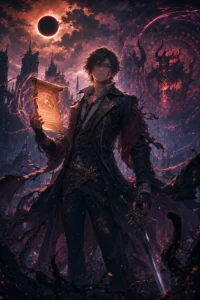
A circle of blue-white fire burned beneath his hands, its lines etched into a floor of polished black stone. Runes crawled around the circumference, shifting like luminous insects. Beyond the circle rose a hall so absurdly grand it took his concussion-addled brain a moment to render it.
Vaulted ceilings vanished into shadows ribbed with gold. Stained-glass windows as tall as apartment buildings depicted armored figures stabbing dragons, hugging angels, or possibly doing both at once. Marble columns twined with flowering vines supported balconies crowded with people in silk, velvet, and expressions of expensive alarm. Banners hung from the rafters: white suns on blue fields, silver lions, a golden crown stitched above a sword. The air was warm, perfumed, and crackling with leftover magic.
Directly in front of Milo stood a semicircle of robed figures holding crystal staves. Most looked elderly in the way wizards did when they had optimized for beard length over cardio. Their robes were embroidered with stars, moons, and what appeared to be legal clauses in tiny gold thread. Several had collapsed into chairs. One was actively smoking from the eyebrows.
Behind them, on a dais, sat a royal family.
Milo knew they were royal because nobody else would voluntarily wear that much jewelry before breakfast.
The king was broad, bearded, and armored in polished silver despite being indoors. A blue cloak spilled around him like a decorative waterfall. His crown had so many points it looked like a weaponized chandelier. Beside him, the queen sat straight-backed and pale, her dark hair coiled beneath a circlet, her gaze sharp enough to trim hedges. A young woman stood at the queen’s right hand: golden-haired, green-eyed, dressed in white and blue, with the flawless posture of someone who had been trained since infancy not to roll her eyes.
She was failing by a millimeter.
At the foot of the dais, a knight in red enamel armor lowered his sword an inch. His jaw tightened. He looked like a man who had ordered a legendary champion and received damp takeout.
Milo coughed again. “Okay,” he rasped. “Either the scooter hit harder than expected, or HR finally got serious about team-building exercises.”
No one laughed.
A thin wizard with a crescent moon tattooed on his bald scalp staggered forward, clutching a scroll. His eyes were huge behind round spectacles. “He speaks the Tongue of Worlds.”
“I speak English,” Milo said. His voice echoed too loudly through the hall. “Possibly with brain damage.”
The wizard flinched as if this confirmed a prophecy.
The knight in red armor took a step closer to the circle. “State your name, summoned one.”
“Milo Finch.”
A murmur rippled through the hall. It had the disappointed texture of an audience discovering the headliner had been replaced by a substitute teacher.
The knight frowned. “Milo… Finch.” He pronounced it like it was a disease affecting poultry. “Your title?”
“Lead systems designer.”
More murmurs.
The smoking-eyebrow wizard whispered, “A designer of systems.”
Another clutched a necklace. “The ancient makers return.”
“Video games,” Milo clarified, because even concussed he understood the danger of letting management misinterpret a job title. “Mostly spreadsheets with dragons glued on.”
The knight’s frown deepened into a trench. “You are not armored.”
Milo looked down.
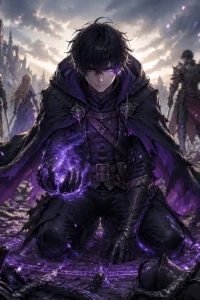
He was still wearing his black hoodie, rain-dark jeans, and one sneaker. The other sneaker was missing, leaving his sock wet, gray, and undignified. His palms were scraped. His knees screamed. A smear of alley grime decorated one sleeve. The folder of bug reports, mercifully, had not followed him, though he suspected this world would have benefited from reading them.
“You caught me between outfits,” he said.
The king rose. Conversations died in a rush. When he spoke, his voice filled the hall with practiced weight.
“Summoned one. I am King Alaric Vaelorian, Shield of the Dawnlands, Keeper of the Seven Oaths, rightful sovereign of Valoria. We have called you across the Veil in our hour of need. The Demon Lord stirs beyond the Ashen March. Monsters multiply. The ancient seals crack. By the covenant of Saint Orival, we beseech the gods for a hero.”
He stared at Milo.
The entire hall stared at Milo.
Milo wiped rainwater from his nose with his sleeve. “I’m sensing a ‘but.’”
The princess made a sound that might have been a swallowed laugh.
King Alaric’s beard twitched. “The ritual should have granted you divine raiment, sacred arms, and the blessing of status revealed.”
“I got hit by a scooter arguing with a vending machine.”
Silence.
The smoking-eyebrow wizard leaned toward another. “Is that a trial of courage?”
“It may be metaphorical,” the other whispered.
“The vending machine had it coming,” Milo added.
The queen closed her eyes briefly, as if asking the universe for patience and receiving back taxes.
The knight in red armor barked, “Archmage Caldus, display the status.”
The bald wizard with spectacles—apparently Archmage Caldus—swallowed. “Yes. Of course. The status shall reveal the truth. All summoned heroes bear the mark. Great strength, holy affinity, combat aptitude, prophetic skills…”
He lifted his crystal staff. Light spiraled from its tip and snapped toward Milo.
Milo recoiled, but the light did not hurt. It unfolded in front of his face like a translucent blue screen.
His breath caught.
Not because it was magical, though it was. Not because it hovered in midair, though that was also a strong point in favor of panic. But because it looked exactly like an interface.
Clean borders. Soft glow. Tabbed categories. Crisp typography. Someone had chosen a readable sans serif. Milo could respect that.
STATUS
Name: Milo Finch
Species: Human (Peripheral)
Class: —
Level: 1Strength: —
Agility: —
Endurance: —
Intellect: —
Spirit: —
Luck: —Skills:
• Edit Description
Everyone stared.
Milo stared hardest.
“That’s it?” the knight demanded.
Archmage Caldus adjusted his spectacles with trembling fingers. “The readings are… incomplete.”
“Incomplete?”
“Blank.”
“Blank?”
“Aggressively blank, Sir Garron.”
Milo waved a hand through the glowing screen. It remained in place, flickering slightly. “Question. Why are all my stats em dashes?”
Sir Garron’s eyes narrowed. “He sees it?”
Caldus’s head snapped up. “You see the status window?”
“Yes. It’s floating in front of me in what I’d call decent UX but questionable onboarding.”
A cluster of nobles gasped.
The princess’s eyebrows lifted.
King Alaric descended one step from the dais. “Only those touched by summoning magic can behold the divine interface.”
“Great,” Milo said. “So I’m hallucinating in high definition.”
Archmage Caldus hurried around the edge of the circle, robe hems flapping. “No class. No attributes. No blessing of sword, shield, flame, light, or beast. Only one skill.” He peered through the shimmering window. “Edit… Description?”
The hall’s murmuring thickened.
“What does that do?” asked the queen.
Caldus licked his lips. “I… am uncertain, Your Majesty. It is not among the recorded heroic gifts.”
“A scribe’s trick,” Sir Garron said with contempt.
Milo looked at the armored knight, then at the sword in his hand, then back at the status screen. “To be fair, documentation is important.”
“Can you wield a blade?”
“I once opened a champagne bottle with a butter knife at a studio party.”
“Can you call upon holy fire?”
“I can call tech support and get put on hold.”
“Have you slain beasts?”
“In games, yes. Professionally.”
Sir Garron turned to the king. “The ritual failed.”
The words dropped like a stone into water. Ripples spread through the hall—whispers, shifting silk, worried armor. Somewhere above, a noblewoman said, “But the omens—” and someone shushed her.
Milo remained kneeling in the summoning circle, water dripping from his hair onto priceless marble, and experienced a complex emotional cocktail. Terror, definitely. Also nausea. Also the irrational professional irritation of seeing a system with missing values pushed to production.
Class dash. Attributes dash. Level one. Great. I died and got imported as corrupt data.
The blue window flickered as he focused on the skill line.
0 Comments