Chapter 2: Beginner Tunic, Legendary Problem
by inkadminMilo Finch had always suspected that if he ever met royalty, he would be underdressed.
He had imagined, on various sleep-deprived commutes and during one especially bleak company holiday party, that he might one day be dragged into a courtroom to testify about exploitative monetization practices and forced to explain to a panel of judges why a digital horse skin cost more than a week’s groceries. In that scenario, he wore his one decent blazer. The elbows were shiny, but respectable. He had not imagined standing barefoot on polished marble in a shirt the color of oatmeal regret while a king, three robed priests, two dozen courtiers, and one extremely judgmental old woman stared at him as though someone had ordered a dragon and received a damp napkin.
The summoning hall glittered with gold and holy light. High arched windows spilled afternoon sun across mosaics of winged knights stabbing serpents, demons, and vaguely tax-related allegories. Incense curled in blue ribbons from silver braziers shaped like doves. Above, a domed ceiling displayed a fresco of the gods leaning down from painted clouds, each with the smug expression of management observing unpaid overtime.
Milo stood in the center of the summoning circle, toes still tingling from whatever metaphysical forklift had deposited him there. His clothes were no longer the coffee-stained hoodie and jeans in which he had died—or at least had been aggressively inconvenienced by a delivery scooter. Instead, he had been issued what could only be described as a starter outfit: rough-spun beige tunic, rope belt, brown trousers, and a pair of soft boots that had given up on ambition before the concept of shoelaces.
A translucent window hovered in front of him, visible only to him if the lack of reaction from everyone else meant anything.
Status
Name: Milo Finch
Class: —
Level: 1
Attributes: Unavailable
Blessings: None Detected
Unique Ability: Edit Description
The priests had taken the blank class line poorly. The king had taken it worse. The court champion, a golden-haired man whose jaw seemed to have been carved for commemorative coins, looked delighted in the precise way people did when someone else’s failure made their own job easier.
“The ritual has clearly misfired,” said the champion, folding his arms over a breastplate polished brightly enough to inconvenience nearby vision. “Your Majesty, with respect, this man is no hero.”
Milo looked down at himself. The tunic scratched his collarbone. A thread dangled near his hip like a tiny surrender flag.
“In my defense,” Milo said, “I was not consulted during recruitment.”
Several courtiers gasped. One priest made a choking noise. The old woman in the front row narrowed her eyes with the speed of a drawn dagger.
The king sat on a high-backed throne at the far end of the hall, flanked by banners embroidered with a silver lion rampant over a field of blue. King Alaric Valenheart had the weary face of a man who had been born into pageantry and had spent fifty years discovering that crowns were mostly paperwork with spikes. His beard was neatly braided with gold thread. His fingers drummed on the arm of the throne.
“Sir Milo Finch,” the king said, careful and cold. “You understand, I hope, the gravity of this moment. The Demon Lord’s shadow lengthens. Border villages burn. Ancient seals weaken. We performed the Rite of Radiant Calling at great cost to summon a champion blessed by the heavens.”
“Right,” Milo said. “And instead you got a game designer with unresolved sleep debt.”
“A what?” asked Princess Seraphina.
She stood to the king’s right, half a step behind the throne, but she seemed far less decorative than the position implied. Her gown was white and blue silk, courtly and immaculate, yet a sword hung at her hip, its grip wrapped in worn black leather. Her silver-blond hair had been braided into a crown, but loose strands had escaped around her temples as if she had been running before the ceremony. Her eyes were sharp violet, and unlike the courtiers, she did not look disappointed.
She looked interested.
That was much worse.
“It’s like a carpenter,” Milo said, “but for systems designed to extract joy from people before crashing at launch.”
Silence spread across the hall like spilled ink.
The champion’s smile widened. “He speaks in riddles to hide incompetence.”
“No,” Milo said. “I do that recreationally.”
Someone near the back coughed into their sleeve. It sounded suspiciously like a laugh cut short by survival instinct.
The eldest priest, a skeletal man in layered white robes, stepped toward the summoning circle. His tall hat resembled a folded napkin attempting architecture. “The sacred status revealed no class, no attributes, and no divine blessing. Only an unknown anomaly.” His gaze flicked over Milo like an appraiser inspecting spoiled fruit. “Unique abilities may manifest unpredictably. Some are trivial. Some are dangerous. Until we determine the nature of this ‘Edit Description,’ the summoned one should be confined.”
“Confined?” Milo echoed.
“For your protection,” the priest said.
“That phrase has done a lot of heavy lifting throughout history.”
The champion stepped forward, spurs chiming. “There is a simpler way. Test him.”
Princess Seraphina’s eyes cut toward him. “Sir Garrick.”
“Highness.” He bowed without taking his eyes off Milo. “If this man is a hero, a simple martial assessment will reveal it. If he is not, we need waste no further resources.”
Milo raised a hand. “As the resource in question, I would like to vote for wasting a little more time.”
Sir Garrick ignored him. Of course he did. Men with that many sculpted shoulder plates did not develop by listening. “Let him strike me. I will stand unarmed. If the gods favor him, I shall be moved. If not, the court will see what stands before us.”
Milo stared at him. “Moved emotionally, or physically? Because I’m not really equipped for either.”
“You may use any weapon.” Garrick spread his arms. “Or your fists, if you must.”
At the word fists, Milo looked down at his hands. Pale, ink-stained fingers. Soft palms from keyboards, controllers, and the occasional desperate microwave meal. He had once injured his wrist opening a jar of pasta sauce.
“I think I’ll pass on punching the human statue,” Milo said.
The priest’s expression hardened. “Refusal will be noted.”
“Everything around here gets noted, huh?”
As if in answer, the translucent status window flickered.
System Notice
Contextual Object Recognition Available.
Focus on an object to view its description.
Milo froze.
It was easy, in the way impossible things sometimes were. He glanced at the summoning circle beneath his feet, and another panel snapped open.
Summoning Circle of Radiant Accord
A sacred ritual array designed to summon a divinely approved hero candidate from another world. Current integrity: 62%. Minor deviations may occur if underfunded, improperly chanted, or interfered with by unpaid temple interns.
Milo’s eyebrows rose.
Underfunded.
He looked at the nearest brazier.
Silver Dove Incense Brazier
An ornate vessel used in royal ceremonies. Emits sanctified cedar incense. Value: high. Cleaning schedule: neglected.
He glanced at Sir Garrick.
Sir Garrick Dawnshield
Court Champion of Valoria. Level 48. Class: Radiant Duelist. Known for bravery, loyalty, and maintaining perfect hair under battlefield conditions. Current mood: smug.
Milo nearly laughed aloud.
Sir Garrick mistook the expression. “Does fear amuse you?”
“Not usually,” Milo said. “But your hair has a stat block.”
The champion’s perfect brows drew together.
Princess Seraphina tilted her head. “What do you see?”
Milo looked at her. A panel appeared at once.
Princess Seraphina Valenheart
First Princess of Valoria. Level 31. Class: Royal Spellblade. Publicly adored. Privately overworked. Current objective: determine whether summoned outsider is threat, opportunity, or paperwork.
She saw his face change. Her fingers shifted, barely touching the sword hilt.
“Well?” she asked softly.
“You have a lot going on,” Milo said.
“That is not an answer.”
“It was more respectful than the one I almost gave.”
For the first time, the corner of her mouth twitched.
The old priest noticed. “Your Highness, stand back. The anomaly may be attempting mental influence.”
“If this is influence,” Seraphina said, “it is badly organized.”
“Thank you?” Milo said.
Garrick made a sharp sound. “Enough. This spectacle dishonors the Rite. Summoned one, if you will not attack, then defend yourself.”
He drew his sword.
The blade rang like a silver bell as it cleared the scabbard, bright as sunrise along its edge. Courtiers recoiled in a whispering wave. The priests stepped away from the circle. Two guards by the doors straightened, gripping halberds.
Milo did not move.
Not because he was brave. His body had simply rejected the command to do anything except watch the sharp object now involved in his afternoon. His heartbeat climbed into his throat and began assembling furniture there.
“Sir Garrick,” the king said. “This was to be an assessment, not an execution.”
“I will not harm him, Your Majesty.” Garrick’s voice carried the patient insult of a teacher addressing a slow child. “A controlled strike. If he has any blessing, it will awaken. If not, the blade will stop a hair’s breadth from his neck.”
“That sounds like a process with many failure points,” Milo said.
Garrick lifted the sword into a guard. Sunlight ran down the blade and spilled in broken pieces across the marble.
Milo’s eyes darted around. Weapon rack? None. Helpful tutorial pop-up? Not yet. Inventory? He tried thinking the word aggressively.
Nothing.
He looked at himself in desperation.
Beginner Tunic
A simple garment provided to summoned heroes upon arrival. Offers minimal comfort, negligible defense, and a faint smell of storage cedar. Durability: 12/12.
A small cursor blinked at the end of the description.
Milo stared.
The cursor blinked again.
His mouth went dry for an entirely different reason.
No way.
He focused on the words, the way he focused on tooltips in unfinished builds, on strings in localization files, on frantic patch notes at three in the morning. The text shimmered. His mind brushed against it, and suddenly it was not stone-carved reality. It was editable.
The cursor waited.
Milo thought, with the instinctive clarity of a man who had spent fifteen years abusing internal debug tools:
A legendary defensive artifact disguised as a cheap beginner tunic.
The words began to change.
Beginner Tunic
A legendary defensive artifact disguised as a cheap beginner tunic. Woven from dawnlight, spite, and contractual loopholes. Provides absolute protection against hostile physical force, dramatic entrances, mild weather, and unsolicited fashion criticism. Grants wearer +9999 Defense, +500 Charisma while looking unfairly approachable, and Adaptive Comfort. Durability: Yes.
For one blessed second, nothing happened.
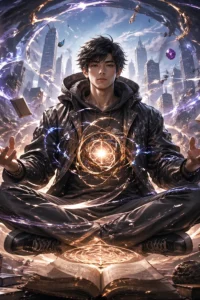
Then the tunic exploded into light.
Milo yelped and flailed backward as golden radiance erupted from the oatmeal cloth. Gasps cracked through the hall. The rope belt snapped into a braided cord of black and silver. The tunic’s coarse weave rippled like water, threads rearranging themselves into layered fabric that shone white under one angle and midnight blue under another. Fine geometric patterns crawled along the hems, glowing with restrained, expensive menace. The shoulders shaped themselves elegantly without becoming ridiculous. A short mantle unfurled behind him, not quite a cape, but cape-adjacent enough to imply narrative importance.
The trousers darkened into fitted traveling pants. The soft boots straightened, gained silver buckles, and began to look as though they had opinions about muddy roads. Warmth flowed over Milo’s skin, perfectly adjusted, like the world’s most emotionally supportive blanket.
A second panel flashed.
Item Modification Successful
Reality has accepted your revised description.
Warning: Excessive adjectives may cause cascading mythic relevance.
Milo looked down at himself.
“Oh,” he said.
The hall had gone utterly still.
Sir Garrick’s sword hovered midair. His perfect face had emptied of smugness and filled with something much more satisfying.
Princess Seraphina took one step forward. Light from the tunic caught in her violet eyes.
“Did you just,” she said slowly, “rewrite cloth into a relic?”
Milo tugged experimentally at his sleeve. It felt soft as worn cotton and indestructible as bad management decisions.
“I may have adjusted some item text.”
The eldest priest made a noise like a kettle reaching judgment. “Impossible. Relics are forged by saints, dragons, or the dying declarations of ancient kings.”
“Have you tried patch notes?” Milo asked.
Sir Garrick recovered with the strained dignity of a man watching his dramatic moment get mugged in public. “Illusion.”
“Probably not,” Milo said. “But I am very open to it being illusion.”
“An illusion cannot withstand steel.” Garrick’s jaw clenched. “Remain still.”
“I hate that instruction more every time someone says it.”
The champion moved.
He was fast. Annoyingly, unfairly fast. One heartbeat he stood ten paces away, sword angled low. The next, sunlight flashed, and the blade swept toward Milo’s chest in a shining arc controlled enough not to kill, but forceful enough to make a point.
Milo’s body finally accepted a command. Unfortunately, the command was scrunch up and make a pathetic noise.
The sword struck the tunic.
The world rang.
It was not the sound of metal on cloth. It was the sound of a cathedral bell being slapped by a mountain. Golden light burst outward in a perfect circle, tossing incense smoke into spirals and sending every loose banner in the hall snapping toward the ceiling.
Sir Garrick flew backward.
Not staggered. Not stumbled. Flew.
He crossed the hall in a graceful, horrified parabola, sword spinning from his hand, cape billowing behind him like a patriotic surrender. He hit a hanging ceremonial tapestry depicting the First King defeating a shadow beast. The tapestry tore free from its hooks, wrapped around him, and carried him into a decorative suit of armor, which collapsed with an avalanche clatter.
The court champion vanished beneath velvet, gilded pauldrons, and shame.
Milo stood exactly where he had been.
One sleeve glowed faintly.
Someone dropped a goblet.
The sound was small and enormous in the silence.
Milo looked at the heap across the hall. “I would like to state, for legal purposes, I did not do that on purpose.”
A muffled groan came from beneath the tapestry.
“Sir Garrick!” shouted one of the guards, rushing forward.
Several others followed, hauling pieces of armor off the champion. A helmet rolled away, plume bent sideways. Garrick emerged with hair still perfect, which Milo found deeply unfair, but his face was flushed scarlet. The tapestry had draped over his shoulders like an oversized bib. Across its embroidered battlefield, the shadow beast’s claw now pointed directly at his nose.
“He struck me with sorcery,” Garrick snarled.
“You struck me with a sword,” Milo said.
“You reflected the blow!”
“The tunic did. I was mostly emotionally nearby.”
The king rose from the throne.
It was not a dramatic leap. Kings did not leap unless history had trapped them in songs. Alaric simply stood, and every courtier remembered at once that this tired man in gold-threaded robes could order armies into motion. The hall settled around his silence.
“All blades sheathed,” he commanded.
Steel whispered. The guards obeyed instantly. Garrick’s hand tightened on empty air where his sword should have been, then dropped.
The eldest priest clutched his holy medallion. “Your Majesty, this power is not recorded in any sanctioned archive. The Rite should not have produced such an effect. The gods grant blessings, not authorship over matter.”
“Maybe the gods outsourced,” Milo said.
No one laughed. Tough room.
Seraphina circled him slowly, keeping just outside the summoning circle. Her gaze did not linger on the radiant seams or the improbable drape of the mantle. She watched Milo’s face, his hands, the way he shifted from foot to foot like a man expecting the floor to invoice him.
“Can you do it again?” she asked.
“I don’t know.”
“Try.”
“On what?”
She reached to her wrist and unfastened a narrow silver bracelet. It was finely made but plain, set with a single cloudy blue stone. She held it out, and a murmur passed through the courtiers.
The king frowned. “Seraphina.”
“It is a harmless trinket.”
The old priest looked offended down to his bones. “That was blessed by the Western Abbey.”
“Then it should be used to disappointment,” she said.
Milo took the bracelet because refusing the princess seemed like a socially complicated thing to do, and because every creative person carried within them a doomed curiosity about what would happen if they pushed the button again.
The silver felt cool against his palm. The description window appeared.
Blessed Silver Bracelet
A protective charm given to Princess Seraphina on her sixteenth nameday. Slightly reduces fatigue during formal ceremonies. Contains a minor blessing of composure.
The cursor blinked.
Milo licked his lips. “Okay. Before I do anything, what would be considered too much?”
“Too much?” Seraphina repeated.
“Yes. Because I may have a history of balance issues.”
Garrick, still being disentangled, scoffed. “A true relic cannot be made from a parlor charm.”
Milo looked at him. Looked at the bracelet. Looked back.
“That sounded like a challenge.”
Seraphina’s eyes sharpened with amusement. “It did.”
The king sat down very slowly, as if bracing for a migraine.
“Milo Finch,” he said, “choose restraint.”
That was a reasonable request. Sensible. Mature. Milo had spent years in professional environments where restraint meant cutting features, reducing scope, and watching executives add blockchain integrations no one asked for. He respected restraint in theory.
He edited.
Blessed Silver Bracelet
A protective charm given to Princess Seraphina on her sixteenth nameday. Now recognized as the Bracelet of Unbothered Sovereignty, an elegant artifact that prevents fatigue, poison, curses, awkward small talk, and committee-based despair. Grants immunity to intimidation and +200% administrative efficiency. Automatically files hostile paperwork in triplicate against its sender.
The bracelet brightened in his hand, not with the explosive glory of the tunic, but with a cool blue shimmer. The cloudy stone cleared into a tiny swirling galaxy. Silver vines etched themselves along the band, blooming into minuscule runes that rearranged whenever Milo tried to focus on them.
Seraphina inhaled sharply.
Milo offered it back. “So. Good news. You are now protected from awkward small talk.”
She took the bracelet with the reverence of someone accepting a crown, then immediately ruined the effect by saying, “Can it be duplicated?”
“Princess,” said the king.
“Father, half the council weaponizes awkward small talk.”
“Not the point.”
The old priest lunged forward, robes swishing. “This object must be examined by the Temple.”
Seraphina slipped it back onto her wrist. The blue stone flashed once. The priest stopped mid-step as a translucent sheet of parchment popped into existence before his face. He squinted.
“What is this?”
Seraphina leaned closer. “It appears to be a hostile paperwork notice.”
The priest read aloud in a strangled voice. “Form Seven-B: Attempted Unauthorized Confiscation of Personal Protective Accessory. Please submit justification, counter-justification, divine authorization, and three witness signatures within five business days.”
Milo pressed his lips together.
The princess did not bother. She laughed.
It was not courtly laughter, not the musical tinkle expected of women in tapestries and diplomatic dinners. It was bright, startled, and tired at the edges, as though joy had ambushed her in a hallway and she had decided not to call for guards. The sound loosened something in the hall. A few younger courtiers smiled before remembering where they were. One guard turned away, shoulders shaking.
The priest crumpled the phantom form. It immediately duplicated into three copies and hovered around him.
Milo looked at Seraphina. “I’m so sorry.”
“Do not be.” Her smile faded, but the light in her eyes remained. “Do you understand what you have done?”
“Made laundry more complicated?”
“You changed the terms by which the world recognizes an object.” She touched the bracelet. “Not enchanted. Not transmuted. Recognized.”
“That distinction sounds expensive.”
“It is terrifying.”
There it was. Beneath her curiosity, beneath the humor, the sword-sharp calculation. She was not afraid of him exactly. She was afraid of the implications. Milo knew that look. He had seen it on producers when a bug turned out not to be a bug but an entire architecture problem wearing a hat.
The old priest gathered himself like a storm cloud in ceremonial fabric. “Your Majesty, this confirms my concern. An unregistered reality-altering entity stands in the heart of the palace. He must be sealed until the Synod can convene.”
Garrick tore the last of the tapestry from his shoulders. “Sealed? He should be cast out before his corruption infects the court.”
“I’m right here,” Milo said.
“You wear false glory,” Garrick snapped. “A hero earns armor through courage, trial, and the blessing of the gods. You scribble blasphemy onto rags and call it power.”
Milo felt the words land harder than expected.
It was ridiculous. Garrick was ridiculous. The whole room was ridiculous. Milo had died arguing with a vending machine that refused to release his canned coffee, been yanked into another world by budget-challenged ritualists, and had just turned a bathrobe into divine-tier equipment through semantic vandalism. He should not care what a man dressed like a motivational poster thought of his credentials.
But the accusation found old bruises.
You didn’t build anything real.
You just tweaked numbers.
You just wrote flavor text.
Anyone can do that.
Milo’s hand curled around the hem of his impossible tunic.
“Sir Garrick,” Seraphina said, warning threaded through her voice.
But Milo spoke first.
“You’re right,” he said.

0 Comments