Chapter 4: Inheritance of Cinders
by inkadminThe coffin was not made of wood, nor bronze, nor any metal Shen Wei knew.
It lay in the heart of the cavern like a piece of night cut out and buried beneath the mountain. Its surface was black, but not the black of stone. Ash drifted over it and did not settle. The pale glow leaking from the crystal-veined walls bent at its edges, as if light itself hesitated to touch it. At the center of the lid, the symbol of the closed eye had been carved with a single flawless stroke, simple enough to seem harmless, ancient enough to make his spine go cold.
Behind him, the corpse fused into black crystal remained half-kneeling against the cavern wall, one arm raised as though still reaching toward the coffin after death had hardened him into a monument. Dust coated the withered face. Empty sockets stared in accusation.
The ember hovering before Shen Wei pulsed once.
Heat brushed his brow.
He stopped a single pace from the coffin and felt his heartbeat in the cuts on his skin. Blood had dried in black strings along his sleeve. His left leg trembled every time he put weight on it. The fall into the ash valley, the chase, the hidden beasts in the dark fissures, the poison fog seeping through the lower tunnels—any one of those things should have killed him. Perhaps they still would.
The ember drifted down and came to rest above the carved eye.
A sound like a breath passed through the cavern.
Shen Wei did not touch the coffin immediately. In the outer sect, the fools died first because they were greedy. The clever died second because they believed caution alone was wisdom. To survive, one had to know when to stop fearing and when to bite.
He studied the seams. There were none. Studied the carving. No residue of spiritual qi clung to it, no familiar array lines, no talismanic grooves. Yet the air around it throbbed with a pressure that made his damaged meridians ache. It felt less like a treasure and more like a beast pretending to sleep.
His throat was dry. “If you wanted me dead, you’ve had chances.”
His own voice sounded thin in the vastness.
The ember gave no answer, only another slow pulse. Red-orange at the core. Black at the edges. Like coal that had learned to burn in reverse.
Shen Wei laughed once, a rasp more than a laugh. “Fine. Keep your secrets.”
He placed his palm on the lid.
Cold.
Not tomb-cold, not stone-cold. This was a cold that seemed to reach through flesh and take hold of the thoughts beneath it. Frost lanced up his arm. For one sick instant he felt as though his bones had turned hollow. Then the carved eye beneath the ember opened.
Not physically. The line did not split. The symbol remained exactly as it had been.
But something saw him.
The cavern vanished.
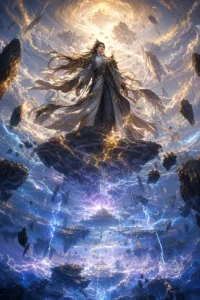
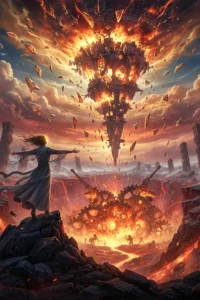
He stood beneath a sky of burning ash. Mountains towered in silhouette all around him, their peaks drowned in a storm of cinders that fell upward instead of down. Rivers of black fire crossed the earth in silent coils. Above those rivers floated countless figures—cultivators, beasts, things with too many wings and crowns of shattered stars. Every one of them was kneeling.
At the center of that impossible world sat a man in plain robes upon a broken throne of meteoric iron.
He was neither young nor old. His hair fell loose over his shoulders, dark as a moonless sea, except for a single white streak near the temple. His face was beautiful in the way blades were beautiful: spare, severe, made for ending arguments. One hand rested on his knee. The other held a narrow cup made of bone. Black fire burned soundlessly in his pupils.
When Shen Wei met that gaze, his knees nearly buckled.
The kneeling hosts around them vanished. The burning mountains vanished. The world narrowed until there was only the man on the throne, the ash, and Shen Wei standing alone under a dead sky.
The man spoke as if he had been continuing a conversation interrupted moments ago.
“You came late.”
His voice was calm. It carried farther than thunder.
Shen Wei forced breath into his lungs. “I got buried.”
For the first time, a hint of expression touched the man’s face. Not amusement. Recognition, perhaps, of insolence where terror would have been more proper.
“Good,” the man said. “Those who arrive easily are never worth taking.”
Shen Wei looked down at his hands. They were whole, not caked in grime and blood. He wore the torn outer disciple robes, but they fluttered untouched by the ash storm. He looked up again. “Who are you?”
The man tilted the bone cup, and black fire slid over its rim without spilling.
“The name I was born with no longer matters. The names my enemies cursed me with mattered even less.” He set the cup aside. “In the final era before my death, the world called me Cinder Sovereign.”
The title struck the air like a struck bell.
Shen Wei had never heard it. But hearing it, he understood the shape of it. A title did not become sovereign by accident. It was stained with conquest, with sects broken and heaven challenged.
He wet cracked lips. “Am I dead?”
“Not yet.”
“Then this is an illusion.”
“No.”
The answer came so flatly that Shen Wei’s next question died before it formed.
The Cinder Sovereign looked at the sky. Ash cascaded upward around his profile, outlining him in pale ruin. “This is the residue of a will stronger than death. A memory-temple. A grave for doctrine. A net cast through time in search of one who has already been broken enough to listen.”
His gaze returned to Shen Wei, and the weight of it deepened. “Tell me, little cripple of a dying sect. What was your verdict?”
The words were not loud. They struck like a rod to the spine.
Shen Wei’s jaw tightened. He had heard that question all his life in a hundred forms. At awakening ceremonies, in the disdainful laughter of clan elders, in the clipped boredom of outer sect registrars, in the lazy sneers of disciples whose roots shone bright as polished jade while his own meridians twisted and failed to hold qi.
Useful. Worthless. Common. Rare. Heaven-favored. Mud-born.
One verdict determined the arc of a life before it began.
He answered without lowering his eyes. “Defective fire root. Collapsed channels. Unfit for inner cultivation.”
“The full verdict.”
Shen Wei’s fingers curled. The old humiliation rose with all its old clarity: incense smoke in the ancestral hall, his mother’s silence, his uncle’s pity sharpened into impatience, the elder pressing cold fingers against his wrist and recoiling as if touching rot.
He made himself say it. “Useless.”
The word hung between them, ugly as spit.
The Cinder Sovereign nodded once. “And what did heaven grant those who judged you?”
Shen Wei said nothing.
The Sovereign’s voice did not harden, yet the world around them seemed to draw taut. “Speak.”
“Authority,” Shen Wei said. “Resources. Technique halls. Pills. Inheritance caves. Respect.”
“And what did it grant you?”
He laughed softly this time. There was no humor in it. “Missions no one wanted. Beatings when strong disciples were bored. A place near the gate if there was room. Leftovers if there weren’t.”
“And when they sent you into the ash valley?”
Shen Wei stared at him.
Of course the thing inside this coffin knew. It had pulled him here. It might have watched every stumbling step.
“They expected me not to come back,” he said.
“Expected?” The Sovereign’s eyes gleamed. “No. They intended it.”
The ash storm swelled.
For an instant Shen Wei saw faces in it—Senior Brother Han with his cultivated smile and serpent eyes; Elder Qiu signing mission slips without glancing up; the trio who had laughed while kicking him into the ravine weeks earlier; even members of his own clan, distant now, but etched into the same cruelty. All of them rose and dissolved in the cinders.
“This world,” said the Cinder Sovereign, “worships roots. It kneels before what is given at birth and calls that law. But roots are merely channels. A spoon by which heaven feeds livestock. The stronger the root, the cleaner the chain.”
Shen Wei’s breath hitched.
No one spoke of spiritual roots that way. Roots were destiny. Roots were divine measure. To question that was to question the order of the cultivation world itself.
“You lie,” he said automatically, because the alternative was too large.
The Sovereign’s expression did not change. “Good.”
He rose from the throne.
The motion was slight. The effect was apocalyptic.
The dead sky split with black light. Rivers of cinder-fire surged in their beds. A pressure descended that drove Shen Wei to one knee despite every ounce of resistance. He felt then what kind of being stood before him—not a remnant, not a ghost, but the imprint of a will that had once scorched worlds.
“Do not believe because I speak,” said the Sovereign. “Believe because you survive.”
He stepped down from the throne, each footfall ringing through the ash plain like a funeral chime. “I forged a path after heaven sealed mine. I was born with roots envied by kingdoms. I burned them out with my own hands.”
He stopped a few paces away.
Shen Wei looked up, heart hammering.
“What replaced them,” the Sovereign said, “was the Ninth Meridian.”
The words ignited inside Shen Wei’s skull.
Visions struck him in a flood—nine hidden lines in the body no orthodox scripture named; a pathway curled around the dantian like a sleeping serpent; black flame coursing through flesh instead of qi flowing through roots; bones tempered in ruin; blood carrying embers; soul and body refined together in violent cycles of destruction and renewal. He saw cultivators shattering themselves against a gate they did not perceive, endlessly polishing spiritual roots like beggars polishing shackles. Beyond them stood another road, terrible and narrow, paved with corpses and breakthroughs stolen from extinction.
Shen Wei gasped and clutched his head.
“No root can carry it,” said the Sovereign. “No orthodox meridian map can contain it. To open the Ninth Meridian, all that heaven marked in you must first be reduced to ash.”
The last phrase echoed.
Reduced to ash.
Shen Wei’s stomach turned cold. He thought of his defective root—not bright, not noble, not even useful by ordinary standards. But it was his only connection to cultivation. Weak as it was, crippled as his channels were, it was still the thing that separated him from mortals. Burn it away, and if this inheritance was false, if this remnant was mad, if one word of this was deception—
He would truly become nothing.
As if hearing the thought, the Sovereign extended a hand.
Above his palm hovered two flames.
One was red-gold, familiar, almost comforting. It gave off the warm spiritual pulse Shen Wei had spent years trying and failing to gather. The orthodox path. Root, qi, foundation, slow ascent under laws every sect knew.
The other flame was black.
It did not illuminate. It devoured illumination. Looking at it made his scarred meridians ache with hunger and dread.
“Choose,” said the Sovereign.
Shen Wei stared at the two flames. “If I choose the first?”
“You wake. You crawl out of this place if you can. You carry your injuries. Perhaps you live a few more years as prey. Perhaps you gain enough strength to become useful to stronger men. Perhaps you die before the season turns.”
“And the second?”
The ash plain went silent.
“You enter the path outside heaven’s registry. You become fuel and forger both. You will suffer.” The Sovereign’s voice remained calm, almost clinical. “You will lose what little was granted to you. You will be remade in a method most would call heresy and the bold would call madness. If your will fails, your body will collapse into cinders. If your soul fails, it will not reincarnate. If you survive, the sky itself will learn your name.”
Shen Wei looked at the red-gold flame again.
It was not really a choice. That was the cruel elegance of it. Choice belonged to people standing on roads. He had been thrown off the road long ago and called fortunate for being allowed to crawl beside it.
His whole life, every insult had hidden the same command: accept your measure.
He thought of the sect disciples who had left him for dead. Of elders who used rules like blades and scripture like chains. Of the small, poisonous shame he had carried since childhood every time someone more gifted looked at him and saw less than a person.
Then he thought of the hidden cavern, the corpse fused to crystal, the ember that had answered him, and the cold certainty that if he walked away from this, he would spend the rest of his life wondering whether heaven’s verdict had ever deserved obedience.
He lifted his head.
“If roots are chains,” Shen Wei said quietly, “then mine were rusted through from the beginning.”
The Sovereign waited.
Shen Wei reached for the black flame.
The instant his fingers touched it, agony erased the world.
He was back in the cavern, screaming.
His hand had fused to the coffin lid. Black fire raced up his arm in branching veins. It did not burn skin first. It plunged through skin as though flesh were smoke and found the deeper structures beneath—meridians, marrow, dantian, every place where spiritual power could ever gather.
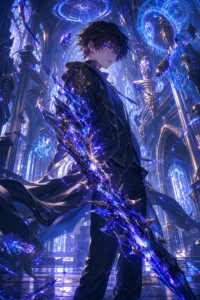
Shen Wei convulsed and slammed against the coffin. The cavern answered with thunder. Cracks of black light spread from the carved eye beneath his palm and ran across the lid in intricate lines, not arrays but something older, like script written by catastrophe.
The ember shot into his chest.
His body arched so violently his back nearly snapped.
There was no air. No up, no down. Only burning.
He had known pain before. Broken fingers. Splintered ribs. Poison eating at his gut while sect healers waved him away because pills were for worthwhile disciples. This was beyond all of that. This was surgery performed by a god of cremation.
He felt the black fire enter his dantian and find the stunted knot of root-essence there.
For one heartbeat, everything stopped.
Then it ignited.
Shen Wei heard himself make a sound no human throat should make. Light exploded behind his eyes. Memories tore loose in the blaze—childhood mornings hauling water before training; his mother combing his hair in silence after the awakening ceremony, her hands shaking only once; kneeling outside the technique hall while inner disciples walked past without seeing him; the first time he had sensed qi and realized it leaked from him faster than he could gather it; the grin on Senior Brother Han’s face when assigning the valley mission.
Each memory caught fire.
Not consumed. Tempered.
The black flames coiled through his root channels, and he felt with horrifying clarity what spiritual roots truly were: not abstract talent, but structures, filaments embedded through flesh and spirit alike, aligning a person to the world’s ambient qi, ordering what could be absorbed, transformed, and circulated. In Shen Wei, those filaments had always been twisted and fractured. That defect had governed his entire life.
Now the fire wrapped them and squeezed.

0 Comments