Chapter 5: The First Burning
by inkadminPain woke him before breath did.
It came without shape at first, a white, depthless violence that erased thought and memory alike. Shen Wei did not know his name. He did not know where his limbs ended. He knew only that something inside him was being torn open and remade with red-hot hooks.
Then air knifed into his lungs.
He convulsed on cold stone, back arching so hard his spine scraped against the rough floor of the black coffin chamber. A ragged cry ripped out of him and broke into a cough. What he spat was not blood, but gray-black soot that scattered over his chest in soft, drifting flakes.
The smell hit him next.
Burnt marrow. Old incense. Charred earth after lightning. And underneath it all, the dry mineral stink of the ash valley, as if he had swallowed the whole dead landscape and it was now smoldering in his ribs.
His fingers clawed at the ground. Nails scraped stone. Every tendon in his arms stood out like twisted cords. His skin felt too tight, as though fire had passed beneath it and left it glazed and brittle. Wherever he touched himself, heat throbbed under the surface—not the bright, rushing heat of fever, but a deeper warmth, banked and patient, like embers buried under ash.
Memory crashed back in fragments.
The mission. The betrayal. The ash valley. The black coffin beneath the bones of the fallen star.
The old voice.
The inheritance.
His spiritual roots burning.
Shen Wei’s eyes snapped open.
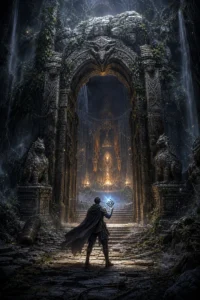
The world tilted. For a moment he saw the chamber through a haze of wavering heat. The giant skeleton above the coffin room cast long shadows across the walls, each rib like the curved bars of a prison forged for gods. Pale glimmers still moved in the crystal veins embedded in the stone, though their light had dimmed. Dust hung in the air in slow-turning ribbons.
And he—he was alive.
That realization should have brought relief. Instead it brought terror.
He rolled onto his side and sucked in another ragged breath. The movement sent fresh agony through him. It was not where he expected it to be. His old injuries—his broken meridians, the familiar deadness and jagged ache that had been with him so long it had become part of his idea of himself—were gone.
Gone.
In their place was something worse.
Something new.
He pressed a trembling palm to his lower abdomen, where the dantian sat. Once, he had felt there only emptiness, an abandoned well lined with cracks. Now he felt a pulse.
One beat.
Another.
Not the clean circulation of qi he had envied in other disciples. This rhythm was heavier. Stranger. Each pulse sent heat through channels that should not have existed, and where that heat passed, he felt raw awareness—as though molten wire had been threaded through his flesh.
His breath hitched.
Meridians?
He shut his eyes and turned inward by instinct, using the meditative habit beaten into every disciple since childhood. Before, inward sight had always shown him ruin: splintered passages, collapsed nodes, a pathetic trickle of spiritual energy leaking into dead ends. It had been like looking into the remains of a house after fire and flood.
Now he saw darkness.
Not empty darkness. Dense darkness. A black-red current moved in spirals through his body, not along the twelve orthodox meridians, but through a single unfamiliar route that wound deeper, closer to bone, nearer to the hidden places where pain lodged. It began below his navel, passed through his spine, branched beneath the sternum, brushed the throat, and climbed behind the eyes before descending again into his limbs in a lattice of dull crimson threads.
Wherever the current moved, faint ash drifted with it.
He stared inward, stunned.
The Ninth Meridian.
It did not refine heaven and earth qi. He understood that instantly, with the cold clarity of someone recognizing the shape of the blade at his own throat. Ambient qi still floated in the chamber, pale and thin. It touched his skin and slipped away, useless as moonlight on iron. But the ash beneath his palms, the stale remnants of old flames in the air, the residue of death and exhaustion and ruin all around him—those responded.
They stirred.
A grain of gray dust near his wrist trembled, rose, and melted into his skin.
Heat flared inside him.
Shen Wei’s eyes flew open.
He froze, barely daring to breathe.
Another fleck of ash lifted from the stone.
Then another.
They drifted toward him in tiny spirals, gathering as if called by a silent tide. When they touched him, they vanished. The pulse in his dantian strengthened. Pain followed each absorption, but not the helpless pain of injury. This was purposeful pain. A smith’s hammer. A whetstone against bone.
He laughed once, a short, incredulous sound that scraped his throat raw.
“So this is your path,” he whispered into the chamber. His own voice sounded unfamiliar, lower and rougher, threaded with exhaustion. “You mad old monster.”
The stone gave no answer.
Yet somewhere in the back of his mind, as if burned into the inheritance itself, fragments of understanding continued to unfold.
The Ninth Meridian did not ask heaven for permission. It did not court spiritual roots, did not nourish them, did not elevate them. It reduced them to fuel. It cultivated from remnants—ashes after destruction, residue after death, heat after lightning, pain after survival. Ruin itself became resource.
It was monstrous.
It was blasphemous.
It was perfect.
For someone like him, cast away by every law the cultivation world obeyed, it was the first thing that had ever fit.
His laugh died as another spasm ripped through him. He slammed a fist against the floor and gritted his teeth so hard his jaw trembled. The current within his body was still unstable. It moved in surges, gouging through newborn pathways. He felt each passage with merciless precision—the searing at the base of his spine, the pressure behind his eyes, the molten ache in the hollows of his shoulders and knees.
He could not stay here writhing like an animal.
He forced himself upright.
The motion nearly blackened his vision. He knelt beside the open coffin, one hand braced on its lip, and endured the dizzy spinning until the chamber steadied. Up close, the coffin was even stranger than he remembered: blacker than shadow, its surface swallowing the dim crystal light. Fine characters had once been carved into it, but most had been worn away by age. Only a few remained visible, sharp and deep.
Ashes return. Fire remembers.
Shen Wei traced the words with sooty fingertips. His hand shook.
“Then remember me,” he muttered.
He pushed himself fully to his feet.
Standing should have been impossible. Hours earlier—was it hours? days?—his body had been one hard fall away from breaking. Now his legs held him. Unsteadily, yes. With pain singing through every joint, yes. But they held.
He took one step.
Another.
No collapse.
His chest tightened with something too fierce to be joy and too dangerous to be hope. He had learned not to trust hope. Hope made people soft. Hope made them look upward when knives came from the side.
Still, his hands clenched at his sides.
I can stand.
He took a third step, then a fourth, circling the chamber with the careful caution of a man crossing thin ice. His body felt wrong in ways both terrible and exhilarating. The old numbness was gone. He could feel the texture of the stone through the torn soles of his boots. He could hear the faint hiss of ash shifting beyond the walls. He could smell ancient blood somewhere under the mineral dust.
His senses were sharper.
Not vastly. Not enough to make him superhuman. But enough that the dead chamber no longer seemed dead at all. It was full of remnants. Traces. Burnt echoes left by age, by sacrifice, by the impossible thing sleeping beneath this valley.
The Ninth Meridian tasted them all.
It was hungry.
A cold thread passed through his exhilaration.
Hungry things demanded payment.
He remembered the voice in the coffin: calm, disdainful, ancient. If you take this path, you will never again belong beneath the ordinary heavens.
“As if I ever did,” Shen Wei said.
The words came out harsher than intended. The chamber swallowed them whole.
He should have left immediately. The ash valley was a graveyard that devoured the careless, and if the others from the sect had survived whatever happened on the surface, they would not mourn him. But he needed to know what had changed.
He closed his eyes again and drew in a slow breath.
Instead of reaching for ambient qi, he followed the instinct forming inside his body like a half-remembered art. He exhaled. The current in his dantian pulsed. Ash from the chamber floor rose in a lazy ring around his ankles, circling once before sinking into his skin.
Pain.
Then strength.
The heat in his limbs deepened. Not much. A cup of water poured into a dry field. But real.
He tried again, this time focusing on the soot still clinging to his sleeves and chest.
The gray dust shivered, then disappeared into him.
The process was ugly. No elegant gathering of spiritual mist, no serene communion with heaven and earth. It was scavenging. Stripping a battlefield after the dead were cold. Yet the result made his heartbeat pound louder.
He could cultivate.
Not as others did.
But he could.
The thought had barely settled when a sound crawled through the chamber.
Scratch.
Shen Wei’s eyes opened at once.
It came again from the tunnel mouth beyond the broken altar stones—a slow, gritty scraping, like claws dragging over rock. The hairs on the back of his neck lifted. This deep underground, sound traveled strangely, but there was no mistaking hunger.
He turned toward the tunnel and listened.
Another scrape.
Then a wet sniffing noise.
The ash valley’s scavengers had caught his scent.
His first instinct was old and bitterly familiar: calculate escape, measure weakness, assume death is the more prepared opponent. He looked around the chamber. The coffin was too low to hide behind, the walls too smooth to climb. The tunnel mouth was narrow, choked by fallen stone. If something small had found its way through, it had done so because it lived in cracks and graves.
The scraping quickened.
Shen Wei bent and seized the first weapon he could find—a jagged shard of black stone from the shattered altar. It fit badly in his hand. Sharp on one side, heavy on the other. Crude, but weight was weight.
His pulse slowed.
That, too, felt new.
Before, fear would have made his body clumsy. Now fear sharpened him. The black-red current in his meridian moved faster, carrying heat into his fingers, his forearms, his calves. Pain and readiness became difficult to separate.
From the tunnel emerged a head.
It was the size of a dog’s, though no dog had ever looked so malformed. Its skin was slate gray and hairless, stretched thin over a skull too angular for flesh. Soot caked its muzzle. One eye was milky and sealed over; the other gleamed a sulfurous yellow. When it opened its mouth, its teeth were not teeth but splintered black shards, like obsidian forced through rotten gums.
Ash-beast.
Shen Wei had heard the outer sect hunters describe them in drunken contempt. Carrion things. Valley vermin. Weak alone, dangerous in packs. Drawn to corpses, blood, and unstable spiritual fluctuations.
The beast wriggled farther into the chamber, shoulders scraping stone. Its body was lean and whipcord-thin, with too many joints in its forelegs and a tail like exposed bone wrapped in gray hide. It sniffed the air and fixed its good eye on him.
0 Comments