Chapter 6: The Red Market
by inkadminAshfall Protocol chapter 6
The cold hit harder in the morning than it ever had before the sky broke.
It lived in the bones of the city now. It came out of cracked concrete, out of the shadows under overpasses, out of the dead black crystal veins that had spread through intersections and parking lots like frozen lightning. Denver used to have a winter smell—exhaust, wet salt, coffee steaming out of shop doors, old snow turned gray at the curb. Now it smelled like ash, rot, and hot metal. The air carried the tang of blood even when there wasn’t any in sight.
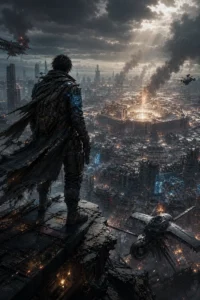
Caleb stood on the roof of the gutted clinic and looked east over a neighborhood that had stopped pretending it was alive. Tarps snapped over blown-out windows. Smoke rose in three thin columns from burn barrels and one thick one from somewhere farther down Colfax where something had gone wrong in the night. Frost silvered the abandoned cars. Black obelisks in the distance caught the weak light and swallowed it whole.
Below him, in the clinic courtyard, Mara argued with a man over half a sack of rice.
“I’m telling you that’s all that’s left,” the man snapped.
“Then tell it more convincingly,” Mara said.
Her voice carried even through the wind—hard, clipped, and too sharp to ignore. She had a knit cap shoved down over her dark hair, a rifle slung across her back, and a knife at her hip she touched whenever she got irritated, which was often lately. Since the raid, since the dead had piled high enough for Caleb’s class to feed and evolve, everybody touched their weapons more.
Everybody watched him too.
Not openly. Not unless they forgot themselves.
Caleb felt it when he climbed down the fire stairs and crossed the courtyard. Conversations hit snags. Eyes flicked toward the black-gray embers that moved under his skin when he drew too much on his power. He wore gloves now because his hands looked wrong in the morning light, the veins around his wrists holding a dim soot-red glow that never fully vanished.
People made room for him anyway. Fear was useful like that.
“How bad?” he asked.
Mara glanced at him, and the anger in her face shifted into something flatter and more tired. “Worse than yesterday.”
The quartermaster—if a half-starved dental assistant named Jorge counted as a quartermaster—hugged the sack of rice like Caleb might steal it by looking. “We can stretch four days,” Jorge said. “Five if we stop pretending anyone needs a full meal.”
“Protein?” Caleb asked.
Jorge laughed once, dry as paper. “Sure. If you want to boil leather belts.”
Mara folded her arms. “Antibiotics are gone. Water filters are failing. .22 rounds are nearly out. And before you ask, no, the greenhouse experiment did not magically become agriculture overnight.”
Caleb looked past them into the clinic lobby, where people huddled under blankets and stripped wiring from a busted vending machine for copper. Too many faces. Too many ribs showing. The survivors they’d taken in after the raid had doubled their numbers and cut their lifespan in half. Every hard choice just opened the door to three more.
“The Red Market’s active again,” Mara said.
That got his attention.
The words spread through Denver like rumors of heaven and plague at the same time. A neutral zone, some said. A trade hub, others said. A slaughter pen with prices written on the walls. It moved when pressure got too high, but for the last week every scavenger, runner, and desperate bastard who limped back west from downtown kept saying the same thing: under the old rail viaduct near RiNo, red lanterns burning after dark, guards from three factions holding the line because everyone needed what was inside.
Caleb had dismissed it as the kind of story starving people told each other to stay in motion.
“You trust that?” he asked.
“No,” Mara said. “I trust hunger.”
A gust of wind pushed ash through the courtyard. It skipped over broken paving stones and caught in Caleb’s coat hem. Somewhere inside the clinic, a child started coughing—the wet, hollow kind that sat in the chest and deepened at night.
Jorge licked cracked lips. “I heard they’ve got canned food. Actual antibiotics. Generator fuel. Skill manuals if you can pay stupid enough. Hell, one runner claimed he saw strawberries.”
Mara snorted. “That runner also claimed he killed a sewer hydra with a crowbar.”
“Maybe he bought the crowbar there,” Jorge muttered.
Caleb almost smiled, but it died before it got anywhere. His eyes drifted toward the northern wall where three bodies still lay under tarp shrouds, waiting. Waiting for burial. Waiting for him.
His class sensed them the way the tongue sensed a missing tooth. The unfinished dead tugged at him. Quiet, constant. Needful.
Grave Warden, Tier II
Echo capacity increased.
Residuals within thirty meters detectable.
Unbound dead attract System predation.
The last line had never stopped making his stomach knot.
He had seen what happened when the System reached first—shimmering scavenger things with too many joints, peeling the soul-stain from corpses like flies stripping meat. His power could protect what remained, bind it, use it. Useful. Necessary. Monstrous.
Mara followed his gaze to the shrouds and looked away first.
“We need to go before dark,” she said. “I want in and out while neutral still means something.”
“Who’s we?” Caleb asked, though he already knew.
“You. Me. Nia for eyes. Briggs because people think twice when they see the size of him. And because if this turns bad, I want someone who can carry you after you decide to do another corpse miracle.”
“Comforting.”
“I aim to serve.”
She was close enough for him to see how exhausted she was beneath the sarcasm. A bruise yellowed under one eye. The cut on her neck from the raid had scabbed clean but angry. She had not slept. None of them had, not really.
“You think they’ll trade with us?” Caleb asked.
Mara’s gaze settled on his gloves. “With you? Yeah. They’ll trade.”
He knew what she meant. The rumors had outrun them. By now half the city had heard some version of the same story: a dispatcher with a death class who turned a massacre into a wall of ash and screaming ghosts. Some versions called him a butcher. Some called him a saint. Most of them got uglier after dark.
“Great,” Caleb said. “So I’m currency now.”
“You always were,” she said. “You’re just expensive these days.”
By noon they moved.
The city chewed at them every block. There was no such thing as a safe route anymore, only paths where fewer things had recently died. Nia took point, slipping ahead in the skeletons of alleyways and returning with hand signals or quick murmured updates. She moved like a rumor—small, fast, layered in scavenged gray cloth that broke up her outline. Before the Fall she had been seventeen and impossible, all smart mouth and side-eye. After the Fall she was still impossible, just sharper about it.
Briggs walked rear guard with a fire axe across one shoulder and a pack that looked too heavy for anyone else to lift. He had once worked loading docks and looked built by someone who thought subtlety was for cowards. The System had rewarded him with a Bulwark path that thickened his frame further, making him broad enough to seem half-armored even in patched civilian gear.
“Place really called the Red Market?” he asked as they crossed a boulevard buckled by crystal growths.
“That’s what people say,” Nia answered from ahead without looking back.
Briggs grunted. “Sounds dramatic.”
“We live in dramatic times,” Mara said.
They passed a bus split open like fruit. Rime glittered on the seats inside. A dead thing hung from the emergency hatch on the roof, all insect limbs and translucent skin, its belly burst and frozen black. Caleb felt the faint residue around it—a smear of panic and hunger already going thin. The city was full of those traces now, emotional grease on every place violence happened. His class tasted them constantly. Terror in stairwells. Rage at boarded doors. The numb, leaden despair of apartments where people had run out of options and then out of time.
Keep moving.
He said it to himself the way he used to say it during overnight dispatch shifts when calls stacked too fast and every headset channel filled with somebody else’s worst day. Back then helplessness had come through speakers. Now it left footprints in snow.
Near the viaduct the signs changed.
They began as chalk marks on brick and concrete pillars: circles bisected by red lines, arrows, numbers, warnings in three languages. Then came sentries. Not hidden. Hidden men got shot. These were meant to be seen.
One perched on the shell of a wrecked SUV with a long rifle and mirrored ski goggles. Another leaned against a pillar wrapped in chains of red cloth strips, the kind of makeshift heraldry people invented when flags were gone. Both wore badges hammered from scrap metal, each stamped with a different symbol. Not one faction, Caleb realized. Several.
The sentry by the pillar lifted a hand. “State your business.”
Mara kept her rifle slung and her palms visible. “Trade.”
The sentry’s gaze traveled over all of them and stopped on Caleb. Interest sharpened. “You’re him.”
Caleb said nothing.
“Thought so.” The man smiled without warmth. “Keep your dead outside, Graveboy. We’re neutral under the bridge.”
Briggs shifted. “You got a problem?”
“Not if he doesn’t make one.” The sentry jerked his chin toward the dark beneath the viaduct where red light flickered. “No active skills. No bloodshed unless challenged. Trade disputes go to the Bell. Stealing loses a hand if you’re lucky. Starting a faction fight gets you fed to whatever’s in the river.”
Nia peered past him. “There’s still a river?”
The sentry’s smile widened just enough to show a chipped tooth. “You’ll hear it.”
They went under.
The Red Market had once been a sprawl of service roads, storage cages, homeless camps, and graffiti-shadowed concrete under the elevated tracks. Somebody had turned ruin into institution with an almost religious commitment to improvisation. Cargo tarps were stretched into ceilings. Shipping pallets made walls. Burn barrels and red lanterns hung in rows, throwing a raw crimson wash over the crowd so everyone looked half flayed. Smoke pooled under the overpass in low bands. Generators thrummed somewhere deeper in. Voices layered over metal clanging, arguments, the squeak of cart wheels, and the crackle of radios running on scavenged batteries.
Food smells hit first, so strong they were almost violent.
Grease. Boiled grain. Something stewing with onions. Fresh bread, impossibly, from somewhere close enough to make the stomach twist.
The market was packed.
People in patched winter gear moved shoulder to shoulder through lanes marked by hanging cloth strips. Makeshift stalls displayed everything from ammunition to canned peaches to bundles of stripped copper wire to carefully wrapped syringes. A woman sold rat pelts beside a man offering sharpened rebar spears. A pair of teenagers in hockey pads stood behind a folding table covered with System cores laid out on black velvet as if they were jewelry. Human teeth hung from another booth on fishing line, tagged by size. At the far end, behind chain-link and two armed guards, Caleb saw a row of people kneeling with boards around their necks listing skills, labor capacity, or just age and sex.
He stopped dead for half a second.
Mara saw it too. Her jaw hardened. “Don’t,” she said softly.
“People?” Briggs asked, voice gone thick.
“Indenture contracts,” Nia said, reading the nearest sign. “Protection, food, shelter in exchange for service. Voluntary, my ass.”
A trader overheard and barked a laugh. “Everything’s voluntary when the alternative is starving.”
He was a narrow man with tattooed cheeks and a coat made from stitched sleeping bags. He was selling batteries, lighters, and packets of freeze-dried coffee one at a time for prices that would have bought a month of groceries two weeks ago and meant absolutely nothing now.
Caleb kept walking because if he stared too long at the kneeling row, he would do something stupid, and neutral places always had teeth hidden in the floorboards.
“Stay close,” Mara murmured. “Eyes open. We buy food first, meds second, ammo third.”
Nia pointed at a stall where two women were haggling over vacuum-sealed meat. “Food first is suddenly my favorite plan.”
But the market had already noticed them.
It happened in ripples. A glance, a whisper, a nudge. Caleb could feel attention catching and traveling. The red glow made everyone’s eyes seem fever-bright. He heard fragments as they moved.
“…that’s him…”
“…saw bodies stand back up, swear on my mother…”
“…forbidden class…”
“…don’t meet his eyes…”
Caleb kept his face blank. Dispatch training again: voice level, heartbeat down, triage the immediate crisis. If he let himself react to every stare, he’d crack. If he let himself enjoy the fear, he’d become something worse.
At a food stall built from stacked milk crates and an old pharmacy counter, Mara struck first blood in the oldest war there was—negotiation.
“That’s extortion,” she said flatly.
The old woman behind the counter shrugged. “That’s lentils.”
“Three minor cores for ten pounds?”
“Would you like to try eating your principles?”
Nia choked back a laugh.
Briggs, to everyone’s surprise, leaned in with solemn interest. “How much for the bread?”
The old woman eyed him. “Depends. You smell like muscle. Muscle means faction. Faction means price goes up.”
“We’re not a faction,” Mara said.
“That’s what weak factions say.”
Caleb almost tuned the haggling out. His attention kept drifting farther in, drawn by a pressure that prickled behind his sternum. There was death under the market. Old death. Layered deep, not fresh enough to scream but present enough for his class to feel it. It clung to the concrete footings and seeped up through cracks in the floor. He looked toward the central aisle and saw a rusted brass bell hanging from a chain, exactly where the sentry had said it would be. Beside it stood a man in a red coat watching the crowd with ceremonial stillness, one hand resting on a machete whose blade had been polished mirror-bright.
Bell judge, Caleb guessed. Executioner too.
“Caleb.”
He turned. A boy no older than twelve stood there holding out a folded strip of red fabric.
“For you,” the boy said. “Table Nine. No charge.”
“Who from?” Mara asked immediately.
The boy gave a theatrical little bow. “A friend of old machines.” Then he vanished into the crowd before Briggs could grab him.
Mara snatched the cloth from Caleb’s hand and unfolded it. Inside was a charcoal mark: a spiral enclosed by six teeth.
Caleb felt cold that had nothing to do with weather.
He had seen that symbol once before, carved into the obsidian-slick side of a black obelisk in a district nobody crossed after sundown. He had also seen it in a dream he did not think was a dream—on a white floor under a sky full of moving gears while a smiling man in a pale coat stood ankle-deep in ash.
“What is it?” Briggs asked.
Caleb answered too quickly. “Nothing good.”


0 Comments