Chapter 7: Winter Wave
by inkadminAshfall Protocol chapter 7
The cold arrived like something with intent.
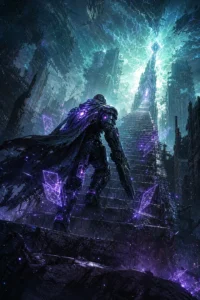
By dusk the sky over Denver had gone from bruised gray to a hard metallic white, the kind of color Caleb associated with emergency pileups and bodies under silver blankets. Wind came first, knifing between dead office towers and rattling the sheets of salvaged metal bolted over the shelter’s lower windows. Then came the ash—old, fine, ever-present ash—lifted off rooftops and vacant lots and spun into the air until it mixed with the first grains of snow. White and black turned together above the street, whirling around the black crystal obelisk four blocks south like a storm being fed.
Inside the old vocational school they’d claimed as a shelter, people tried to pretend weather still meant weather.
They moved cots closer together in the gym. They patched blankets with duct tape. They argued over stove fuel and whether the neutral hub had cheated them on the rice. They listened to the groan of the building and avoided looking too long at the frosted windows, as if by refusing to stare outside they could deny what was coming.
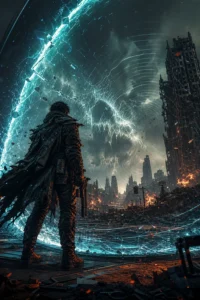
Caleb stood at a second-floor classroom window and watched the first true wave of winter hit Colfax. Snow hissed sideways past abandoned buses and burned-out sedans. The crystals embedded in the roadway gave off a low violet pulse under the accumulating ice. Every flash made the drifting flakes glow from within, as though the storm had nerves.
Mara came up beside him carrying a dented stock pot that smelled faintly of boiled beans and rust. “You’ve got the same face you had in the trade hub.”
He didn’t look away from the window. “That face got us back alive.”
“That face says you heard something useful and didn’t share.”
Below them, someone laughed too loudly in the hallway. Somewhere down the corridor, a baby began to cry. The sound made the building feel even colder.
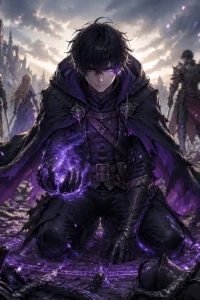
Caleb rubbed at the scar tissue along his palm where his class mark burned whenever the System was about to make his life worse. Tonight it had been prickling for an hour.
“Ryland was moving people east,” he said. “Not raiding. Relocating.”
Mara’s expression changed by a degree. That was all. It was enough. “Because?”
“Because even warlords don’t abandon profitable ground for no reason.”
“And the Apostle?”
He finally glanced at her. “Smiled at me.”
“That thing is always smiling.”
“Yeah.” Caleb watched a stoplight sway over the intersection, long dead, turning in the wind like a hanged thing. “But this time he looked at me like he’d already read Ashfall Protocol chapter 7 and knew how it ended.”
Mara snorted despite herself. “Cute. I hate it.”
Then the screaming started.
Not in the room. Not in the building.
Outside.
It came in thin through the wind at first, easy to mistake for brakes or twisted metal. Then there was another voice and another, layered under the howl of the storm, and one of the sentries down in the lobby bellowed for the doors.
Caleb was already moving before the second shout.
The stairwell smelled of wet concrete and bodies. Mara’s boots hammered behind him. By the time they hit the first floor, people were piling away from the front entrance while two of the watch tried to drag the iron-reinforced doors shut against a man half-falling through them.
He collapsed onto the tile in a burst of snow and blood. His coat had been torn open from collarbone to belly. Not clawed. Split. The flesh beneath looked boiled, gray-red and glossy. Small pale things moved inside the cavity where his lower ribs should have been.
For one half-second Caleb thought maggots.
Then one of them pushed its head out through the meat.
It had too many jaws.
“Back!” Mara shouted, dropping the stock pot. It hit the floor and rolled, bean water fanning across the tile.
The man on the floor was still alive. His hands scrabbled weakly, leaving red tracks across the school’s faded mascot emblem.
“Please,” he said. His lips were blue. Ice jeweled his eyelashes. “Please get them out—”
A bulge rippled under the skin of his throat.
Caleb felt death before he saw it. The air around the man dimmed at the edges, not with shadow but with pressure, the subtle fold Caleb had come to know since awakening. Souls frayed in a particular way at the end. The Grave Warden in him heard it the way a radio operator heard static before the transmission died.
“Move!” he barked.
Too slow.
The dead man arched once and ruptured.
Wet heat slapped the air. Tile cracked under the force. A cluster of white, eel-thin creatures the length of forearms burst out in all directions, slick with blood and amniotic slime. People screamed. One latched onto a sentry’s leg and bored through denim into flesh so fast the man dropped his spear and started hitting himself with both hands. Another hit the wall, unfolded six spider-like limbs from along its body, and launched at a woman’s face.
Caleb drew his hatchet and met it in the air. The blow sheared it almost in half. Black milk sprayed over his sleeve and smoked where it struck the tile.
[Grave Warden Skill: Ash Bind available.]
Not enough. Too many moving.
Mara slammed her fire axe through the one on the sentry’s calf, then drove her boot down until the squirming body stopped twitching. “Doors!” she roared. “Seal the damn doors!”
Luis, skinny and fast and all elbows, kicked the fallen spear toward Jonah while trying to help haul the injured watchman backward. “There are more outside!” he yelled. “A whole street full!”
One of the creatures reached a corpse bag stacked by the wall—someone they hadn’t been able to bury before the ground froze. It pressed its head into the zipper seam and vanished into the plastic with obscene eagerness.
Caleb swore and thrust his left hand out.
Ash bled from his fingers in a dark stream and laced around the bag like a nest of black wire.
[Ash Bind engaged.]
The body bag convulsed. The zipper split. Something inside hit the ash cords from beneath and failed to break through.
Everyone in the lobby heard it begin to chew.
For a second nobody moved. The storm hammered the doors. The injured watchman screamed as Mara hacked the burrowed parasite out of his calf. On the floor, the man who’d brought the infection in finished dying in small wet breaths.
Then Caleb understood.
“Any dead body,” he said, voice flat with horror. “They’re using corpses as nests.”
Silence broke apart into panic.
Someone near the reception desk whispered, “Oh God.”
Because everyone in the shelter knew how many bodies there were.
The school freezer had failed three days ago. They had wrapped the dead in curtains and plastic and stored them in side rooms, in lockers, in the maintenance shed, waiting for a safe day to burn or bury them. There had never been a safe day.
Outside, in apartment blocks, clinics, buses, offices, stairwells, alleys—Denver was full of the dead.
And now winter had come to hatch them.
[Regional Event Initiated: WINTER WAVE]
[Environmental Hazard: Whiteout conditions. Exposure damage increased. Visibility severely reduced.]
[Event Modifier: Carrion Bloom. Uncremated dead may be converted into Brood Nests. Destroy nests before maturation.]
[Survival advisory: Static defense is not recommended.]
“Of course,” Jonah said hoarsely. “Of course it says that now.”
The body bag by the wall split completely. A hand shoved through from inside, its fingers stripped to tendon. Then a second shape rose behind it, not the person they’d zipped in, but a bulbous white sac rooted through a ribcage like a fungus erupting from rotten bark.
Caleb buried his hatchet in it before it could open.
The thing burst in a shriek of hot foul vapor. Everyone in the lobby gagged. The smell was a slaughterhouse left inside a freezer and then reheated.
Mara wiped spatter off her cheek with the back of her wrist. “Talk,” she snapped. “Right now. Defend or run?”
Caleb was already calculating routes. The school had been good in normal bad conditions—thick walls, fenced yard, rooftop sightlines. In a storm event tied to corpses, it was a coffin with cots. Too many rooms. Too many dead nearby. Too many civilians.
He thought of the subway maintenance map he’d taken from the transit office two weeks ago, mostly because no one else had thought it worth carrying.
“We evacuate,” he said.
Jonah stared at him. “Into that?”
“Into the tunnels. Union line access half a mile north.”
“You want eighty-three people underground with whatever else is breeding in this city?”
“I want them away from every corpse in a five-block radius.” Caleb yanked his hatchet free. Black slurry dripped off the blade. “We can secure choke points below. We can’t secure a neighborhood.”
Mara met his gaze, measuring. Then she nodded once. “Everybody moving in five minutes. Essentials only.”
The objections came like thrown stones. Too dangerous. Too cold. Too many children. What if the tunnels were collapsed? What if there were monsters? What if this was another one of Caleb’s death-soaked instincts dragging them toward hell?
He let the noise rise. Then he climbed onto the reception desk and shouted with the old dispatch-floor command voice that had once cut through callers in hysterics and officers with blood in their mouths.
“Listen to me.”
The room faltered quiet.
“If there is a body in this building and we leave it here, it can turn. If there is a body in the houses next to us, it can turn. If we stay, they will hit us from every wall before dawn. Grab what you can carry. Food, blankets, weapons, water. No souvenirs. No second trips.” He pointed to Mara, then Jonah. “You two organize squads. Luis, roof team down now and perimeter count. Tessa, triage the infected and anybody who can’t walk.”
Tessa’s face went white. “The infected?”
Caleb looked at the sentry with the shredded calf. Thin white threads were already moving under the flesh around the wound.
“If they’ve burrowed deep,” he said, “they don’t come with us.”
The silence after that was worse than the screaming had been.
The sentry, a broad man named Ellis who had spent the last week teaching kids how to sharpen rebar into spears, understood before anyone else did. He stared at his own leg, then at Caleb. “You serious?”
Caleb didn’t lie. “Yes.”
Ellis swallowed. The muscle in his jaw jumped once. “Then don’t let me hatch.”
Mara gripped his shoulder. “Not yet.”
But Tessa’s eyes said she already knew. So did Caleb.
The next ten minutes shredded the shelter’s fragile illusion of order. People tore through classrooms and supply closets, slinging packs over shoulders, bundling children into winter coats that were too thin and too damp. Jonah’s team ripped open the rooms where they’d stored their dead and carried the bodies into the parking lot on tarps. There was no ceremony. Caleb used Ash Bind to hold three of them motionless while Mara and Luis doused them in siphoned gasoline. The flames struggled in the snow and burned greasy orange, lighting the black iron fence in hellish bars.
By then shapes were moving across the street.
Not shambling. Not undead. Worse.
Figures staggered through the whiteout with their torsos split open into blossoming, petaled structures of bone and membrane. From inside those living cradles, pale broodlings spilled and skittered over wrecked cars, over snowbanks, over each other. One thing that had once been a woman lurched forward on broken legs while a translucent sac larger than a bathtub dragged behind her, tethered by ropes of sinew. The sac pulsed every few seconds and expelled another clutch of twisting white young.
Luis came down from the roof so fast he nearly fell off the ladder. “There are dozens,” he panted. “Maybe more. Coming from the apartment towers. We saw lights go out block by block.”
“Good,” Mara said grimly. “Then we’re leaving before they remember us.”
They left in a staggered column through the school’s rear service entrance, into an alley already filling with drifted snow and black ash. Caleb took point with Mara. Jonah and three spear carriers guarded the center. Tessa moved among the civilians, checking faces for fever, listening for wet coughs, watching wounds with the desperate focus of someone trying to stop time by sheer force of will.
The storm erased distance. Buildings loomed out of white blur and vanished again. The city sounded muffled and monstrous, every crash and shriek flattened by snow into something close and directionless.
The cold hit like a living hand around the throat.
Caleb kept them moving north, one block at a time, cutting behind shuttered storefronts and through a parking garage whose upper levels had collapsed into sparkling heaps of frozen concrete. Twice they had to stop while he checked for echoes. His class felt death now the way skin felt static before lightning. The city was full of it—old deaths, fresh deaths, dying things under floors—but certain concentrations stood out like bonfires in fog.
“Not that way,” he muttered at one intersection, and veered them east.
Mara didn’t ask why anymore. She simply relayed the order.
They passed a bus half buried in snow. Every window was opaque with frost except one. Through it Caleb glimpsed movement inside: something pale and many-limbed packed shoulder to shoulder against the glass, jerking whenever the bus frame creaked. He put a finger to his lips as the children stared. Nobody made a sound.
At the mouth of a narrow street, they found a barricade of grocery carts and office furniture. Three bodies were frozen into it, mouths open beneath a lace of ice. One of them twitched.
“Back,” Caleb snapped.
Too late. The corpse’s abdomen split in a neat vertical seam and unfolded like a flower of cartilage. Mara’s axe took off its head before the brood could emerge, but from the windows above, answering shrieks cut through the storm.
Lights flashed on in an apartment building.
Then they burst outward as brood forms slammed through the glass.
The next minute dissolved into white chaos.
Caleb chopped one parasite out of the air and felt another hit his shoulder hard enough to spin him. Its hooked limbs skittered over his coat, searching for purchase near his throat. He seized it barehanded and his class answered with instinctive revulsion; ash flooded his palm and cooked the thing from the inside. It writhed, shrank, and left a handprint of soot on his skin.

0 Comments