Chapter 4: The Girl Who Counted Flames
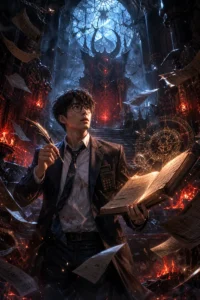
by inkadminBefore dawn, the refuse slope behind the alchemy halls breathed like a sleeping beast.
Steam rose in slow white ribbons from the heaps of ash and slag. Half-burnt herbs gave off a bitter, medicinal fragrance that clung to the back of the throat. Charred paper talismans lay plastered to the wet stones like dead moths. Somewhere beneath the mounds, a stopped-up furnace vent still exhaled heat in uneven sighs, warming one patch of earth while frost silvered the next. The whole place was a graveyard of ambition—failed pills, cracked cauldrons, ruined ingredients, wasted qi.
Jian Mu moved through it with a wicker basket on his back and a rake in his hands, just another servant before first light.
That was what anyone watching would see.
His body still ached from the Blood-Iron pellet. The ache had changed since last night. At first it had been a savage tearing, as if some invisible blacksmith had heated his bones and hammered them out on an anvil. Now the pain had sunk deeper. It lived in the marrow, dense and heavy, every step making his legs feel as though iron filings had been mixed into his blood. When he flexed his fingers around the rake handle, the tendons stood out more sharply beneath his skin than before.
He had tested it in the servants’ shed before coming here. A rotten water bucket that usually took both hands to lift had risen with one. Not easily. Not cleanly. But it had risen.
For someone with a crippled dantian, that was the sort of change worth dying for.
And perhaps, he thought as he nudged aside a crust of green-black ash, worth dying from.
The seed inside him had not been quiet since the pellet. It nested below his ruined dantian, a presence colder than iron and darker than sleep, turning with slow appetite whenever he neared spiritual residue. Here, behind the alchemy halls, it was almost wakeful. Thin streams of sensation tugged at him from every side—the stale bitterness of wasted medicinal qi, the acrid sting of burned poison, the dry snap of failed furnace heat. It was not like seeing, or hearing. More like standing in a dark room and somehow knowing where every knife had been hidden.
He kept his face blank and raked ash into ordered lines.
Servants were assigned to sort the remains by broad category: ordinary burn waste, salvageable metal, herb ash for fertilizer, and hazardous remnants to be sealed and buried. No one cared if a few fistfuls shifted from one pile to another. No one cared because no one believed the trash held value. Failed pills were dead medicine. Corrupted qi dispersed uselessly. Burnt ingredients had already given what they could.
Only Jian Mu knew that was not entirely true.
He crouched beside a mound of dull gray residue that had spilled from an overturned bronze tray in the night. Beneath the surface lay clumped granules of dark crimson and soot-black. A failed pellet batch, likely over-fired. He touched it with the tips of his fingers and felt that inward pull again—the seed stirring, eager.
He glanced toward the alchemy halls.
Their eaves rose in tiers against the paling sky, each roof corner hung with little bronze lanterns engraved in cloud patterns. Most were dark. Two still burned with lambent blue flame, marking furnaces that had not been allowed to cool. The disciples and apprentices inside would be half-dead with exhaustion after a night’s refining. Good. Exhaustion made people careless.
Jian Mu shifted his body to block the view from the main path. With practiced motions, he scooped a handful of the denser ash into the false bottom of his basket, then spread loose slag over the top. His pulse remained even. A servant who looked guilty invited questions. A servant who looked numb became part of the background.
He took three more measured scoops from three different piles. Never too much from one place. Never from a batch that would be counted. Never from fresh trays near the door.
The seed hummed once, a cold vibration behind his navel.
Later.
He did not know whether he was speaking to it or to himself.
A clay jar shattered somewhere uphill.
He straightened at once, rake in hand, and turned just in time to see a kitchen servant muttering curses as he gathered shards. Jian Mu lowered his gaze and resumed work. The sky was beginning to whiten around the eastern ridge. Soon the first apprentices would emerge to dump the night’s failures. He needed enough to matter, not enough to be noticed.
He had just reached the furnace vent stones, where black ash mixed with tiny silver flecks from shattered spirit-char, when he felt heat brush the side of his face.
Not furnace heat. Focused. Intentional.
“If you move that basket one inch,” a girl’s voice said behind him, “I’ll light your sleeve and shout for the supervisors.”
Jian Mu froze.
The heat sharpened near his left shoulder. He could smell singed cloth before any flame actually touched him. Slowly, without wasting a breath, he set down the rake and turned.
She stood two paces away on the rise above him, one hand lifted. A bead of pale gold fire floated over her fingertip, steady as a lantern wick, no bigger than a fingernail and yet bright enough to edge her features in molten light.
She looked to be fifteen or sixteen, perhaps a year younger than him, perhaps not. In the sect, rank and clothing told more truth than age. Her robe was apprentice green, but the cuffs had been patched twice and the hem was stained with soot. Her hair was caught in a careless knot with a burnt bamboo pin. A smear of black dust streaked one cheek. She should have looked disordered. Instead she looked sharpened, like a knife that had been used so often it no longer needed polishing.
Her eyes were the first thing anyone would remember. They were too clear, a strange amber-brown that seemed to hold reflections others could not see. They were fixed not on his face, but on the basket at his back.
Jian Mu measured the slope, the distance to the vent ditch, the angle of her arm. If he lunged, she could scream before he reached her. If she screamed, others would come. If others came and searched his basket—
“You’re thinking too loudly,” she said.
“I didn’t know thoughts made sound.”
“Only desperate ones.” The little flame dipped, then steadied again. “Take the basket off.”
Jian Mu’s expression did not change. “I’m collecting furnace fertilizer.”
“And I’m the Azure Emperor.”
There was no contempt in her tone. That unsettled him more than disdain would have.
He unhooked the basket and set it on the ground between them. The false bottom was well-made, but not perfect. If she dug, she would find it.
“Kick it here,” she said.
He did.
She crouched, still holding the flame over one finger. Instead of rummaging through the basket, she leaned close and inhaled once through her nose, like a fox scenting a trail. Then she lifted a handful of top ash, rubbed it between her fingers, and smiled very slightly.
“Blue Poria, burnt bitter-vine, two cracked marrow lotus seeds…” Her gaze flicked up to him. “And beneath that, over-fired scarlet pellet residue from Furnace Hall Three. You’re either stupid enough to steal from people who count every grain, or clever enough to know what they don’t count.”
Jian Mu said nothing.
She tipped her head. “The second one, then.”
“If you know what’s in the basket,” he said, “why ask me to open it?”
“To see whether you’d lie with your hands as smoothly as with your mouth.”
Her flame winked out. She stood and brushed ash from her fingers. For an instant the dawn seemed colder where the light vanished.
Jian Mu did not relax.
“You’re not shouting,” he said.
“No.”
“Why?”
The girl looked past him toward the row of furnace chimneys. Thin streamers of smoke climbed into the paling sky, crossing and uncrossing like black threads.
“Because if I shout,” she said, “the deacon takes your basket, beats you half to death, and asks no questions worth hearing. Then whatever answer I’m looking for disappears with you.”
“What answer?”
Now she looked at him directly. “Why a servant with a crippled dantian reeks of swallowed pill ash.”
For the first time that morning, Jian Mu’s heartbeat changed.
It did not race. It fell. One hard beat, then another, the way a body reacts on the instant before a blade enters it.
He kept his voice level. “A servant sorting pill ash smells like pill ash. How surprising.”
“No.” She stepped down the rise. “Freshly handled ash smells dead. Stale. Flat around the edges. You smell like someone burned medicine inside you and left the furnace door open.”
There was no bluff in her face. She believed what she was saying.
Jian Mu had seen all kinds in the sect: bullies fat on borrowed status, disciples who trampled servants because they could, old men who had survived long enough to become patient snakes. But curiosity of this kind was rarer and often worse. Curiosity looked at a thing not as prey or trash, but as a locked room.
And locked rooms were made to be opened.
“Who are you?” he asked.
“Lian Yue.” She said it simply, as if names should be enough to explain themselves. “Outer alchemy apprentice. Furnace Hall Five, though mostly they use me to carry slag and watch fire vents because Senior Brother Han says my eyes are wasted on counting herbs.”
“Can they do more than count?”
A little smile touched her mouth. “You should ask a question you don’t already want answered.”
The morning bell sounded from the central court, a deep bronze note rolling over the slopes. One strike. Another. Servants would begin changing posts soon. The refuse yard would not remain empty long.
Lian Yue heard it too. She folded her arms. “We don’t have much time. So let me make this easy. You can tell me why you’re stealing failed pellet ash, or I can tell Deacon Qiu I found a servant filching alchemical waste from Hall Three.”
“You said you wanted an answer worth hearing.”
“I do.”
“And if I refuse?”
“Then I settle for the answer I can get.”
Jian Mu studied her. The soot on her cheek, the patched cuffs, the burn marks along two fingers of her right hand. Not decorative scars. Working scars. Her posture balanced forward without realizing it, the posture of someone who spent hours staring into furnaces and leaning toward danger instead of away from it.
There was greed in the sect everywhere. In her, he saw hunger of a different shape.
“What did you really notice?” he asked.
“Mm?”
“Not the smell. Not the basket. Me.”
Her eyes narrowed, as though the fact he had asked pleased her.
“Yesterday,” she said, “you came with the noon refuse cart to Hall Five. You walked like your ribs hurt. Today you’re favoring your left side, but your step is heavier through the heel, not lighter. That means the pain moved lower. Your wrists are swollen where channels strain when weak bodies absorb strong medicinal force. Also…” She glanced at his hands. “Your nails darkened slightly at the base. Blood-Iron residue. Poorly refined.”
Silence hung between them, full and dangerous.
Then Lian Yue crouched and with one finger drew a neat circle in the ash at her feet.
“I spend more time watching fire than people,” she said. “People lie. Fire doesn’t. Every herb, every ore, every pill gives off its own temperament before it breaks. If you stare long enough, you learn which sparks mean collapse and which mean transformation. You…” She looked up. “You look like someone who should have collapsed.”
Jian Mu felt the seed stir once more, cold and listening.
“Yet I’m standing,” he said.
“Exactly.” Her smile vanished. “That interests me.”
There it was. Naked, clean, and more dangerous because of it.
Two servants appeared on the upper path carrying hooked poles and talking sleepily. Neither glanced down yet.
Lian Yue rose in a single smooth movement. “Come on.”
“Where?”
“If I wanted to expose you, I’d do it here. If you want not to be seen with a stolen basket, follow me before those two idiots remember they have eyes.”
She turned without checking whether he obeyed.
Jian Mu looked once toward the path, once toward the basket, then picked it up and followed.
She took him not toward the halls, but around them, through a narrow passage where cracked furnace bricks had been stacked in leaning walls. Hot runoff hissed through shallow channels cut in the stone, carrying a metallic smell. The passage opened into a yard so small it was more a forgotten corner than a place: one abandoned charcoal shed, a rain barrel with green scum on top, coils of old vent tubing, and a dead peach tree blackened by lightning long ago. The trunk still stood, split down the middle, one side smooth as bone.
No one came here unless sent.
Lian Yue closed the warped shed door behind them and dropped the wooden latch into place. It would not stop anyone determined. It would stop accidents.
The interior was dim, lined with shelves of cracked crucibles, chipped stirring rods, and worm-eaten sacks that stank of old mineral powder. Sunlight leaked through the roof in thin bars, turning the dust to drifting gold.
“Set it down,” she said.
Jian Mu did.
“Now talk.”
“You first.”
“Bold for someone with theft in his basket.”
“Careful for someone who brought a thief into a private room.”
For a heartbeat she stared at him. Then she laughed.
It surprised him. The sound was low and abrupt, as though she had not expected amusement from herself any more than he had expected it from her.
“Fine,” Lian Yue said. “I’ll trade a little truth for a little truth.” She leaned against the split peachwood post. “I noticed you because Hall Five’s night furnace cracked two weeks ago. Not visibly. Everyone else said the spirit-char was poor quality. I said the heat pattern was wrong. Senior Brother Han told me to keep my eyes on what mattered. Last night the crack widened, and half a batch of marrow-warming pellets curdled into poison slag.”
She nodded at his basket.
“That slag should be dead. But when you moved near it this morning, the residue pulled.”
Jian Mu’s gaze sharpened. “Pulled?”
“Like cinders breathing toward a draft.” She lifted two fingers and mimed a tiny current in the air. “The ash around your basket shifted before you touched it. Not much. Enough.”
The seed went still inside him.
So she had seen that.
“You have some method,” she said softly, and now the words carried no teasing at all. “Maybe not a proper art. Maybe not even something you understand. But you can draw what should have dissipated. Corrupted medicinal force. Burnt remnants. Failed heat. Something.”
Jian Mu let the silence lengthen.
It was an old skill of the low-born: say nothing, and other people reveal themselves trying to fill the space.
Lian Yue pushed off the post and came closer. “I don’t care if it’s ugly. I don’t care if it’s forbidden. If I cared about rules, I wouldn’t be standing in a scrap shed bargaining with a servant before sunrise.”



0 Comments