Chapter 7: Borrowed Breath
by inkadminThe Azure Lantern Sect changed its face after sunset.
By day, the outer sect was a ladder of stone courtyards, white walls, and young disciples pretending not to look down at those beneath them. Bells rang from the teaching terraces. Sword light flashed over the training fields. Incense drifted from ancestral halls where old names were spoken with trembling reverence. Everything was order, rank, and measured grace.
At night, the mountain breathed differently.
Mist came crawling through the pines in long pale skeins. Lanterns burned blue beneath the eaves, turning faces bloodless and shadows deep. The distant roar of alchemy furnaces rolled through the valleys like caged thunder. Somewhere higher up, spirit beasts cried in their pens, and the sound traveled down the slopes thin as torn silk.
Jian Mu stood at the threshold of his assigned room and looked at what probation had bought him.
A narrow chamber of rough stone. A low wooden bed with a straw mat that smelled faintly of mildew. One chipped basin. One cracked screen. One window no wider than his forearm, cut high in the wall so he could not even lean out and see the path below.
On the small table lay a folded gray disciple robe, coarse as sackcloth compared to the bright blue worn by full outer sect disciples. Beside it rested a bamboo token stamped with a single line of red script.
Outer Sect Probationary Disciple. Restricted access. Restricted movement. Restricted resources.
Even the token felt lighter than it should have, as if the sect had gone out of its way to make his place among them insubstantial.
Jian Mu stepped inside, closed the door, and slid the bar into place. The wood clicked. Silence settled around him with the patience of a predator.
He exhaled slowly.
He was inside.
Not as a servant skulking behind the alchemy refuse pits. Not as a nameless pair of hands carrying loads too filthy for disciples to touch. Not even as a hidden scavenger picking fortunes from ash.
He was inside as one of them.
Probationary. Watched. Distrusted.
But inside.
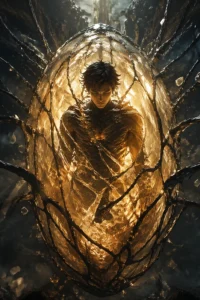
His hand moved to his chest almost unconsciously. Beneath cloth and skin, beneath the thin scar at his sternum that only he knew to fear, the black seed sat in its impossible stillness. It did not pulse like a heart. It did not hum like qi. Yet whenever his awareness brushed against it, something cold and vast seemed to open one lidless eye in the dark.
He had no desire to meet whatever Elder Wei had seen at the examination platform.
That memory returned without invitation: the crystal array brightening beneath his palm; the elders’ expressions hardening; the recording jade showing nothing at all.
No affinity. No grade. No root pattern. No weakness. No strength. Only absence.
As though heaven itself had looked into him and failed to understand what was looking back.
The intervening elder had saved him, if that was the right word. The old man’s sleeves had been plain, his face dry as old bark, his eyes half-lidded with sleepy disinterest. Yet his words had carried enough weight to cut off all argument.
“If the array cannot read him,” the elder had said, “that proves only the array has limits. Put the boy in the outer sect and see whether he explodes. If he does, report it.”
Then he had laughed softly, as if that possibility pleased him.
Nobody had given Jian Mu the elder’s name.
Nobody needed to. In a sect like Azure Lantern, men who could turn suspicion into silence with a sentence did not require introductions.
Jian Mu undid the cloth bundle at his waist and set his meager possessions on the table: a needle, thread, a flint shard, two stale cakes saved from the kitchens, and the blackened iron ring he had once found in the refuse heaps and never managed to identify. Last, he placed down the thin booklet given to all new probationary disciples.
The cover was made of common paper, but a faint spirit seal marked its corner.
Azure Lantern Sect Basic Qi Guiding Method
He looked at those characters for a while before sitting.
Outside, footsteps passed his door. Voices drifted by with the careless arrogance of those who had never had to earn the right to breathe quietly.
“That one? The empty reading?”
“I heard he bribed someone.”
“With what? Servant rations?”
Laughter.
“Senior Brother Han said to keep an eye on him. Anyone the elders spare is trouble.”
The voices moved on.
Jian Mu opened the manual.
The script inside was clear and neat. Breathing patterns. Meridian diagrams. Cautions repeated every few pages in formal language. Draw qi from heaven and earth into the lower dantian. Rotate according to the Lesser Lantern Circuit. Cleanse turbid breath. Refine pure spiritual essence. Temper the body. Warm the meridians. Stabilize the sea of qi.
To anyone born with even ordinary roots, it was painfully basic.
To Jian Mu, it might as well have been instructions for becoming rain.
He studied it anyway.
He read until the blue lantern outside his room had burned low and his eyes ached. Then he folded his legs on the straw mat, straightened his spine, and followed the opening posture described in the first section.
Inhale through the nose. Exhale through the mouth. Still the heart. Empty distracting thoughts.
He almost laughed at that. His life had never permitted the luxury of an empty mind. Hunger filled it. Caution filled it. Calculation filled it. The old habit of listening through walls filled it. The memory of fists, boots, and kitchen ladles filled it. The seed filled it most of all, a black point around which every thought eventually bent.
Still, he breathed.
The mountain’s night air entered cool, carrying resin from pine bark and the faint metallic tang of distant furnace smoke. He guided his awareness as the manual instructed, tracing a path from brow to throat to chest, descending toward the crippled hollow where his dantian should have answered.
Nothing.
He tried again, slower.
The disciples’ manuals spoke of sensing the world’s qi like warmth from sunlight on closed eyelids. Some described it as threads in water. Some as wind through silk. He had heard servants whispering similar things with awe, as if spiritual roots did not simply measure talent but determined what reality itself felt like.
Jian Mu found nothing.
No warmth. No thread. No current. No luminous breath descending from heaven and rising from earth to meet within him.
Only the ache of old damage in his abdomen and the coarse scrape of straw through thin cloth.
He sat for an hour. Then two.
The moon shifted its angle against the slit window. His legs went numb. Sweat cooled on the back of his neck.
At last he let out a slow breath and opened his eyes.
In the dim room, the manual lay beside him with infuriating calm.
Jian Mu picked it up, flipped through the pages again, and searched not for what it said but for what it assumed. Every instruction rested on a single unspoken certainty: that the body welcomed qi. That the dantian, if weak, would still respond. That spiritual energy wished to gather when invited correctly.
His body had never welcomed anything.
It endured. It adapted. It scavenged.
And the thing inside him did not gather. It devoured.
He closed the booklet and sat in silence for a long while.
If the door in front of you was built for other people, stop trying to fit your bones through it.
It was not wisdom from any master. It was simply what the alleys had taught him.
The next morning, the outer sect showed him exactly how much of a disciple he was not.
Probationary disciples were allowed a place in the dawn lecture terrace, but only at the back. They received half ration pellets. They were forbidden from entering the scripture pavilion, the weapon hall, the beast grounds, and most of the medicinal gardens. They were assigned labor under the excuse of “temperament refinement.”
Jian Mu’s labor assignment nearly made him smile.
The alchemy quarter outflow paths.
A young steward with a face like boiled dough read the assignment jade and wrinkled his nose. “Do you smell of furnace ash already, or is that just your face?”
Jian Mu bowed just enough to avoid trouble. “This one is familiar with waste sorting, Senior Steward.”
“Of course you are.” The steward flicked two fingers toward a side path. “Outer runoff channels, pill ash bins, broken talisman disposal, and herb mash pits. Do not touch marked containers. Do not ingest anything, no matter how hungry you look. If you die from stupidity, make sure you do it downhill so the smell doesn’t blow back.”
“Understood.”
“And if anyone asks, you were assigned there because of your useful experience. Not because nobody else wanted the work.”
The steward waved him off.
The alchemy quarter sprawled over three linked terraces where stone halls clung to the mountain like barnacles around heat and smoke. Bronze chimneys belched out spirals of green-white vapor. Apprentices hurried with trays of herbs and sealed gourd bottles. Fire arrays glowed beneath the open mouths of furnaces. The air was thick with so many scents at once that a lesser nose would have surrendered: bitter ginseng, scorched cinnabar, wet clay, sulfur, burnt honey, copper, blood, and that underlying medicinal sweetness that always threatened to curdle into poison.
For a heartbeat, Jian Mu was back in his old life.
Not entirely. The outer sect alchemy quarter was cleaner, more ordered, and far richer than the refuse slopes where he had spent so many nights digging with half-frozen fingers. Yet waste still had to go somewhere. The rejected things of cultivation still needed hands to move them.
That was where sects and the world resembled each other most honestly.
He spent the day hauling bins, scraping pill residue from cracked trays, draining dark runoff into designated channels, and feeding spoiled herb mash into purification pits where worms the size of fingers writhed beneath the sludge. No one spoke to him unless they had an order to give. A few apprentices looked at him with the shallow curiosity reserved for strange animals.
By midday, his robe clung damply to his back. Gray dust coated his forearms. His palms stung from lye used to clean one of the residue troughs.
It was miserable work.
It was also an education.
Ordinary qi moved through the alchemy quarter in constant streams. He still could not sense it directly as the manual described, but he could feel its effects the way a blind man felt heat through a wall. Some furnaces made the skin between his shoulder blades prickle. Some pill ash bins left a faint buzzing in his teeth. The broken talisman disposal racks crackled with remnant intent, like old lightning trapped in paper.
Not all spiritual things were equal after being rejected.
Some died quickly once their structure failed. Others lingered stubbornly, half-spoiled but not empty. The ones that lingered had a quality he could not name at first. A roughness. A wrongness. As if they had once been invited into a shape and now resented being cast out of it.
Tainted.
Discarded.
Rejected.
He kept his face blank and his hands obedient while his mind circled that realization like a starving wolf around a trap.
That evening, after the lecture terrace and the humiliation of being publicly corrected by an instructor for “slouching like a laborer,” Jian Mu returned to his room with a small cloth packet tucked beneath the inner seam of his sleeve.
Three pinches of pill ash gathered from a tray marked ruined. A sliver of blackened talisman paper whose ink had split. Dried herb mash from a batch that had fermented too long and begun to emit a faint sour vapor. Nothing valuable. Nothing enough to be missed.
He barred the door. Set the packet on the table. Sat in the dark until his breathing slowed.
Then he opened it.
The room filled at once with the scent of burnt minerals and sour roots. The pill ash glittered faintly in the blue lantern light leaking under the door, dull silver flecks among gray powder. The talisman scrap had a curled edge and one remaining line of crimson script. The herb mash looked like dead moss.
Jian Mu reached for the manual, then stopped.
No.
Tonight, he would not imitate methods made for another kind of body.
He closed his eyes and touched his awareness to the black seed within him.
At first there was only that familiar abyssal stillness. Not the stillness of peace. The stillness of deep water beneath winter ice, where light had never reached.
Then, as his attention sharpened, a sensation surfaced.
Hunger.
It was not his own. Or perhaps it had become so intertwined with him that the difference no longer mattered.
Jian Mu inhaled and placed two fingers into the pill ash.
It was cool, finer than flour, and left a metallic grit on his skin. He brought those fingers close to his nose. The scent was bitter enough to sting.
Nothing happened.
He took the ash between thumb and forefinger and pressed, feeling the residual dryness crumble.
Something in his chest shifted.
Not outward. Inward. A minute folding of dark space.
The ash on his fingertips seemed to lose weight.
Jian Mu’s eyes snapped open.



0 Comments