Chapter 1: When the Lights Went Out
by inkadminThe power died at 8:17 p.m., and the first thing Owen heard in the dark was someone eating.
Not chewing. Not the absentminded snap of gum or the crackle of chips in a vending-machine hallway. This was wetter than that, intimate and busy, the sound of soft tissue being worried apart by determined teeth.
For one stunned second, Owen thought the ambulance generator had coughed out and his tired brain had filled the darkness with nonsense. Then the dashboard went black. The streetlights outside died in a rippling chain down Halpern Avenue. The neon cross over St. Gabriel’s emergency entrance blinked once, twice, and vanished. Summer heat pressed into the cab like a damp hand.
“You seeing this?” Nia asked.
Her voice came from the passenger seat, too calm by half. Nia Bennett had been an EMT for three years and had learned the profession’s oldest trick early: if your hands were shaking, keep your voice steady and people would trust the lie.
Owen already had one hand on the radio. Dead. No static, no dispatcher, not even the comfort of useless noise. His other hand tightened around the flashlight clipped to his belt.
In the patient compartment behind them, their overdose woke with a ragged gasp and started to thrash against the straps.
“Easy,” Owen called over his shoulder. “Sir, stay still. You’re okay.”
The words were automatic. He had said them to men pinned inside burning cars and women clutching at blood-slicked bellies. He had said them to a seven-year-old with glass in her neck while her father screamed in the front yard. He had said them to people who were fine and people who were already dead and people who would die before he finished the sentence.
You’re okay had never once changed reality. It only changed the last thing some people heard.
Another sound came from outside. A cry, cut short so abruptly it might have been a switch thrown. Then running feet slapped pavement. Then more of that wet, intent chewing.
Nia turned in her seat. In the blackout, her face was a suggestion more than a shape, but Owen knew the set of her jaw. “That’s not funny.”
“I’m not laughing.”
He killed the ignition, because instinct said engine noise was a beacon and because the dark outside the windshield had somehow become larger than a city without electricity should have been. It felt deep. Not merely unlit, but depthless, as if the night had acquired another dimension while no one was looking.
The emergency entrance sat thirty feet away, glass doors sealed and blind. Usually St. Gabriel’s bled light. Usually there were idling cars, security guards smoking where they weren’t supposed to, families carrying coffee and fear through the doors. Now the driveway was a black mirror.
Something moved across it low and fast.
Nia sucked in a breath.
“Dog?” she whispered.
Owen didn’t answer. It was the wrong shape for a dog. Too many joints in the hind legs. Shoulders too narrow, spine too flexible. It crossed under the dead glow of the ambulance’s parking lights and vanished beneath the overhang.
Behind them, the overdose patient started screaming.
The sound blew the moment apart. Owen was out the driver’s door before thought caught up, boots slapping hot asphalt. The summer air smelled like oil, rain trapped in concrete, and from somewhere close, the copper-rich reek of opened blood.
Nia came around the hood with her penlight in one fist and trauma shears in the other. “You get the doors,” she said. “I’ll—”
The emergency entrance exploded outward.
One of the glass panels burst into pebbled safety cubes that sprayed across the driveway. A woman in pink scrubs staggered through the ruined doorway, hit the pavement on her knees, and scrambled toward them on raw palms. Her face was gray with shock. Something dark sheeted down the front of her uniform.
“Help me,” she gasped. “Please, please, it—”
Something hit her from behind.
Owen caught a glimpse of too-pale limbs and a slick, hairless head before both bodies slammed sideways into the ambulance. The thing on her back was man-sized and horribly wrong. Its arms were longer than they should have been, elbows knuckling backward when it landed. Its skin shone with the waxy translucence of fat left out in a butcher’s tray. Where its face should have had a nose, there were only slitted folds. Its mouth opened in a vertical seam lined with tiny moving teeth, as if the whole inside of it was trying to crawl out.
It drove its face into the nurse’s throat and began to eat.
Nia made a sound Owen had never heard from her before. Not fear. Revulsion stripped bare.
“Move!” Owen shouted.
He grabbed the mounted oxygen wrench from the side compartment and swung before the creature could lift its head. The steel cracked against its temple with a meaty thunk. It jerked sideways, skin splitting, and a spray of black fluid hit the ambulance door.
The nurse gurgled and kicked.
The thing flowed off her with insect speed and turned toward him.
Its blind face angled. The slits where a nose should have been flexed open, tasting the air. The mouth seam peeled wider, teeth whispering over one another.
Then the overdose patient in the back screamed again, and the creature snapped toward the sound.
It launched.
“No!” Nia yelled.
Owen moved without thinking. He stepped into it, took the impact in his chest, and they went down hard on the pavement. It was lighter than a man and stronger than any dog. Its limbs wrapped him in a frenzy of elbows and claws. The smell rolling off it was morgue-cold and rotten milk. Teeth rasped against his collarbone, seeking purchase.
He jammed his forearm under its throat seam and felt cartilage flex like wet wicker. Its claws raked his side. Heat flared. He brought the oxygen wrench down once, twice, a third time. The third strike caved part of its skull with a crack like stepping through plaster.
The thing spasmed. Its black blood spilled over his wrist, warm as soup.
For one impossible beat the city seemed to hold its breath.
Then screams rose from inside the hospital.
Not one or two. Dozens. A whole building discovering pain at once.
Nia hauled him upright by the shoulder strap of his uniform. “Owen. Owen!”
He was staring at the nurse. Her body twitched near the rear tire, fingers opening and closing on nothing. The front of her throat was gone.
Dead. Can’t fix dead.
He forced his gaze away and yanked open the rear ambulance doors.
The patient on the stretcher thrashed wild-eyed in the red pulse of battery-backed monitor lights. Sweat glazed his face. Naloxone had pulled him halfway out of oblivion and dumped him into a nightmare.
“What the hell is happening?” the man babbled. “What the hell is—”
“Get him unstrapped,” Owen said.
Nia whipped around. “Are you serious?”
“He screams, we die.”
She looked back at the dark hospital, where another pane of glass shattered inward. Something unseen shrieked in a register that made Owen’s teeth ache. Her mouth flattened. “Yeah. Fine.”
They cut the straps. The patient tried to bolt and nearly face-planted out of the rig before Owen caught a fistful of his gown.
“Listen to me.” Owen shoved him back against the stretcher. “You make one sound and I leave you outside. Nod if you understand.”
The man stared at him, offended, frightened, then finally nodded in frantic little jerks.
“Good.”
A shape pounded against the shattered entrance from inside. Human. The security guard, Owen thought a second before the man burst through. He was huge, broad as a refrigerator in his stab vest, one arm hanging wrong. He barreled down the driveway trailing two civilians—an elderly man in a hospital gown and a teenage girl barefoot and sobbing silently, mascara smeared into raccoon hollows.
“Inside!” the guard barked, pointing not at the ER but at a side service door tucked beneath the overhang. “Not the main lobby! Move, damn it!”
Owen and Nia got the overdose patient between them and ran.
The driveway had become a chorus of noises: distant car alarms winking on and dying, people shouting in buildings up the block, somewhere glass raining onto concrete. Above it all came the strange tearing sound that had no business in open air, like fabric being ripped by giants somewhere high overhead. Owen risked one glance upward.
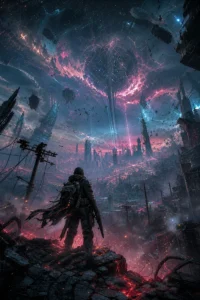
The sky above downtown had cracked.
Not metaphorically. The black over the city was scored with pale, branching fractures that spread from horizon to horizon like stress lines in glass. Through them leaked a light that wasn’t white, wasn’t blue, but some bloodless color his eyes couldn’t hold onto. It made the towers seem farther away and less real, as if they had been painted onto a sheet and the sheet was pulling apart.
The teenage girl saw him looking and choked on a sob.
“Don’t,” the guard snapped. “Eyes down.”
They hit the service door in a knot of bodies. It was propped with a rubber wedge, thank God. The guard dragged everyone through, slammed it shut, and dropped the bar into place. Metal rang. A second later something bumped the other side, light and curious, then scuttled away.
Darkness swallowed them whole.
The air inside the hospital was ten degrees warmer than outside and smelled of bleach, old coffee, and fear. A battery-powered emergency strip over the door cast a watery red wash across a narrow receiving corridor stacked with linen carts and bins of medical waste.
The security guard leaned against the wall, sucking air. Up close he looked older than Owen first thought, maybe fifty, with gray in his beard and a line of sweat cutting through the powder on his forehead. “Name’s Ruiz,” he said. “You with EMS?”
“Paramedic.” Owen pointed. “Nia, EMT. We were dropping a patient.”
“Lucky you.” Ruiz peered at the overdose man. “Is he useful?”
The patient blinked. “What does that mean?”
Ruiz looked at Owen and asked again, “Useful?”
“He can walk,” Owen said. “That’s enough for now.”
“Then congratulations, buddy, you just got promoted.” Ruiz pushed off the wall and nodded down the corridor. “Rest of us are holed up in decon on the west side. Main ER’s gone. Those things came through triage, through the fucking walls, I don’t know. They go for noise. Maybe movement too, but noise for sure. We lost a lot of people learning that.”
The elderly man in the gown whispered, “Martha.”
No one answered him.
Nia shone her penlight at Owen’s side. “You’re bleeding.”
He touched his ribs and his fingers came away slick. Four parallel cuts. Not deep enough to spill him open, deep enough to matter later. He’d had worse. He’d had better too.
“Later,” he said.
Ruiz started down the corridor at a fast crouch, gesturing for silence. They followed. Wheels of abandoned gurneys loomed from the dark like waiting knees. Somewhere nearby, an IV pump beeped a low-battery complaint until the sound cut off in a wet crunch. The teenage girl clamped both hands over her mouth. Her shoulders shook hard enough to rattle.
At the end of the corridor, the hospital opened into a loading intersection where hallways branched toward imaging, surgery elevators, and emergency. The red emergency strips were dimmer here. Enough to suggest forms. Not enough to make any of them harmless.
A body lay half in the intersection.
Human. Male. Lab coat. His legs were still in the hallway, but everything from the sternum up was a ruin. Rib ends gleamed pale through the dark. One hand twitched in little blind spasms, fingers closing as if searching for a pen.
The overdose patient made a strangled noise.
The thing under the check-in desk heard him.
It came out on all fours with impossible grace, spine humping high, bald head rotating as if listening with its entire skin. Another followed. And another. Three of them, sleek with blood.
Ruiz fired.
The muzzle flash turned the corridor into frozen daylight for a heartbeat—blood on walls, abandoned clogs, Owen’s own hand up in reflex. The first shot took one creature in the chest and spun it. The second missed. The third hit the desk behind another thing and showered the floor in laminate splinters.
Then the gun clicks became louder than the shots had been.
“Run,” Ruiz said, with the bitter calm of a man who’d just found the edge of his options.
They ran.
The hospital became a throat trying to swallow them. Shoes slapped vinyl. The barefoot girl stumbled and Owen caught her by the elbow without breaking stride. Nia shoved a rolling stool into the hallway behind them and it clattered magnificently. The creatures veered after the noise. One still came on.
“Left!” Ruiz barked.
They cut through a treatment bay. Curtains hung half-open like pale skins. A patient in bed stared at them from the dark, oxygen cannula in place, eyes huge above a wash of age spots. She lifted one shaking hand.
“Please,” she whispered.
Nia twisted toward her.



0 Comments