Chapter 10: Something Wakes Below
by inkadminThe first warning was not the siren.
It was the way the ash in the collection trays began to move.
Owen saw it while he was binding a split forearm in the old staff break room they had turned into a clinic. The patient—one of the highway crew from the afternoon skirmish, face gray with pain and stubbornness—was saying something about the bolts on the west gate when Owen’s eyes snagged on the stainless tray by the wall. The ash inside it shivered. Not from wind. Not from footsteps. It rippled in concentric rings, like dark pond water responding to a stone dropped somewhere deep beneath the earth.
Then every tray in the room answered.
A dry hiss spread through the crematorium. Fine gray dust danced across countertops and shelves, rose in thin twisting columns, and drifted toward the floor drain as if pulled by a single, invisible breath.
“Hold still,” Owen said automatically, fingers finishing the knot on the bandage even while his pulse kicked hard.
The man stared past him. “What the hell is that?”
The lights flickered.
They were not city lights—nothing in the city worked cleanly anymore—but the converted emergency rigs, battery banks, and scavenged System conduits they had bolted together into a half-functional grid. Those lights had become the closest thing the refuge had to certainty.
Now they dimmed to a sick orange glow.
From somewhere below the cremation chambers came a long, low sound, too deep to be machinery and too steady to be collapse. It was like hearing an iron door groan open at the bottom of the ocean.
Owen was already moving.
“Nia!” he shouted as he hit the hallway. “Mara! Everyone to stations. Now!”
The refuge answered with the panicked rhythm of people who had learned that hesitation got you killed. Doors slammed. Boots pounded. Someone began yelling for the children in the loading bay barracks. Another voice cut across the building, sharp and furious—Mara’s—ordering the rooftop team down from the watch positions.
The siren finally went off then, a hand-cranked klaxon shrieking through concrete corridors and tiled rooms.
It was almost a relief. The noise made it easier to believe this was only another attack.
Until the floor cracked.
It split with a report like a gunshot under Owen’s boots. He lurched back as a black line raced across the corridor tiles, spearing toward the central furnace hall. Heat came up through it in a sudden blistering gust carrying the stink of soot, scorched metal, and something older—something mineral and bitter and alive enough to make the back of his tongue numb.
Nia rounded the corner at a run, a carbine in her hands and a medic satchel slamming against her hip. Ash dusted her shaved scalp silver. “Tell me that’s one of your upgrades,” she snapped.
“If it was, I’d be lying about it already.”
She flashed him a glare that, under other circumstances, might have been almost a smile. “Good. Hate it when you’re honest.”
The building trembled again.
Mara came in from the opposite hall with two scavenged magazines hooked through her fingers and a machete strapped across her back. Blood had dried black on one sleeve from the fighting earlier, and she looked insulted by the idea that disaster had chosen to arrive before she’d had a chance to eat. “Perimeter’s holding,” she said. “If this is another wave, it’s coming from under us.”
“Not a wave,” Owen said.
He did not know how he knew. But the ash vein beneath the crematorium had been part of him since the class change, a cold pressure at the edges of thought, a reservoir he tapped whenever he shaped dead matter into wards, servitors, or fuel. For days it had felt swollen, taut as infected tissue. Now it felt like a heartbeat too large for the ground containing it.
Refuge Alert: Core Vein Instability Detected.
Subterranean Seal Failure Imminent.
Mortuary Warden Authority Recognized.
Containment Window: 00:07:43
The block of text erupted in front of him in a wash of ember-red script. No blue. Never blue. The System’s messages in Owen’s path came like words burned onto the inside of his eyes.
Mara saw his expression harden. “What did it say?”
“Seven minutes until something under the city breaks loose.”
“Can we kill it?” she asked.
Nia barked a humorless laugh. “There’s the team spirit.”
“Can we?” Mara repeated.
Owen looked toward the furnace hall, where the air was already wavering with heat. “I don’t know.”
That was the worst answer he could have given, because Mara stopped joking with her face. Nia went still. Around them, people rushed through the corridors carrying water, weapons, children, blankets—whatever instinct told them mattered when the ground itself decided to become the enemy. Overhead, dust sifted from vents in soft dry veils.
Then the old maintenance intercom crackled to life by itself.
At first it was only static. Then voices.
Not current voices. Echoes.
The tiny speaker spat out snippets of speech in broken overlapping layers—operators calling furnace temperatures, a woman weeping, a priest reciting something in Latin, laughter, coughing, a child asking where his mother had gone. Owen’s stomach turned cold. He had heard enough death-hall acoustics in hospitals and wrecks to know when sound was merely carrying and when a place was remembering.
The crematorium was remembering.
“Get everyone to the east annex,” he said. “As far from the furnace core as possible. Barricade and wait for my signal.”
“Signal for what?” Nia demanded.
“Either all-clear,” Owen said, “or run.”
“Absolutely not,” Mara said. “You are not saying that sentence and then walking into a hole by yourself.”
Another crack split through the building. Somewhere metal screamed. A pipe burst overhead and sprayed a hiss of steam that smelled faintly of old rot. The floor beneath the furnace hall sagged an inch, then another.
Owen met Mara’s eyes. She had become one of the load-bearing walls of this place—hard, brutal, impossible to move once she decided where she stood. Nia was the same in a different shape: all sharp intellect and held-together fury. He trusted both of them more than he trusted most of his own instincts.
Which was why he needed them away from what came next.
“If I don’t go,” he said quietly, “everyone in this building dies.”
Nia’s jaw flexed. “And if you do?”
He thought of the message. Containment Window. Authority Recognized. The System had waited until now to start using words that sounded almost respectful. That alone made his skin crawl.
“Then maybe only I do.”
“You’re not that lucky,” Mara said.
For half a second, despite the heat and the shaking floor and the gathering roar under the building, Owen almost smiled.
Then the furnace hall collapsed.
The tiles blew upward in a burst of shattered ceramic and cinders. A gout of black-red fire punched through the floor, not flame exactly but particulate light—ash made incandescent, spiraling in a column thick as a truck. The impact threw all three of them backward. Owen hit the wall, pain flashing white across his shoulders, and watched through watering eyes as the center of the crematorium peeled open like a wound.
Below was no maintenance chamber.
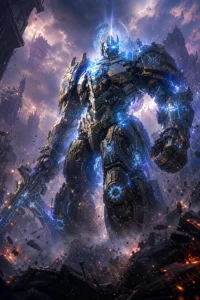
There should have been ducts, structural braces, the narrow service platform he’d used more than once to access the ash vent. Instead there was depth. Vast depth. A shaft descending through strata of brick, bedrock, rusted rebar, and impossible architecture exposed by the rupture. He glimpsed carved stone blacker than coal and links of chain as broad as streetcar rails sunk into the walls at angles that made no engineering sense. Heat rolled out of it in waves that smelled of furnace slag and grave dirt after rain.
From below came a sound like breathing.
Not animal. Not human.
Something older than both, drawing in through a throat the size of a tunnel.
People were screaming now. Owen pushed himself upright and bellowed, “Move! East annex! Move!” His voice cut through enough of the panic to start bodies in the right direction. Mara was already on her feet, shoving two stragglers toward safety. Nia hauled a stunned teenager by the collar and slapped him hard enough to restart his legs.
Good. Good.
Owen stepped toward the ragged edge of the rupture.
The heat intensified instantly, searing the moisture from his mouth. Ash spiraled around him in intimate coils, brushing his skin like the touch of dead moth wings. In the shaft below, the giant chains shuddered once, each vibration traveling up through the walls and into the soles of his boots.
Subterranean Entity Seal at 19%.
Mortuary Warden may attempt Descent and Parley.
Warning: Survival probability indeterminate.
Parley.
That was a word things used when they believed themselves stronger.
“Owen.”
Mara stood at his shoulder. Nia on the other side. Neither had obeyed him. Of course they hadn’t.
“You need to go,” he said.
“No,” Nia replied.
“Concise,” Mara said. “I respect that.”
The floor shifted again. One of the support beams over the hall snapped loose and crashed into the shaft, vanishing into the dark without striking bottom.
“Listen to me.” Owen turned to them fully. “If whatever this is comes up and I fail to stop it, you get everyone out through the east service road. Don’t hold the building. Don’t come looking. Just go.”
“You sound like a man giving instructions from inside a body bag,” Nia said. Her eyes were bright with anger and fear she would rather have died than admit to either. “I am getting tired of that.”
“Take it as medical advice,” Owen said.
Mara’s mouth flattened. “You think we can outrun what’s under there?”
He looked back into the shaft. The chains. The carved dark stone. The glow pulsing far below like a buried star beating under mountain layers. “No,” he said. “I think if I can’t stop it, distance won’t matter.”
That landed. He saw it in the small, terrible stillness that took both women at once.
Then Nia reached into her satchel, pulled out a compact emergency flare, and shoved it into his hand. “If you start seeing dead people that aren’t yours,” she said, voice rough, “light that. Pain sometimes cuts through hallucinations.”
Mara unhooked the machete from her back and offered it hilt-first.
Owen blinked. “I have a knife.”
“And this is better.”
He took it.
For one irrational moment he thought of all the ambulance bays, all the trauma rooms, all the scenes under flashing red where people had pressed tools into his hands because doing so felt like fighting. A clamp. A flashlight. Gauze. Faith shaped like an object.
Then Mara leaned in, gripped the back of his neck, and knocked her forehead once against his.
“Come back,” she said.
Nia looked away as if granting privacy to something too raw to watch. “If you die,” she muttered, “I am not inventorying your corpse constructs. I want that in writing.”
Owen almost told them something noble.
Instead he said, “Lock the east doors behind you.”
And jumped.
The shaft swallowed him in heat.
He fell through layers of air so hot they felt liquid. Ash streamed past his face, glowing red at the edges. Instinct snapped his class into motion before terror could fully root: gray sigils flared over his forearms, and dead ash surged upward around him, slowing the drop in a whirling sheath that rasped against the walls.
The stone rushing by was wrong. It shifted between city strata and older cuts that should not have existed beneath modern foundations—arches carved with flensed figures, niches full of fused bone, metal plates etched in a language that made his eyes ache. The chains threaded through all of it, disappearing downward into the glow.
Then his boots hit something solid hard enough to drive pain through both knees.
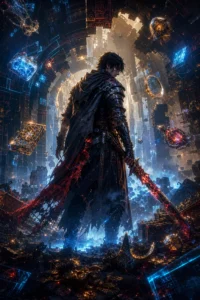
He dropped into a crouch on a circular platform of black basalt suspended over a gulf of fire-veined darkness. The impact knocked ash loose around him in dull silver bursts. Above, the rupture in the crematorium ceiling looked impossibly far away, a jagged wound rimmed with tiny figures moving frantically at its edge. Ahead, a bridge of chained slabs stretched into the dark toward an enormous gate built directly into the rock.
The gate was open.
Not wide. A seam only, perhaps three feet at its largest point. Yet through it poured enough heat to redden the chain links and make the stone sweat.
And from behind it came whispering.
Hundreds of voices. Thousands. Some crying. Some praying. Some laughing like people at the edge of a breakdown. Owen knew, in the marrow-deep way one sometimes knows a truth before any evidence arrives, that none of those voices belonged to the living.
Mortuary Warden.
The words did not come through his ears. They arrived inside his chest, vibrating his ribs.
Owen straightened slowly and raised the machete in one hand, flare in the other. “If you can talk,” he said into the dark, “you can answer questions.”
A pulse of heat crossed the bridge. Ash lifted in a circular wave around his boots.
I have answered questions for empires. For priests. For starving kings who cut open the future and begged me to make the screaming stop.
The voice was vast and intimate at once, male and female and neither. Ancient enough that words seemed like a poor medium for it.
You smell of ambulance lights and wet asphalt. Of failed resuscitations. Of hands that learned too well the weight of cooling flesh. Good. You are suitable.
Owen’s skin prickled. “Suitable for what?”
Witness.
The bridge moved.
No—memory moved through it.
The basalt under Owen’s boots rippled, and suddenly he was standing in a hospital corridor half drowned in blackout dark, hearing Mrs. Alvarez gasping against pulmonary edema while he and his partner fought to bag enough air into her lungs to buy transport time. He smelled bleach and vomit and summer rain blowing through a broken ambulance bay door. He saw her eyes on him as the monitor flattened.
He flinched. The vision shattered.
Then another took its place.
A sedan wrapped around a utility pole. Glass glittering on pavement. A little girl in the back seat with one shoe missing and blood bubbling pink from a punctured lung while her father screamed for someone to save her first. Owen’s hands slick inside nitrile gloves. The impossible arithmetic of triage.
“Stop,” he rasped.
The shaft answered by giving him more.


0 Comments