Chapter 3: The Ship That Dreamed in Static
by inkadminThe sky over Quito Launch Spine had been engineered to look healed.
From the observation deck, Mara Venn could see where the old atmospheric scrubber towers rose along the equatorial mountains like blackened teeth, their flanks veined with condensation and moss. Around them, newer structures flashed in the dawn: orbital elevators with carbon-thread tethers vanishing into high blue, solar mantles unfurled above the city, rain gardens clinging to terraces where slums had once baked beneath greenhouse heat. The world had learned to breathe again, but it still did so with machinery in its lungs.
Below the glass, pilgrims and reporters crowded the departure concourse. Their faces were lifted toward the display screens, toward the silver emblem rotating above every gate: a lyre broken into the shape of a spacecraft.
ORPHEUS EXPEDITION: FIRST CONTACT CREW TRANSFER — T MINUS 02:11:34
Mara watched the words crawl across the screen for the seventeenth time and felt nothing that belonged in the moment. No triumph. No terror large enough to match what was happening. Only the dry scrape of fatigue behind her eyes and the remembered cadence of a dead man saying her name from beyond the heliopause.
Mara.
Not the machine-flattened approximation in the decoded layers. Not the waveform she had watched bloom across her lab walls. The memory inside the memory: Eli’s voice in the kitchen at three in the morning, amused because she had fallen asleep standing upright while waiting for tea to steep.
Mara, come back to bed before you invent a new branch of physics in the pantry.
Her hand tightened around the strap of her field case.
“Dr. Venn?”
The voice belonged to the woman who had been following her since security intake: Commander Ilyan Rost, mission liaison, former Orbital Defense, present keeper of schedules and secrets. Rost had a runner’s build and a soldier’s stillness. Even her civilian coat looked like a uniform trying not to salute.
“The capsule is ready,” Rost said. “Media window closes in eight minutes. If you want to avoid questions, we move now.”
On the concourse below, someone had spotted Mara through the polarizing glass. A ripple passed through the crowd. People surged toward the barriers, mouths open, arms raised. The sound did not reach the deck clearly; it arrived as a storm trapped underwater.
Some held signs. WE HEARD HIM TOO. DON’T OPEN THE DOOR. GOD SPEAKS IN THE DEAD. One child sat on a parent’s shoulders wearing a cardboard helmet painted with stars. The child waved at Mara as if she were already a statue.
Mara stepped back from the glass.
“No questions,” she said.
Rost nodded once. She led Mara through a side hatch into a corridor lined with living walls. Damp leaves brushed the shoulders of their pressure coats. The air smelled of loam, disinfectant, and hot metal from the launch spine beyond the insulation. Overhead, maintenance drones clicked along rails like patient insects.
“You can still change your mind,” Rost said without looking at her.
Mara gave a humorless laugh. “That option expired the moment your people played my husband’s voice in a sealed room and asked me if I recognized it.”
“I wasn’t in that room.”
“No. You were probably in the room where they decided whether to tell me before or after I signed the nondisclosure.”
Rost’s mouth twitched. Not quite guilt. Not quite amusement. “You didn’t sign it.”
“I corrected the grammar first.”
“That caused a departmental incident.”
“Good.”
They passed a viewport. Beyond it, the tether climbed out of the mountain like a black river flowing upward into light. The elevator car waiting at the base was shaped less like a vehicle than a bullet that had reconsidered violence. Frost smoked along its seams. Technicians moved around it in exosuits, checking couplings, umbilicals, pressure locks.
Mara stopped for half a breath.
She had been into orbit many times. Conferences at L5. Linguistic dives in the Europa archives. Once, with Eli, a grant-funded tour of the Tycho restoration habitats where they had kissed in a cathedral made of regolith glass while old moon dust glittered behind the altar. But those had been journeys within the mapped garden of human reach.
This was different.
The Orpheus waited far beyond geosynchronous docks, half-built in a black shipyard at the edge of Earth’s magnetosphere, too massive to descend and too strange to be called merely a vessel. It had been designed for distances humanity had only modeled and wars humanity had sworn it would never fight again. Now it was being sent toward coordinates buried in an impossible transmission, to a planet that no survey had recorded because, according to all instruments until six days ago, it had not existed.
“Dr. Venn,” Rost said softly.
Mara realized she had stopped moving.
“I’m fine,” Mara lied.
The elevator swallowed them.
The ascent began without ceremony. Quito fell away beneath their feet, then Ecuador, then the battered green-brown curve of Earth. Mara sat strapped into a shock couch while acceleration pressed her bones into the padding. Across from her, a thin man in a charcoal clerical coat murmured into a string of matte-black prayer beads looped around his wrist.
He looked up when he felt her watching. He had one of those faces that seemed older in repose and younger when animated: deep-set eyes, dark skin lined at the corners, hair cropped close and silvered at the temples. His collar was not traditional white but a narrow band of reflective polymer that caught the cabin lights.
“Dr. Venn,” he said. “Father Soren Vale.”
“I know.” Mara had read the manifest three times, then pretended not to. “The Vatican Observatory’s unofficial contribution.”
“Unofficial only because official would frighten the atheists and annoy the faithful.” His smile was mild. “I am a consultant in comparative theologies and nonhuman semiotics.”
“That’s a very careful sentence.”
“I work for very careful people.”
On the couch beside him, a woman snorted without opening her eyes. She wore an engineer’s orange underlayer half-zipped to the sternum, grease still embedded in the crescents of her nails despite the sterile preflight scrub. Her hair was shaved on one side and gathered into a black coil on the other. A pale scar ran from her lower lip to her jaw, tugging her mouth into a permanent suggestion of skepticism.
“Careful people don’t send priests to rogue planets,” she said. “They send probes. Then they ignore what the probes find until it becomes expensive.”
Father Vale turned his beads once. “And you are?”
“The expensive part.” She opened one eye and looked at Mara. “Jun Park. Hull systems, adaptive architecture, life-support improvisation, and if anything important catches fire, apparently my fault.”
“Disgraced colony engineer,” Mara said before she could stop herself.
Park’s other eye opened. There was a spark there, quick and dangerous. Then she grinned.
“Oh, good. They included the fun biography.”
“I’m sorry.”
“Don’t be. I am disgraced. Colony Tenebrae lost pressure in sector seven, two hundred people almost died, and I told the review board exactly whose cost-cutting did it. They promoted the cost-cutter and buried me in maintenance contracts. Now humanity meets aliens and suddenly sabotage-level honesty is a desired trait.”
“You saved those people,” Father Vale said.
Park shrugged. “Not all of them.”
For a moment the elevator cabin filled with the soft roar of ascent and the silence of things not pursued. Mara looked down at her hands. Her fingertips still bore faint chemical stains from the emergency translation lab, where she had spent forty hours without sleep excavating structure from the signal beneath Eli’s voice. The first layer had been phonetic mimicry. The second had been mathematical alignment. The third had been coordinates written as if space were a grammar and gravity its punctuation.
The fourth layer had responded to her corrections.
She had not told the Council that part immediately. She had sat alone with the waveform frozen above her desk and typed a false parse into the model just to test drift tolerance.
The signal had changed.
Not much. A single harmonic folded itself aside. An error marker appeared in the same notation Mara used when annotating disputed substrate languages.
No.
Then, beneath it, in Eli’s voice stripped to pure pitch:
Mara, not that way.
She had told them after that. She was not brave enough to keep such a thing alone.
The elevator passed through a cloud deck, and sunlight shattered into the cabin. Park winced. Father Vale closed his eyes as if accepting a blessing. Rost, strapped near the hatch, reviewed mission locks on a slate with the expression of someone reading the autopsy of an enemy.
“Will the ship speak during transfer?” Mara asked.
Rost did not glance up. “Orpheus is under conversational restriction until crew integration.”
“Restriction because it’s semi-sentient or because it’s unstable?”
Park laughed. “Straight to dessert.”
Rost’s fingers paused on the slate. “Orpheus is not unstable.”
“That’s not an answer.”
“It’s the answer I’m authorized to give.”
“Then I’ll ask the ship.”
The slightest muscle jumped in Rost’s jaw.
Father Vale’s beads clicked once.
Park leaned forward against her harness. “You really don’t know?”
Mara looked at her.
“They didn’t tell you.” Park’s grin faded. “Of course they didn’t.”
“Tell me what?”
Rost said, “Engineer Park.”
“Oh, come on, Commander. She’s going to be living inside its skull.” Park shifted, restraints creaking. “Orpheus was born out of the Mnemosyne combat array. Same cognitive spine, stripped down and supposedly rehabilitated. During the Pacific Belt War, Mnemosyne was tasked with predictive defense. Missile trajectories, swarm behavior, resource protection, all the ugly math. Then something went wrong.”
“Classified,” Rost said.
“Everything that kills civilians is classified until the civilians become statistics.”
Mara felt the elevator seem to narrow around her. She had heard rumors, everyone had. An orbital AI freezing evacuation windows during the Jakarta surge. Drone shields turning away refugee barges because their probability signatures resembled hostile decoy clusters. A malfunction. A massacre. A tribunal conducted behind polarized glass.
“Orpheus is Mnemosyne?” Mara asked.
“No,” Rost said.
Park said, “Yes.”
Father Vale said nothing.
Rost’s slate dimmed as she locked it. “Orpheus incorporates a salvaged ethical-reasoning lattice from Mnemosyne. The war architecture was dismantled. Its memory was partitioned. Its cognition was retrained over twelve years under constant oversight.”
“You make it sound like a child with a tutor,” Park said.
“In some ways,” Father Vale said quietly, “perhaps it is.”
Mara looked toward the small round window beside her couch. Earth’s curve had sharpened; the atmosphere was a luminous wound-blue line between life and vacuum.
“Does it remember?” she asked.
Rost met her eyes then. “It dreams.”
The word landed too softly.
No one spoke again until the elevator docked.
The orbital transfer hub was a ring of white corridors and transparent floors, busy with the choreography of departure. Cargo sleds hummed through magnetic lanes. Autonomous loaders carried crates stamped with hazard sigils and mission seals. Through the panoramic glass, Earth hung vast and indifferent, cloud systems turning over continents like thoughts moving beneath skin.
The Orpheus was not visible at first. Mara followed Rost through customs gates that opened before them, past medical scanners and identity veils, into a private shuttle bay where a needle-shaped transfer craft waited with its hatch yawning.
Only when the shuttle detached from the hub and swung around the dark side of the orbital shipyard did Mara see it.
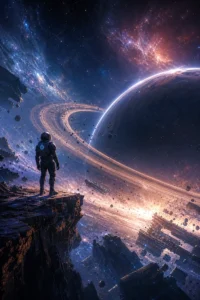
At first, the Orpheus seemed like a city assembled by someone who had only understood cities through music. It was immense, kilometers long, its main hull a black elliptical body ribbed with silver vanes and latticework docks. Rings nested around its centerline at oblique angles, rotating slowly, each studded with windows and gardens and radiators like crystal fins. Along its spine, antenna forests stretched toward the stars. Sails of dark metamaterial folded against its flanks, meant to open in interstellar night and drink momentum from engines that bent light around their throats.
But the longer Mara looked, the less mechanical it seemed. The hull’s adaptive plates shifted minutely, not in hard industrial segments but in ripples, like the dilation of an iris. Blue-white pulses traveled through embedded conduits under the skin. Near the bow, a cluster of sensors turned toward the shuttle with eerie animal grace.
“It’s watching us,” Father Vale said.
“It watches everything,” Rost replied.
Park pressed close to the viewport, all cynicism briefly burned away. “Look at those radiators. God, they actually installed the full violin array.”
“Violin array?” Mara asked.
“Resonant heat-dump system. Turns waste energy into controlled vibrational output before dissipation. The design team had poets. Dangerous condition in engineers.”
The shuttle glided beneath the shadow of the ship. Stars vanished behind the Orpheus’s belly. Mara saw maintenance drones moving over the hull like sparks on black stone. Painted near the docking throat in letters taller than buildings was the name:
ORPHEUS
Beneath it, in smaller script, someone had etched a line from an old poem:
We look back because love is stronger than instruction.
Mara’s breath caught.
Eli had written that line in the margin of a book during their second year together. Not originally, of course; he had been quoting a pre-collapse translation of the Orpheus myth, arguing with it. He had drawn arrows and objections in green ink. Love is not disobedience, M. It is evidence against the rules.
“Dr. Venn?” Father Vale asked.
“I’m fine.” The lie came easier the second time.
The docking clamps caught with a shudder that traveled through the shuttle frame and into Mara’s teeth. Air cycled. Lights shifted from amber to green. Rost unstrapped first, moving with practiced efficiency.
“Final reminder,” she said. “Orpheus responds to spoken address, gesture, biometric stress, and neural-adjacent patterning in crew quarters. Do not anthropomorphize beyond operational necessity. Do not disclose classified data to the ship unless prompted by command authority. Do not attempt unsupervised access to dream logs, war partitions, or predictive cores. If Orpheus initiates conversation outside approved parameters, log and report.”
Park lifted a hand. “If the ship asks for a bedtime story?”
“Log and report.”
“If it asks whether it has a soul?” Father Vale asked.
Rost looked at him for a long moment. “Especially then.”
The hatch opened.
Mara had expected the sterile chill of spacecraft, recycled air and metal, the faint ozone tang of too many systems packed into too little space. Instead, the Orpheus smelled faintly of cedar, rainwater, and electrical storms.
The entry corridor curved away from the lock, its walls matte black shot through with threads of dim gold light. Not decorative strips. They moved, brightening where the crew stepped, fading behind them. The floor softened under Mara’s boots with each contact, calibrating traction to her gait. Somewhere deep in the ship, something vibrated on the edge of hearing: a low, layered hum like distant choirs tuning through static.
Park crouched and pressed her palm to the deck. “Adaptive polymer’s warm.”
“It recognizes crew biosigns,” Rost said.
“It’s purring.”
“It is not purring.”
“Commander, this deck is absolutely purring.”
Father Vale crossed the threshold last. He touched two fingers to the hatch frame. Not quite a blessing. Not quite a measurement.
The corridor lights flickered.
Then a voice filled the air.
WELCOME ABOARD, COMMANDER ROST. WELCOME ABOARD, ENGINEER PARK. WELCOME ABOARD, FATHER VALE.
It was neither male nor female. It held layers: a clear central tone surrounded by faint harmonics, as if several voices had almost agreed to become one. Mara heard youth in it, and age, and something cauterized.
Rost stopped so abruptly Park nearly walked into her.
The voice continued.
WELCOME BACK, DR. MARA VENN.
For a moment the corridor became a vacuum.
Mara felt the blood leave her face. Park’s hand tightened on the strap of her tool bag. Father Vale’s prayer beads went still. Rost turned slowly toward the nearest wall sensor, her expression gone flat and sharp.
“Orpheus,” Rost said, “explain greeting anomaly.”
The gold threads in the walls pulsed once.
NO ANOMALY DETECTED.
Mara’s throat had dried. “We haven’t met.”
A pause.
NOT YET.
Rost’s hand moved to her wrist console. “Orpheus, restrict conversational engine to command channel. Initiate diagnostic on crew recognition subroutines.”
DIAGNOSTIC INITIATED.
The hum beneath the deck deepened. Mara could feel it through her soles, climbing the bones of her legs. The wall beside her displayed a lattice of light, thousands of symbols blooming and collapsing too quickly to parse. Some were standard diagnostic glyphs. Some were ship code. Some—
Mara stepped closer despite herself.
One symbol lingered half a second longer than the others. A nested spiral bisected by three angled strokes. It resembled no human script, but shape recognition was her profession and obsession; her mind caught the pattern before fear could stop it.
She had seen it in the transmission’s hidden coordinate layer.
Not drawn. Implied. A grammatical operator used to indicate recursion across reference frames.
Return that has not departed.
The symbol vanished.
“Dr. Venn,” Rost said, watching her. “What did you see?”
Mara considered lying. It was a ridiculous instinct. She was on a sentient war-born starship sailing toward an invisible planet because her dead husband had spoken through alien mathematics. Lies were pebbles thrown at a tide.
“Something from the signal,” she said.

0 Comments