Chapter 1: The Boy Beneath the Dead Moon
by inkadminThe night Liang Chen failed the spiritual root test, the dead moon opened one silver eye and looked directly at him.
He did not see it at first.
At first, he saw only the testing platform beneath his bare feet, the polished stone cold enough to bite through his soles. He saw the faces of Moonfall Village gathered around the shrine courtyard, round and eager and cruel in the yellow lantern light. He saw Elder Yu of the Azure Lantern Sect holding the bronze measuring rod as if it were a sword meant to separate the living from the already-dead.
Then he saw the rod in Elder Yu’s hand crack.
A sound like frozen bamboo splitting ran through the courtyard.
No one breathed.
The bronze rod had been pressed to the center of Liang Chen’s chest, just below the collarbones where the old village midwife claimed the spirit gate slept. For every child before him, the rod had glowed according to destiny. Little Hu San had made it shine a dull brown, an earth root of low grade but still worth a murmur. Chun Mei had coaxed green light from it, thin as spring grass. And when Zhao Feng, son of the village head, had stepped up with his oiled hair and new boots, the measuring rod had blazed blue-white, bright enough to bleach the faces of the villagers.
“Water and wind dual roots,” Elder Yu had said then, his narrow eyes warming for the first time all evening. “Middle-high purity. Acceptable.”
Zhao Feng had tried to look humble and failed so badly even the chickens watching from the shrine wall seemed offended.
But when Liang Chen stepped up, the bronze had not glowed.
It had trembled.
Then it cracked.
A black line crawled across the rod’s surface like a worm under skin. Elder Yu’s fingers tightened. The two Azure Lantern disciples behind him stiffened, their blue robes snapping in the wind that came down from the mountain pass. One of them, a young woman with a sword on her back and frost in her gaze, leaned forward with faint distaste.
“Again,” Elder Yu said.
His voice was soft. That softness frightened the villagers more than shouting would have.
Liang Chen stood still.
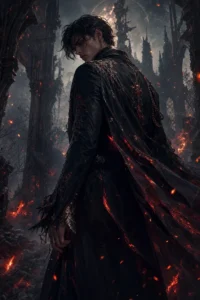
He was thirteen that winter, though hunger and weather had shaved him down to something smaller. His hair was tied back with a strip of hemp. His gray tunic had been patched so many times there was almost no original cloth left, and there were scratches on his forearms from gathering thornvine in the northern gullies. He smelled faintly of crushed mintroot, damp earth, and smoke from the orphan hut he kept alive with stolen firewood.
He looked at the measuring rod. Then at Elder Yu.
“Should I breathe differently?” he asked.
Someone in the crowd laughed. It was quickly swallowed.
Elder Yu’s mouth thinned. “Stand straight.”
Liang Chen straightened.
The rod touched his chest again.
This time, the courtyard lanterns guttered.
Cold rushed through Liang Chen. It did not enter from outside. It rose from somewhere beneath his ribs, from a place he had never been able to touch but had always known was broken. Every child in Moonfall Village had grown up hearing about spiritual roots—the hidden veins through which Heaven poured its breath into mortal flesh. Roots could be thick or thin, pure or muddied, aligned with fire, water, wood, metal, earth, wind, thunder, ice, and all stranger things that belonged to the great sects and old clans. A child with roots could draw qi, step upon the path of cultivation, and perhaps one day fly on a sword beneath the scarred sky.
A child without them tilled fields, married early, bent under taxes, and died.
Liang Chen had known since he was six that something inside him did not flow correctly.
When other children played at breathing exercises stolen from passing traders, they felt warmth in their bellies, tingles in their fingers, dreams of blue light behind closed eyes. Liang Chen felt only a scraping emptiness, as if his body were a broken bowl and the world’s qi leaked away the moment it touched him.
Still, he had climbed the east ridge every dawn to gather dewleaf. He had memorized the smell of fevercap, the shape of snakebone grass, the bitter milk that oozed from cut ghoststem. He had listened outside the healer’s hut while Old Ma muttered about meridians and medicine. He had dried herbs under his roof and ground roots by moonlight until his hands blistered. If Heaven denied him a path upward, he would at least learn every plant that grew in the mud beneath its feet.
The measuring rod’s crack deepened.
A second line branched from the first. Then a third. Black veins webbed through bronze.
The young female disciple took half a step back. “Elder Yu.”
“Quiet,” the elder said.
Liang Chen felt the cold sharpen.
For one heartbeat, pain filled him—not large, not dramatic, but intimate. A thousand hairline fractures lit within his chest and belly and spine. He saw them not with his eyes, but with the same secret awareness that knew when rain was coming from the ache in old bones. His spiritual roots were there. They existed.
They were shattered.
Not absent. Worse.
Like a tree struck by lightning, each root split, burned, curled inward. Qi touched them and scattered into useless sparks. Nothing could travel through such ruin. Nothing could grow from it.
The bronze measuring rod gave a final, brittle cry and broke in Elder Yu’s hand.
Pieces struck the stone platform and spun.
Silence fell so completely Liang Chen heard a moth beating itself against a lantern paper.
Then someone whispered, “Ill omen.”
The words moved through the crowd like spilled oil catching flame.
“Broken the immortal tool…”
“His parents died under the moon-sickness, didn’t they?”
“Shattered roots.”
“Not even mortal clean. Cursed.”
Liang Chen lowered his gaze to the bronze fragments near his toes. In one shard, his reflection looked long and warped. A thin boy. Dark eyes. Cheekbones too sharp. No tears.
He had promised himself he would not cry tonight.
Promises were easier to keep when one had nothing else.
Elder Yu lifted the broken handle. Fine dust sifted from his grip. His expression had become unreadable, carved from old ivory and colder than the wind.
“Liang Chen,” he said, and the name sounded like a sentence being recorded by an execution clerk, “age?”
“Thirteen.”
“Parents?”
“Dead.”
“Occupation?”
“Herb-gatherer. Sometimes I help Old Ma prepare medicine.”
“You have attempted qi breathing before?”
Liang Chen paused.
Lying to a cultivator was like hiding smoke in a closed room.
“Yes.”
Mocking laughter rose again, louder now that fear had found a smaller target.
Zhao Feng stepped forward at the edge of the platform, his new disciple token already tied at his waist with red cord. The token’s lacquered surface caught the lantern light. Azure Lantern. The sect that ruled the three mountain towns, seven river valleys, and every village beneath the dead moon’s shadow.
“No wonder the village qi has been thin,” Zhao Feng said. “He’s been leaking bad luck into the soil.”
The villagers laughed because Zhao Feng’s father stood behind him, broad-bellied and proud, and because the Azure Lantern disciples did not tell him to stop.
Liang Chen looked at Zhao Feng.
Zhao Feng smiled with all his teeth. “What? Did the orphan want to become an immortal? Maybe sweep their courtyard first. If you don’t break the broom.”
More laughter.
Liang Chen’s hands rested at his sides. The left thumb rubbed the callus across his palm, a habit born from grinding herbs. Once, when they were nine, Zhao Feng had pushed him into a ditch and held his head under muddy water because Liang Chen had found a patch of silverthread mushrooms before him. Liang Chen had not fought then. He had waited, counted breaths, and when Zhao Feng loosened his grip to laugh, Liang Chen had bitten his wrist to the bone.
He still remembered the taste of blood and pond scum.
After that, Zhao Feng had always mocked from a distance.
Tonight, there were cultivators between them. Tonight, Zhao Feng had wings newly sprouting from his back.
Liang Chen said nothing.
That made Zhao Feng’s smile twitch.
Elder Yu turned toward the village head. “This child’s spiritual roots are not merely low grade. They are fragmented beyond use. If he forces qi through them, he may cripple his organs or die.”
A woman gasped. Someone muttered a prayer.
The village head bowed until his hat nearly fell. “Immortal Elder is wise. We will ensure he does not trouble himself with improper dreams.”
Liang Chen’s mouth tasted of iron.
Improper dreams.
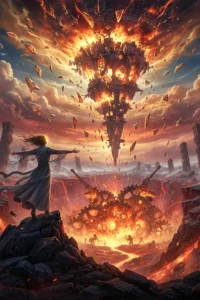
Above them, the corpse of the moon hung over Moonfall Village.
It had dominated the sky longer than any living elder could remember: a vast broken sphere, too large, too close, its silver surface cracked by black ravines. Old stories said it had fallen in the age when gods still walked among mountains and dragons drank from star rivers. It had not struck the earth. Instead, it had stopped above the northern peaks, dead yet never falling, shedding cold light and strange dust. Every year, pale meteor stones rained into the valley. Every generation, some children were born fevered, silver-eyed, or wrong in quieter ways.
Moonfall Village had grown beneath that corpse because herbs loved cursed soil. Spirit moss grew on grave stones. Pale ginseng twisted under dead moonlight. Cultivators came to buy what mortals were brave enough to harvest.
Liang Chen had spent his whole life beneath that broken face.
Tonight, it seemed larger.
Elder Yu handed the broken measuring rod to the female disciple. “Record him as unfit.”
The disciple took out a jade slip. A faint glow passed from her finger into the stone.
“Unfit,” she repeated.
The word settled over Liang Chen like snow.
Elder Yu looked past him. “Next.”
For a heartbeat, Liang Chen did not move.
Not because he hoped the elder would change his mind. Not because he expected Heaven to split open and announce an error. He simply listened to the echo of the broken rod and the laughter it had awakened.
Then he stepped down from the platform.
No one touched him. The crowd parted as if shattered roots were contagious.
He walked past Old Ma, the village healer, who stood near the incense burner with his back bent and his clouded eyes wet. The old man’s lips moved as though forming an apology, but no sound came out. Liang Chen gave the smallest shake of his head.
Do not pity me here.
Old Ma’s jaw clenched. He lowered his gaze.
The testing continued behind Liang Chen. Cheers rose for a girl with low-grade fire roots. A baby cried. A dog barked twice, then fell silent.
Liang Chen reached the edge of the shrine courtyard and stopped beside the ancient stone tortoise that guarded the path. Moss grew in the cracks of its shell. Children liked to sit on it during summer festivals. Tonight, frost silvered its head.
He looked up.
The dead moon looked back.
A line of light had opened across its broken surface.
Not sunlight. Not reflection. An eyelid of stone and ancient dust had parted along one of the black ravines, revealing a narrow silver radiance beneath. It was shaped like an eye—long, cold, and impossibly alive. Its gaze did not fall on the village. It did not fall on Elder Yu, nor the newly chosen disciples, nor the shrine with its cracked incense bowl.
It fell on Liang Chen.
His breath stopped.
The cold inside his shattered roots answered.
Not with warmth. Not with hope.
With hunger.
A pulse shuddered beneath his feet.
It was so faint that the villagers did not notice. Lantern flames leaned inward. The moss on the stone tortoise trembled. Somewhere below the shrine courtyard, deep under packed earth and old bones, something beat once like a buried heart.
Liang Chen gripped the tortoise’s stone shell.
Again.
A second pulse rose through the ground and entered his palm. Pain flashed through the fractures of his spiritual roots. He bit the inside of his cheek hard enough to draw blood, but he made no sound.
The dead moon’s eye narrowed.
Then clouds moved across the sky, thin and ragged as funeral cloth, and the eye vanished.
The courtyard noise rushed back.
Liang Chen stood very still while his blood dripped onto his tongue.
“Chen.”
Old Ma’s whisper came from behind him.
Liang Chen turned.
The old healer had followed, leaning on a cane carved from black pine. His robe smelled of camphor, smoke, and the bitter tea he brewed for coughs. Under the lantern light, his wrinkles looked cut with a knife.
“Did you feel that?” Liang Chen asked.
Old Ma glanced toward the platform. Zhao Feng’s little sister was stepping up, cheeks flushed with excitement.
“Feel what?”
Liang Chen studied him.
Old Ma’s fingers were white around his cane.
So he had felt something.
“The ground,” Liang Chen said.
“The ground is old. Old things groan in winter.”
“The moon opened.”
Old Ma’s face changed.
Only for a moment. It was like seeing a fish turn beneath dark water.
Then he snapped, too loudly, “You failed a root test, not your sanity. Keep your voice low unless you want them to mark you as moon-touched too.”
Liang Chen looked past him to the villagers. No one seemed to have noticed the dead moon’s eye. Or if they had, fear had taught them blindness.
“Come,” Old Ma said. “You should not linger.”
“The testing isn’t finished.”
“Yours is.”
The words were harsh, but the hand that closed around Liang Chen’s sleeve trembled.
They left the courtyard by the side path, through frost-stiff weeds and rows of prayer tablets leaning like broken teeth. Behind them, Elder Yu’s voice rose and fell, measuring lives. Cheers followed. So did sobs. Heaven’s favor was a feast served in public, and those who starved were expected to watch politely.
Moonfall Village crouched beyond the shrine, its mud walls and thatch roofs washed silver by the corpse above. Smoke seeped from chimneys. Spirit-drying racks stood beside houses, draped with bundled herbs that rustled like dead insects. At the northern edge, the black silhouette of Moonjaw Mountain bit into the sky, its peaks forever rimmed in pale dust.
Liang Chen’s hut stood near the herb fields, where the soil was too cursed for grain but perfect for plants that preferred misery. He had patched its roof with reeds and flattened bark. A single clay lamp waited inside. A sleeping mat. A grinding stone. Bundles of dried root hanging from rafters. Three books wrapped in oilcloth under a loose floorboard, each bought with years of saved copper: Basic Herb Properties, Common Meridian Ailments, and a torn manual called First Breaths Toward Immortality.
He wondered if he should burn the last one.
At Old Ma’s hut, however, the healer dragged him inside instead of letting him continue home.
“Sit.”
Liang Chen sat on the low stool by the medicine stove.
Old Ma shut the door, barred it, then stuffed a rag under the threshold. He checked the paper windows. Only then did he light three sticks of bitter incense and plant them before a small wooden tablet with no name carved upon it.
Liang Chen watched.
“That’s not for the village ancestors.”
“No.”
“Who is it for?”
Old Ma did not answer. He took a clay cup, poured steaming black tea, and pushed it into Liang Chen’s hands.
“Drink.”
“Will it fix shattered roots?”
“It will keep your tongue from running wild.”
Liang Chen drank. The tea was so bitter his eyes watered. He welcomed the sting. It gave his body something ordinary to endure.
Old Ma sat opposite him with a slow exhale. For a while, only the stove spoke, popping softly as dried twigs collapsed into coal.
Finally, the old man said, “When your mother was pregnant with you, the moon rained for seven nights.”
Liang Chen’s cup stilled.
No one talked about his parents unless they had to. The village preferred its tragedies simple: fever, burial, orphan, done.
“Silver stones fell into the fields,” Old Ma continued. “Most were cold by morning. One was not. Your father found it near the shrine after the seventh night. Small thing. Blacker than iron, edged with silver. It burned through the shovel head.”
Liang Chen listened with the stillness of a snare.
“He brought it to the village head?”
Old Ma gave a humorless smile. “Your father was kind, not stupid. He brought it to me.”
The stove cracked.
“What was it?” Liang Chen asked.
“Star-metal.”
The word entered the hut like another person.
Liang Chen had heard of star-metal in trader stories. Fragments that fell from beyond the heavens. Materials used by great sects to forge flying swords, soul bells, spirit furnaces. A sliver the size of a fingernail could buy a village. A fist-sized piece could summon bandits, cultivators, and wars.
“Where is it?” he asked.
Old Ma’s eyes sharpened. “Buried where greed cannot easily dig.”
“Under the shrine.”
The old healer’s silence answered.
Liang Chen looked toward the barred door, toward the distant courtyard and the stone beneath it.
The pulse.
“Why tell me now?”
Old Ma rubbed his face. For the first time that night, he looked not old but exhausted by the effort of surviving too many years beside a secret.

0 Comments