Chapter 6: The Outer Court Wolf
by inkadminThe morning after Elder Su spared him, frost lay over the outer court like powdered bone.
Liang Chen woke before the bell. The straw mat beneath him had soaked through with the night’s damp, and the little room assigned to the servants breathed cold from every crack in the walls. Four other boys slept in huddled shapes under threadbare quilts, their breath pale in the gloom. A mouse scratched behind a loose brick. Somewhere beyond the paper window, wind dragged dead bamboo leaves along the stones with the dry whisper of scales.
Chen sat up slowly.
Pain bloomed.
Not pain from injury—not the sharp, honest sting of split skin or bruised bone. This was deeper. It lived in the places where his shattered spiritual roots twisted through his flesh like broken glass veins. After last night’s desperate refinement in the forbidden furnace, those roots no longer merely ached. They smoldered.
Each breath fed embers hidden behind his ribs.
He closed his eyes and listened inward.
There, beneath the flutter of his pulse, something moved like a star being ground between millstones. Faint. Hungry. Patient.
Failure is ore.
The phrase had come to him in the dark hours before dawn, not spoken by a voice and yet too clear to be imagined. It settled into him with the weight of an ancient law.
Failure was ore. Pain was fire. Humiliation was bellows.
The furnace mark on his left palm was hidden beneath a strip of gray cloth, but warmth seeped from it all the same. Chen flexed his fingers. The warmth answered, not like obedience, but like a beast lifting its head after smelling blood.
He stilled it at once.
The Azure Lantern Sect was waking.
A bell rang from the inner mountain, its voice deep and clean, rolling over tiled roofs and pine groves. At once the outer courtyard stirred. Doors opened. Buckets clattered. Servants coughed and cursed softly as they stumbled into the cold. From the distance came the measured chanting of outer disciples beginning their dawn breathing exercises, each syllable polished by arrogance and years of instruction.
Chen rose, folded his mat, and wrapped his thin servant robe tighter around him. Its sleeves were patched at the elbows. Its hem had been washed so often it had turned the color of rainwater. Beside the door, a wooden basin waited with a skin of ice across its surface.
He broke the ice with two fingers and washed his face.
The cold bit. The furnace within him swallowed the sensation.
For one terrifying instant, the chill did not fade—it became fuel. A thread of pale force slipped beneath his skin, wound through his meridians, struck the ruined knots of his spiritual roots, and vanished into the furnace warmth in his palm.
Chen froze, water dripping from his chin.
A servant boy named Mo Yun blinked awake on the nearest mat. He was broad-faced, twelve or thirteen, with cheeks still soft from childhood despite the labor that had already bent his shoulders. “Brother Chen? You alive?”
“I am washing.”
Mo Yun squinted. “You looked like you saw a ghost.”
Chen wiped his face with his sleeve. “Only myself.”
“That bad?”
Chen glanced at him.
Mo Yun grinned, then winced as he pulled on his shoes. “Don’t look at me like that. Makes a man feel he owes the heavens money.”
“We do,” muttered another servant from beneath a quilt. “We were born.”
The room fell briefly quiet.
No one laughed at that.
Outside, the eastern sky had begun to pale behind the corpse of the fallen moon.
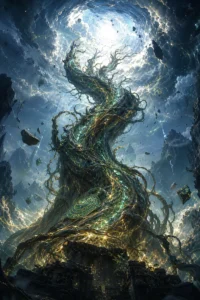
It hung beyond the sect peaks like a broken white continent suspended in heaven, its surface split by black ravines wide enough to swallow cities. Even by day, it did not fade. It watched the Nine Provinces with a blind and ruined face, and beneath its gaze the Azure Lantern Sect climbed the mountain in rings of privilege: servant quarters at the muddy foot, outer court above them, inner halls higher still, and the mist-hidden peaks of elders where lantern flames burned blue even in sunlight.
Chen had grown up in a border village beneath that same dead moon. As a child, he had thought it a sleeping god. Later, after famine and fever took everyone who would have corrected him gently, he learned that gods did not sleep. They fell. They rotted. Their corpses became omens for mortals to fear.
He took up his broom.
The handle fit his palm with familiar smoothness. Before the furnace, before Elder Su’s eyes had narrowed over his wrist, before the forbidden inheritance had named hunger a path, this broom had been the measure of his days. Sweep the east courtyard before the disciples passed. Scrub the alchemy hall steps if pill ash stained them. Haul water. Sort herb refuse. Keep his head low when robes with azure hems crossed his vision.
That morning, every sound seemed too clear.
The scrape of broom straw over stone. The resinous snap of pine branches in the wind. The distant hiss of steam from the pill kitchens. Even the whispers of other servants carried through the courtyard like threads pulled taut.
“Did you hear? Elder Su came down herself last night.”
“For him?”
“Who else? Liang Chen was caught near the refuse pit.”
“I heard he swallowed rotten pills.”
“Rotten pills? With his roots? He should be dead.”
“Maybe he is. Look at him.”
Chen swept around a stone lantern carved with cloud patterns. He did not turn.
The whispers mattered less than they should have. Once, he had guarded his small dignity like a beggar guards a winter coal. Now humiliation no longer merely burned. It could be refined.
That thought frightened him more than the whispers.
A path that made suffering useful could teach a man to seek suffering. A furnace that devoured pain might one day hunger for screams. Chen’s hand tightened around the broom.
No.
The Dao could devour stars. It would not devour his heart.
The outer court began to fill as sunrise bled gold over the tiled roofs. Disciples in gray-blue robes crossed the courtyard in clusters, their belts marked with small copper lanterns. They carried wooden practice swords, jade tablets, bundles of scripture. Most ignored the servants entirely. A few wrinkled their noses as if passing livestock pens.
Then the air changed.
Conversation thinned. Servants lowered their gazes. Even several outer disciples stepped aside with sour expressions they did not dare make openly.
Han Rui came through the eastern arch.
He was not the strongest outer disciple. He was not the most talented. His spiritual roots were middling, his family minor, his future narrow enough that even flattery could not make it grand. But in the outer court, where boys with shattered roots and girls sold by starving clans carried water until their fingers split, Han Rui was a wolf among tethered goats.
He wore his disciple robe loose at the throat to show a corded neck and a pendant shaped like a tiny iron fang. His hair was tied high with a strip of red leather. A bruise yellowed along his jaw from some recent sparring defeat, and perhaps that was why his eyes looked especially mean that morning.
Two followers trailed him: thin Liu Pei, who laughed before jokes were made, and square-shouldered Guo Sheng, whose silence was the silence of a stick waiting to be swung.
Han Rui stopped in the middle of the courtyard and clapped his hands.
“Rent day.”
The word cracked louder than the bell.
A line of servants stiffened near the well. Mo Yun, who had been hauling ash buckets, went pale beneath the soot on his cheeks.
Han Rui smiled. “Don’t all rush at once. I know gratitude overwhelms the low-born.”
No elder had assigned rent. No sect rule allowed outer disciples to take spirit coins, food tokens, or pill fragments from servants. But the outer court had rules written on paper and rules written into bruises. Paper rules lived in archives. Bruise rules lived everywhere.
An elderly servant named Auntie Wu shuffled forward first. Her back was bent like a bow left strung too long, and her hands trembled as she took three copper bits from her sleeve. “Young Master Han, this old woman has only—”
Han Rui slapped the coins from her palm.
They rang across the stones, tiny and bright.
“Copper?” His smile widened. “Do I look like a beggar?”
Auntie Wu flinched. “My food tokens were taken last week. I can repay after—”
“After?” Han Rui leaned close. “After you die? That would be inconvenient. I dislike chasing debts into the Yellow Springs.”
Liu Pei giggled.
Chen’s broom stopped.
Across the courtyard, Mo Yun caught his eye and shook his head once, sharply. Don’t.
Chen looked at Auntie Wu’s trembling hands. He looked at the copper coins scattered near Han Rui’s boots.
The furnace warmth stirred.
Not yet.
He resumed sweeping.
Han Rui moved down the line, collecting little tributes with the bored cruelty of someone peeling fruit. A half steamed bun from one servant. Two food tokens from another. A chipped piece of low-grade spirit stone from a girl who began crying before she handed it over. Han Rui made her thank him for accepting it.
When he reached Mo Yun, the boy swallowed so hard his throat bobbed.
“Brother Han,” Mo Yun said, forcing a grin that looked nailed to his face. “I have something good today.”
He took out a small paper packet.
Han Rui snatched it and unfolded the paper. Inside lay gray powder—the residue scraped from the bottom of pill cauldrons, sometimes sold among servants for warmth in winter or hallucinations in despair.
Han Rui’s expression flattened. “Ash?”
“High quality ash,” Mo Yun said quickly. “From the Bone Mending Pill batch. Smells medicinal, doesn’t it?”
Han Rui backhanded him.
The sound was wet and loud. Mo Yun stumbled, hit the well curb, and collapsed to one knee. Blood slid from the corner of his mouth onto the frost.
“Do you think I am a dog,” Han Rui asked softly, “that you feed me scrapings?”
Mo Yun pressed a hand to his cheek. His eyes shone, but he did not cry. “No, Brother Han.”
“Then bark and explain why you offered dog food.”
Liu Pei bent double laughing. Guo Sheng smiled without showing teeth.
The courtyard held its breath.
Mo Yun’s face changed. Shame flooded through it in blotches of red. His gaze darted to the other servants, to the disciples pretending not to watch, to Chen standing by the stone lantern with his broom.
“Brother Han,” he whispered.
Han Rui cupped a hand behind his ear. “What was that? Did the dog learn to speak?”
Mo Yun’s lips trembled.
Chen leaned his broom against the lantern.
The small motion seemed to thunder in his own ears.
Mo Yun saw him and shook his head again, more desperate this time.
Chen walked forward.
At first no one understood what he was doing. Servants did not walk into the center of the courtyard while Han Rui was collecting rent. Servants flowed around danger like water around a rock. Chen’s steps were neither hurried nor dramatic. His worn shoes made soft scuffs on the frost-damp stone.
Han Rui turned when Chen was five paces away.
Recognition sharpened his gaze. Then delight.
“Ah.” He looked Chen up and down. “The trash-eater.”
A murmur passed through the watching crowd.
Chen stopped beside Mo Yun. “He has nothing else.”
Han Rui blinked. Then he laughed, once. “Did I ask you?”
“No.”
“Then why is your mouth open?”
Chen bent, picked up the scattered copper coins Auntie Wu had dropped, and placed them neatly on the well curb. His movements were unhurried. He could feel every stare like needles pressing into his skin.
Han Rui’s smile thinned. “You have grown bold since stealing from refuse.”
“I was hungry.”
“Hungry.” Han Rui rolled the word on his tongue. “Listen to this. A servant eats sect trash, survives by luck, and thinks the heavens have kissed his forehead.”
Liu Pei chimed in, “Maybe the trash improved his roots.”
Several disciples laughed.
Chen said nothing.
Han Rui stepped closer. He was taller by half a head, broader through the shoulders, his body hardened by years of martial drills and Qi circulation. Faint spiritual pressure leaked from him—not much, merely the aura of someone at the third layer of Qi Condensation, but to ordinary servants it pressed like a hand on the chest.
Chen felt it wash over his broken roots.
Once, such pressure would have left him breathless.
Now the shattered places inside him rang softly, like cracked bells struck from afar.
The furnace inhaled.
Chen lowered his eyes before Han Rui could see the flicker in them.
“Kneel,” Han Rui said.
Mo Yun whispered, “Brother Chen…”
Han Rui glanced at him. “Quiet, dog. Your friend wants to speak for you. Let him do it from the proper height.”
Chen’s fingers curled.
The memory of Elder Su’s hand on his wrist returned: dry, light, impossible to shake off. Her eyes had watched his pulse as if seeing a flame through skin.
Hide.
If he struck now, if he revealed anything strange, questions would come. Elder Su’s questions had been knives wrapped in silk. Others would use iron.
He looked at Auntie Wu. At the crying girl clutching her empty sleeve. At Mo Yun, blood on his chin, trying not to meet anyone’s eyes.
Endure.
Chen knelt.
The frost soaked through his trousers at once. Cold bit his knees. The courtyard released a long breath, relief and disappointment mingled together.
Han Rui’s boot appeared before him.
“Good.”
The first kick caught him in the ribs.
It lifted him sideways and drove the air from his lungs. Stone struck his shoulder. The world flashed white around the edges.
Laughter burst from Liu Pei. Someone gasped. Mo Yun cursed and lunged, but Guo Sheng planted a foot on his back and forced him down.
Chen lay on the cold stone, mouth open, unable to breathe.
Pain unfolded through him.
Hot. Jagged. Bright.
The furnace mark beneath his bandage burned.
Pain is fire.
He did not move. He did not reach for the pain. He simply allowed it to exist.
The heat in his ribs gathered into a thread. It slid inward, not through meridians as ordinary Qi did, but through the cracks between them. His shattered roots, useless to orthodox cultivation, caught the pain like broken teeth catching meat. The furnace pulled.
A tiny ember formed beneath his sternum.
Chen sucked in a breath.
Han Rui crouched beside him. “You should thank me. I am teaching you where servants belong.”
Chen pushed himself back to his knees.
Blood tasted metallic beneath his tongue. “Thank you for your instruction.”
Han Rui’s eyes narrowed. The words had been obedient, but the tone—too calm. Not defiant. Worse. Unmoved.
“Again,” Han Rui said.
This time he punched.
His fist struck Chen’s cheekbone with a crack that snapped the watching servants silent. Chen’s head whipped aside. Blood sprayed onto the frost in a red crescent. His vision split into two courtyards, both spinning.
The pain came sharper than before.
It entered like lightning through the skull, exploded behind his left eye, and spilled down his neck in molten lines.
The furnace devoured.
Not all. Never all. Enough remained to make him human, to make the world real. But beneath the agony, something refined. The ember under his sternum brightened.
Chen swayed, then straightened.
His cheek was already swelling. Blood slid from his nose over his lips. He swallowed it.
The taste woke the inheritance further.
For a heartbeat, the courtyard vanished.
He saw black sky. Not night—the absence before night was born. Across that void hung chains of stars, each immense, each singing with cold fire. Then something opened beneath them. A mouth? A furnace? A law older than both. Stars bent. Their light stretched into threads and vanished screaming into hunger.
Chen blinked.
The courtyard returned.
Han Rui stood before him, breathing slightly harder. “Still looking calm?”
Chen said nothing.
“Good. I dislike unfinished lessons.”
The blows became a rhythm.
A palm to the ear that turned sound into thunder. A kick to the thigh that numbed his leg from hip to ankle. A fist buried in his stomach, folding him over so bile burned up his throat. Each time, Han Rui gave him a chance to fall. Each time, Chen returned to his knees.
The courtyard changed with every blow.
At first there was laughter. Outer disciples enjoyed small cruelties when they required no commitment. Then laughter thinned. The servants watched with faces drawn tight, fear shifting into something more dangerous: witness. Even Liu Pei’s giggles became uncertain.
Han Rui noticed.
His blows grew heavier.
Spiritual force seeped into the next punch.
It struck Chen’s shoulder like an iron mallet. Something tore. His arm went limp. The force burrowed beneath his skin, seeking meridians to disrupt, roots to pressure. In a normal cultivator it would have clogged circulation and caused vomiting blood. In Chen, it found ruins.
Broken roots welcomed intrusion like collapsed mines welcoming rain.
The hostile Qi scattered through him, cutting and burning. Chen nearly screamed. His teeth sank into his tongue until blood filled his mouth.
The furnace mark flared beneath the cloth.
The hostile Qi did not vanish. It was ground. Its edges broke. Pain and foreign force swirled together, dragged through the invisible furnace inside him, reduced to a dark, grain-sized spark that fell into his dantian like a coal into ash.
Chen trembled.
Not from fear.
From the effort of not smiling.
His dantian, long stagnant, flickered.
A single wisp of black-gold energy curled there, thin as hair and heavy as night.
Star-Eating Qi: one thread.
The words appeared in his mind like characters branded onto darkness.
Chen’s heart lurched.
System? Scripture? Memory? The inheritance did not explain. It named, and the name became true.
Han Rui grabbed his hair and yanked his head back. “What are you hiding in those eyes?”
Chen stared up at him through blood and swelling. The sky behind Han Rui was pale blue. The dead moon hung above his shoulder, cracked and indifferent.
“Nothing,” Chen said.
Han Rui’s face flushed.
He had wanted begging. Tears. At least hatred. Calmness denied him the shape of victory. It made his cruelty look like effort.
“Then bark,” Han Rui said.
Chen remained silent.
“Bark.” Han Rui jerked his hair harder. “For every servant here. Bark, and I’ll forgive Mo Yun’s debt.”
Mo Yun, still pinned beneath Guo Sheng’s foot, shouted hoarsely, “Don’t! He’s lying!”
Guo Sheng pressed down. Mo Yun’s shout broke into a gasp.
Han Rui smiled. “Bark, trash-eater.”
Chen looked at Mo Yun.
There were many kinds of humiliation. Some were light and could be worn like dust. Some entered the bones. He had endured hunger, pity, contempt, and the quiet way people looked through him when discussing the future.
But to bark on command before those who shared his mud and hunger would not only wound him. It would teach them their spines were mistakes.
His silence lengthened.
Han Rui’s grip tightened.
“Fine.”
He lifted his hand. Qi gathered around his knuckles, pale and visible now, a thin frost-like glow. The watching disciples stirred. Using Qi against a servant was not forbidden if called discipline, but visible Qi meant intent. Bones could break. Organs could rupture. A dead servant caused paperwork, not grief.
Mo Yun thrashed. “Brother Han! I’ll bark! I’ll pay! Hit me instead!”
Auntie Wu covered her mouth.

0 Comments