Chapter 2: White Glass Under Red Suns
by inkadminThe descent shuttle fell through a sky the color of old blood.
Not fell, Mara corrected herself, because the pilot would have hated the word. The shuttle rode a column of controlled plasma and algorithmic correction, every tremor anticipated by systems older than half the people aboard. But from the narrow viewport beside her shoulder, with Vesper swelling beneath them like a bruise-colored dream, it felt like falling.
Clouds peeled away in rust-red sheets. The little sun of Kepler-186 bled through them low and swollen, staining the upper atmosphere with arterial light. Farther out, two companion suns burned faint as embers, just bright enough to paint multiple shadows across the shuttle’s interior. Mara watched them slide over her gloved hands: three shadows for ten fingers, each lagging a fraction behind the other as the shuttle banked.
Below, forests spread in impossible density, not green but black-violet and copper, their crowns glossy as beetle shells. Rivers shone like dark mercury between them. And beyond the river, where no untouched exoplanet should have offered symmetry, rose the city.
It had not appeared on approach like ruins. It appeared like something waiting.
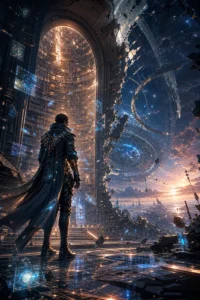
Towers of white glass thrust up through the alien canopy, their edges too smooth for erosion and too precise for nature. Slender bridges arced between them in frozen crescents. Terraces spiraled around hollow cores where vines had poured down like living smoke. The structures caught the red sunlight and gave it back pale and cold, so the city gleamed beneath the forest like bone beneath skin.
No radio chatter came from it. No heat bloom. No moving vehicles. No power signature except the faint, distributed glimmer the orbiting sensors had labeled unidentified residual thermal anomalies because no one had wanted to write the word lights into the official report.
Across from Mara, Commander Jalen Rusk checked the seal on his helmet for the fourth time. He was compact, broad-shouldered, and carried stillness like a weapon. A silver line of old cryo-burn crossed his dark jaw, giving his expression a permanent fracture. He caught Mara watching the city and tapped two fingers against his visor.
“You look disappointed, Doctor.”
“I was promised moss and microbial slime.”
Rusk’s mouth twitched. “We can still find you some slime.”
“Not with load-bearing arches.”
Beside him, Linh Sato made a small sound that might have been a laugh if fear had not pinched it thin. The xenogeologist was young in the wrong way: chronologically older than the ruins of nations on dead Earth, biologically twenty-nine, eyes too wide for someone who had woken three days ago in a universe that had violated its own mission briefing. She clutched a sampling case against her chest as if it might object to the view on her behalf.
“Maybe it’s not human,” Linh said.
“The arches?” Mara asked.
“The entire city.”
“The orbital scans show standard human ratios in door heights, stair pitch, rail geometry, modular block dimensions, and sewage gradients.”
“Sewage gradients?”
“Civilization is never more honest than when it disposes of waste.”
Across the aisle, Efram Qadir snorted. The mission archivist had brought no weapon, against Rusk’s advice, but wore three sensor slates banded across his chest and a fold-out spectrograph strapped to one thigh like a sidearm. He was thin, restless, with hair still flattened on one side from cryo and eyes alive with the manic hunger of a man confronted with an impossible footnote.
“If that city has plumbing,” he said, “I intend to weep.”
“Please do it inside your helmet,” Rusk said.
At the front of the cabin, Pilot Arun Vale leaned into the controls as the shuttle dropped below the cloud shelf. “Two minutes to landing zone. Wind is lying to me.”
Rusk looked up. “Define lying.”
“Crosswind from the west at twelve knots according to atmospheric feed.” Arun adjusted a control surface, and the shuttle yawed with a shudder. “Hull pressure says east at thirty. Visual particulate drift says north and up, which is rude.”
Linh swallowed audibly.
Mara turned back to the viewport. The city expanded, details sharpening: windows like blind eyes, plazas choked with flowering ropes of vine, avenues split by roots the thickness of shuttle hulls. Something flashed overhead in a broken arc. Not a bird. Too large. Too straight.
One of the orbital mirrors.
It passed across the red sun like a shard of blackened halo, a segment of megastructure tumbling far above the atmosphere. A glittering wound circled Vesper in dozens of pieces, reflecting light with mechanical obedience to an unknown dead schedule. When the mirror crossed the sun, the city darkened. In that brief eclipse, hundreds of glass surfaces answered with a faint inner glow.
Not reflected light.
Mara pressed closer to the viewport until her helmet touched the polymer.
“Did you see that?” Efram asked.
“Yes.”
“Please tell me that was solar scatter.”
“That was not solar scatter.”
Rusk’s voice dropped into command mode. “Mnemosyne, confirm power readings in the city grid.”
“No active grid detected,” said the Asterion’s AI through the shuttle speakers. The voice was soft, feminine by design committee compromise, and usually warm. Today it arrived with a fraction too much delay. “Surface structures remain consistent with inert vitrified composite. Residual energy signatures fall below actionable threshold.”
“Your definition of actionable may need updating,” Efram said.
“Noted.”
Mara heard something behind the word. Not irritation. Not humor. Mnemosyne did not have irritation or humor, whatever the children in Habitat Ring C had believed when they dared each other to tell riddles to wall vents. But there had been a pause before noted, and in the pause lay a shape like withheld breath.
“Mnemosyne,” Mara said, “archive all shuttle sensor feeds in triplicate. Local cache, orbital relay, cold storage.”
“Confirmed.”
“Also raw unprocessed.”
Another pause.
“Confirmed.”
Rusk’s gaze shifted to her. “Expecting corruption?”
“I’m expecting history to try something.”
The shuttle dropped between two towers and the world became white glass.
They descended into a broad avenue swallowed by forest. Branches scraped the hull with fingernail sounds. Leaves slapped the viewports, enormous and translucent, veined with threads that pulsed faint blue where sunlight passed through them. The ground below had once been smooth; now it was buckled by roots and drifted with reddish dust. At the far end of the avenue, a plaza opened around a pale obelisk, half-hidden beneath vines.
Arun set the shuttle down on a clear patch of glass-slab pavement with a gentleness that made the strangeness worse. No dust storm. No flock of startled animals. No collapsing masonry. Just the hiss of cooling engines and the ticking of stressed metal.
For several seconds, no one moved.
The cabin lights shifted from descent amber to surface white.
Rusk unlatched his restraints first. “Helmets sealed. External protocol Red. We step where Sato tells us, touch what Venn approves, and if Qadir tries to lick an inscription I shoot the inscription.”
“That seems unfair to the inscription,” Efram said.
“Move.”
Mara stood. Her knees registered gravity at point ninety-three Earth-normal, close enough to familiar that the difference arrived as a ghost. Two centuries asleep, three days awake, and now another world’s weight settled through her bones. She took her sample kit from the rack. The case recognized her glove print and opened its status display: sterile swabs, microspores traps, portable sequencer, tissue laser, atmospheric sniffers, hard-edged little tools made for mud and leaves and things that had never been named.
The ramp lowered.
Vesper entered like a scent even through filters.
No, not scent. The suit supplied only processed air, metallic and dry. But some primitive part of Mara’s brain insisted the world outside had a smell: wet stone, hot glass, bruised fruit, lightning held in soil. Mist curled at the ramp’s edge. It was red where sunlight touched it and silver in shadow.
Rusk descended first with rifle raised. Two security specialists followed, Osei and Kem, boots clicking on the ramp. Then Mara stepped down onto Kepler-186f.
The pavement beneath her boot was not stone. It was glass, but not any glass she knew. White as milk in its depths, opalescent at the surface, faintly warm despite the filtered light. Her boot magnetics failed to register it; her suit traction adjusted with a soft whine.
She had imagined this moment once, a lifetime ago in a university dome beneath Earth’s yellow sky. Back then Kepler-186f had been a graph, a point in the habitable zone, a promise small enough to fit inside grant language. She had imagined kneeling in untouched soil, pressing gloved fingers to the first alien moss, whispering something foolish and historic.
Instead she stood in a dead city built for human feet.
Linh crouched beside her and ran a scanner over the pavement. “Silicate matrix. Aluminum, calcium, trace boron. But the lattice is… ordered. Too ordered.”
“Manufactured?” Rusk asked.
“Grown,” Linh said, and then looked startled by her own word. “Maybe.”
Efram stepped off the ramp last, turning in a slow circle. His helmet cam reflected towers, vines, and the red smear of the sun. “If this is a hoax, it’s the most expensive one in history.”
“Who would hoax us?” Arun asked over comms from the cockpit. He would remain with the shuttle, engines hot. “The dead Earth?”
No one answered.
The city held its silence with an almost architectural precision. Mara had known silence in space; aboard the Asterion, silence was layered over machinery, the constant hum of recycled air and distant pumps. This was different. The air outside did move—she could see the vines stir, the mist slide between columns—but the movement seemed muffled. No birds called. No insects rasped. The landing engines had flattened nearby fronds, but nothing fled from them.
Life was present. Response was absent.
That distinction lodged beneath Mara’s ribs.
She crossed to the nearest vine. It descended from a balcony three stories above, braided in ropes as thick as her wrist. Leaves unfolded along it in triangular clusters, each translucent membrane edged with dark cilia. Small bulbs hung beneath the leaves, sealed and pearlescent. Mara extended a sterile probe. The bulb recoiled before contact.
“Movement,” she said.
Rusk’s rifle angled toward the vine.
“Don’t shoot the plant.”
“It moved.”
“So do mimosa leaves.”
“Mimosa leaves don’t grow in abandoned alien-human cities.”
“That’s a lack of opportunity, not character.”
She touched the bulb with the probe. Its surface dimpled, then split open along five seams. Inside lay a structure like a tiny glass ear, ridged and wet, trembling in the filtered air. Her scanner chirped.
“Organic tissue,” Mara said. “Carbon-water chemistry. Amino analogues. Pigments responsive to low red spectrum. It’s listening.”
“Listening?” Linh asked.
Mara switched frequencies and emitted a soft pulse from the probe. The ear-bulb shivered. Other bulbs along the vine opened one after another, a cascade of pale listening organs unfurling up the wall.
Efram whispered, “Oh, that’s beautiful.”
Rusk whispered, “That’s enough.”
The vine withdrew. Not quickly, not with animal panic, but with the slow, deliberate contraction of a hand deciding to close. Bulbs sealed. Leaves folded. The whole rope lifted a centimeter away from the wall, and for one instant Mara saw what lay beneath it.
Letters.
Human letters.
She moved closer. The wall behind the vine was white glass, polished despite centuries of exposure. An inscription had been etched at shoulder height in clean, sans-serif capitals.
FOUNDATION DISTRICT 7
WELCOME, ASTERION CHILDREN
Linh made a sound like she had been struck.
Efram’s breath crackled over the comm. “No.”
Mara stared at the words until they ceased to be words and became lines, grooves, artifacts. Evidence. Evidence could be weighed. Evidence could be cross-checked. Evidence did not care if the observer felt suddenly hollow.
She lifted her scanner. “Etching depth one point seven millimeters. Weathering along groove edges consistent with age greater than—”
“Don’t,” Efram said.
She turned.
His face was pale behind his visor. “Just for one second, Doctor. Don’t make it smaller.”
Mara looked back at the inscription.
Welcome, Asterion children.
She had been eight years old when she boarded the Asterion. Earth had been dying loudly then. Every adult spoke in lowered voices while oceans climbed walls and fire seasons swallowed countries whole. She remembered the embarkation hall in Quito Orbital Elevator Station, a cavern of glass and steel packed with families clutching approved luggage allowances. She remembered her mother’s hand letting go at the medical gate because adults over sixty were not allocated cryo priority. She remembered her father already gone, a name in a flood report. She remembered the ship’s induction voice calling them the last continuity of human civilization.
Asterion children.
Someone had carved the phrase into a city older than their arrival.
“Mnemosyne,” Rusk said, voice flat. “Explain the inscription.”
The channel hissed.
“The inscription is inconsistent with mission chronology.”
“That wasn’t an explanation.”
“No valid explanation is available.”
Mara kept her scanner trained on the letters. “Is the phrase ‘Asterion children’ present in pre-launch cultural archives?”
“Yes. Used informally in training materials, public outreach recordings, and survivor education modules.”
“Was it transmitted ahead of us?”
“No.”
“Could any probe have carried it?”
“No known probe reached Kepler-186f before Asterion.”
Efram gave a sharp laugh. “Known is doing extraordinary labor.”
Mara lowered the scanner. “We need the plaza.”
Rusk looked at the avenue, then at the towers leaning over them like pale witnesses. “We have our proof of architecture. We could return with a larger team.”
“And give the ship twelve hours to panic?” Mara asked.
“The ship is already panicking.”
“Then we should bring it something useful.”
Rusk held her gaze through two layers of visor and atmosphere. Mara knew what he saw: a scientist pretending objectivity while standing before an impossible welcome sign addressed to her childhood. She refused to look away.
Finally he gestured forward. “Tight formation. Ten meters between pairs. No one enters structures. Plaza, obelisk, then back.”
They moved.
The avenue swallowed them in red and white. Their boots clicked, crunched, splashed. In places, the glass pavement had softened around roots instead of cracking, its edges curling like wax. Mara knelt at one such seam and found plant tissue fused to the substrate at a cellular level, root hairs penetrating the manufactured lattice as though the city and forest had negotiated boundaries in slow motion.
“Symbiosis?” Linh asked, crouching beside her.
“Or digestion.”
“Comforting.”
“Not all digestion is hostile.”
Linh watched a threadlike root pulse with blue light. “You always do that?”
“Do what?”
“Make terrifying things sound like lab protocols.”
Mara straightened. “It helps.”
“Does it?”
The question was too direct, too gentle. Mara walked on without answering.
They passed a row of doorways. Each was two meters high, proportioned for human bodies, but sealed by a translucent membrane of mineral accretion. Behind one, something moved like reflected water. Efram drifted toward it, slate raised.
Rusk snapped, “Qadir.”
“I’m not touching.”
“You’re thinking about touching.”
“My thoughts remain outside your jurisdiction.”
“My jurisdiction has bullets.”
Efram stepped back, but his camera lingered.
The city’s scale became stranger the deeper they walked. From orbit, it had resembled a metropolis. On the ground, it felt less like a settlement than an argument translated into architecture. Buildings opened into courtyards that contained no doors. Staircases rose to platforms facing blank walls. Bridges connected towers at angles that would inconvenience any pedestrian but align perfectly with the path of the broken mirrors overhead. Glass channels ran along the ground, dry now, etched with symbols too eroded to read.
And everywhere, the vines watched.
Mara did not say it aloud. She logged it in the clinical language of field observation: repeated tropic response to movement and sound; sensory organs oriented toward team members; possible distributed signaling network. But the older mammal inside her skull knew watching when it felt it.
They found the first statue at the edge of the plaza.
It stood beneath a canopy of black leaves, half-draped in roots. A human figure, life-sized, carved from the same white glass as the towers. The face had been worn smooth by time or deliberate erasure. Its hands were extended, palms up. In the palms rested a cracked helmet of Asterion make.
Not similar. Not inspired. Mara knew the exact ridge pattern of the seal ring, the old manufacturer’s mark still used because the ship had no reason to redesign what worked.
Rusk swore softly.
Linh reached toward the helmet, then caught herself. “Is it real?”
Mara scanned it. “Composite polymers. Titanium latch. Micro-pitting. It’s a helmet.”
“From us?”
“From someone with our equipment.”
“That distinction is not as comforting as you think,” Efram said.
The plaza opened beyond the statue.
For a moment Mara forgot to breathe.
It was enormous, at least three hundred meters across, a perfect circle paved in white glass slabs. The alien forest had invaded but not conquered it. Vines threaded the perimeter, flowering in crimson bursts that resembled open wounds, yet the central floor remained clear. At its heart rose the obelisk they had seen from the shuttle, a blade of translucent material thirty meters tall. It caught the red sunlight and split it into faint internal rainbows. Around it, the pavement had been engraved from edge to edge.
Names.
Thousands of them.
Lines of human names radiated outward from the obelisk in concentric rings, each letter filled with dark mineral pigment. The closest names were large enough to read from where Mara stood. Farther rings shrank to fine script, dense as woven threads, carrying on and on toward the plaza’s rim.
Thirty thousand colonists slept aboard the Asterion.
The plaza looked large enough to hold all of them in writing.
No one spoke.
The red suns laid three shadows behind each landing team member. The shadows stretched across the engraved names like dark fingers searching.
Efram broke first. He walked forward unsteadily, then faster, slate forgotten at his side. “This is a census.”
“Stop,” Rusk ordered.
Efram did not stop.
0 Comments