Chapter 5: The Mouth Under the Foundation
by inkadminThe house waited until after midnight.
That was what it felt like to Mara, though she knew perfectly well houses did not wait for anything. They settled. They creaked. They expanded in heat and shrank in cold. They did not bide their time like an animal watching a rabbit come close enough to pounce.
But the Voss house had spent the evening in a listening hush.
Rain had begun at dusk without clouds, tapping at the warped windowpanes with the dry, papery sound of fingers before deepening into a steady hiss. Mara sat in her mother’s study with the journal open on the desk and her camera disassembled beside it, cleaning lenses with methodical hands she did not trust. Every few minutes she caught herself looking at the line she had read an hour ago.
Do not let it hear your real name in the cellar.
There was no explanation beneath the warning. The next page was covered in frantic graphite sketches of the foundation stones below the house, each one shaded until it looked wet. At the center of the page, over and over, she had drawn the same shape: a black circle bordered by hatch marks like teeth.
Mara had stared at that circle so long the edges of it seemed to crawl. Then the study door had clicked open by half an inch, though she was certain she had latched it, and a smell had drifted in from the hall—cold mud and old pennies and something rankly sweet, like flowers left too long in a funeral parlor.
Now the grandfather clock downstairs tolled twelve with a voice thick as a cough.
Mara put the lens cloth down. “Fine,” she muttered to the room. “You want me to look? I’ll look.”
Her own voice sounded used up.
She took the flashlight from her bag, checked the batteries, slid the journal under her arm, and left the study.
The hallway beyond was dark except for the weak amber glow of a bulb at the far end. The wallpaper’s pattern of lilies and reeds shivered in the unsteady light. Water stains climbed the plaster in branching brown veins. Somewhere deep in the walls, pipes ticked with no relation to any real plumbing she had yet found.
Mara paused at the head of the back stairs, listening.
The house answered with silence so complete it rang in her ears.
Then, faintly, from below: a soft, irregular knock.
Not on a door. Not from a pipe.
From inside the walls.
One. Two. Three.
A pause. Then two more, closer together, like knuckles impatient on wood.
Mara went down.
The stairs complained under her weight, old oak groaning as if in warning. At the bottom landing the air cooled sharply. The kitchen door stood ajar. Through it she could see the black square of the back hall and beyond that the cellar door, swollen with damp, a length of iron chain wrapped uselessly around the handle. She knew from trying it earlier that the chain wasn’t locked to anything. It had just been wound there, as if someone had wanted the appearance of restraint.
The knocks came again.
This time she knew where from.
Not the cellar.
The pantry.
The little door off the kitchen had looked ordinary all day: narrow shelves, old jars, a cracked flour bin, mouse droppings in the corners. But one of the sketches in the journal showed the flour bin pulled forward on gouged floorboards, and behind it, in crooked pencil strokes, a dark seam running down the wall.
“Right,” Mara said, mostly to keep from bolting back upstairs. “Let’s get the jump scare over with.”
She crossed the kitchen. The room smelled of wet wood and dead pilot lights. Moonlight from the sink window silvered the counters and made the hanging copper pots look like skinned heads. When she opened the pantry, cold air breathed over her face.
The flour bin sat where the sketch had shown. It was wider than it needed to be, built from painted pine with rusted hinges. Mara grasped the side handles and shoved.
For a moment it stuck. Then something grated under it, and the whole thing lurched away from the wall with a scream of hidden casters.
Behind it was not a seam but a door.
Not a proper door anyone had wanted found. Its outline had been plastered over and painted to match the pantry wall, the knob removed, the keyhole filled with putty. The wood beneath had swelled with moisture, and black mildew furred the lower panels like mold on old bread.
The knocking stopped the instant she saw it.
Mara’s mouth went dry. She set the flashlight between her teeth, ran her fingers along the frame, and found a recessed iron latch where the molding should have been. It resisted. She put her shoulder to the panel and shoved.
The door opened inward with a long sucking sound.
The smell that rolled out made her stagger back.
Not cellar damp. Not rot alone. It was the smell of earth opened too deep, of trapped water, of stone that had never seen daylight and resented the intrusion. Under it lurked a meat-sourness she knew from work, from summer crime scenes where bodies had lain in heat too long. Her stomach clenched hard.
The beam of her flashlight cut into a narrow stairwell dropping steeply into blackness.
Stone steps, not wood. Walls lined in brick sweating beads of water. Thin roots dangled from the mortar overhead like veins stripped from a hand.
The hill isn’t that high, she thought. This house sits above the basin. There shouldn’t be room for—
She stopped herself before the thought finished. There were many things in Stillwater that should not exist. Objecting to one more was like standing in a flood and complaining your shoes were wet.
She picked up the journal, took a breath she regretted immediately, and went down.
The stairs turned once, then again. The temperature dropped with each step until her skin pebbled under her shirt. Water dripped somewhere ahead at a slow, maddening rhythm. The beam of her flashlight caught on brick stamps near the fourth landing—manufacturer marks, half-obscured by mineral bloom. Different marks. Different eras. Some bricks were old enough their edges had softened to cakes of clay. Others looked machine-cut and recent.
She crouched, running her fingers over a date stamped into one.
1912.
Three steps below it, another brick bore 1948.
At knee level in the opposite wall, a stone block had a mason’s chisel mark in the shape of a V crossed by a line. She had seen that symbol already, carved into the attic rafters, scratched under the study desk, hidden on the underside of a serving tray in the dining room. Her mother’s mark, maybe. Or the family’s. Or the house’s.
The stairwell ended in a low tunnel where she had to duck. The brick gave way to rough stone, then to timbers black with age, then back to brick again as if the passage had been torn open and reinforced and torn open once more, over and over through decades. Her flashlight revealed old nail holes, patched sections, collapsed arches braced with newer lumber. Whatever lay below, people had kept trying to reach it—or keep it covered.
Mara’s shoes splashed.
She angled the light down and saw water spreading across the floor in a thin, black sheet. It reflected the beam oddly, swallowing most of it and returning only a faint skin of shine, as if the liquid were thicker than water should be. The hem of her jeans darkened at once. The cold bit through to her ankles with a sensation uncomfortably close to hands.
The tunnel widened. The ceiling rose beyond the reach of her light. To the left, a row of support posts vanished into darkness. To the right, the wall sweated steadily and seemed to pulse with shadows. She moved slower now, one hand trailing along the stone.
It moved under her palm.
Not much. Not enough to see. But there was a softness in it, a give, as though the mortar hid packed muscle instead of rock. She jerked her hand away and the wall became a wall again.
Behind her, from far up the stairs, something clicked softly.
The pantry door closing.
Mara shut her eyes for one heartbeat.
“Okay,” she whispered. “You can do this.”
Her voice struck the passage and came back warped.
…do this…this…
Then another sound answered from deeper ahead.
Breathing.
Not human breathing. Not even animal, exactly. It came in vast, wet draughts threaded through the walls themselves, inhalation dragging with a deep stone rasp, exhalation released in a long shudder that made droplets tremble loose from the ceiling. The tunnel seemed to draw inward with it, narrowing by an inch, then relax when the breath went out.
Mara stood frozen in the water while every instinct she had screamed for retreat.
If you turn around now, you’ll spend the rest of your life hearing it through every wall you sleep beside.
That thought was not comforting. It was simply true.
She kept walking.
The tunnel forked at a masonry arch. One branch sloped down into a broader dark where the water deepened. The other bent sharply and ended, after a dozen yards, in a bricked-up wall. Someone had mortared it hastily. The center had cracked in a rough starburst, and from the split seeped a ribbon of black water thick as oil.
Set into the mortar at eye level was a tarnished brass plate. She wiped slime off with her sleeve and read:
SECOND CLOSURE. 1978.
Below it, scratched in frantic handwriting:
too much singing under load-bearing wall
Mara barked a laugh before she could stop it, a tiny brittle sound that had hysteria bright at its core. “Sure,” she said. “That’s a sentence.”
She photographed the wall. The flash burst white in the dark and for a split second the crack looked less like fractured mortar and more like lips forced shut around a tongue of liquid black. When her vision cleared, the wall was normal again.
The other passage drew her on.
Here the supports changed. Round columns of poured concrete had been sunk around older stone piers, some of them numbered in red paint. On one column someone had penciled dates one above another in a neat ledger hand:
1889 foundation added
1903 rebuild after settling
1949 east wing replacement
1978 reinforcement after breach
1997 lower cribbing
At the bottom, in heavier graphite, likely much newer:
It is not settling. It is chewing.
Mara touched the last line with two fingers.
The pencil smeared. Fresh enough to smudge.
Her heart gave a painful thud.
“Who’s down here?” she called.
The breathing continued.
No answer.
Then, very softly, from somewhere ahead and below, a woman’s voice said, “Don’t use that one.”
Mara spun so fast she splashed water up her legs. The light swept pillars, stone, black surfaces, emptiness.
“Who said that?”
Silence.
She lifted the flashlight higher. The tunnel opened at last into a chamber so large the beam could not claim all of it. Brick walls rose in curves. Catwalk planks had once been built across part of the space but had collapsed into the water below. A rusted pulley hung from the ceiling on a chain green with corrosion. And at the center of the chamber was the thing from her sketches.
A shaft.
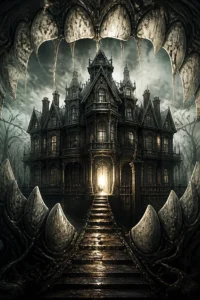
Perfectly circular, lined in ancient stone blocks slick with moisture, wide enough across to swallow a delivery truck. Iron braces ringed it at intervals, each newer than the stone, each bent subtly inward as if under pressure. The floor around the shaft had been rebuilt in layers. Old foundations radiated from it like scars. Brick met timber met concrete in overlapping attempts to anchor a house over something that did not want anchoring.
The shaft should have dropped maybe twenty feet. Thirty, if the hill was hollow.
Mara stepped to the edge and pointed her flashlight down.
The beam fell, and fell, and fell.
It never found bottom.
Instead it struck drifting mist far below, then darkness so complete it seemed to eat the light. The air rising from the opening was colder than winter. It smelled of deep water and old metal and the inside of a fresh grave.
The breathing came from there.
Every exhale rose up the shaft in a slow tidal gust, lifting strands of Mara’s hair. Every inhale drew air downward with such force that the hanging chain above the opening quivered and ticked.
Her skin crawled from scalp to heel.
She forced herself to look away from the throatlike dark and scan the chamber.
On the walls, bolted haphazardly to brick and stone, were maps. Survey plats. Structural plans. Hand-drawn cross-sections gone wavy with damp. She moved among them with the flashlight, her pulse hammering in her neck.
None of the maps matched the house she had walked through.
Some showed a smaller structure on the hill—a square farmhouse with a central chimney. Others showed the Victorian footprint she knew, then later additions, then impossible revisions where rooms narrowed to accommodate the shaft at the center. One engineering sheet showed the mansion in ghostly blue lines above a circular void labeled only with a black X. Another had that same space omitted entirely, floor joists drawn straight across as though the hole were not there.
In the margin, someone had written:
County records altered 8/14/49. Original plans removed.
Another note, in different ink:
0 Comments