Chapter 3: The West Wing Has No Mirrors
by inkadminThe door marked MOUSE did not open for her.
Mara stood in the corridor long after the crying had stopped, the key ring biting a cold crescent into her palm. The brass tags clinked softly whenever her fingers twitched. LAUNDRY. BOILER. EAST DORM. HYDROTHERAPY. WEST WING—ADMIN. WEST WING—PATIENT. WEST WING—OBS.
And one tiny, modern key with a plastic label that said, in the property manager’s blocky handwriting: DO NOT USE.
The locked door with her childhood nickname had no label on the ring.
It sat at the end of a second-floor hall where there should have been only plaster, a narrow wooden door painted hospital green, its surface bubbled by old damp. MOUSE had been written across it in pencil at a child’s height, the letters slanted and impatient. Elise had called her that when they were little, before Mara grew tall and serious and learned to sleep with notebooks under her pillow. Mouse, because Mara used to move silently through their parents’ house at night, collecting proof that everyone kept breathing.
The crying behind the door had been adult, muffled, wet with exhaustion.
“Elise?” Mara had said, and hated how small her voice became.
No answer came now. Only the building’s slow settling. A distant pipe ticked in the wall like fingernails against porcelain. Somewhere below, snow hissed against boarded windows.
Mara tried the knob again. It did not so much as rattle.
“Fine,” she whispered.
The word steamed faintly in the cold corridor. She was aware, with the prickling clarity of sleep deprivation, of every inch of herself: wool socks damp at the toes, left temple pulsing from too much caffeine, the grit behind her eyes, the weight of the small digital recorder in her coat pocket. She had promised herself she would document, not react. Observe. Catalog. Sleep researchers did not stand in abandoned psychiatric hospitals whispering to doors because a missing woman might be sobbing behind them.
Former sleep researchers, a meaner voice corrected.
Mara backed away from the green door. The beam of her flashlight trembled across the pencil letters.
MOUSE
The pencil line looked fresh enough to smudge.
She returned to the caretaker’s room on the first floor without running, though the urge crawled up the backs of her legs. Her room had once been an admitting office. Someone had wedged a narrow cot between a metal filing cabinet and a radiator shaped like a rib cage. The desk still bore a Bakelite phone with no cord, a blotter darkened by old spills, and a bulletin board displaying yellowed notices no draft had ever managed to dislodge.
Black Pine Sanitarium Regulations for Night Staff:
1. Do not answer patients who address you by family names.
2. Do not permit reflective glass in the west wing.
3. If you hear counting from below the surgical theater, report to Sister Agnes before dawn.
4. Any patient waking in another patient’s body must be restrained humanely.
Mara had found the notice on arrival and decided—firmly, scientifically—that it was either a prank by locals or an institutional artifact from a facility whose treatment protocols had long since curdled into folklore. She had photographed it anyway.
Now, at 2:13 a.m., she sat on the cot fully dressed and replayed the recorder.
Static. Her footsteps. The scrape of keys.
Then her own voice: “Elise?”
Then silence so thick the recorder seemed to sink into it.
No crying.
Of course there was no crying.
Mara laughed once, without humor, and rubbed at her mouth. Her reflection stared from the black square of the dead computer monitor on the desk: pale face, dark hair caught in a careless knot, eyes too alert. The sight startled her. She turned the monitor facedown with more force than necessary.
She found the pill case in her suitcase. White for wakefulness, blue for sleep, half a peach-colored tablet she was not supposed to mix with either. Her prescription labels had begun peeling from damp. She had packed as if coming here meant continuing a life rather than suspending one.
She took nothing.
Sleep, when it came, was shallow and crowded.
She dreamed of Elise at twelve years old, sitting cross-legged on the floor of their shared bedroom, a hand mirror balanced in her lap. Elise was using their mother’s lipstick to write backward letters across the glass. Mara watched from her bed, pretending to read.
“Don’t look until I’m done,” Elise said.
“What are you writing?”
“A spell.”
“Spells aren’t real.”
Elise looked up. In the dream, her eyes were older than they should have been. “Then why are you scared?”
Mara woke to a sound like bricks shifting inside a wall.
Morning arrived without sunrise. The storm had deepened overnight, pressing its white body against the sanitarium until every window glowed with diffused snowlight. Wind combed through the black pines beyond the drive. The building creaked and breathed around her.
Mara dressed in layers, wound a scarf twice around her neck, and made coffee in the staff kitchenette from grounds that tasted of paper and pennies. Her hands steadied after the second cup. The world regained its edges.
By daylight, the door marked MOUSE was gone.
The corridor ended where the corridor should have ended: cracked plaster, a rust stain spreading down from the ceiling, an old gurney with one wheel missing. No green door. No pencil letters. No sound but the wind bowing the window boards.
Mara photographed the wall. She pressed her palm to it. Plaster cold, solid, faintly gritty. She found no seam.
“Hypnopompic intrusion,” she said aloud.
Her voice sounded too loud in the hall.
It was possible. Stress, grief, isolation, the first-night effect magnified by environmental triggers. She had built a career on the mind’s ability to populate thresholds. The brain, deprived of sleep or certainty, became generous with monsters.
It did not explain the keys.
At nine, she laid them on the admitting desk in a row. The west wing keys were tarnished darker than the rest, their teeth intricate and oddly delicate. The tags looked older too, stamped rather than written. WEST WING—ADMIN. WEST WING—PATIENT. WEST WING—OBS.
According to the county records she had spent three nights downloading before accepting the job, Black Pine’s west wing had burned in 1969 and been demolished in 1972. According to the property manager, Mr. Rusk, nobody went there because there was no there to go to.
“Old labels,” he had said, handing her the ring with hands chapped red by cold. “Half these keys probably don’t fit anything anymore.”
He had not met her eyes when he said it.
Mara slipped the recorder into her pocket, took a crowbar from the maintenance closet, and went looking for the place that no longer existed.
The first floor of Black Pine presented itself as a rational structure if one did not examine it closely. Main lobby, admitting office, nurses’ station, two patient dormitories, dining hall, chapel, hydrotherapy. Decay had softened every edge. Paint peeled in long tongues from the walls. Wheelchair marks scored the baseboards. A film of dust lay over everything except certain paths that seemed recently disturbed, though Mara could not tell whether by drafts, animals, or something worse: habit.
The west corridor began behind the old nurses’ station.
She had passed it twice yesterday without seeing anything more than a locked fire door and a laminated asbestos warning. This morning the warning was gone. In its place hung a framed photograph of Black Pine’s staff from 1938, their faces arranged in solemn rows on the front steps. Doctors in dark suits. Nurses in white caps. Orderlies with sleeves rolled to the elbow. At the far left, half-obscured by glare, stood a woman who looked enough like Elise that Mara’s breath stopped.
She leaned closer.
Not Elise. The mouth was wrong. The chin. The eyes seemed to blur when Mara tried to settle on them.
A typed caption under the frame read:
THE WEST WING OPENS ITS DOORS TO THOSE WHO REQUIRE A DEEPER REST.
Mara raised her camera. The screen displayed only a blank rectangle of wall.
She lowered it.
The photograph smiled without smiling.
“All right,” she said softly. “No more pretending you’re shy.”
The fire door’s lock accepted WEST WING—ADMIN with a sigh that sounded almost relieved.
Beyond lay a vestibule colder than the rest of the hospital. Her flashlight beam found white tile walls, a floor checkered in black and gray, and a second door swollen tight in its frame. Frost furred the hinges. Someone had scratched a message into the paint with a sharp point, stroke over stroke until the letters were deep as wounds.
NO MIRRORS PAST THIS POINT
Mara touched the words. The grooves held black dust.
“Because reflective surfaces were thought to aggravate patients?” she said for the recorder. “Possibly linked to delusional misidentification. Capgras. Cotard. Autoscopic hallucination.”
Her professional voice steadied her. It made a lab of the vestibule. It put glass between her and the cold.
Then, from somewhere on the other side of the swollen door, came three soft taps.
Tap. Tap. Tap.
Mara went still.
The taps had not been random settling. They had rhythm. Knuckle on wood. Patient, almost polite.
“Hello?”
No response.
She fit the second key into the lock. WEST WING—PATIENT. It resisted, then turned with a thick internal clack. The door opened inward on air that smelled of wet brick, antiseptic, and something sweetly spoiled beneath.
The west wing waited in a long, dim corridor.
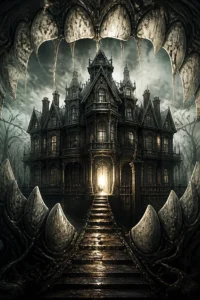
It had not burned. It had not been demolished. It stretched ahead with the impossible confidence of something that did not care what records said. Ceiling lights hung dark in wire cages. Doors lined both sides, each with a small observation window painted over from within. At intervals, alcoves interrupted the hall where mirrors should have been mounted above washbasins. Mara knew that at once, before the flashlight confirmed it: the height, the tiled backsplash, the rusted brackets still bolted into place.
Every mirror had been removed and bricked over.
Not boarded. Not plastered. Bricked.
Red masonry filled each recessed rectangle, rough and uneven, as though installed in a hurry. Mortar bulged between bricks like gums. In some places, scraps of silvered glass protruded from the edges, trapped under brickwork, catching the flashlight in brief, wounded flashes.
Mara stepped into the corridor.
The door shut behind her.
She turned sharply. The handle remained. The key remained in her pocket. She refused to test it.
“West wing corridor,” she said into the recorder, though her mouth had gone dry. “Approximately forty meters visible. Patient rooms on both sides. Evidence of systematic removal or concealment of reflective surfaces. Brickwork appears… interior-facing.”
She stopped.
It appeared interior-facing because the rough side of the brickwork faced the hall. The neat side—the side a mason would present outward—must be behind the wall, against the mirror.
Someone had bricked them over from inside the mirror alcoves.
Mara moved to the nearest one. The washbasin beneath it was cracked down the middle, its porcelain stained brown around the drain. Above it, the bricks humped outward slightly, as if pressure from behind had bowed them over time. She touched the mortar. It flaked under her glove.
Something tapped three times behind the bricks.
Mara snatched her hand back.
The taps were close enough that she felt them in her fingertips.
Tap. Tap. Tap.
Then nothing.
“Who’s there?” she asked.
The corridor swallowed the question. Patient doors watched her with their painted-over windows.
Mara backed away from the alcove. Her heartbeat had become embarrassingly loud. She lifted the crowbar and hated herself for how comforting the weight felt.
The first patient room opened with WEST WING—PATIENT. Inside, two iron beds sat parallel against opposite walls. Mattresses had been stripped, leaving coiled springs like exposed nerves. The smell intensified: old sweat, carbolic acid, mouse droppings. A leather restraint hung from one bedframe. On the wall above it, someone had written rows of names in tiny pencil script.
Mara brought the flashlight close.
At first the names meant nothing. HENRY. AGNES. LUCILLE. MARION. THOMAS. Then, midway down, her sister’s name appeared.
ELISE VALE.
Mara’s knees loosened.
The pencil letters were the same cramped style as the others, old and faded into the paint. Not recent. Not fresh. Her mind lunged for explanations and found none that held.
Below Elise, another name had been written, darker than the rest.
MARA VALE.
She heard the recorder click in her pocket, though she had not touched it.
A woman’s voice emerged from the speaker, low under static.
“Subject displays heightened responsiveness to personal stimuli.”
Mara jerked the recorder out. The screen showed RECORDING, the timer advancing.
“Who is this?” she demanded.
Static breathed.
Then her own voice answered, intimate and close, as if spoken against her ear.
“Mouse.”
Mara dropped the recorder. It hit the floor and skittered beneath the bed.
The room seemed to contract around her. She crouched, snatched the device back, and punched STOP with her thumb again and again until the screen went dark.
“Audio contamination,” she said, but the words came apart. “Prior recording. Playback error.”
The pencil names remained on the wall.
She photographed them. This time the camera captured the writing. In the image, however, Elise’s name had shifted position. It appeared directly above Mara’s. The two surnames overlapped, graphite bleeding together as if the wall had tried to write both at once.
Mara left the room and shut the door carefully, absurdly, like politeness mattered.
The west wing corridor seemed longer now. Snowlight did not reach it. Her flashlight beam thinned as though the dark had texture. With every few steps, another bricked mirror alcove emerged from shadow. Each one different. Some neat, some frantic. One had been sealed with bricks stolen from at least three places, colors mismatched. Another bore handprints in the mortar—not impressed from the hall side, but pushed outward from behind, fingers spread, palms small. Children’s hands.
Tap. Tap. Tap.
She spun toward the sound.
It came from the alcove ahead on the left.
Mara approached despite every animal part of her insisting she leave. Fear sharpened into purpose. Elise had come here with a university field team six months ago to study folklore around psychiatric ruins. Elise, who had laughed at grant language and called Mara “Doctor Doom” when she forgot to eat. Elise, who had left three voicemails the night before she vanished, each containing forty seconds of silence and, beneath the silence, a faint rhythmic tapping.
Tap. Tap. Tap.
Mara had played those voicemails until the police detective asked her to stop sending audio enhancements at three in the morning.
Now the same pattern trembled through the bricks.
She put the crowbar’s hooked end against a seam in the mortar.


0 Comments