Chapter 4: Patient Zero Was a Choir
by inkadminThe third tap did not echo.
It landed inside the wall, soft and polite, as if knuckles had touched wood rather than brick. Mara stood with her hand on the cold seam of mortar, her breath clouding between her and the place where Elise’s voice had whispered, not yet.
Snow hissed against the west wing windows. Somewhere deep in Black Pine, a pipe knocked once, twice, then settled into a long digestive groan.
Mara did not move until her fingers began to ache from the cold. The wall in front of her had been bricked from the inside. She had seen enough masonry in her father’s workshop to know the difference. The mortar bulged toward her in rough gray lips. Whoever had sealed the mirror hadn’t done it to keep people out.
They had done it to keep something in.
“No,” she whispered, though she did not know if she meant it for Elise, the wall, or the part of herself that wanted to press her ear against the bricks and beg for another word.
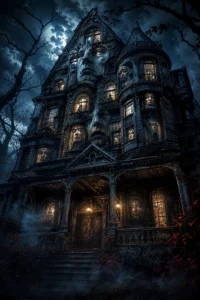
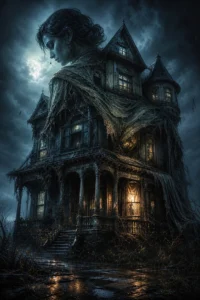
The corridor behind her breathed with abandoned length. Frost furred the windowpanes in white veins. Her flashlight beam trembled over flaking mint paint, over wheelchair scuffs fossilized in the floor wax, over doors with observation slots like cataracted eyes. The west wing had the stillness of a throat holding a secret.
She backed away slowly. Her boot sole stuck to something on the floor with a wet little kiss. When she looked down, she saw a smear of dark residue leading from the bricked-over mirror to the corridor intersection. It had the glossy thickness of old blood, but when she crouched and touched it with the tip of her gloved finger, it came away black and gritty.
Soot.
The official story came up in her head in its clean municipal phrasing: Black Pine Sanitarium closed after a boiler malfunction caused an explosion and subsequent fire on February 3rd, 1983. No patients remained in residence at the time.
No patients. No mirrors. No whispers with her sister’s voice.
Mara wiped her glove against the wall and tasted aspirin at the back of her throat, bitter and powdery, though she had not taken any in hours.
Her recorder hung heavy in her coat pocket. She took it out. The red indicator light blinked patiently. She had forgotten to stop it after the wall began speaking.
“Time,” she said, and her voice sounded small inside the corridor. “Approximately 11:42 p.m. Location: west wing, second floor. Auditory hallucination—or unknown sound source—imitating Elise Vale. Source appeared to be behind bricked mirror.”
She paused. Clinical language formed a thin crust over panic. It always had. Name the symptom and you could stand one step outside it. Observe the terror and it became data. Data did not have your sister’s voice.
The recorder crackled.
Then Elise whispered through its tiny speaker, though the playback button had not been touched.
“Mara.”
Mara’s grip tightened until the plastic creaked.
“No,” she said again, louder.
The red light blinked.
“Mara, don’t—”
She stabbed the stop button. The recorder died in her palm. Silence rushed back, too full and too fast.
At the end of the hall, one of the doors gave a soft click.
Mara swung the flashlight up.
The door to Room W-214 stood open by three inches. She was certain it had been closed before. Its brass number plate caught the light: tarnished digits, a fingernail scratch beneath the four. From within came the faint, dry rustle of paper.
“I’m done,” she said to the corridor, and hated herself for making it sound like a negotiation.
She turned away from the west wing and walked, then walked faster, refusing to run because running would admit there was something behind her worth fleeing. Her beam bounced over the floor. The soot trail appeared again at the junction, not leading from the mirror now but curving ahead of her, as though the building had reconsidered where it wanted her to go.
It led down the main stairwell.
“Of course it does,” Mara muttered.
The stairwell was colder than the hall. Wind slid somewhere inside the walls, making a sound like a woman inhaling through her teeth. The handrail wore a coat of frost. Below, the lobby waited in a cave of blue shadows. The huge reception desk crouched beneath the stained-glass window, its surface littered with old intake forms that had not been there when Mara arrived.
She descended with her shoulder brushing the wall. Halfway down, her flashlight flickered.
For one blink, the stairwell was full of people.
Patients in white gowns stood on every step below her. Men with shaved heads. Women with hair pinned under gauze caps. Children holding metal bedrails like toys. Their faces tipped upward, mouths slightly open, eyes closed as if listening to music she could not hear.
Then the light steadied.
The stairwell was empty.
Mara’s knee struck the wall. Pain flared bright enough to anchor her. She gripped the rail and took three breaths, counting each one in the old way. Four in. Hold seven. Eight out. Her pulse hammered anyway.
Grief hallucinations are not uncommon.
Her own voice, from a paper she had presented six years earlier before everything in her career curdled. Bereavement imagery. Hypnagogic intrusion. Sleep debt. Pattern completion in the auditory cortex. She could still see the conference room carpet, still feel the lukewarm water glass trembling in her hand because Elise had texted her thirty-seven minutes before the panel.
Field site is creepy as hell. If I start levitating, delete my browser history.
Mara reached the lobby.
The soot trail crossed the cracked marble floor in a single black line and disappeared under a door behind the reception desk. She had not noticed the door before. The caretaker binder in the gatehouse had mapped the first floor with institutional neatness: lobby, dining hall, chapel, administrative offices, hydrotherapy, laundry. No door behind reception. No records room marked in pale brass script on a plaque that looked recently polished.
RECORDS.
Mara stared at it.
“You’re very theatrical for a building,” she said.
Her voice came out steadier than she felt. It helped to insult it. It helped to pretend Black Pine had taste, intentions, a weakness for drama.
The plaque was warm when she touched it.
She almost pulled her hand back. Instead, she curled her fingers around the knob and turned.
The records room smelled of paper, mildew, and something sweetly medicinal, like children’s cough syrup left uncapped. Her flashlight picked out rows of filing cabinets stretching impossibly far into the dark. Not a storage closet. Not a small archive tucked behind the lobby. A warehouse of records, deeper than the footprint of the building allowed, its ceiling lost above in black iron trusses and dangling fluorescent tubes.
One tube flickered. Then another. Light shivered to life down the aisles in a stuttering procession, revealing cabinet after cabinet, each painted hospital green, each labeled with stamped metal tags: AARON—ABEL, ABELARD—ACKERMAN, ADMISSIONS 1901–1904, AUTOPSY SUPPLEMENTAL, DREAM SPEECH VARIANCE, INCIDENT—MIRROR, PATIENT SLEEP CHORUS.
Mara stopped breathing.
At the far end of the central aisle stood a wooden desk under a cone of yellow lamplight. On it sat a rotary phone, a box of index cards, a glass ashtray overflowing with cigarette butts so old they had turned gray as moth wings, and a single folder tied with red string.
Her boots whispered over the floor.
The room had a sound of its own. Not silence. Not quite. A layered papery murmur, as if thousands of pages were being turned just beyond hearing. When she passed the cabinets, some drawers clicked softly from within. Metal settling. Or files shifting themselves into a more convenient order.
She reached the desk and set the recorder beside the folder.
The label on the folder read:
SOMNILOQUY EVENT CLUSTER / WARD C / 1979–1981
ATTENDING: DR. H. E. LOEB
RESTRICTED INTERNAL REVIEW
Mara’s mouth went dry.
Somniloquy. Sleep-talking. Her field, before it had become a punchline muttered in faculty hallways. Before the missing data scandal. Before she had become the woman who heard voices in sleep labs and wrote them down as if they were meaningful.
She untied the string.
The first page was a typed summary, the ink faded to brown.
Onset: November 13, 1979.
Subjects: Twelve patients participating in nocturnal monitoring trial for recurrent parasomnia, Ward C.
Initial Phenomenon: Subjects entered REM sleep within seven minutes of lights-out despite heterogeneous medication schedules. At 02:13 all subjects began speaking simultaneously. Vocalizations were identical in timing, pitch variation, and content despite physical separation in individual rooms.
Content: See attached transcripts.
Staff Response: Observation. No immediate intervention.
Notes: Patient Zero designation inappropriate. No singular origin identified.
Beneath the last line, someone had written in pencil, hard enough to tear the paper:
Patient Zero was a choir.
The room seemed to lean closer.
Mara took off one glove with her teeth and turned the page. Her bare fingertips stuck faintly to the paper. The attached transcript was laid out in columns, each headed with a patient’s name: Holloway, Ruth. Bix, Daniel. Crane, Meredith. Janko, Peter. Elise was not among them. Of course Elise was not among them. Elise had not even been born in 1979.
Still, Mara checked every name twice.
The transcript began at 02:13:04.
ALL SUBJECTS: Good evening, Dr. Loeb.
Mara looked toward the dark aisles.
One fluorescent tube buzzed and dimmed.
She read on.
DR. LOEB: Can you hear me?
ALL SUBJECTS: We hear the room you are standing in.
DR. LOEB: Do you know where you are?
ALL SUBJECTS: We are under the hospital.
DR. LOEB: You are in Ward C.
ALL SUBJECTS: Ward C is a story told to the waking parts.
DR. LOEB: Who is speaking?
ALL SUBJECTS: The part that learns.
Mara’s fingers tightened on the page.
There were notations in the margins. Pulse irregularities. EEG synchronization. Respiratory alignment across rooms. Twelve patients sleeping separately had produced one voice, not blended but matched. Perfect unison. The kind choirs spent years failing to achieve. Even the pauses were identical.
Her researcher’s mind flared awake despite the fear. She could not help it. The old hunger rose: impossible data, anomalous patterns, the seduction of a phenomenon that should not exist. She saw electrodes glued to scalps. The wavy lines of sleep architecture. REM marked by rapid eye movement under fragile lids. The body paralyzed, the brain lit from within.
And beneath that, something listening.
She flipped to the next transcript.
02:17:22
ALL SUBJECTS: Ruth’s mother had blue hands when they pulled her from the river.
RUTH HOLLOWAY: [No independent speech. Subject asleep.]
ALL SUBJECTS: Daniel stole the ring and swallowed it because he wanted to keep a circle inside him.
ALL SUBJECTS: Meredith lies about the baby. The baby cried once. The snow took the rest.
ALL SUBJECTS: Peter does not remember biting his brother because Peter was not in his mouth at the time.
Mara swallowed.
Each line was followed by verification notes. Family interviewed. County records requested. Confession obtained. No prior staff knowledge established.
Sleep-talking patients revealing secrets they could not have known about one another. Or something using their mouths to demonstrate what it had learned.
A drawer opened behind her.
Mara spun.
Three aisles down, a filing cabinet drawer had slid out by itself, metal runners screaming softly. Inside, folders stood packed so tightly their tabs made a jagged yellow grin.
“Absolutely not,” she said.
The drawer remained open.
The overhead light above it flickered twice.
Mara glanced back at the folder on the desk. There were more pages. Too many. But the open drawer waited with the obscene patience of a held breath.
She picked up the recorder.
“Time approximately midnight,” she said. “Records room located behind lobby reception. Spatially inconsistent with floor plan. Reviewing historical sleep study files. Now observing apparent environmental response to—”
The recorder played her sister’s laugh.
Not the whisper from the wall. Not imitation. A bright, ugly snort of laughter from a summer porch three years ago, when Elise had choked on cheap wine because Mara told a terrible joke about Freud and mattress salesmen.
Mara’s hand went slack.
The laugh cut off. The red light blinked.
She brought the device close to her face. “Stop it.”
Her recorded voice answered, flattened by the speaker.
“Stop it.”
Then another voice, deeper, male, speaking through static: “Dr. Vale?”
Mara’s heart slammed once so hard she felt it in her teeth.
“Who is this?”
The recorder hissed. “You shouldn’t be in Records after lights-out.”
The voice had an accent buried under New England vowels. Old-fashioned. Tired. It sounded like a man speaking from the bottom of a well.
“Dr. Loeb?” Mara asked before she could stop herself.
The red light flickered.
“We never found the first throat,” the voice said. “That was our mistake. We kept looking for a patient.”
“Where is Elise Vale?” Mara demanded.
The filing drawer at the end of the aisle slammed shut.
Every fluorescent tube in the room went out.
Darkness crushed down.
Mara stood blind, one hand on the desk, the recorder a warm shape in her palm. Her own breath sounded indecently loud. The papery murmur of the archive swelled around her, pages turning faster now, thousands of them, millions, like wings trapped in walls.
From the dark came a chorus of sleeping voices.
“Dr. Vale.”
They spoke from all sides. Men, women, children. Dry tongues. Wet throats. Dentures clicking. A child’s lisp folded into an old woman’s rasp. Yet each voice struck the same syllables at the same moment, forming one terrible unity.
Mara did not answer.
“Dr. Vale,” the chorus repeated. “You have a sister.”
She fumbled for the flashlight clipped to her belt. Her fingers found only wool coat, then metal, then the switch. The beam came on weakly, a narrow cone with a yellow edge.
The central aisle was empty.
But every filing cabinet drawer stood open.
Folders protruded in hundreds of thin paper tongues. Labels faced her from both sides, and as the flashlight swept over them, their text changed.
HOLLOWAY became VALE.
BIX became MARA AGE SIX.
CRANE became ELISE BROKEN ARM / TREEHOUSE.
JANKO became MOTHER’S LAST WORDS.
Mara backed into the desk. The lamp flickered on again with a dull pop, throwing her shadow long and warped between the cabinets.
On the desk, the red-string folder had closed itself.
A new folder sat beside it.
Its tab read:
VALE, ELISE M.
FIELD STUDY ADMISSION / WINTER TERM
Mara stared until the letters blurred. Her hand moved before thought could stop it.


0 Comments