Chapter 1: The Key in the Ashes
by inkadminThe house key arrived in a box of ashes, and when Mara touched it, something inside the urn began to breathe.
Not loudly. Not dramatically. It was not the theatrical gasp of a corpse sitting up beneath a sheet, nor the death-rattle she had heard from ruined lungs at three in the morning in rented rooms that smelled of medication and old flowers. It was smaller than that. A soft, patient inflation. A long exhale through something damp.
Mara Voss went still with her fingers on the key.
The lawyer’s office around her seemed to hold its own breath in response. Rain freckled the tall window behind Mr. Pell’s desk, smearing the view of the narrow street and the harbor beyond into gray streaks. Somewhere below, a truck backed up with three flat electronic beeps. A radiator ticked in the corner. The fluorescent light above the filing cabinets flickered once, hesitated, then steadied itself like an old man pretending he had not nearly fallen.
Mr. Pell had been talking. He stopped.
“Ms. Voss?”
Mara did not answer right away. Her hand remained inside the little ceramic urn, two fingers hooked through the cold iron loop of the key, her knuckles dusted in fine gray ash. The box it had come in sat open on the desk between them, its white paper wrapping folded back with careful legal neatness. The urn itself was plain and ugly, no taller than a coffee mug, stoppered with red wax that had cracked when Pell pried it open with a letter opener. A strip of paper had been tied around its neck with black thread.
For my daughter, when I am dead enough to be believed.
Her mother’s handwriting. Or something close enough to it that Mara’s stomach had folded over on itself before she could stop it.
Now the ashes shifted against her skin.
Another breath came from within the urn.
Inhale.
Exhale.
Mr. Pell’s eyebrows moved toward each other. He was a thin, tidy man in his late sixties, with tobacco-colored age spots across the backs of his hands and a bow tie the exact green of old hospital curtains. Everything about him had been arranged to inspire confidence: the polished shoes, the framed degrees, the black-and-white photograph of a stern courthouse hung behind his desk. But the longer Mara sat across from him, the more she saw the strain beneath the varnish. His collar was too tight. His fingertips worried the edge of the will without seeming to know they were doing it. He had not once looked directly at the urn since opening it.
“Ms. Voss,” he said again, softer. “Is something wrong?”
Mara lifted the key from the ashes.
The breathing stopped.
Gray powder slid from the bit and teeth of the key in soft veils. It was larger than any modern house key had a right to be, blackened iron with a shank as long as her palm and a bow wrought into the shape of a thorned circle. Its teeth were uneven, almost organic, like the jagged edge of a broken bone. It was cold enough to hurt.
For one absurd second, she expected the thing to twitch.
It did not. It only lay against her fingers, heavy and wet-looking, though no moisture marked her skin.
“Fine,” Mara said.
Her voice sounded perfectly normal. That was one of her talents. She could make her voice normal in almost any room. She had done it beside beds where people bled from places they should not bleed, in hallways where families collapsed into one another, in kitchens where hospice prescriptions sat beside unpaid bills and loaded guns. Calm was a skill, not a virtue. Sometimes it was the only knife you were allowed to carry.
Mr. Pell watched her brush ash from her fingers onto the inside of the box.
“You felt something?” he asked.
Mara looked up.
He flinched, barely.
“Why would you ask that?”
His mouth pressed flat. Outside, the rain thickened until the window looked less like glass than falling water. “Old houses have old stories. People attach meaning to objects.”
“I asked why you asked.”
Pell removed his glasses, pinched the bridge of his nose, replaced them. “Because your mother’s instructions were unusual.”
“My mother’s entire existence was unusual, Mr. Pell.”
A ghost of a smile crossed his face and died quickly. “Yes. I suppose it was.”
Mara set the key on the desk between them. A small gray crescent of ash remained beneath one of her nails. She rubbed it against her thumb, and the smell rose at once.
Not crematorium ash. She knew that smell, too: sterile heat, calcium, burned cloth, the faint sweetness that clung to the back of the throat no matter how professional the funeral home tried to be.
This smelled like low tide.
Salt. Mud. Rotting weed. Stones newly uncovered by the sea.
Beneath it, almost hidden, was the clean mineral scent of a cellar after flooding.
She wiped her hand on her black jeans.
“Let’s finish,” she said.
Pell studied her for a moment, then lowered his eyes to the document spread open on the blotter. His office was warm enough to make the window sweat, but Mara’s fingertips still ached from touching the key. Behind him, shelves of leather-bound case reporters filled one wall. Between them sat small nautical antiques: a brass compass, a chipped scrimshaw whale, a ship in a bottle listing forever on painted waves. Local décor. Coastal respectability. The kind of things people placed in offices to suggest roots, history, belonging.
Mara had none of those things. She had a duffel bag in her trunk, a secondhand phone with a cracked corner, and sixty-two dollars in checking after the motel charged her card for two nights.
“As I explained over the phone,” Pell said, “your mother, Evelyn Voss, has been legally declared deceased by the Knox County Probate Court. The petition was uncontested. Given the length of her disappearance and the absence of evidence of life, the court found sufficient basis.”
“Twenty years is sufficient basis,” Mara said.
“Usually, yes.”
“Usually?”
Again, that tiny hesitation. She hated hesitations. They were the gaps where people tried to hide what mattered.
“There were complications,” Pell said. “Your mother had made certain arrangements before her disappearance. Durable instruments. Trust provisions. Instructions that appeared, at the time, eccentric but legally valid.”
“She ran off and left paperwork.”
“She vanished,” he corrected gently.
Mara leaned back in the chair. The upholstery wheezed under her. “People who vanish usually do it from somewhere. My mother vanished from my life when I was nine. The rest is geography.”
His gaze flicked toward the key.
“From Blackthorn House,” he said.
The name settled into the room like damp fog.
Mara had seen it printed in the notice, of course. She had seen it in emails from Pell’s assistant and on the inheritance documents he had mailed to the motel where she had been living for the past eleven days. Blackthorn House. A grand name for a rotting estate on a strip of Maine coast no one visited unless they had family buried there or warrants to serve. But hearing it aloud woke something under her ribs. Not memory, exactly. More like the shape a memory left when it had been cut out.
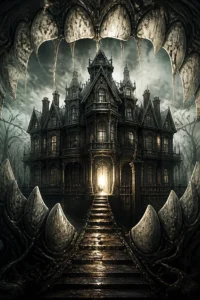
Black shingles slick with rain.
A staircase curving into darkness.
Her own small hand pressed against wallpaper that pulsed warm as skin.
Then nothing.
She blinked, and Pell’s office returned: paper, rain, radiator, ash.
“I don’t remember the house,” she said.
It came out sharper than she intended.
Pell folded his hands. “You lived there as a child.”
“So people keep telling me.”
“You don’t recall any of it?”
Mara looked at the diplomas on the wall, at the little gold seals and Latin names. “I remember a yellow raincoat. I remember my mother singing in the kitchen, but not the song. I remember a dog that may or may not have been real. I remember a bedroom with two windows.” She paused. “When I try to picture what was outside them, I get a headache.”
Pell said nothing.
She gave him a humorless smile. “Childhood trauma. Very fashionable.”
“Ms. Voss—”
“Don’t.”
The word landed harder than she meant it to. Pell’s hands stilled.
Mara exhaled through her nose. She had driven four hours through rain with too much coffee in her blood and a letter from the state board of nursing folded in her glove compartment like a wound that would not close. She had not slept more than three hours the night before because the motel pipes kept knocking inside the walls. Or perhaps because every time she closed her eyes, she saw Mrs. Albright’s face at the inquest table, blue-lipped, mouth open around the question nobody had asked while she was alive.
Did Nurse Voss administer the morphine contrary to protocol?
Did Nurse Voss understand the difference between comfort care and hastening death?
Did Nurse Voss act alone?
Mara had understood everything. That had been the problem.
“I’m not here for therapy,” she said. “I’m here because a woman I haven’t seen since the third grade has apparently left me a condemned house. I sign, you give me keys, I sell it to whatever idiot wants a cliff and mold problem. Correct?”
Pell’s eyes softened in a way she disliked more than suspicion. Pity she could not use. Pity accumulated, turned rancid, made people careless.
“The estate is not condemned,” he said. “Not officially.”
“Comforting.”
“It has been unoccupied for most of the last two decades.”
“Most?”
“Caretakers. Occasional inspections. Trespassers.”
“Ghost hunters?”
He did not smile. “Among others.”
“And all this is mine now.”
“If you accept the inheritance.”
Mara laughed once. It surprised both of them. “Is there a version where I don’t?”
“You may disclaim. The property would pass according to the alternate provisions, which…” He lifted a page, scanned it though he clearly knew what it said, and set it down. “Which are complex.”
“Meaning?”
“Meaning the house would likely enter litigation.”
“For how long?”
“Years.”
“And in the meantime I get nothing.”
“There are liquid assets.”
Her spine straightened despite herself.
Pell opened a folder and slid a single sheet across the desk.
Mara looked down.
For a heartbeat, the number did not resolve into meaning. Her mind arranged the digits, rejected them, rearranged them. Then it struck.
Not wealth. Not freedom. But enough.
Enough to pay the lawyer handling her board appeal. Enough to settle the credit cards she had used after suspension. Enough to stop calculating groceries by protein per dollar. Enough to get her car’s transmission fixed before it stranded her somewhere between nowhere and worse.
She touched the paper with two fingers.
“Why?” she asked.
“Why what?”
“Why would she leave me anything?”
Pell’s expression changed. It was not sadness. Not exactly. It was the look people got when standing at the edge of an old story, deciding whether to step in.
“Your mother spoke of you often.”
Mara’s mouth tightened. “You knew her?”
“As a client.”
“That wasn’t the question.”
Rain rattled harder against the window. The harbor beyond had vanished completely, swallowed by weather. Pell glanced toward the door, though no one had approached it.
“I knew her as well as anyone in Harrow might claim to have known Evelyn Voss,” he said. “She was… private.”
“She was unstable.”
“She was afraid.”
The words slipped out with more force than he seemed to intend.
Mara watched him. “Of what?”
Pell took too long.
She let the silence stretch. She had learned in hospice that people feared silence more than death. Silence asked for filling. Families confessed in it. Doctors admitted what charts concealed. Dying men told nurses where they hid money and which child they had never forgiven.
Pell broke first.
“Blackthorn House has a reputation,” he said.
“So does every ugly house with a long driveway.”
“This is not Amityville, Ms. Voss. I’m not selling tickets.”
“Then speak plainly.”
He removed his glasses again and polished them with a cloth from his breast pocket. Without them, his eyes looked pale and watery, almost defenseless.
“The peninsula used to be larger,” he said. “Before the storm of 1911. There was a village below the cliffs. Blackthorn was built above it by a shipping family, the Vale family. When the seawall failed, the lower settlement drowned in one tide. Forty-three people, depending on whose records you believe. Houses, churchyard, schoolhouse. Gone before dawn.”
“A tidal disaster,” Mara said. “I read the brochure version online.”
“There is no brochure.”
“Wikipedia, then.”
“Wikipedia does not mention that pieces still surface after storms.”
“Pieces.”
“Foundation stones. Buttons. Children’s shoes. Once, a church bell.”
Mara imagined a bell rising from black water, tongue mute and barnacled. Against her will, a chill moved along her shoulders.
Pell continued. “After the flood, the Vale family remained in Blackthorn House. For a time. Then Jonah Vale disappeared. His wife was found walking on the tidal flats at low tide, though she had been bedridden for six years. Their son inherited. He vanished in 1934. His daughter after him. Then a doctor from Boston bought the property. Then a woman from Providence. Then your grandfather.”
“And let me guess,” Mara said. “They all disappeared.”
“Eventually.”
She gave him a flat look. “People die. People leave. Coastal towns turn coincidence into folklore because tourism requires ghosts.”
“Harrow does not want tourists.”
Something in his tone made her pause.
“Then what does Harrow want?”
Pell put his glasses on. Behind the lenses, his face closed again, lawyerly and neat. “Mostly to be left alone.”
Mara picked up the key by its iron ring. It had warmed slightly in her hand. Or her hand had grown colder around it.
“My mother believed the stories?”
“Your mother believed Blackthorn House was dangerous.”
“But she stayed.”
“For a while.”
“With me.”
“Yes.”
The little word touched something raw in her chest. Mara looked away before Pell could see it move across her face.
There had been a foster mother once, Mrs. Keene, who kept a scrapbook of Mara’s school certificates and dental records because she believed love was paperwork done consistently. She had told Mara, years later, that Evelyn Voss was not dead, only gone, and that sometimes gone was a cruelty worse than dead. Mara had been fifteen and furious, all elbows and black eyeliner, and she had said she was glad. Let the bitch stay gone.
That night she had cried into a pillow until her nose bled.
Now there was an urn of ash on a lawyer’s desk and a house key cold in her hand.
“What are these ashes?” she asked.
Pell looked at the urn.
The ash inside lay smooth now, innocent. There was no sign anything had moved beneath it.
“I don’t know.”
“You opened it.”
“Under instruction.”
“From my mother.”
“Yes.”
“Was she cremated?”
“No remains were recovered.”
“Then these aren’t hers.”
“Presumably not.”
“Presumably.”
Pell’s jaw flexed. “The urn was delivered to this office nineteen years ago by courier, with sealed instructions to be opened only upon legal declaration of death. It has been in our vault since.”
“You kept a mystery urn in your vault for nineteen years.”
“This is Maine,” he said, with a tiredness that almost made the joke land. “We keep stranger things in vaults.”
Mara leaned forward and smelled the ash again before she could talk herself out of it.
Seaweed. Silt. Old salt. And beneath it, faint but unmistakable, the copper warmth of blood.
Her throat tightened.
She sat back.
“There’s one more matter,” Pell said.
“Of course there is.”
He opened the lowest drawer of his desk with a key from his pocket. From it he removed a slim envelope, yellowed at the edges, sealed with the same red wax that had stoppered the urn. Mara saw a pressed design in the wax: a circle of thorns.
Her fingers closed around the iron key.
“This was to be given to you after you took possession of the key,” Pell said.
“Possession? Like it’s a cursed pirate doubloon?”
“Those were her words.”
He held out the envelope.
Mara did not take it.
For a moment neither of them moved. Then, irritated by her own hesitation, she snatched it from him.
Her name was written across the front.
Mara Elise Voss
Not printed. Written. Her mother’s hand again, black ink faded to brown, the downstrokes too heavy, the final s in Voss curling back like a hook.
“Do you want me to read it here?” Mara asked.
“That is your choice.”
“What did she instruct?”
“That you read it before entering the house.”
“How dramatic.”
“Evelyn was rarely dramatic without reason.”
That was the second time he had defended her. Mara filed it away.
She slid a finger under the flap and broke the wax.
Inside was a single sheet of thick paper folded once. No perfume. No pressed flower. No apology tucked into the crease. The handwriting was cramped, hurried, as though written in a place where time had become dangerous.
Mara read.
Mara,
If this reaches you, then they have finally agreed I am dead. Good. Let them. It is safer to be dead on paper than alive in that house.
You must sell Blackthorn if you can. Burn it if you cannot. Do not sleep inside before you know which rooms still belong to the house and which have learned to belong to you.
Do not trust photographs.
Do not answer if you hear my voice from the walls.
And if you remember the red nursery, leave before the tide turns.
I am sorry I did not keep you original.
—Mother
Mara stared at the last line until the ink blurred.
I am sorry I did not keep you original.
The office seemed suddenly too small. The radiator heat pressed against her face. The smell of seawater thickened, though the urn sat untouched on the desk. Beneath it came another scent, faint and sour: wet plaster. Old wood. Something closed up too long.
“What does this mean?” she asked.
Pell had the decency not to pretend ignorance too quickly. He looked at the letter, then at her.
“I don’t know.”
“That’s becoming a theme.”
“Your mother wrote many strange things in the months before she disappeared.”
“You saw them?”
“Some.”
“About rooms belonging to houses?”
He said nothing.
“About photographs?”
Still nothing.
Mara folded the letter carefully along its original crease. Her hands were steady. Too steady. A nurse’s hands, some attending physician had once said with approval. Later, at the hearing, the same steadiness had been described as chilling.
“Tell me,” she said, “what happened to my mother.”
Pell’s face seemed to sag by years. He rose from his chair and went to the window. Beyond the streaming glass, the town of Harrow huddled under the rain: slate roofs, brick chimneys, gulls hunched along a sagging power line like old judges. The harbor was a smear of masts and gray water. Somewhere out there, farther down the coast, Blackthorn Peninsula hooked into the Atlantic like a broken finger.
“The official account,” Pell said, “is that Evelyn Voss was last seen on October twelfth, 2004, at Wren’s Market on Seabed Road. She bought candles, batteries, salt, canned peaches, and a disposable camera. She spoke with the cashier. She seemed agitated. That evening there was a storm. Not remarkable by local standards, but strong enough to take down trees and cut power to the peninsula. Two days later, Sheriff Dyer went to Blackthorn for a welfare check at the request of your foster placement officer.”
Mara’s pulse ticked once, hard.
“I was already gone?”
“You had been removed from the home three weeks earlier.”
“Why?”
Pell turned from the window.
“You don’t remember?”
Her patience snapped tight as wire. “Do you think I would ask if I remembered?”
“No,” he said quietly. “No, I suppose not.”
“Why was I removed?”
“A teacher reported bruising.”
Mara felt the room tilt a fraction.
She looked down at her hands. There were no bruises now, only pale skin, ash under one nail, a small scar near her thumb from where a dementia patient had bitten her eight years ago.
“My mother hit me?”
“You said no.”
“Children lie.”
“Yes.”
“What did she say?”
“That the house had done it.”
The radiator knocked violently, three hollow bangs that made them both start.
Pell looked at it with naked dislike.
Mara laughed under her breath, but there was no humor in it. “Well. That must have gone over well with child services.”
“You were placed temporarily with a family in Rockland. Evelyn was ordered to undergo psychiatric evaluation. She missed the appointment. Then she vanished.”
“And I don’t remember any of this.”
“Trauma can—”
“If you say trauma again, I’m going to throw that scrimshaw at you.”
He closed his mouth.
Mara stood. The chair gave a relieved creak behind her. She tucked the letter into the inner pocket of her jacket and picked up the key. It left a dark smudge on the legal pad beneath it, not ash this time but moisture. A perfect outline of the thorned bow, like a brand.
Pell saw it. His mouth went gray around the edges.
“Ms. Voss,” he said, “I am obligated to advise you regarding the legal and financial aspects of the inheritance. I am not obligated to offer personal counsel. Nevertheless, I hope you’ll allow an old man one indiscretion.”
“If it’s ‘don’t go to the house,’ you’re late.”
“Don’t go alone.”
“I’m always alone.”
“That is precisely what worries me.”
The words struck too cleanly. Mara looked at him then, really looked. In the lines around his eyes, in the careful rigidity of his posture, she saw fear not for himself but for something he had failed to prevent once and expected to watch happen again.
“You think the house is alive,” she said.
Pell’s gaze moved to the urn.
For one instant, the ash inside dimpled.
Not much. Just enough to form a shallow hollow, as if something beneath the powder had inhaled through a small mouth.
Mara’s skin tightened from scalp to heel.
Pell whispered, “I think some places learn.”
A phone rang in the outer office before she could answer. Both of them flinched like guilty children. Pell’s assistant murmured beyond the door, voice muffled by oak. A printer woke and began to chatter. The modern world reasserted itself with paper trays and phone lines and appointments booked in half-hour increments.
Mara put the key into her coat pocket.
“I’ll need copies of everything,” she said.
Pell nodded, as if relieved to return to ritual. “Of course.”
They completed the paperwork in twenty-three minutes.
Mara signed where he pointed. Her signature looked increasingly unlike itself with each page, the M too sharp, the V in Voss cutting low like a blade. Pell explained transfer taxes, deed recording, insurance complications, outstanding utility accounts. His voice became a murmuring current of words. She caught enough to nod at the right moments. The liquid assets would take several business days to release. The house and surrounding fourteen acres were hers immediately upon filing. The county road to Blackthorn Peninsula remained accessible, though prone to flooding at high tide. There was a caretaker, technically, a man named Silas Vale who had performed quarterly inspections for years.
“Vale?” Mara interrupted.
“A distant relation to the original family,” Pell said. “Half of Harrow is distantly related to someone unfortunate.”
“Does he live there?”
“No. No one lives there.”



0 Comments