Chapter 6: The Drowned Village
by inkadminBy morning, the water in the kitchen sink had turned clear again.
Mara stood over it for a long time with the faucet running full blast, watching it churn white against the stained porcelain before thinning to transparency. The smell remained. Not strong enough to accuse, not obvious enough to make a plumber blink, but there beneath the mineral tang of old pipes: brine, mud, and something green that had never seen sunlight.
The strand of silver hair lay coiled in a juice glass beside the sink.
She had not thrown it away. That annoyed her more than the hair itself. There were reasonable things one did with disgusting debris pulled from plumbing. Bag it. Dispose of it. Bleach the sink. Call someone. Instead, she had fished it out with the tip of a paring knife and lowered it into the glass as if preserving evidence from a crime scene.
It was longer than her forearm, impossibly fine, shining faintly even in the dull gray light of morning. Her mother’s hair had gone silver early. Mara remembered that much with the fractured certainty of a childhood photograph: Adrienne Voss in a red wool coat at the edge of the cliff, hair whipping across her mouth, one hand clamped on Mara’s shoulder hard enough to hurt.
Don’t drink the tap water.
The voice had come through the pipes after midnight, not from the drain exactly, not from the walls either, but through the house’s throat. It had said her name with the intimate exhaustion of the dying.
Mara shut off the faucet. The sudden silence rang.
She had slept badly in the parlor with a chair wedged under the door handle and the iron poker across her lap. Not because she believed in barricades against voices in plumbing, but because nursing had taught her the value of symbolic gestures. Families wanted morphine pumps and locked cabinets and laminated care plans. They wanted something they could point at and say, There. We did what we could.
At dawn, she had found the hall outside the parlor dry. The bathroom sink clean. The upstairs tub empty. No black tide seeped under doors. No drowned woman waited on the landing.
Only the glass with its hair.
And the journal she had not opened again since finding the phrase that had seeded itself behind her eyes and sprouted teeth.
It does not haunt. It studies.
Mara made coffee with bottled water from the case she had brought in two days ago. She drank it standing, scalding her tongue, and looked out the salt-fogged window toward the road vanishing between wind-bent spruces. Blackthorn House brooded behind her, settling and ticking, its damp plaster exhaling faint heat. In daylight its menace became architectural: bad wiring, rotten beams, pipes with opinions. She could manage architecture. She could sell architecture.
What she needed was paper. Records. Dates. Names that stayed where they were written.
At seven forty-five, Mara put the silver hair in a sandwich bag and tucked it into the inside pocket of her coat.
The decision felt ridiculous until the house gave a soft groan above her, like an old person turning in bed.
She left without breakfast.
The road from Blackthorn to town had been cut into the peninsula like an afterthought. It ran high above the water, then low through marsh, then high again across a rib of granite where the Atlantic gnawed white scars into the rocks below. Fog lay in the ditches. It snared the tires of her borrowed Subaru and smeared the windshield until the wipers only rearranged the gray.
At the first bend past the iron gate, Mara glanced in the rearview mirror.
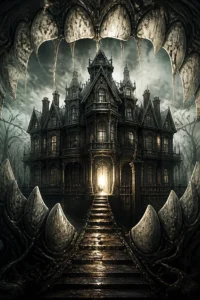
Blackthorn House was there, perched on the cliff, all black gables and blind windows, its roofline uneven against the sky. For one breath, she saw a figure standing in the round attic window. Pale. Still. One hand pressed to the glass.
She braked hard enough that the seat belt locked across her chest.
The car idled. Fog rolled behind her. In the mirror the attic window showed only a flat oval of darkness.
“No,” Mara said aloud, to the road, to the house, to whatever part of her brain wanted to start being dramatic before nine in the morning. “We’re not doing that.”
She drove on.
Harrowick had the grim charm of towns built to survive weather rather than welcome visitors. Its houses crouched close to the harbor with their backs bowed against winter; clapboard facades flaked under layers of salt; gulls screamed from the roof of the closed bait shop as if announcing bad news to the dead. The main street offered a diner, a hardware store, a pharmacy with sun-faded postcards, and a municipal building whose brick face bore a bronze plaque greened by rain.
The fog thinned as Mara parked by the curb. She could smell frying onions from the diner and diesel from lobster boats rocking in their slips. Men in rubber boots stood near the pier, coffee cups in hand, talking in low voices that stopped when she stepped out of the car.
Not stopped abruptly. That would have been too theatrical. Their conversation faltered, bent around her, and resumed in a different shape.
One of them touched the brim of his cap. Mara couldn’t tell if it was greeting or warding.
Inside the municipal building, the air smelled of wet wool, old paper, floor polish, and radiators laboring against coastal damp. A corkboard near the entrance advertised clam permits, grief counseling at St. Bartholomew’s, a missing orange cat named Julius, and a storm preparedness notice printed in urgent red. At the bottom, someone had underlined DO NOT ATTEMPT TO CROSS THE CAUSEWAY DURING SURGE three times.
The archive occupied the basement.
Mara found the stairs beneath a sign with peeling gold letters: HISTORICAL ROOM — HOURS 9–3, TUES/THURS OR BY APPOINTMENT. Today was Thursday. Her phone said 8:58.
She descended anyway.
The basement hall was narrow and low-ceilinged, lit by fluorescent tubes that buzzed with insectile persistence. Framed photographs lined the walls: stern fishermen with beards like storm clouds; women in high collars standing beside baskets of fish; a church steeple rising above a village green; children posed barefoot on a dock, squinting into sunlight gone sepia with age.
At the end of the hall, a frosted-glass door read HARROWICK HISTORICAL ARCHIVE. Behind it, something scraped.
Mara knocked.
“If you’re from the planning board, I’m dead,” called a woman’s voice.
“I’m not.”
“If you’re from the historical society, I’m worse than dead.”
“Mara Voss.”
The scraping stopped.
For a moment, the fluorescent lights did all the talking.
Then the lock clicked.
The woman who opened the door was small, elderly, and severe in a plum cardigan buttoned to her throat. Her white hair had been braided and pinned flat against her skull with militant precision. She wore tortoiseshell glasses on a silver chain, and her eyes behind them were a washed-out blue that made Mara think of winter surf.
“No,” the woman said.
Mara blinked. “No?”
“Whatever it is, no.”
“I haven’t asked yet.”
“You said your name.”
“That’s usually how appointments begin.”
“Do you have an appointment?”
“No.”
“Then we’re already off to a poor start.”
The woman began to close the door. Mara put one hand against it. Not hard. Just enough.
“I inherited Blackthorn House,” Mara said.
The archivist’s gaze flicked over Mara’s face with a speed and precision that felt almost medical. Hairline. Eyes. Mouth. The scar at Mara’s chin from falling down stairs she did not remember. Whatever the woman saw made her grip tighten on the door until her knuckles shone.
“I know what you inherited.”
“Then you understand why I’m here.”
“People come here to make sense of things.” The archivist’s voice lowered. “Blackthorn is what happens when sense gives up.”
“That sounds like something that should be in a brochure.”
The woman’s mouth compressed.
Mara softened her tone by conscious effort. She had used that same modulation at bedsides, with sons who threatened doctors and wives who refused oxygen tanks in living rooms because it meant the end had a shape. “I’m trying to establish provenance. Ownership history, construction dates, survey maps. Anything relating to the property before the house was built.”
“For a sale?”
“Yes.”
“Good.”
The answer came too quickly.
“Good?” Mara asked.
“Sell it. Burn it. Push it into the sea. I don’t care which order.” The archivist stepped back at last. “Wipe your feet.”
Mara entered.
The archive was a cramped kingdom of boxes. Metal shelves bowed beneath ledgers, deed books, rolled maps, cracked leather albums tied with ribbon. A dehumidifier hummed in the corner, losing its war. The air tasted of dust and iodine. On a central table beneath a green-shaded lamp lay a spread of photographs, each weighted at the corners by smooth black stones.
“Evelyn Pike,” the woman said. “Archivist by title, janitor by funding, lunatic by popular vote.”
“Mara.”
“I heard you the first time.”
Evelyn moved around the table with surprising speed, gathering photographs into a stack and turning them face down before Mara could see more than an edge: a row of houses, a blur of white water, something like a bell tower leaning at an impossible angle.
“Coffee?” Evelyn asked.
“No, thank you.”
“Good. It’s terrible.”
She disappeared between shelves and returned with a gray archival box. The label on its side read BLACKTHORN / BELLWETHER / MISC. in careful block letters. Beneath that, in older ink, someone had written: DO NOT LEND.
Evelyn set it on the table but kept one hand on the lid.
“Before we begin,” she said, “tell me what you already know.”
Mara took off her coat. The sandwich bag in the inner pocket crackled faintly. “That the house was built in 1913 by Silas Blackthorn. That it has had seven owners since, depending on whether you count trusts and corporate shells. That several of them died or disappeared under circumstances local real estate listings prefer not to emphasize.”
“Realtors are poets of omission.”
“That there was a village called Bellwether somewhere near the property.”
Evelyn’s fingers tightened on the box lid.
“Not near,” she said. “Under.”
The word settled between them like a stone dropped into deep water.
Mara waited.
Evelyn sighed through her nose, then lifted the lid.
Inside were folders, a brittle newspaper folded in tissue, a rolled map, and a small tin of loose photograph negatives. Evelyn selected the map first. She cleared the table with sharp, irritated motions and unrolled it, weighting the corners with the black stones.
The paper was browned and soft at the creases. Inked coastlines wavered where damp had chewed them. Mara leaned over it.
At first she recognized nothing. The peninsula had been drawn plumper, less eroded, with coves where there were now only teeth of rock. A village clustered on the low ground below the cliff: tidy rectangles labeled Chapel, School, Smokehouse, Cooper, Well. A road wound through them and climbed toward a marked rise where Blackthorn House now stood.
But on the map, the rise bore another name.
WIDOW’S KNOLL.
Mara touched the ink without meaning to. “This was Bellwether?”
“Population two hundred and sixteen in the 1910 census,” Evelyn said. “Fishing, curing, some boatbuilding, some smuggling if you believe the temperance ladies. Founded around 1768. Gone in an evening.”
“The tidal disaster.”
“Freak tide, the papers called it. As if giving a thing an adjective makes it less hungry.” Evelyn opened the tissue around the newspaper with reverence. The masthead read THE PORTLAND ARGUS, dated October 3, 1911. Below a grainy illustration of waves swallowing rooftops, a headline shouted: BELLWETHER LOST TO SEA — SCORES DEAD IN UNPRECEDENTED SURGE.
Mara bent closer. The smaller print blurred, not because she couldn’t read it, but because the words seemed to move away from her attention.
“It says the tide came in at low tide,” she said.
“It did.”
“That’s impossible.”
“So everyone agreed, which comforted the dead immensely.”
Evelyn placed one finger on a paragraph. “‘At approximately six o’clock in the evening, witnesses from Harrowick observed the waters beyond Bellwether draw outward from the shore as if inhaled. Boats grounded in mud. Fish flopped in the harbor. Children reportedly ran onto the exposed seabed to gather shells.’” She paused. “‘Minutes later, a wall of water returned from the east, exceeding all known storm surge marks despite clear weather and a waning moon.’”
Clear weather. Waning moon.
Mara could see it too easily: children laughing on wet sand, gulls wheeling confused overhead, mothers calling from doorways, the sea pulled back like a curtain before an execution.
“How many died?” she asked.
“Officially? One hundred and forty-three.”
“Unofficially?”
“Bellwether kept poor records when it suited them. The sea kept worse.” Evelyn slid a folder toward her. “Bodies washed up for weeks. Some were never found. Some were found more than once.”
Mara looked up.
Evelyn did not smile.
“That’s what the fishermen said,” the archivist continued. “A woman identified by her wedding ring buried on Monday, then found again Thursday tangled in kelp below Cormorant Point. A boy with a harelip laid out at St. Bartholomew’s, then pulled from a lobster trap ten days later. The coroner blamed confusion. Grief makes witnesses unreliable.”
“Grief does,” Mara said.
“You’d know.”
There was no warmth in it. Only fact, or something pretending to be fact.
Mara felt the old defensive plates slide into place beneath her skin. “I worked hospice.”
“Worked.”
“Yes.”
“Past tense is a room with a locked door.”
“Do you speak like that to everyone, or am I special?”
“You’re at Blackthorn. Special is one word.”
Mara gave a short laugh despite herself. It came out dry.
Evelyn watched her for a moment, then reached into the box and removed a photograph mounted on curled cardboard. She did not hand it over immediately.
“After the flood,” Evelyn said, “the surviving families left. Most came here. Some went inland. The land should have been condemned. It was unstable, contaminated, full of wreckage and bodies. Instead, Silas Blackthorn purchased the entire tract from the county for a sum that would embarrass a pickpocket.”
“Why?”
“He said he wanted the view.”
Evelyn turned the photograph around.
It showed the cliff before the house. Widow’s Knoll rose bare and black above a scoured landscape. At its base lay Bellwether—or what the tide had left of it. Roofs crushed flat. Boats lodged in trees. The chapel steeple pierced through a pile of timbers like a bone through skin. Mud covered everything, glossy and dark, reflecting a pale sky.
Near the center of the image, a group of men stood around a hole.
No, not a hole. A well.
The label below the photograph, written in neat white ink, read: Bellwether well after recession. Oct. 1911.
Mara’s fingertips went cold.
“There’s a well,” she said.
“There was.”
“On the map it’s in the village center.”
“Yes.”
“Blackthorn House’s kitchen is above it, isn’t it?”
Evelyn’s silence answered before her mouth did.
“Not directly,” the archivist said at last. “Directly is an accusation surveyors get paid to avoid. But close enough that when they dug the foundation, they found stone lining. Silas had it capped.”
“Capped.”
“With slate, iron, concrete, and a prayer from a minister who left town before winter.”
Mara remembered the kitchen sink coughing black water. The silver hair uncoiling from the drain like something born.
Her hand moved to her coat pocket.
Evelyn noticed. Her eyes sharpened. “What did you bring?”
“Nothing.”
“That was a poor lie.”
“It’s not relevant.”
“Things from that house are always relevant. They’re how it travels.”
Mara looked at her. “Travels.”
Evelyn closed the box lid halfway, as if shielding its contents from the conversation. “What happened?”
The fluorescent light hummed. Somewhere overhead, footsteps crossed the municipal lobby. The archive felt suddenly below more than one floor, buried under brick, under town, under years of chosen silence.
Mara should have lied again. She had lied to licensing boards, to debt collectors, to herself at three in the morning when she said she could still sleep if she just closed her eyes. But Evelyn Pike was looking at her not with pity or curiosity, but with the resigned alarm of someone who had seen a weather vane spin before the gale arrived.
“Last night,” Mara said, “the taps ran black.”
Evelyn shut her eyes.
“And there was hair in the water,” Mara added.

0 Comments