Chapter 5: The Locked Ward
by inkadminThe next morning, the house smelled of brine and iodine.
Mara woke on the floor beside the claw-foot tub with her cheek pressed to black-and-white tile and one hand still curled around the handle of the fireplace poker she had dragged in from the hallway. Her neck ached. Her teeth hurt in the deep, humming way teeth hurt after being clenched too long. For several seconds she did not move, because the mirror above the sink had cleared sometime during the night and now reflected only the bathroom’s cracked plaster, rust-streaked sink, and her own pale shape twisted on the floor like a body somebody had tried to hide.
No silhouettes stood behind her.
No delayed smile waited in the glass.
The room had dried out except for a thin crust of salt along the mirror’s wooden frame. It glittered in the gray light seeping through the frosted window. Salt on the mirror. Salt in the drain. Salt in her hair, where damp strands clung to her cheeks as if she had slept beneath a tide.
Mara sat up too quickly. The world tilted. Her stomach followed.
“No,” she whispered, as if nausea could be negotiated with. “Not today.”
Her voice rasped. She tasted metal and ocean.
She rose, using the sink for balance, and did not look at the mirror longer than necessary. Even then, her gaze skated over it in fragments—chin, shoulder, the gray half-moon smudges beneath her eyes. A woman assembled from evidence. Her reflection moved when she moved. Blinked when she blinked. Lifted one hand to her throat when she did.
Normal, then.
Normal had become a word she did not trust.
The second-floor corridor waited beyond the bathroom door, dim and still. Rain worried the windows. Wind pressed itself against the house with a long, animal patience. Somewhere far below, the sea struck the cliff hard enough that Mara felt the impact through the soles of her feet.
She stepped out with the poker raised.
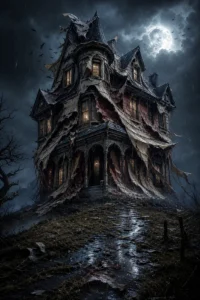
Blackthorn House listened.
It had listened since she arrived, but now she could feel the attention more clearly, as if her night on the bathroom floor had thinned some membrane between them. The mansion’s silence had texture. It gathered in corners, nested beneath peeling wallpaper, hung in the open mouths of rooms whose doors had swollen in their frames. The old hospice did not creak at random. It shifted when she passed. It sighed after she breathed.
“You’re wood and rot,” she said under her breath. “You’re nails. Pipes. Bad wiring. Nothing more.”
The radiator at the end of the hall ticked three times.
Then the intercom speaker above it crackled.
Mara froze.
The speaker was a cream-colored oval set into the wall, its grille clotted with dust. She had noticed them throughout the house—leftovers from Blackthorn’s hospice years, when nurses could call between wards and kitchens and treatment rooms. None of them had power. The panel in the administrator’s office had been gutted, its wires chewed by mice.
The speaker hissed again.
“Breakfast trays to east wing,” a woman’s voice murmured through static. “And tell Mrs. Kellerman her son is here.”
Mara’s hand tightened around the poker until the ridges bit her palm.
The voice vanished beneath a swell of static like surf dragged over gravel.
“There is no east wing,” Mara said.
Her words came out less steady than she wanted. She knew there had been an east wing once. She had read it in the brittle binder of property records left in the office. Torn down in 1978 after a structural failure. Removed before Blackthorn became a hospice. Removed before any patient named Kellerman could have waited there with tubes in her arms and hope making a fool of her.
Unless the house remembered rooms the world had taken away.
Mara backed toward the stairs. Her bare feet were cold. She had slept in yesterday’s clothes, the cuffs damp and stiff, and her sweater smelled of mildew. The sensible thing would have been to pack, to take the caretaker’s truck and risk the flooded road, to walk if she had to. But the road had collapsed in two places during last night’s storm, and the last time she had tried the satellite phone, it had breathed in her ear with the wet, laughing voice of a drowning child.
I’m sorry, Jonah.
The thought rose before she could stop it.
Not memory. Reflex. A bruise pressed from inside.
She closed her eyes, and for one heartbeat she saw the boy’s sneakers beneath her office couch. Blue canvas. White rubber toes. He had tucked one shoelace under the other foot, a child’s nervous habit she should have noticed and asked about. She had been looking at his mother instead, at the performance of grief before grief had happened, at the way Mrs. Bellamy had spoken for him while Jonah dissolved into the upholstery.
Then the house groaned.
Not a creak. Not the settling of old beams. A long, deep sound rolled through the walls, beginning somewhere below the foundation and climbing upward. The floorboards trembled under Mara’s feet. Dust sifted from the ceiling. Far off, a door slammed, then another, then another, a chain reaction of unseen rooms sealing themselves.
Mara opened her eyes.
The sound ended in a faint, moist click.
Like a jaw finding its proper hinge.
“No,” she said again. It seemed to be the only word she had left.
She dressed in layers with shaking hands: dry socks, boots, her thick coat, fingerless gloves that still smelled faintly of coffee from Portland. She tied her hair back and avoided the bathroom mirror while doing it. In the kitchen, she forced down two crackers and a mouthful of bottled water. The power remained off, though the refrigerator hummed in intermittent bursts as if dreaming of electricity. The emergency lights along the baseboards glowed a sickly red despite being dead the day before.
She needed tools. A flashlight with fresh batteries. A crowbar. The floor plans.
And answers.
She found the binder where she had left it in the administrator’s office, beneath a framed photograph of the Blackthorn staff from 1996. The people in the picture stood on the front steps in blue scrubs and cardigan sweaters, smiling with the professional warmth of those who spent their days teaching the dying how to leave politely. The hospice director, Dr. Eamon Lark, occupied the center, tall and narrow, his hands folded over the silver wolf’s head of his cane. His smile had always unsettled Mara. It had too many decisions in it.
Today, every face in the photograph had turned slightly toward the camera.
Not much. Just enough to suggest they had been caught listening.
Mara flipped the frame facedown.
The binder’s maps were creased and water-stained. She spread them across the desk, weighting corners with a stapler and a ceramic mug that read GRIEF IS LOVE WITH NOWHERE TO GO. Someone had crossed out sections in red marker: chapel roof unsafe, hydrotherapy room closed, west dormitory mold contamination. But it was the oldest map that drew her eye. Victorian ink, reproduced poorly. Blackthorn House before renovations, before hospice additions, before the east wing’s demolition.
There, between the pharmacy and what later became medical storage, was a corridor drawn in thin black lines.
It did not appear on any modern plan.
The corridor ended at a rectangular block labeled in a hand so faded she had to bend close to read it.
Charity Ward.
Mara stared until the letters blurred.
The house exhaled around her.
She took the map, the crowbar from the maintenance closet, and the heavy flashlight with the rubber grip. The pharmacy lay on the first floor behind the old nurses’ station, a room she had avoided because its shelves still held the hospice’s stale medical smell. Expired antiseptic. Powdered latex. The bitter ghost of crushed pills. When she unlocked it, the door resisted for a moment as if someone leaned on the other side.
“Move,” Mara snapped.
The latch gave.
The pharmacy was colder than the hall. Narrow shelves lined three walls, crowded with empty brown bottles, rusting tins, boxes of gauze, plastic pill trays, and records tied in bundles with string. A barred window looked out on the dead forest, where rain threaded through black branches. The fluorescent tubes overhead were dark, but the emergency strip beneath the counter painted everything in red—the shelves, the floor, her hands—until the room seemed submerged in blood diluted by seawater.
Mara wedged the door open with a metal wastebasket.
She did not like the idea of it closing behind her.
The old map trembled in her hand. According to the plan, the hidden corridor should begin behind the west shelving, somewhere near the locked narcotics cabinet. But the wall there looked ordinary: warped paneling painted a jaundiced cream, a strip of baseboard chewed by damp, shelves bolted into studs. Nothing that suggested absence.
She began pulling things down.
The work steadied her. One box, then another. Gauze. Glass vials. A jar of tongue depressors fuzzed with mold. A ledger whose pages had swollen into a single brick of paper. The shelves shrieked when she dragged them from the wall, each bolt tearing free with a sound like fingernails ripping from flesh.
Behind the shelving, the paneling was darker. No, not darker—newer. A section had been installed over something else, its seams hidden by decades of grime. Mara ran her gloved fingers along the edges and felt the faint square outline of a patch.
Her pulse climbed.
She set the flashlight on the counter, angled the beam, and drove the crowbar into the seam.
Wood splintered.
The smell came first.
Not rot. Not mold.
A sealed-up breath escaped from the wall, sour and old and human, carrying with it iodine, fever sweat, candle wax, damp wool, and something beneath all of it: the copper stink of blood dried so long it had become part of the air’s memory.
Mara gagged into her sleeve.
The panel cracked. She pried again. A strip peeled away, revealing brick behind it.
Red brick. Mortar veined with black.
Her flashlight flickered.
For one terrible second, the beam dimmed enough that she saw not brick but skin—reddened, mortared with scar tissue, breathing through hairline seams.
Then the light steadied.
Mara stumbled back.
“Nope,” she said, though nobody had asked her anything. She laughed once, sharply, and the sound broke. “No. That’s enough.”
She turned toward the door.
The wastebasket remained in place. The hall beyond was visible. Empty. Gray morning light. Normal floorboards. Escape shaped like a doorway.
Then something knocked from inside the bricks.
Once.
Softly.
Mara’s skin went cold beneath her clothes.
Another knock answered it, lower down. Then three quick taps near her shoulder height. Then a dragging sound, as if palms slid over brick in search of a weak place.
She could not move.
The knocks multiplied.
Behind the bricked-over corridor, hands began to wake.
Some were small and frantic. Some were slow, arthritic, patient. Some struck with fists. Others scratched, nails rasping against the far side of the wall in a dry chorus that set Mara’s molars on edge. The sound gathered until the whole pharmacy seemed filled with people trapped behind a surface just thin enough to hear through.
Then the voices started.
“Nurse?”
“Please.”
“It’s morning, isn’t it? They said my daughter would come in the morning.”
“Don’t open it.”
“Water. God, water.”
“Don’t let it finish.”
Mara pressed both hands over her ears. It did not help. The voices were not only sound. They came through the floor, through the crowbar handle, through the scars she had found on her body that morning after the first night—thin red lines curving over her ribs in patterns too architectural to be injury. They hummed along those impossible marks now, as if her skin had become a receiver tuned to the sealed ward.
“Who are you?” she asked.
The voices tumbled over one another.
“Room twelve.”
“I was in bed four.”
“Tell Elise I kept the photo.”
“No names, no names, it eats names.”
“It wore my husband on Tuesday. He had been dead nine years.”
“It made a door out of my mother.”
“Don’t listen if it sounds like love.”
Mara backed away until her shoulders hit the opposite shelf. Pill bottles rattled and fell around her boots, skipping across the floor like teeth.
“You’re not real,” she said.
The wall answered in a voice so close it seemed the speaker had placed her mouth against the brick.
“That is what we told ourselves.”
Mara stopped breathing.
The woman’s voice was hoarse but clear, threaded with authority frayed by terror. Not the pleading murmur of a patient calling from a bed. Someone who had once given instructions. Someone used to being obeyed.
“Were you staff?” Mara asked.
A pause.
“I was night supervisor. Lenora Pike.”
Mara remembered the name. It had appeared in one of the caretaker files, typed beneath a report about unauthorized ward closures and missing morphine stock. No photograph. No obituary in the clippings she had found. Just a name that stopped appearing after November 1973.
“Lenora,” Mara said carefully, as she would have spoken to a client standing on a bridge. “What happened here?”
Laughter moved behind the wall—not amusement, but a dozen throats breaking the same way.
“Here?” Lenora said. “Child, here is only the scab.”
The bricks bulged.
Mara flinched. Mortar dust sifted down in black grains. For an instant, she saw the pattern of the hidden corridor in her mind: long and narrow, bending left, doors on either side like ribs. At the end, the Charity Ward. Beds placed too close together. Curtains yellow with age. Rain at high windows. A smell of lavender water failing to hide decay.
She had never been there.
Yet she knew where the nurses had kept extra blankets. She knew one window had been painted shut. She knew the last bed on the right had belonged to a man who sang hymns after losing his tongue.
Mara swallowed bile.
“Why is it sealed?”
“Because brick was all we had left.”
“Against what?”
The voices fell silent so abruptly that the room seemed to lose pressure.
Beyond the wall, something large shifted in its sleep.
The sound was not on the other side of the bricks. It was deeper. Beneath them. Beneath the foundation. A slow movement, as of vast tissue adjusting around bones made of timber and stone. The pharmacy shelves trembled. A line of brown bottles clicked together in nervous applause.
Lenora whispered.
“Against the house.”
Mara’s laugh came out thin and ugly. “The house.”
“Not the building. The thing wearing it.”
The emergency light at the baseboard pulsed. Red, darker red, red.



0 Comments