Chapter 1: The Winter Caretaker
by inkadminThe house had been empty for twenty years, but someone had made the bed with Mara’s childhood sheets.
She did not know that when she first saw Blackthorn House through the windshield, wipers clawing at rain so hard it seemed the sky had decided to bury the Oregon coast in water. All she knew then was that the house stood where the map insisted it would, at the end of a road that had become less road with every mile—first asphalt veined with weeds, then gravel, then two ruts of black mud between wind-warped firs.
The Pacific should have been visible beyond the cliffs. Instead it announced itself as a presence: a vast gray animal breathing below the world, exhaling salt through the trees. Every gust rocked Mara’s ancient Subaru hard enough to make the suspension complain. Rain hit the hood in handfuls. Branches scraped the windows like fingernails of something trying to get in before she reached the door.
For the last thirty minutes she had been telling herself not to turn back.
There was nowhere to turn back to.
The final bend spat her out of the forest, and Blackthorn House rose in front of her.
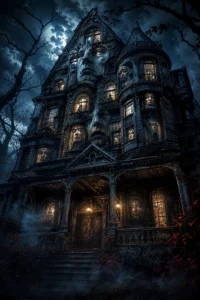
It had once aspired to grandeur. Even ruined, it held the cliff with the stubborn posture of old money and older sickness. Three stories of weather-blackened Victorian architecture hunched beneath a roof of broken slate. Turrets leaned at either end like watchmen who had dozed off and died standing. Long verandas wrapped around the front, their railings moss-soft and skeletal. Boarded windows stared from the façade in uneven rows, some planks loose enough to knock softly in the wind.
Above the main entrance, half hidden under ivy gone brown with winter, carved letters remained:
BLACKTHORN MERCY HOME
FOR THE CHRONICALLY ILL
Mara slowed in front of the iron gate. It sagged open on one hinge, as if something had left in a hurry and never bothered closing it behind itself. Her headlights caught the old sign nailed to the gatepost beneath the hospice name. White paint, red warnings, official municipal font.
PRIVATE PROPERTY
STRUCTURE UNSAFE
DEMOLITION SCHEDULED: APRIL
April. Four months.
Four months of rain, inventory lists, generator checks, contractor visits postponed by storms, and silence. Four months without the pale green walls of her office. Without the framed certificates she had packed in a box and shoved into a storage unit after the review board meeting. Without parents with trembling hands and faces hollowed by hope asking, Is this normal? Should she be this quiet? What do we do?
Four months without children.
The thought came sharp enough that Mara almost missed the figure standing on the porch.
He was small beneath a yellow rain slicker, though he might have been taller without the house above him. The porch light behind him flickered in a glass globe full of dead moths. He lifted one arm in an efficient, impatient wave.
Mara drove through the gate and up the curved drive. Gravel crackled under the tires. Puddles swallowed the headlights and gave back warped pieces of the house. A fountain stood dead in the center of the drive, choked with pine needles and rainwater; something pale floated in it, then turned over and revealed itself as a strip of bark.
She parked beside a mud-spattered white pickup with the logo of Harrow & Pike Property Management peeling from its door. For a moment she stayed inside, hands tight around the steering wheel.
Her own reflection hovered in the windshield between the streaks of rain: thirty-seven, though winter light and insomnia had been taking liberties. Dark hair twisted into a knot at the nape of her neck. Skin too pale. A narrow face made sharper by months of not eating when she should. The bruise-colored shadows under her eyes looked almost theatrical.
She had been told she looked composed. She had been told this by grieving families, by colleagues, by reporters whose questions had serrated edges under velvet.
Composed meant they could not see the tremor if she kept her hands still.
A fist rapped the driver’s window.
Mara flinched hard enough to knock her knee against the dash.
The man in the yellow slicker peered in at her. His hood shadowed most of his face, but she saw a thin mouth and a mustache the color of wet straw.
She rolled down the window. Rain immediately needled her cheek.
“Ms. Vale?” he shouted over the storm.
“Mara,” she said.
“Ellis Pike.” He thrust a hand through the open window, realized it was slick with rain, wiped it against his coat, and thrust it in again. “You made decent time.”
His palm was cold and damp. He shook once and withdrew quickly, as if physical contact was a contractual obligation he had satisfied.
“Road’s worse than they said,” Mara said.
“Road’s always worse than we say.” His smile showed small teeth. “If we told the truth, nobody would come out here.”
He laughed. Mara did not.
Pike glanced toward the house, then at the low clouds pressing down over the cliff. “Let’s get you inside before the light goes. Storm’s supposed to tear up the coast tonight.”
“I thought you were staying to walk through the systems.”
“That’s what we’re doing.”
“Before sunset?”
His smile flickered. “Before the roads wash out.”
He had already stepped back. Mara rolled up the window, killed the engine, and opened the door into a slap of wind that stole her breath. She dragged her coat tight and wrestled her duffel from the passenger seat. The storm immediately soaked the shoulders of her wool coat. By the time she reached the porch steps, her hair had loosened into wet strands around her face.
The porch sagged under her boots.
“Careful there.” Pike bounded up ahead of her with surprising agility. “Don’t trust anything painted green. Original boards. Termites got sentimental about the place.”
“That in the orientation packet?”
“Packet was written by lawyers. I’m giving you the version that keeps your ankles intact.”
The front doors were enormous, dark oak swollen from decades of sea air. Their carved panels showed thorn vines twisted around open hands. Pike produced a ring of keys heavy enough to belong to a jailer and selected one wrapped in blue tape. It fought the lock, then turned with a deep metallic clunk that Mara felt in her teeth.
When he pushed the doors open, the house exhaled.
Not a breeze. Not simply stale air displaced by movement. Something warmer than the outside wind slid across Mara’s face, damp and faintly sweet, carrying old rot, furniture polish, mildew, and beneath that a trace of antiseptic so thin it might have been memory. It touched the back of her throat and settled there.
Pike stepped in without hesitation. “Welcome to Blackthorn.”
Mara followed.
The foyer swallowed the storm into a dim cathedral of wood. Her boots clicked on black-and-white tile cracked into a spiderweb pattern. A grand staircase rose ahead and split in two, climbing to a second-floor gallery where sheeted furniture hunched beneath dust. The walls wore faded wallpaper patterned with thorny roses, burgundy blooms browned nearly black. Water stains had spread across the ceiling in shapes that made Mara think of continents on maps of countries that no longer existed.
The air held its own weather. Colder near the floor, warmer near her face. Somewhere, water dripped with patient regularity.
Pike shut the door behind her. The sound rolled through the foyer and vanished into the house.
For a second, everything listened.
Mara shifted the strap of her duffel. “Power’s on?”
“Generator’s on. Grid hasn’t serviced this spur in years.” Pike pointed to a row of bulbs in a tarnished chandelier. Only three worked, glowing dull amber. “She’s temperamental, but she’ll do. You’ve got diesel enough for two weeks if you’re not wasteful. Delivery’s scheduled for the fifteenth. Weather permitting.”
“And if weather doesn’t permit?”
“Then you conserve.”
“Helpful.”
He gave her another quick smile. His eyes did not join it. They were pale, almost colorless, and always moving: stairwell, hallway, ceiling, her face, the door.
“Kitchen, caretaker’s rooms, office, utility access,” he said, ticking items off on gloved fingers. “East wing and third floor are closed. Roof’s bad. West ward is stable enough if you don’t go exploring after a bottle of wine. Basement’s locked. Don’t unlock it. Boiler room’s down there, but we bypassed everything.”
“If the boiler’s bypassed, how is there heat?”
“There isn’t, not really.” He shrugged. “Space heaters in your rooms. Wood stove in the kitchen if you’re feeling rustic. Keep it ventilated unless you want to join the building’s history.”
Mara looked up at the staircase. The banister was glossy where countless hands had polished it smooth. “How many patients lived here?”
Pike’s keys jingled as he walked. “At capacity? Seventy-six beds. More during flu years, if you believe county records.”
“Seventy-six terminal patients on a cliff road that barely exists.”
“It existed better then. And families paid for privacy.”
The word settled between them. Privacy. Not care, not comfort. Privacy.
Pike led her through a pair of double doors into a long corridor. The hospice revealed itself in layers: Victorian bones beneath institutional additions, beauty disciplined into usefulness. Decorative moldings interrupted by handrails. Stained glass transoms above doors fitted later with safety glass. Rooms once meant for parlors converted into wards, offices, treatment spaces. Everything smelled of damp cloth and plaster slowly surrendering to the sea.
As they passed the first ward, Mara looked in.
Rows of beds stood beneath tall windows boarded from the outside. Narrow iron frames. White sheets pulled tight. Pillows centered. Blankets folded with military precision at the foot of each mattress.
She stopped.
“I thought the place was empty.”
Pike turned back. “It is.”
“The beds are made.”
He did not look into the room. “Staging.”
“For demolition?”
“For investors, originally. Historic preservation group came through five, six years ago. Took pictures. Promised grants. Vanished when they saw the structural report.”
Mara stepped closer to the doorway. The sheets were white, but not fresh. They had yellowed faintly at the folds. Still, there was something deliberate about them. No dust lay across the pillows. No fallen plaster dappled the blankets. Each bed waited with unsettling patience.
“Someone maintained these.”
“Probably Mrs. Gannet.” Pike’s voice hardened around the name. “Old caretaker. Lived here until last winter.”
“I thought the job had been vacant.”
“It has. Since she died.”
Mara looked at him. “Here?”
“On the road.”
He answered too quickly.
A gust hammered the building. Somewhere upstairs, a door slammed. Mara’s shoulders tightened before she could stop them.
Pike laughed under his breath. “You’ll get used to that. House has more drafts than walls.”
“I’m sure.”
He continued down the corridor. Mara followed, but the ward pulled at her attention until the doorway slipped behind them.
They passed a nurses’ station with a curved counter scarred by cigarette burns. Behind it, cubbies still bore names on peeling tape: WARREN, CHO, LASKY, BELL. A glass-fronted medicine cabinet hung empty except for one brown vial lying on its side, label obliterated by age. On the wall above the counter, a clock had stopped at 3:17.
Mara did not like stopped clocks. In her old office, after the review board boxed her files, one battery clock had kept ticking though its hands had frozen. She had stared at it for twenty minutes while Dr. Haldane used words like “boundary collapse” and “clinical misjudgment” and “tragic but foreseeable.”
Foreseeable.
As if grief came with weather radar.
“You all right?” Pike asked.
Mara realized she had stopped walking again. “Fine.”
He did not believe her. That was all right. She had stopped needing belief from men in clean raincoats.
The caretaker’s quarters occupied what had once been a servants’ suite behind the kitchen. Pike showed her a sitting room with a threadbare rug, a wood stove, a desk, a bookshelf bowed under manuals and mouse-chewed paperbacks. The bedroom contained a brass bed, a dresser with swollen drawers, and two space heaters sitting like squat little sentries. The bathroom taps coughed brown before clearing to water that smelled faintly metallic.
“Linens?” Mara asked.
“Closet there. Best use your own if you brought any.”
She had. Two gray sheets, one blanket, one pillowcase. Practical, anonymous, purchased after she had thrown out nearly everything that reminded her of the townhouse she used to share with Daniel.
Pike slapped a folder onto the desk. “Emergency numbers. Radio frequencies. Generator instructions. Inventory checklist. You email weekly when the satellite cooperates, radio if it doesn’t.”
“And the demolition crew?”
“Surveyors may come in February. Maybe March. Depends on the cliff.”
“What about the cliff?”
His eyes slid away. “Erosion. Whole point is to bring her down before she goes on her own.”
Mara looked toward the window. Through warped glass, the rear grounds sloped into fog and rain. She could hear the sea now more clearly, a steady concussion below the wind. “How close is it?”
“Close enough not to sleepwalk.”
When she turned back, Pike was already moving toward the kitchen.
It was enormous, tiled in white gone ivory, with industrial sinks and prep tables from the hospice years. Rust freckled the fixtures. A black cast-iron stove occupied one wall, chimney pipe disappearing into darkness. Someone had laid kindling inside it already, neat as a suggestion.
“Pantry’s stocked for a month,” Pike said. “Canned goods, dry goods, water jugs. Don’t trust the cistern after heavy rain unless you boil it. Mice got into the flour last time, so I’d inspect before baking your welcome cake.”
“I’ll try to contain my disappointment.”
This time his smile almost reached his eyes. “You always this cheerful?”
“Only when my employer lies about road conditions, utilities, and the number of deceased caretakers.”
He studied her then, really looked at her for the first time since she had arrived. Rain ticked against the kitchen windows. The generator hummed somewhere below like a thing sleeping with one eye open.
“Harrow & Pike didn’t lie,” he said. “We summarized.”
“That must be comforting in court.”
“You read the liability waiver. You signed it.”
“I also read the job description. ‘Light caretaking duties. Isolated historic property. Suitable for writer, artist, or professional seeking retreat.’”
“You seeking retreat, Ms. Vale?”
The question slipped in cleanly. Too cleanly.
Mara reached up to untie the damp knot of her hair, then thought better of it. “I’m seeking a paycheck.”
Pike’s gaze dropped to the duffel at her feet, then to her face. “Aren’t we all.”
For an instant she heard another voice over his. A girl’s voice, hoarse from crying.
I don’t want to get better if better means she’s still gone.
Mara’s fingers tightened around the strap of her bag.
Not here. Not now.
The girl’s name had been Lena Bell. Fifteen years old. Hair dyed blue-black in uneven patches because her mother would only let her do the ends and Lena had done the whole thing locked in the bathroom with a drugstore kit. Her brother had drowned in July. By October she had stopped speaking except in sessions, where she spoke too much, words pouring out as if Mara were a drain and Lena could empty the poison if she just found the right angle.
Mara had found her on a Thursday.
No. Mara had not found her. Lena’s mother had.
Mara had been called afterward.
There were distinctions that mattered to review boards and insurance carriers. They did not matter at three in the morning.
“Ms. Vale?”
Mara blinked. Pike stood by the back door, holding out a set of keys.
“Sorry,” she said.
“Storm noise gets inside your head here.” He said it lightly, but he watched her hands. “These are yours. Front, kitchen, supply closets, office. Not basement.”
She took them. The ring was heavier than expected, keys of different ages biting into her palm. One long iron key had no label.
“What’s this one?”
Pike’s expression closed. “Old ward.”
“I thought the east wing was closed.”
“It is.”
“Then why give me the key?”
“It’s on the ring.”
“That’s not an answer.”
Rain slammed the windows hard enough to rattle the panes. Pike looked toward the sound. When he spoke again, he had lowered his voice, though there was no one in the house to overhear.
“There’s a sealed section behind the east wing. Victorian ward. Original structure. It’s not part of your duties.”
“Sealed how?”
“Brick, boards, common sense. The key opens the corridor door before it, not the ward itself. Don’t go in.”
“Because of structural danger?”
“Because you’re being paid not to.”
Mara let the keys hang from her fingers. “You’re very good at making this job sound normal.”
“This job isn’t normal. Normal jobs have traffic and coffee shops and people asking how your weekend was. This job has a roof leak over the chapel and a raccoon in the laundry chute. But it is simple.” He stepped closer, the brim of his hood dripping onto the tile. “Keep the generator running. Keep vagrants and teenagers out. Document storm damage. Don’t play historian. Don’t play ghost hunter. Don’t make the place more interesting than it is.”
Mara met his eyes. “Do people do that?”
“People do everything.”
Something in his face suggested he knew this intimately and wished he did not.



0 Comments