Chapter 4: The Woman in the Silver Hall
by inkadminThe handbook page had swollen from the damp until the ink bled like old bruises.
Mara stood at the kitchen table long after the furnace groaned itself quiet, reading the final line again and again beneath the weak yellow cone of the hanging lamp.
The house cannot enter a room unless invited by reflection.
The sentence had the neat, cramped handwriting of a person trying not to panic. Above it, ordinary notes dissolved by degrees into madness: clean the boiler filter every Sunday; salt the east steps after freezing rain; if you hear singing in the dumbwaiter, do not answer in harmony; never cover a mirror with cloth unless you are ready to keep it covered forever.
The kitchen smelled of cold grease, mouse droppings, and the mineral tang of the island water. Wind pressed itself against the windows in long, searching palms. Somewhere in the walls, pipes ticked like fingernails on teeth.
Mara closed the handbook.
The sound cracked through the room.
She flinched at her own movement, then swore under her breath and rubbed both hands over her face. Her skin felt clammy. She had slept badly the night before—if sleep was what one called lying stiff beneath two wool blankets while the house settled around her in voices almost too low to understand. Twice she had woken convinced someone sat in the chair beside her bed. Twice she had turned on the lamp to find only the cracked leather armchair and the gilt-framed mirror above the dresser reflecting her back to herself: hair in a dark snarl, eyes too wide, cheekbones sharpened by exhaustion.
She had considered removing that mirror.
The memory of the owner’s rule stopped her hand before it touched the frame.
Never remove the mirrors from their walls.
Such a simple instruction. Simple rules were how people concealed complicated sins.
Mara lifted the handbook again and checked the page after the warning. Blank. Not merely unwritten, but scraped. Under the right angle of light she could see where a pen had pressed hard enough to dent the paper, loops and slashes ghosting beneath the surface. Someone had written something there and then worked it away with a knife or thumbnail.
She carried the book to the stove and angled it toward the burner’s dead pilot light. The indentations trembled. She made out a few partial words.
silver
hall
don’t let her—
A knock sounded from beneath the floor.
Mara froze.
It came again. Three measured taps from the black cellar below the kitchen. Not pipes. Not the settling bones of an old building. A pause followed, patient and polite.
Then three more taps.
She did not move. Her mouth had gone dry.
The cellar door stood at the far end of the pantry, beyond the shelves of rusted cans and cloudy jars the previous owners had abandoned. A towel had been wedged beneath it to stop the draft. The towel shifted now, the smallest puckering of fabric, as though something on the other side had taken a breath.
“No,” Mara said.
Her voice sounded absurdly loud. It gave her courage and embarrassed her in the same moment.
The tapping stopped.
She waited, listening to the house listen back.
A minute passed. Then another. The wind lashed snow against the windows in a dry hiss.
Mara took the handbook and her flashlight from the table. She checked the battery by clicking it on and off twice. Its white beam cut across the kitchen cabinets, the stained sink, the porcelain knobs shaped like tiny eggs. Ordinary things. Things with edges and purpose. She clung to them.
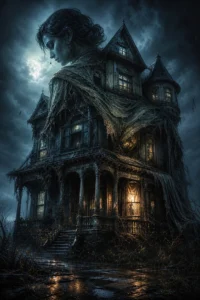
The caretaker’s suite on the second floor was too full of mirrors for comfort. The kitchen had one, a tarnished rectangle above the washbasin tilted down as if to admire the drain. The front hall had three. The east parlor had a wall of them in foxed panels, each reflecting a slightly different angle of rot. Blackdove House had been built by someone who believed the human soul needed constant surveillance.
Or by someone who had wanted to give something inside the walls a thousand doors.
Mara moved through the kitchen and stopped before the mirror over the sink. Her reflection stood there in the spotted glass, dimmed by age. The woman looking back had the same black sweater, the same gray wool socks, the same ugly cut on one knuckle from wrestling open the coal room latch yesterday. But her face seemed deeper in the glass than it should have been, set farther back in a room Mara could not quite see.
She lifted her right hand.
The reflection lifted hers.
At once.
“Good,” Mara whispered.
Her breath fogged the glass. For a moment the reflection’s mouth vanished behind the mist. When it cleared, Mara was not sure whether the woman in the mirror had stopped whispering at the same time she had.
She turned away before her nerves could make shapes out of coincidence.
The previous caretaker’s notes had mentioned the silver hall on three earlier pages, but never in a way that explained what it was. Polish silver hall sconces with dry cloth only. Do not use ammonia in silver hall. If silver hall smells of low tide, sleep downstairs. Mara had assumed the phrase referred to a wing of the mansion with decorative fixtures. Blackdove House was full of pretentious names for decayed rooms: the Rose Library with its dead vines pressing through broken panes, the Admiral’s Breakfast Room where a portrait of some nineteenth-century bastard watched mold creep over his wallpaper, the Winter Gallery where no one sane would linger after dusk.
The floor plan in the handbook showed no silver hall.
That bothered her more than the tapping.
She found the map folded into the back cover, its linen paper soft from age. The mansion sprawled in inked rectangles and crooked corridors, additions tacked onto additions until the architecture resembled a family tree drawn by someone who hated lineage. The first floor was marked in tidy block letters. The second floor was less precise. The third had entire wings scratched out. No silver hall.
Except—
Mara leaned closer.
Between the west stair and the old patient ward, a narrow blank space ran through the center of the second floor. It was not labeled. It had no doors drawn into it, yet the surrounding rooms bulged away from it, as if the architect had shaped the house around an absence.
A corridor hidden in plain sight.
The handbook’s scraped page seemed to pulse in her mind.
silver hall
don’t let her—
“You’re not going there,” she said.
Blackdove House gave a long, low creak.
Mara laughed once, humorless and breathy. “I said I’m not going there.”
And because fear was a lever, because the house had already learned the shape of her resistance, because she had built an entire career on telling grieving people that avoidance gave the dead more rooms to occupy, she was climbing the back stairs ten minutes later with a flashlight in one hand and the handbook tucked under her arm.
The stairwell narrowed after the first landing. Salt damp had furred the wallpaper loose in gray curls. Faces bloomed in the pattern when the flashlight shifted—roses becoming mouths, leaves becoming half-lidded eyes. She kept the beam low.
Halfway up, the house exhaled through the vents. A smell rose around her: iodine, wet wool, old flowers left too long in vase water.
Hospital smell.
No, not hospital. Institution. Her body knew the distinction before her mind named it. Disinfectant over urine. Boiled vegetables. Laundry steam. Human fear hidden under soap.
A memory struck with such force she missed a step.
Her mother’s hand around her wrist, too tight. Fluorescent lights buzzing overhead. A woman behind a nurses’ station saying, “Visiting hours are over, sweetheart.” Her father beyond a wire-reinforced window, sitting with his back to them, one slipper missing.
Mara caught the banister and sucked in a breath.
The memory receded, leaving behind the old ache in her wrist where her mother’s fingers had pressed crescents into the skin.
She had not thought about that place in years. Not clearly. Her father’s final hospitalization existed in her mind as a set of sealed drawers: the drive through sleet, her mother’s silence, the sour coffee from a vending machine, the terrible way he had looked when he finally turned around and did not recognize either of them.
Blackdove House settled again.
“Cheap trick,” Mara said.
Her voice trembled.
At the second-floor landing, the west corridor waited in darkness. The overhead fixtures were dead, their bulbs clouded with dust. Her flashlight found closed doors on either side, most labeled with brass numbers: 2W, 4W, 6W. Old patient rooms. Some doors still had observation windows, the wired glass cracked like ice. Behind one, a curtain stirred though no window was open.
Mara walked.
The runner carpet had rotted down the center, exposing boards pale as bone. Her socks made almost no sound, yet something beneath the floor seemed to pace with her. Not matching exactly. A delay. Step—then step. Step—then step.
She stopped.
The second set stopped after half a heartbeat.
Mara turned and shone the flashlight behind her.
The corridor stood empty. Doors. Peeling paint. A wheelchair folded against the wall, its rubber tires split. A long smear of black mildew rising from the baseboards like smoke.
“Mr. Vale?” she called.
The owner had not set foot on the island since dropping her at the dock two days ago, but her mind offered him anyway: his narrow smile, his leather gloves, the way he had looked at the house with something between devotion and disgust.
No answer.
“If this is some kind of test, I bill by the hour.”
Her attempt at sarcasm fell flat, swallowed by the corridor.
She consulted the map. The blank space should have been behind the linen storage near the west stair. She found the door at the end of the hall, its label half-scraped away. Inside, shelves bowed under moldering sheets. The air was dry and sharp with mouse nests. She pushed aside stacks of stiff towels, the flashlight beam darting over droppings and a dead moth the size of a child’s thumb.
At the back, behind a curtain of yellowed linens, her hand found cold metal.
A doorknob.
It was oval, not round, and so polished that even in the dark it held a dull gleam. No dust clung to it. Mara stared, heartbeat thickening.
On the door above the knob, someone had carved a line of text with a shaking hand.
If you see yourself first, close your eyes.
Below it, in smaller letters, another hand had added:
If she sees you first, run.
Mara should have gone back downstairs. She knew this in the clean, clinical part of her mind that had once explained trauma responses to people sitting on her couch with tissues shredded in their laps. Fear narrowed choices. Curiosity was not courage. Compulsion was not destiny.
Her fingers closed around the knob.
It was warm.
Not room warm. Body warm.
She almost let go.
Instead, she whispered, “No invitations.”
Then she turned the knob and opened the door.
The smell reached her first.
Silver polish. Cold stone. Rainwater trapped in an old vase. Beneath it, faint but unmistakable, was the coppery sweetness of blood.
Her flashlight beam entered the hidden corridor and fractured.
Mara stood at the threshold of a hall unlike any other in Blackdove House. It ran straight and narrow for perhaps sixty feet, though perspective warped strangely, stretching the far end into a pale vanishing point. The walls were lined floor to ceiling with mirrors.
Not decorative panels. Not the foxed parlor glass with its cloudy romantic decay. These were tall, severe mirrors in silver frames, each one human-sized, each frame engraved with patterns that looked at first like vines and then like veins. They faced one another across the corridor, creating a tunnel of reflected tunnels, a procession of Maras receding in both directions beyond counting.
The ceiling was arched and painted dark blue, though most of the paint had flaked away to reveal plaster the color of old teeth. Sconces shaped like cupped hands jutted between the mirrors. No candles burned in them, yet a faint pearly light filled the hall, sourceless and cold.
The silver hall.
Mara remained in the doorway, one hand on the frame, careful not to step inside.
Her reflections looked back.
Dozens of them. Hundreds. Each holding a flashlight. Each with black hair loose around a pale face. Each wearing the same guarded expression, though age and distortion altered them down the line. In one mirror she seemed younger, eyes softer, mouth not yet carved by professional failure and sleeplessness. In another she looked older, cheeks hollow, lips gray. Farther away, some versions were only dark blots with eyes.
She raised the flashlight.
The corridor erupted in white shards.
At once, the reflections lifted theirs.
At once.
Mara let out a slow breath.
“Good.”
The word came back in whispers. Not an echo. Echoes repeat sound. This returned it in many mouths, each fractionally different.
Good.
Good.
Good.
Her scalp prickled.
She lowered the beam and forced herself to examine the nearest mirror on the left. Its surface was pristine, untouched by the damp that ruined the rest of the house. Her reflection stood within it from the knees up. Behind the reflected Mara, instead of the linen closet, a room stretched away: green walls, a desk, two chairs angled toward one another.
Her office.
Mara stopped breathing.
Not approximately her office. Not a dream-version assembled from guilt and suggestion. The mirror showed the exact office she had rented above the bakery in Portland before everything collapsed. The sea-glass lamp on the side table. The framed credential crooked by a millimeter. The blue ceramic mug she used for pens. Even the stain on the rug where a client had spilled coffee and apologized until Mara had wanted to take her by the shoulders and say, Please, save your grief for something worthy.
In the reflected office, snow fell against the window though it had been summer the last time Mara had seen it.
The woman in the mirror turned her head.
Mara had not.
Every muscle locked.
The reflected Mara—no, not her, not exactly—looked toward the office door. Her expression changed from wary to attentive. Professional. Softened around the edges in that way Mara had once practiced until it became a second face.
A knock sounded inside the mirror.
Mara stumbled back from the threshold. The flashlight beam jumped.
Down the silver hall, all the reflected Maras stumbled, but one beat too late.
She noticed it then.
Not in the nearest mirror. Not in the next. Farther down, perhaps twelve frames away on the right, a figure stood where no reflection should have held that angle.
A woman.
At first Mara’s mind tried to make her another version of herself. Same height. Similar dark hair. Wool sweater rendered silver by the hall’s light. But the proportions were wrong in a way that made Mara’s stomach turn: neck too long, shoulders too narrow, hands hanging with fingers tapered beyond natural grace. Her face was angled downward, hidden by hair.
Mara lifted her right hand.
The woman lifted hers half a second later.
Mara’s throat tightened.
She lowered it.



0 Comments