Chapter 2: Seventy-Two Hours to Prove You Deserve Breath
by inkadminThe ambulance screamed through a city that had forgotten how to be a city.
Mara Venn kept one hand clamped to the wheel and the other braced against the dash where the plastic had split from a spiderweb crack. Blood dried in the grooves of her knuckles. Some of it was hers. Most of it wasn’t. The siren wailed above her like an animal begging to be put down, but the traffic ahead did not part because traffic had become a graveyard.
Cars lay skewed across Grand River Avenue in every direction, their windshields fogged with handprints and blood. A bus had jackknifed through the front of a payday loan place, its rear wheels still spinning slowly in the air, shedding ribbons of rubber smoke. Three blocks east, a column of black fire climbed from a gas main rupture and painted the underbellies of the clouds orange.
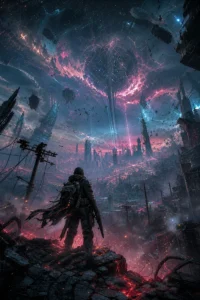
The sky above Detroit was wrong.
It had not simply cracked. Cracks belonged to glass, ice, bone. This was a wound. Long blue-white fractures stretched from horizon to horizon, pulsing with light behind the clouds like something enormous pressing its fingers through the membrane of the world. Sometimes the fractures widened and showed impossible depth: dark machinery turning behind the atmosphere, teeth of cold stars, columns of symbols spinning too fast to read.
And things were still falling.
Wet impacts thudded across rooftops and hoods. Something the size of a refrigerator dropped into the intersection behind them and burst apart into a spray of black meat and rust-colored hooks. A woman crawling from a minivan looked back at the sound, her mouth open around a word Mara couldn’t hear.
The meat convulsed. The hooks unfolded. The thing stood on too many legs.
Mara hit the gas.
“Oh God, oh God, oh God,” sobbed the girl in the passenger seat.
Her name was Tasha. Maybe. Mara had pulled her from the sidewalk three minutes ago when the girl’s mother stopped screaming mid-word because something made of femurs and tow chains had folded itself through the driver’s window of their Honda. Mara knew Tasha’s name because the girl kept saying it as if reminding the universe she still existed.
“Breathe,” Mara said.
“My mom—”
“Breathe first.”
“You don’t understand, my mom—”
“I understand,” Mara said, and hated herself for how flat it came out. “Breathe anyway.”
In the rear compartment, someone groaned. Calvin Briggs, fifty-nine, construction foreman, pulseless three times in the last twenty minutes and too stubborn to stay dead. He lay strapped to the cot beneath a silver trauma blanket, skin the color of old candle wax, his left side soaked red through Mara’s best pressure bandage. A shard of rebar from a collapsing overpass had punched through him below the ribs and missed everything vital by the width of a prayer, until the world ended and prayers got expensive.
Beside him, Jonah Pike—Mara’s partner, if the word still meant anything after the sky opened—held pressure with both hands. His glasses were gone. Blood ran from a cut over his eyebrow into one eye, and every time the ambulance bounced, his jaw clenched so tight Mara could hear his teeth click.
“Mara,” Jonah called, voice strained. “He’s circling the drain again.”
Calvin’s laugh rasped wetly. “Tell him drains don’t scare me. Been crawling out of union meetings thirty years.”
“Save your oxygen,” Jonah snapped.
“You save yours. You breathe like a pug.”
Mara glanced at the monitor mounted over the cot. The waveform jittered. Weak. Irregular. Bad and getting worse. She’d already pushed epi. Already packed the wound. Already done everything short of opening him up on the floor while monsters rained from heaven.
The first message had burned across every human eye twelve minutes after the fracture.
SEED-WORLD SOL-3 EVALUATION COMPLETE.
STATUS: FAILED DEVELOPMENT BENCHMARKS.
RECLAMATION TRIAL INITIATED.
People had stopped driving. Some crashed. Some prayed. Some clawed at their own faces trying to peel the letters away. Mara had nearly rear-ended a cement mixer when the words flared in her vision bright enough to blind her. She’d blinked them off and kept moving, because panic was something she treated in other people, not something she indulged while behind the wheel of a six-ton box full of drugs and oxygen.
The second message had come after the first things started eating.
TRIAL STAGE ONE: BREATHRIGHT.
DURATION: 72:00:00.
OBJECTIVE: SURVIVE.
SECONDARY OBJECTIVES: KILL HOSTILES. CONTRIBUTE TO GROUP SURVIVAL. SECURE SHELTER. PRESERVE VIABLE POPULATION.
SUCCESS CONDITION: CLASS AWAKENING.
FAILURE CONDITION: RESOURCE RECLAMATION.
Resource reclamation. That was what the System called a man being dragged screaming into the storm drain by something wearing his wife’s voice.
Mara swerved around a delivery van lying on its side. Its rear doors hung open. Packages spilled across the pavement like bright little coffins. A dog stood on top of them, barking at nothing, hackles high, one rear leg twisted backward. For one stuttering second Mara’s foot eased off the gas.
Then a shadow moved under the van.
The dog vanished with a yelp cut clean in half.
Tasha screamed.
Mara floored it.
The ambulance bucked over the curb and smashed through a newspaper box. The front bumper tore something loose with a shriek of metal. Mara fought the wheel, heart hammering in the hollow behind her ribs. A sign flashed past: GAS • FOOD • ATM • LOTTO. Half the letters were out. The canopy over the pumps sagged but still stood. Beyond it, the convenience store had its metal shutters half-lowered, one glass door cracked but intact.
Light. Walls. Maybe people.
Maybe a deathtrap.
“We’re stopping,” Mara said.
Jonah’s head snapped up. “The hell we are.”
“He needs stabilization.”
“He needs a hospital.”
“Hospitals are where everyone went.” Mara’s eyes flicked to the rearview. In the distance, something crawled over the roof of a police cruiser, jointed limbs scraping sparks. “Everyone includes them.”
“Mara—”
“Look at his pressure.”
Jonah looked. His mouth compressed into a bloodless line.
Calvin’s eyelids fluttered. “Gas station,” he mumbled. “Figures. Always said I’d die somewhere with bad coffee.”
“Nobody’s dying,” Jonah said.
Mara swung the ambulance into the lot hard enough that the tires screamed. A sedan blocked two pumps, driver’s door open, radio still playing some cheerful pop song under layers of distant sirens and closer human shrieks. She clipped the sedan’s bumper, shoved it sideways, and brought the rig to a shuddering stop beside the store entrance.
The second the siren died, the world rushed in.
Fire crackle. Car alarms. Gunshots from somewhere west. A baby crying thinly. Wind moaning through the cracked sky. And beneath it all, a sound like knives being dragged across concrete, slow and patient, from the far side of the pumps.
Tasha had both hands over her mouth. “What is that?”
Mara killed the engine and grabbed the portable radio out of habit. Static snarled. Dispatch was gone, or busy screaming, or dead.
“Stay close,” she said.
“I can’t. I can’t move.”
Mara looked at her. Tasha was maybe seventeen, mascara striped down her cheeks, one hoop earring torn loose and bleeding along her jaw. Her hands shook so violently her nails clicked against her teeth.
“You can,” Mara said. “Because the alternative is worse.”
The girl stared at her.
“On three. One.” Mara opened her door. “Two.” She slid out into air thick with gasoline and hot metal. “Three.”
Tasha stumbled after her, legs almost folding. Mara caught the back of her hoodie and hauled her upright. The cold came next, sudden and unnatural, rolling across the pavement in a wave that raised gooseflesh under Mara’s uniform. It smelled like pennies and old rain.
On the far side of the pumps, something clicked.
Not one thing. Several.
Mara saw them between the islands of fuel dispensers: low shapes moving on hands that were not hands, bodies narrow and lacquer-black, heads hidden under masks of fused bone. Rusted license plates grew from their shoulders like insect wings. Their limbs ended in hooked tire irons. Five of them. Maybe six. They moved with horrible restraint, sniffing the air through slits where mouths should have been.
One lifted its head.
Its mask had a human jaw bolted across the forehead.
Mara did not run. Running made prey. She moved fast, controlled, around to the rear doors.
“Jonah,” she said quietly.
“I see them.”
“We have thirty seconds.”
“That’s optimistic.”
The back doors banged open. Jonah jumped down first, then grabbed the cot rails. Calvin tried to raise his head and failed.
“New neighbors?” Calvin wheezed.
“Quiet ones,” Mara said. “Don’t offend them.”
The store door rattled.
Mara turned, trauma shears already in her fist like a knife. A face appeared behind cracked glass: a man in a Lions sweatshirt, broad, bald, eyes wild behind thick frames. He held a shotgun badly, the muzzle wavering between Mara’s chest and Tasha’s face.
“Back off!” he shouted through the glass. “We’re full!”
“Open the door,” Mara said.
“I said we’re full!”
Behind him, Mara saw movement. A woman clutching a toddler. An old man with a cane. Two teenage boys dragging a metal shelf toward the entrance. More people crowded between aisles, faces pale under fluorescent lights that flickered but somehow still burned.
“We have injured,” Mara said.
“Everybody’s injured!” the man yelled.
The scraping beyond the pumps grew louder. A wet, eager chitter threaded through it.
Mara took one step toward the door. The shotgun steadied. She stopped.
“Listen to me,” she said. “I’m a paramedic. That man dies out here, he dies loud. Those things are already tracking sound and blood. You keep us outside, we become bait against your front door.”
The man swallowed. Sweat shone on his scalp.
A woman behind him said, “Leon, open it.”
“No.”
“Leon.” The woman’s voice sharpened. “She’s right.”
Something struck the side of the ambulance.
The rig rocked.
Tasha shrieked. Jonah swore and almost lost his grip on the cot. Mara spun as one of the bone-masked creatures clung to the ambulance roof, its hooked limbs punched through the metal. It peered over the edge at her upside down. Its face split vertically. Inside was a red tongue threaded with barbs.
Mara threw the trauma shears.
They bounced off the bone mask with a useless metallic clink.
The thing lunged.
Glass exploded behind Mara.
The shotgun blast hit the creature mid-leap and flung it backward into pump number three. It hit hard, limbs spasming, black fluid splattering the concrete. The pump alarm began to scream.
Leon stared through the broken door, shotgun smoking.
“Move!” he shouted.
Mara didn’t waste gratitude. She and Jonah hauled the cot toward the door while Tasha stumbled ahead. Another creature skittered around the sedan, claws scraping sparks. It paused at the blood trail dripping from Calvin’s cot and trembled as if delighted.
“Faster,” Jonah grunted.
“You want to carry him?” Mara snapped.
“I am carrying him!”
The cot wheels jammed on the threshold. Calvin let out a sound that tried to be a laugh and became a cough. Mara kicked the wheel free. Leon grabbed the front rail with one hand and yanked. Together they dragged Calvin inside, then Tasha, then Jonah. The shotgun roared again over Mara’s shoulder. The second creature’s mask cracked, but it didn’t fall. It recoiled, shrieking through a mouthful of wires.
The old man with the cane slammed the door. The teenagers shoved the metal shelf against it. Someone else dropped a case of motor oil on top. For a moment everyone inside froze, listening to the creatures scrape and sniff at the glass.
The convenience store smelled of spilled soda, fear sweat, fryer grease, and the sharp copper stink Calvin brought in with him. Fluorescent bulbs buzzed overhead. A spinning hot dog machine clicked behind the counter, still rotating three shriveled sausages through the end of the world. The absurdity of it nearly made Mara laugh.
Instead, she pointed at the floor near the back wall.
“Clear space. Now.”
No one moved.
“Now!”
The command cracked across the store like a defibrillator shock. People jolted into motion. A man in a suit swept bags of chips off a low display. The woman with the toddler grabbed an armful of lottery pamphlets and flung them aside. Jonah guided the cot through the narrow aisle, knocking candy bars to the floor.
Mara followed the blood.
Too much. Calvin’s bandage had shifted during the run. Dark red soaked through the blanket and pooled beneath the cot. She felt the old tunnel vision trying to settle over her—the blessed narrowing, the world reduced to airway, breathing, circulation, pressure, rhythm. A patient was easier than an apocalypse. A wound had edges. A heartbeat had rules.
“First aid kit?” she asked.
Leon blinked at her, still holding the shotgun. “What?”
“First aid kit. Towels. Duct tape. Clean shirts. Alcohol if you have it, drinking or medical. Gloves.”
“I got vodka,” called the man in the suit.
“For cleaning, not courage.”
“That’s not how vodka works,” Calvin whispered.
Mara cut his shirt open. His skin was cold and slick. The rebar shard had torn him deep before they’d managed to get him free. She pressed both hands over the bandage and felt warmth flood between her fingers.
“Jonah.”
“I’m here.”
He was already at her side, pale but steady, pulling supplies from the jump bag. They moved around each other with practiced intimacy, two halves of an argument that had lasted four years and saved hundreds of strangers. He handed her gauze before she asked. She passed him tape without looking.
Outside, claws ticked along the glass.
People whispered. Someone prayed in Spanish. Someone else whispered every curse they knew. The toddler began to cry, and the mother clamped a hand over his mouth, eyes wide with apology and terror.
The System chose that moment to speak again.
The words did not appear in the air. They ignited behind Mara’s eyes, crisp and merciless, layered over Calvin’s gray face and Jonah’s bloody hands.
TRIAL CLOCK SYNCHRONIZED.
71:46:12 REMAINING.
LOCAL HOSTILE DENSITY: RISING.
GROUP SURVIVAL NODE DETECTED.
CONTRIBUTION TRACKING ENABLED.
A chorus of cries rose through the store as everyone saw it. The old man crossed himself with a trembling hand. One of the teenagers punched a shelf hard enough to dent it.
“What does that mean?” Tasha whispered. She had sunk to the floor by the energy drinks, arms wrapped around her knees. “Contribution tracking?”
Mara packed fresh gauze into Calvin’s wound. He bucked, teeth bared.
“Means,” he gasped, “corporate found a way to monetize the apocalypse.”
“Don’t talk,” Mara said.
“You always this bossy?”
“Only when people are bleeding on my shoes.”
Leon pushed through the watchers carrying an armful of dish towels and a red plastic first aid kit small enough to be insulting. His shotgun hung crooked in the crook of his arm. Up close, he was younger than Mara had thought. Late thirties, maybe. Not hard, just terrified into the shape of hardness.
“This all we had,” he said.
“It’ll work.” It wouldn’t, but despair was contagious and she refused to be patient zero. “Who owns this place?”
“My cousin. I was just getting gas.”
“Congratulations. You’re management now. How many people?”
Leon looked around as if the number might bite him. “Nineteen. No. Twenty-two with you.”
“Weapons?”
“Shotgun. Six shells left.”
“Five,” said the old man with the cane. “You fired twice.”
Leon glared at him.
The old man lifted his chin. “Numbers matter.”
Mara liked him immediately.
“Name?” she asked.
“Mr. Alvarez.”
“First name?”
“At my age, you earn the mister.”
“Fair.” Mara glanced at the door. The creatures had retreated from direct view, which was worse. “Mr. Alvarez, count exits.”
He tapped his cane once. “Front door, back delivery door, restroom window if you enjoy dying thin, roof hatch behind the cooler. Maybe.”
“Good. Leon, get the teenagers barricading the back. Jonah, vitals.”
“Mara,” Jonah murmured.
She looked down.
Calvin’s eyes had rolled back. The monitor gave a weak, wandering beep. Then another. Then a flatline tone that seemed impossibly loud in the little store.
For half a heartbeat, everything stopped.
Mara moved before thought could poison her. “Starting compressions.”
Jonah grabbed the BVM. “No pulse.”
“I know.” She locked her hands over Calvin’s sternum and drove down hard. Ribs flexed under her palms. “One, two, three, four—”
Outside, something slammed into the shutter. Metal boomed. The toddler screamed against his mother’s hand.
“—five, six, seven—”
“They’re coming back!” one of the teenagers yelled.
“—eight, nine, ten—”
“We need to be quiet!” Leon shouted. “Stop that!”
Mara didn’t look up. “Touch me and I break your hand.”
“He’s dead!”
“Not yet.”
Jonah squeezed the bag, forcing air into Calvin’s lungs. Mara counted compressions. Sweat slid down her temples. Her shoulders burned. The store shook as another impact dented the shutter inward. Potato chips rained from a shelf. Someone sobbed that they were all going to die.
Mara had heard that before. In wrecked cars. In bedrooms with pill bottles spilled across carpets. In alleys in February where men froze with needles in their arms. People often announced death before it arrived, as if naming it gave them bargaining rights.
Death rarely bargained.
“Switch,” Jonah said.
“No.”
“Mara—”
“Charge the pads.”
“Rhythm’s asystole.”
“Then give me something shockable.”
His expression twisted. “That’s not how hearts work.”
“Today isn’t how anything works.”
The System flared again.
CRITICAL EVENT DETECTED.
VIABLE HUMAN: CALVIN BRIGGS.
STATUS: RECLAMATION IMMINENT.
INTERVENTION VALUE: HIGH.
CONTRIBUTE?
Continue ReadingYou are reading a free preview (50%). Log in to unlock the full chapter and join comments.Log In to UnlockCreate Account
0 Comments