Chapter 5: Choose Your Dead
by inkadminThe hospital breathed like a dying animal.
Not in the clean mechanical rhythm it had once possessed—ventilators sighing in patient rooms, elevators humming behind steel doors, air handlers pushing disinfectant-cold wind through ceiling vents—but in wet shudders and groans. Pipes knocked inside the walls. Somewhere below, something scraped along tile with the slow patience of a butcher sharpening a blade. The stairwell doors thumped every few minutes as if the dark on the other side had shoulders and was testing them.
Mara Vale stood in the fourth-floor ICU with a flashlight clenched between her teeth, her prosthetic hand braced against the medication cart, and blood drying stiff down the side of her neck.
The flashlight beam cut across faces.
Too many faces.
Old men with oxygen cannulas taped under their noses. A woman whose abdomen had been split open twelve hours before the sky broke and whose wound vac had died with the power. A teenage boy strapped to a bed with both legs in traction, pupils blown wide from whatever painkillers they’d managed to scavenge before pharmacy locked itself behind a door now welded shut by warped steel and crawling black moss. A nurse named Estelle whispering the Lord’s Prayer under her breath as she pumped a manual bag valve mask for a sedated patient who would suffocate the moment her hands stopped.
The ICU had been built for twenty-eight beds.
There were sixty-three people in it now.
Patients had been dragged in from step-down, surgery recovery, oncology, even the NICU, because the fourth floor still had doors that could be barricaded and windows that hadn’t yet become mouths. They lay in beds, on mattresses, on gurneys, on blankets spread over the floor. Families crouched beside them with empty water bottles and eyes that followed Mara whenever she moved.
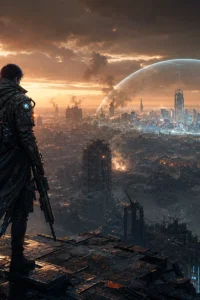
Outside the windows, Denver burned in strips of orange and violet. The skyline had changed while they fought in the stairwell. One tower downtown had stretched taller than physics allowed, its glass skin splitting into black facets, its top lost inside a rotating crown of storm clouds. Glyphs pulsed beneath the haze like infected veins.
Earth, integrated.
People, counted.
Lives, assigned value.
Mara tasted copper and old smoke around the flashlight.
“We have four cylinders left.” Nadia Kim’s voice came from behind her, flat as a slammed drawer.
Mara turned.
Nadia had been a respiratory therapist before the world acquired levels and monsters. She was five foot nothing, wore Hello Kitty clogs, and had the expression of a woman who could argue a hurricane into changing direction. Her black hair had escaped its bun in frizzy strands. One lens of her glasses was cracked. She held a clipboard in both hands like it was the last relic of civilization.
“Four full?” Mara asked.
“One full, two half, one lying to us.” Nadia tapped the gauge with a fingernail. “Needle’s stuck. I kicked it. Needle stayed stuck. So unless System Jesus wants to refill tanks, it’s decorative.”
“How long?”
Nadia’s eyes flicked toward Estelle and the woman she was bagging. “If we keep the intubated patients alive? Forty minutes. Maybe less.”
The room seemed to contract.
Someone heard. Someone always heard. A man near the far wall began to sob without making much noise, his shoulders hitching as he clutched the hand of a gray-faced woman under a foil blanket.
Mara took the flashlight from her mouth. “If we don’t?”
Nadia’s jaw tightened until the muscles jumped. “If we pull oxygen from anyone who can breathe room air and stop bagging the ones who can’t protect their own airway, we can stretch portable support for the move.”
“How many can move?”
Nadia looked down at the clipboard. The paper trembled once, then stopped because she forced it still.
“Forty-one with assistance. Eight can walk if we lie to them about how far. Sixteen cannot be moved without equipment we don’t have, staff we don’t have, or a miracle that isn’t currently answering pages.”
Mara’s prosthetic fingers clicked softly around the cart handle.
Sixteen.
In the Army, triage tags had colors. Red, yellow, green, black. Immediate, delayed, minor, expectant. Clean categories printed on laminated cards for dirty decisions. In practice, black tags were never black. They were brown eyes begging you not to leave. They were a boot twitching in dust. They were a kid with half his jaw gone trying to say his mother’s name.
Here, there were no tags left.
Only Mara.
A shape moved at the edge of her vision.
Caleb Reyes stepped over a sleeping child and ducked under a strip of torn privacy curtain. He carried a fire axe across his shoulders, both hands hooked over the haft. Dried monster ichor had turned his paramedic uniform into something stiff and black. The left side of his face was swollen, his eye narrowed to a slit.
“Barricade on west stairwell is holding,” he said. “For now. Whatever’s down there keeps sending little ones up. Not attacking hard. Just… touching the doors. Scratching. Backing off.”
“Testing response time,” Mara said.
He nodded once. “Like before.”
From the hallway came a faint skitter.
Everyone in the ICU froze.
It passed overhead, not underfoot—a dry, rapid clicking through the ceiling panels. Dust sifted down from the fluorescent fixtures. A baby began crying in a thin, exhausted rasp. His mother clamped him to her chest and whispered nonsense into his hair.
Caleb slowly lifted the axe from his shoulders.
The clicking moved away.
No one breathed until it was gone.
Then a new sound rose in the wake of it: the high alarm of an oxygen monitor running on its last internal battery. A single shrill beep, again and again, slicing through the dark.
“Turn that off,” Nadia snapped.
“I can’t,” Estelle said from beside the ventilated patient. Sweat sheeted her face. Her hands compressed the bag, released, compressed, released. “It won’t—”
Mara crossed the room and ripped the monitor cable out with her prosthetic hand. Plastic cracked. The beeping died.
The silence after was worse.
Dr. Kenji Sato emerged from between two beds, sleeves rolled to his elbows, silver hair plastered to his forehead. He had once been head of emergency medicine and had the calm, expensive voice of a man trusted by donors and terrified residents. That voice had frayed over the last day, thread by thread.
“Mara,” he said quietly. “We need to talk in the hall.”
“No,” said a woman on a mattress near the nurses’ station.
Her name was Paula Watkins. Mara knew because Paula had repeated it six times when they carried her husband up from surgical recovery. She sat beside him now, one hand gripping his limp fingers. He was intubated, yellow-skinned, belly distended beneath a blood-spotted gown.
“No hall,” Paula said louder. “You talk here. You tell us what you’re deciding.”
A murmur spread. Fear finding teeth.
“Ma’am,” Sato began.
“Don’t ma’am me.” Paula’s eyes were red, but dry. “I watched that thing with no face eat a security guard outside the elevators. I watched you people drag us up here and tell us we were safer. Now you’re whispering. Whispering means someone gets left.”
No one contradicted her.
Mara looked at Sato. He looked back, and for a moment they were in the old world again—two medical professionals standing over a problem, pretending the answer hadn’t already chosen itself.
Then the System made a soft chime inside Mara’s skull.
Localized Crisis Event Detected: Critical Resource Collapse
Population Under Provisional Command: 214
Viable Evacuation Window: 00:47:12
Primary Threat Vectors: Sublevel Nest Expansion, Oxygen Depletion, Morale Fracture
Optional Objective Generated: Maximize Survival Efficiency
Suggested Action: Identify Nonviable Assets. Reallocate Resources.
Reward scaling based on percentage survival of viable population.
Penalty scaling based on waste.
Mara went cold.
Not scared. Not angry. Those came hot.
This was cold in the marrow, the sensation of stepping barefoot into snow and realizing there was no shelter behind you.
Nonviable assets.
Her vision tunneled around the words floating in the air only she could see. Clean letters. Elegant. Bright. The System did not shout. It did not snarl. It did not sound like the things in the stairwell.
It sounded like hospital administration.
“Mara?” Caleb asked.
She blinked the message away. The room returned, crowded and breathing and rank with sweat, blood, antiseptic, urine, fear.
“Everyone listens,” she said.
The murmurs died unevenly.
Mara climbed onto the base of the nurses’ station so they could see her. Her bad knee protested; her prosthetic hand clamped around an overhead rail. The flashlight beam hung from her fist like a captured star.
“We are leaving this floor,” she said. “Not eventually. Not when rescue comes. There is no rescue coming. The lower floors are compromised, the building is changing, and the things below are learning how to get around our barricades.”
A man shouted, “Where are we supposed to go?”
“Out. Then west. There’s a reported Safe Zone near Mile High.”
“Reported by who?”
“People who died getting the message to us.”
That shut him up.
Mara swept the light over the room, forcing herself to meet eyes, not scan bodies like inventory.
“We have limited oxygen. Limited carriers. Limited hands that can fight. Some patients can walk. Some can be carried. Some can be moved if we strip beds into sleds and pray the wheels don’t jam. Some…” Her throat closed for half a beat. She crushed it open. “Some will not survive transport.”
Paula rose to her knees. “You don’t know that.”
“I do.”
“You are not God.”
“No,” Mara said. “God didn’t show up for rounds.”
Gasps. Someone cursed. Sato closed his eyes.
Mara didn’t stop. Mercy was a blade; if you hesitated, it tore instead of cut.
“We will assess everyone. If you can move, you move. If you can help, you help. If you can carry supplies, you carry supplies. Anyone who attacks staff, steals oxygen, or sabotages the group gets restrained and left. I will not let two hundred people die because one person panics.”
“And the ones you decide aren’t worth it?” Paula demanded.
The words struck hard because they were almost right.
Mara stepped down from the station. The impact traveled up her spine.
“Worth has nothing to do with it,” she said. “That’s the cruelty of this. They’re worth everything. We just don’t have everything.”
For a moment, Paula looked as if Mara had slapped her.
Then the woman turned back to her husband, shoulders curling protectively around his bed.
Work began in a frenzy because stillness would have broken them.
Mara divided the ICU with the precision of a field hospital under shelling. Green: ambulatory, even if feverish, even if limping, even if they needed someone to yell at them every twenty steps. Yellow: moveable with assistance. Red: critical but transportable with resources. Black: expectant.
She did not use the colors aloud.
People knew anyway.
Caleb took volunteers into the hallway to strip metal IV poles, bedrails, and privacy screens into makeshift spears and braces. A janitor named Luis found a maintenance closet with mop handles, duct tape, and three industrial flashlights. He wept when he discovered a case of bottled water tucked behind floor wax, then punched a wall until his knuckles split because there were only twenty-four bottles.
“Half-cups,” Mara ordered.
“They’re thirsty,” Luis said.
“They’re alive.”
His face twisted. Then he nodded and started pouring caps instead of cups.
Nadia moved from bed to bed, listening to lungs, checking oxygen saturation by touch and instinct because the monitors were dead. Her clipboard filled with hard marks. Once, she stopped beside an elderly man whose lips were blue despite the cannula.
“Mr. Abernathy,” she said gently. “Can you squeeze my hand?”
His fingers fluttered. His daughter leaned over him, gray braid swinging. “Dad? Dad, do what she says.”
He did not squeeze.
Nadia looked at Mara across the bed.
Mara looked at the oxygen line running from his nose to the last good cylinder.
The daughter saw the look. “No.”
Nadia swallowed. “He’s not getting enough even with support.”
“Then give him more.”
“There is no more.”
“Take it from someone else.” The daughter’s voice rose, raw and cracking. “Take it from me. I don’t need it.”
“That’s not how oxygen works,” Nadia whispered.
The old man’s chest hitched. His eyes opened halfway, cloudy and unfocused. Mara wondered what he saw. The hospital ceiling. His daughter’s face. The burning glyphs beyond the glass. Maybe nothing.
His daughter bent until her forehead touched his. “Please,” she said. Not to Nadia. Not to Mara. To him. “Please don’t make me go without you.”
Mara’s System interface pulsed in the corner of her vision.
Resource Waste Detected: Oxygen allocation to nonviable subject reduces projected viable survival by 3.2%.
Recommendation: Reallocate.
Mara’s fingers curled.
Shut up.
The message did not vanish. It waited.
She reached for the cannula.
The daughter caught Mara’s wrist with surprising strength. “If you touch him, I’ll scream.”
“If you scream, the things in the ceiling may come back.”
The daughter’s grip tightened. Hate lit her face. Hate was easier than grief. Cleaner. It gave the hands something to do.
“You monster,” she breathed.
Mara leaned close enough that only she and Nadia heard.
“Yes,” Mara said. “Today, I am. And because I am, your father’s oxygen buys three children enough air to reach the lobby.”
The daughter stared at her. Then her face collapsed.
She let go.
Mara removed the cannula.
Nadia turned away as she connected the line to a portable splitter rigged from scavenged tubing. Across the room, a little girl with pneumonia took her first deep breath in an hour and began coughing pink foam into a towel.
Mr. Abernathy died seven minutes later while his daughter sang “You Are My Sunshine” in a voice that broke on every other word.
When his breath stopped, Mara felt it.
Not emotionally. Not metaphorically.
Something cool slid under her skin, through the scars on her left forearm, into the blackened pathways the System had carved when it made her Gravebound Warden. Death essence gathered like mist in a graveyard. It smelled, impossibly, of rain on old stone.
A faint ring of gray light formed around her boots before sinking into the floor.
Nadia saw. “Mara?”
“Keep working.”
“Your eyes—”
“Keep working.”
Nadia kept working.
Mara walked to the supply alcove before anyone else noticed and pressed her prosthetic hand into the wall hard enough to dent the plaster.
Her class wanted death.
It did not revel. It did not cackle. It simply opened when people died nearby and filled itself with what remained. The first time, in the stairwell, she had used that power to shield the rescue team from a monster’s bone shards. It had saved lives.
That did not make the sensation less obscene.
A prompt appeared.
Death Essence Absorbed
Source: Human Civilian, Level 0
Purity: High
Grave Reservoir: 18/100
Skill Synergy Available: Pallbearer’s Aegis efficiency increased when protecting assigned dependents.
Mara laughed once, soundless and ugly.
“Assigned dependents,” she whispered.
The System had words for everything. That was how it made murder look like math.
A crash exploded from the hallway.
Someone screamed.
Mara spun and ran.
At the ICU entrance, two visitors fought over a backpack. One was a broad-shouldered man in a Broncos hoodie with a kitchen knife. The other was Luis, blood dripping from his split knuckles, one hand locked around the strap.
“It’s my food!” the man shouted. “My wife needs it!”
“That came from the staff lounge,” Luis snarled. “It’s for everyone!”
The knife flashed.
Caleb moved first, ramming the axe haft across the man’s forearm. Bone cracked. The knife clattered. The man howled and lunged anyway, wild with terror.
Mara hit him from the side.
They went down hard. His elbow caught her cheek. Stars burst across her vision. He bucked beneath her, spitting curses, stronger than he looked. Hunger had given him animal power.
Her prosthetic hand closed around his throat and pinned him to the linoleum.
“Stop,” she said.
He clawed at the metal fingers. “She’s pregnant! My wife’s pregnant!”
Mara’s grip loosened half an inch.
His eyes flicked toward the dropped knife.
Caleb kicked it away.
“Don’t,” Caleb said. “Man, don’t be stupid twice.”
The man sagged, chest heaving. Tears cut tracks through grime on his face. “She hasn’t eaten.”
Behind him, a woman leaned against the wall, one hand on the swell of her belly. She looked no older than twenty. Her lips were cracked white. She stared at the backpack like it was salvation.
Mara got off him slowly.
“Name,” she said.
“Trevor.”
“Trevor, if you pull a weapon on my people again, I leave you. Not your wife. You.”
He flinched.
“Food gets counted,” Mara said. “Pregnant women, diabetics, kids, people marching on their own feet. In that order. You want to help your wife? Carry someone who can’t walk.”
His face twisted with shame and fury. For one awful second, Mara thought he’d spit at her.
Then his pregnant wife said, “Trevor.”
Just his name. Soft. Devastated.
He broke. Shoulders folding, he pressed his forehead to the floor and nodded.
Caleb leaned close to Mara as Luis retrieved the backpack. “Morale fracture, huh?”
She glanced at him.
He gave a humorless smile. “You get that same creepy blue box I do sometimes? Mine mostly says congratulations, idiot, you survived being bitten.”
Mara wiped blood from her cheek. “Mine has opinions.”
“About?”



0 Comments