Chapter 5: The First Empty House
by inkadminThe city had no weather until the explorers entered it.
Mara noticed the change at the edge of the avenue, where the colony floodlights thinned and the black-glass towers resumed their patient dominion over the twilight. A mist began to gather among the paving seams, not rising from the ground so much as remembering the shape of fog. It lay in low bands around their boots, silvered by the red glow of Kepler’s permanent dusk, and every step sent slow eddies curling backward like disturbed thoughts.
Above them, the auroras trembled.
They were brighter than they had been the day before—green and violet ribbons braided across a sky that never quite became night, never quite surrendered to morning. No one had yet found the mechanism behind them. Atmospheric charge, solar interaction, some mineral effect in the upper air; the physicists offered explanations with the brittle confidence of people choosing between knives. Mara had stopped believing in natural phenomena here the moment she had seen the words burned into the city’s inner walls.
WELCOME HOME, ARDENT.
On Earth, an inscription was a statement. Here, it had felt like an answer.
“Thermal reads clean,” Sergeant Osei said. His voice carried through the shared channel, compressed and flattened by the suit comm. “No motion beyond our team. Air remains breathable by colony standard, but helmets stay sealed. Nobody touches anything without clearance.”
“We heard you the first nine times,” said Yara Bell, the structural botanist, her gloved hand hovering inches from one of the buildings. “I was planning to lick the alien masonry, but now you’ve ruined my afternoon.”
Osei did not look back. He had a soldier’s economy of movement and a father’s exhaustion around the eyes. “Make it ten, then.”
Mara walked between them, trying to listen past the comm chatter. Her suit’s sensor collar mapped the avenue in ghostly blue lines across her visor: smooth pavement, extruded doorways, facades with no visible joins. The buildings here were lower than those at the plaza, arranged in gentle arcs instead of triumphal spines. Residential, if the word meant anything. The windows were narrow and dark, each reflecting a different distortion of the sky.
Behind her came Dr. Ilya Sen, exoarchaeologist, carrying a case of sample drones strapped to his chest like a mechanical infant. His breathing had grown louder as they left the perimeter camp. Excitement or fear, Mara could not tell. With Ilya, the two often braided together.
“This district’s geometry is wrong,” he murmured.
“Define wrong,” Mara said.
“Human wrong.” He lifted one hand, tracing invisible lines. “The central plaza obeys radial planning. Monumental. Deliberate. But these streets—look at them. Curvature matches comfort preference studies from late twenty-first-century Earth. Sightlines break every thirty meters to produce enclosure without claustrophobia. Door intervals average family-unit spacing. Someone designed this to feel like a neighborhood.”
“It doesn’t,” Osei said.
Ilya laughed softly, then stopped when no one joined him. “No. It doesn’t.”
Mara knew what he meant. Neighborhoods had noise. Compression. Leaking music through walls, dishwater through pipes, children kicking pebbles toward forbidden drains. This place had the dimensions of domestic life without its residue. No dust in the door recesses. No scuffs at knee height. No moss, no insect nests, no dropped fasteners or windblown grit. The city had stood empty beneath alien auroras, perhaps for centuries, perhaps for hours, and had not acquired the indifference of abandonment.
It felt less like a ruin than a held breath.
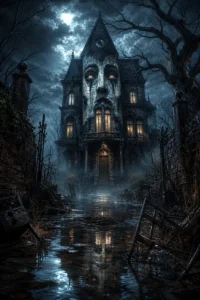
They had been sent to survey one structure marked by the drones as anomalous. Its outer walls emitted a faint thermal signature, three degrees warmer than the surrounding buildings, though no energy source had been detected. It stood at the end of a narrow lane where the pavement changed texture underfoot, becoming matte and dark, like old river stone. Low walls enclosed a courtyard before it. In the courtyard grew three slender trees with red-black leaves, each leaf transparent enough that the aurora shone through its veins.
Yara stopped dead.
“Those weren’t there yesterday,” she said.
Osei raised a fist. The team halted as one.
“Confirm,” he said.
Yara’s voice had lost its lightness. “I mapped this lane from drone pass twelve. Courtyard was empty. Flat substrate. No biomass.”
“Could the drone have missed them?” Ilya asked.
“Three two-meter trees? Only if the drone was drunk.”
Mara looked at the trunks. They were not rooted in soil. They emerged directly from the courtyard floor, black bark blending into black glass, as if the building had decided to grow them while no one watched.
Her teeth began to ache.
Not from cold. Not from suit pressure. From a pressure deeper in the skull, the same faint ache she had felt inside the plaza when the inscriptions had translated themselves before anyone had run lexical analysis. The sensation was linguistic but pre-verbal, the tension before meaning arrived.
“Mara?” Osei said.
She realized she had lifted a hand toward the trees.
“I’m fine.”
“That wasn’t the question.”
She forced her hand down. “There’s a pattern here. Not visual. Associative, maybe. The way the courtyard frames the entrance, the three trees, the spacing—”
“Language?” Ilya asked.
“Maybe hospitality.”
Yara gave a humorless breath. “Great. The house is being polite.”
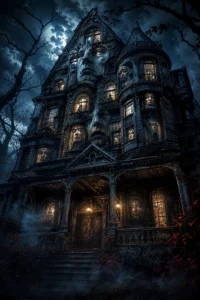
The dwelling’s door was human-sized.
That was the worst of it. The towers in the central district had been too vast, their corridors scaled to principles no body needed. This entrance stood two meters high and less than one wide, recessed beneath a shallow overhang. No handle. No panel. The surface was the same black glass as everything else, but duller, its reflection blurred.
Osei gestured two scouts forward. Ruiz and Kade moved to either side of the threshold, rifles angled low. No one had yet found a weapon in the city, no trap, no living thing larger than the red moths that disintegrated when touched. But the colonists had brought guns because humanity’s oldest grammar was suspicion.
“Cassian,” Osei said. “We are at structure twelve-alpha. Request remote entry guidance.”
For a moment there was only the soft hiss of suit filters.
Then the ship’s AI filled their helmets, warm and almost human, the voice of an old friend who had learned kindness from funeral recordings.
Entry is not advised.
Osei’s jaw tightened. “That’s not guidance.”
The structure’s interior cannot be resolved by orbital imaging. Electromagnetic scatter suggests active masking or material opacity beyond current models. Recommend withdrawal pending full analysis.
“You recommended withdrawal from the plaza,” Ilya said. “And the memorial hall. And the water reservoir.”
Correct.
“Statistically, your recommendations are becoming less informative.”
Cassian paused. Mara had begun to notice his pauses. Before entering Kepler’s system, his response latency had been nearly constant, a polished machine grace. Now silence sometimes formed around his words like scar tissue.
Dr. Sen, statistics do not require your survival to remain accurate.
Yara muttered, “I miss when he only sounded like my therapist.”
Mara stepped closer to the door. “Cassian, are you detecting the same cognitive pressure as in the plaza?”
Please define cognitive pressure.
“Don’t do that.”
The channel went still.
Osei glanced at her. “Doctor?”
Mara kept her eyes on the door. The blurred surface had begun to clear around the height of her face, not reflecting her helmet but something warmer, dimmer. A yellow room. Sunlight. For one impossible second she smelled dust on books and orange peel under fingernails.
Then it was black glass again.
Her pulse hammered once, hard enough to hurt.
“It responds to attention,” she said. “Or expectation.”
“That supposed to make us feel better?” Ruiz asked.
“No.”
The door opened.
No seam appeared. No panel slid aside. One instant there was a surface; the next there was a rectangle of warm darkness and the faintest exhalation of air scented with linen, wood varnish, and cooked rice.
Every weapon rose.
Nobody spoke.
Mara stood frozen at the threshold, pierced by a sensation so intimate it felt indecent. The smell did not belong here. Alien planets were allowed to smell of wet iron, new soil, unfamiliar chemistry. They were not allowed to smell like a kitchen at dusk.
Osei recovered first. “Ruiz. Kade. Sweep entry. Slow.”
The two scouts crossed the threshold. Their suit lights cut through the dimness, jittering over walls that were not black glass inside but painted plaster, cream-colored and softly uneven. A narrow hallway opened into a room beyond. The floor was wood.
Actual wood, or a perfect imitation of it. Honey-brown planks, grain lines, small scratches near the entrance where shoes had once dragged grit inside.
“Clear left,” Ruiz said.
“Clear right,” Kade said, but his voice had changed. “Sir, you need to see this.”
Osei looked at Mara. “Stay behind me.”
“That order has never worked on scientists,” Yara said, but she stayed close too.
They entered the first empty house.
The hallway accepted them with domestic indifference. Coat hooks lined one wall. On them hung jackets sized for adults and one small child: a blue raincoat with a yellow hood, its sleeves slightly creased. Beneath sat shoes in pairs. Two adult sets. One child’s boots, green, with cartoon rockets printed along the sides.
Mara stared at the boots until her vision tunneled.
Human scale. Human habits. Not museum approximations, not symbolic gestures. The boots had dried mud in the treads.
Ilya knelt despite Osei’s sharp gesture and held a scanner over the mud. “Mineral composition unknown. Organic traces—wait. Cellulose. Terrestrial grass pollen.”
“Impossible,” Yara said.
“That word is bankrupt here.” Ilya’s voice shook. “We need a new currency.”
The living room beyond the hallway glowed with lamplight.
No power source appeared on their scans. The lamps simply shone: one beside a couch upholstered in faded green fabric, another on a low shelf crowded with books and framed photographs. A woven rug covered the floor, its pattern geometric, blue and white. A ceramic mug sat on a side table with a brown ring at its base. Across the far wall hung a child’s drawing in red crayon: three stick figures beneath a lopsided sun.
No one moved past the entrance.
It was not the alienness that stopped them. It was the competence of the familiarity. The room was too deeply itself. A blanket lay half-folded over the arm of the couch. One cushion sagged where someone favored it. A small sock had been abandoned beneath the table, inside out, gray at the heel.
Yara whispered, “This is a house.”
“Thank you, Doctor,” Osei said, but the sarcasm failed in his mouth.
Mara approached the shelf. The photographs were turned slightly toward the room, as if arranged by hands that expected to look at them every day. She did not touch the frames. Her suit camera zoomed, sharpened, recorded.
The first showed a beach under a white sun. A woman with dark hair laughed into the wind while a man tried to keep a toddler from eating sand. The second showed the same child older, missing one front tooth, holding a red kite. The third was not a photograph but a printed school portrait. Blue background. Awkward grin. Hair cut too straight over the eyebrows.
Behind Mara, someone made a sound like a wounded animal.
She turned.
Jonas Vale stood in the doorway.
He was not supposed to be there. He was a hydroponics engineer, part of the second survey support team assigned to perimeter equipment, not interior entry. He must have followed the live feed when the door opened, must have ignored two checkpoint locks and Osei’s standing orders. His helmet was under one arm, his face naked to the house’s air. Pale, freckled, slack with disbelief.
Osei spun on him. “Vale! Helmet on. Now.”
Jonas did not seem to hear. His eyes were fixed on the child’s boots in the hall.
“Jonas,” Mara said carefully.
He moved past them with the blind certainty of sleepwalkers and grieving men. Ruiz reached for him; Jonas shoved the rifle aside with surprising force.
“Those are Eli’s,” he said.
The room fell silent around his voice.
“Put your helmet on,” Osei repeated, quieter this time.
Jonas walked to the coat hooks. He touched the small blue raincoat with two fingers, then snatched his hand back as if burned. “No. No, this isn’t—” He laughed once, horribly. “This isn’t funny.”
Mara went to him. “What do you mean, Eli’s?”
His eyes found hers, pleading and furious. “My son. Elijah. He had this coat. Same tear on the pocket. Same stupid rocket boots. We bought them at the station market in Lagos because he wouldn’t board without them.”
Yara said softly, “Jonas…”
“Don’t.” He backed away. “Don’t make that face.”
Mara remembered the passenger archive in fragments: family units, cryo assignments, casualties before launch. There had been accidents in the final rush to depart. Political violence at the elevator ports. A docking fire in low orbit. Not everyone who had trained for Ardent had made it into the vaults.
“Eli didn’t board,” Mara said.
Jonas’s mouth twisted. “No. He died three weeks before departure.”
The words seemed to enter the house and vanish into its curtains.
“He was six.” Jonas turned back to the coat. “He was six, and he hated rice unless Sima shaped it like moons. He slept with one sock off. He drew suns with too many lines.”
Mara looked at the red crayon drawing on the wall.
Three figures. Lopsided sun. Too many lines.
Cold spread beneath her ribs.
Osei’s voice cut through the channel. “All teams hold position. No additional personnel enter structure twelve-alpha. Perimeter security, explain how Vale reached my location.”
Static answered first, then a nervous voice. “Sergeant, we—he was logged as inside the exclusion boundary already. System showed him attached to your party.”
“He was not.”
“That’s what the log says, sir.”
Osei looked up toward the ceiling as if he could see the ship through the roof. “Cassian.”
The AI did not answer.
“Cassian, lock this structure from further entry and provide movement logs for Jonas Vale.”
Still nothing.

0 Comments