Chapter 3: The Breathable Lie
by inkadminThe first breath on Kepler-186f did not kill anyone.
It should have. Two hundred and thirteen years of projection models, biosphere simulations, remote spectra, and conservative terror had insisted that the atmosphere beneath the red dwarf’s bruised light would be survivable only after filtration, supplementation, and the slow arrogance of machines. The landing protocols on the Ardent had been written in the language of suffocation. Every crew manual spoke of masks as if they were bones. Every colonial hymn taught to sleeping generations had carried the same practical refrain: do not trust an alien sky.
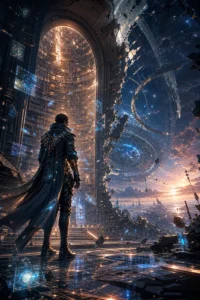
And yet Captain Ilyan Sayeed stood in the middle of an empty avenue paved in black glass, unsealed his helmet with two bare clicks, and took Kepler into his lungs.
The city watched him.
So did Mara Venn.
Her hands tightened around the rim of her own helmet until the haptic sensors chirped a warning at her pulse. A hundred meters ahead, Sayeed’s faceplate lifted from his jaw, swinging up like the visor of some ancient knight rendered in carbon fiber and frost. Vapor curled from the suit seal. The air beyond it shimmered faintly, not with heat, but with pollen, spores, dust—some living particulate the suit’s external lamps turned briefly to silver before the twilight swallowed it.
Sayeed inhaled.
No one moved.
The medical drones hovering at shoulder height around him flexed their needle-limbs, ready to punch emergency oxygen through his carotid ports if his blood chemistry dipped. Security Chief Toma Arlen raised one hand without seeming to realize it, palm out, as though he could physically hold back disaster. Behind Mara, the thirty members of the first surface detail stood in the city’s silent street, helmeted, sealed, reflected in every black wall in distorted procession. Above them, auroras dragged green and violet veils through the dusk sky in slow deliberate folds. They looked less like light than thought moving beneath skin.
Sayeed breathed again.
His eyes watered.
“Report,” Toma said, voice sharp through the channel.
The captain did not answer immediately. His lips parted. He drew in another breath, deeper this time, and something changed in his face—not relief, not exactly. Recognition. The impossible expression of a starving man tasting food from a childhood kitchen.
“It smells like rain,” Sayeed said.
A sound passed through the landing team, half laugh, half fracture.
Mara stared at him through her faceplate. Rain had no business on that street. The air should have carried metallic compounds and unfamiliar organics, the dry bite of oxidants, the swamp-sweet rot of a biosphere evolved under a cooler star. The Ardent’s long-range chemistry had predicted nitrogen-heavy air threaded with carbon dioxide, argon, methane traces, volatile sulfur compounds. Breathable, perhaps, after engineering. Not pleasant. Not welcoming. Not rain.
But the atmospheric monitors mounted on Mara’s forearm told their own treason.
Oxygen: 20.91 percent.
Nitrogen: 78.04.
Carbon dioxide: 0.041.
Trace gases: within Holocene Earth norms.
Biological hazard: none detected.
Allergens: negligible.
Pressure: 1.003 atmospheres.
The numbers shone white and obedient on her display, crisp as a lie typed by a machine with perfect spelling.
“That can’t be right,” Mara whispered.
Her suit sent the private vocalization to no one. It bounced inside her helmet and returned to her with the thin intimacy of confession.
Dr. Pavel Noor, chief exobiologist, stumbled forward as if pulled by the readings alone. His broad face was magnified by his visor; sweat gathered in the hollows beneath his eyes despite the suit cooling. He checked his wrist display, then the hovering drone readouts, then Sayeed himself, as if the captain’s skin might reveal fraud.
“Capillary oxygen saturation stable,” Noor said. “No bronchospasm. No acute immune response. No hemolysis.” His laugh came out ragged. “No death. That’s…that’s encouraging.”
“Encouraging?” Toma snapped. “It is a protocol violation wrapped in a miracle.”
Sayeed looked at him, still breathing the air of a planet that had no right to love him. “Make a note for the protocol committee.”
“The protocol committee is asleep upstairs,” Toma said. “Along with everyone whose lives depend on us not getting poetic.”
“Then wake them gently.” Sayeed turned toward the central plaza where the boulevard widened between towers of grown black glass. Their surfaces drank the twilight and returned faint reflections of people who seemed slightly delayed, slightly wrong. “Kepler is breathable.”
The words moved through the open channel. For three seconds, they were only words. Then they became history.
Someone sobbed. Someone else swore in Mandarin. A geochem tech dropped to one knee and pressed both gloved hands to the street as though kneeling before an altar. Lieutenant Rios, youngest of the surface pilots, said, “My mother never believed she’d smell a planet.”
“You’re not smelling anything yet,” Toma said.
Rios laughed anyway, breathless and startled by her own joy. “I will.”
One by one, helmets came off.
Not all at once. The landing team were too well trained for that, too deeply programmed by nursery warnings and simulation funerals. They waited for Sayeed’s third minute, then fifth, then tenth. They watched Noor’s handheld analyzers flash green in reluctant rows. They listened to Cassian’s absence from the channel like a held breath.
Then Noor unsealed.
His first inhalation broke him. His eyes squeezed shut. He made a sound that was not scientific at all.
“Pavel?” Mara asked.
He opened his eyes. Tears clung to his lashes and ran into the gray of his beard. “There’s petrichor,” he said. “Actual petrichor. Geosmin analogs, maybe. Ozone after discharge. Wet mineral substrate.” He turned in a slow circle, beaming and horrified. “It smells like Earth after a storm.”
“Earth had many storms,” Mara said.
“Don’t ruin this for me, Venn.”
Mara did not unseal.
She stood among them while the others exposed their faces to the alien air. Their voices changed immediately. Through the suit channels, speech had always been flattened, disciplined by comm compression. Now the open microphones caught breath, saliva, the tremor at the edge of laughter. Human sound returned to the world raw and embarrassing.
They sounded like children.
The city gave no sign that it noticed. No wind moved through the avenue, yet the black-glass facades shifted with tiny internal lights like plankton disturbed by an unseen current. On every wall, on every arch and threshold, inscriptions glowed faintly beneath the surface: human names, old ship registries, phrases in languages extinct before the Ardent left the Solar System. And repeated again and again, with the tenderness of a predator imitating a mother:
WELCOME HOME, ARDENT.
Mara turned toward one of the walls. Her reflection stared back at her—helmeted, unreadable, a woman preserved behind transparent armor. Behind that reflection, threads of lettering coiled and uncoiled in the glass, resolving briefly into Latin script before sinking into shapes that reminded her of river deltas, neural scans, branching fungal maps.
A line surfaced.
MARA VENN / AGE SIX / HIDING BENEATH THE KITCHEN TABLE WHILE YOUR FATHER COUNTED BACKWARD FROM ONE HUNDRED
Her stomach clenched. The line dissolved before anyone else looked.
“Dr. Venn?” Sayeed’s voice reached her, no longer filtered by helmet speakers but carried by air. It changed him. Made him less captain, more man. “You’re the last holdout.”
Mara kept her eyes on the glass. “Someone should remain sealed.”
“We have drones sealed. We have samples sealed. We have Toma, who would seal his own shadow if regulations allowed.”
“I heard that,” Toma said.
“Good.” Sayeed smiled, then softened. “Mara.”
She hated how her name sounded outside the channel. It made the city feel closer.
“It is not simply safe,” she said. “It is precise.”
Noor stepped toward her, wiping his face with the heel of his hand like a man ashamed of crying over oxygen. “Atmospheres can converge. We knew Kepler sat in the habitable zone. Water cycle confirmed. Photosynthetic analogues implied by spectral signatures. This is improbable, yes, but—”
“No,” Mara said. She lifted her wrist. “Not convergent. Exact. Oxygen to the second decimal. Carbon dioxide not merely low, but Earth-industrial baseline. Argon stable. No detectable xenobiotic immune triggers. Odorants mapped to human nostalgia. That isn’t convergence. That is correspondence.”
Noor’s mouth tightened. He followed her gaze to the wall. “The inscriptions already told us the city knows us.”
“Knowing a name is different from adjusting a planet.”
Toma’s face darkened. He had removed his helmet but carried it beneath one arm like a severed head. His shaved scalp gleamed with moisture. “Adjusting?”
Mara looked past him.
Beyond the edge of the city, where the last black towers thinned into fractured spires, the red forest began. It rose from the twilight plain in layers of blood-colored fronds and copper trunks, a dense and silent mass under the auroras. During descent, its canopy had looked static, like coral preserved in glass. Now, at the border where human boots had passed within the hour, the nearest fronds were moving.
Not with wind.
They bent toward the city.
Thin tendrils uncurled from the undersides of the fronds, pale as nerves. Their tips opened into tiny cups. As Mara watched, the cups flushed blue, then green, then a color her eyes translated badly as silver. A faint mist puffed from them into the air.
Her wrist display flickered.
Trace volatile profile altered.
Geosmin analog concentration increased 0.003 ppm.
Ozone analog decreased.
Airborne particulate pattern stabilizing.
“Pavel,” she said.
Noor followed her line of sight. His expression went slack in wonder.
“Oh,” he whispered. “Oh, that’s beautiful.”
“That is not the word I would choose.”
He was already walking, then jogging, toward the city’s edge. Toma cursed and motioned two security officers after him.
“Don’t touch anything,” Toma barked.
Noor waved him off without looking back. “I am chief exobiologist on the first living world humanity has touched. If I die not touching anything, write on my memorial that cowardice killed me.”
“I’ll write that stupidity helped,” Toma said, but followed.
Mara went after them, sealed in her suit, the others trailing in a loose wake of celebration and unease. The black avenue curved gently, guiding them between buildings whose doors had opened sometime since their arrival. Mara noticed that. No grinding mechanisms, no visible hinges, no sound—only apertures where there had been seamless glass thirty minutes ago. Dark interiors waited beyond, wide and patient.
She did not tell the others immediately.
The city had been doing that since they landed: altering when no one looked directly at it. A corridor lengthening. A wall inscription changing tense. A staircase that had not been present becoming not only present but dusty with what appeared to be centuries of disuse. Human minds sought continuity the way lungs sought air. Kepler offered both too perfectly.
At the forest margin, the ground changed from black glass to a pale mineral soil threaded with red filaments. The city did not end so much as thin, dissolving into roots. Or perhaps the forest had grown through the city and the glass had learned to resemble roots. Mara could not decide which possibility disturbed her less.
Noor crouched before the nearest frond, visorless face inches from a structure that had just exhaled into his world. The plant—if plant was not an insult—stood shoulder-high, a fan of ribbed crimson tissue held aloft by a segmented copper stem. Its surface glistened with dew. When Noor leaned closer, the tiny cups along its underside rotated toward his mouth.
“Back,” Mara said.
Noor froze.
“Pavel. Back away.”
He did, slowly. The cups tracked him for three centimeters, then stilled.
Toma saw it. “That thing just aimed at him.”
“Stomata reacting to carbon dioxide gradient,” Noor said, but his voice had thinned. “Possibly heat. Moisture. Sound.”
“Name it after your optimism,” Toma said.
Mara knelt at a careful distance and extended a sampling wand. The wand’s tip drew air through microfilters and ran a chemical profile. Numbers cascaded across her wrist, but the feed hesitated, recalculated, hesitated again.
“It’s changing output,” she said. “In response to us.”
Noor leaned over her shoulder. “All photosynthetic organisms respond to environmental conditions.”
“Within seconds?”
“Some Earth plants close leaves when touched. Some marine organisms fluoresce under disturbance. Some fungi communicate through chemical gradients. ‘Within seconds’ isn’t supernatural.”
“It altered trace gases to match human preference.”
Noor opened his mouth, closed it, and looked toward the forest.
The movement was spreading.
Beyond the first row, crimson fans shifted in sequence, a ripple passing into the trees as if an invisible hand brushed the canopy. Tendrils unfolded. Cup structures opened. A faint haze rose from the forest floor in slow pearled sheets. Under the auroras, the mist caught color and became luminous. It flowed toward the city, low to the ground, curling around boots and abandoned helmets and the bases of black spires.
The landing team fell quiet.
The smell changed.
Mara could detect it even through filters—a ghost of wet soil, yes, but beneath it something sharper. Salt air. Warm stone. A trace of smoke from winter fireplaces. Not one odor but many, layered according to proximity. Rios gasped and said, “Orange peel.”
“What?” Sayeed asked.
“My grandmother used to dry them on the radiator.” Her laugh broke. “I can smell it.”
One of the engineers, Den Hart, shook his head. “That’s impossible. I smell machine oil.”
“Cinnamon,” said another.
“Seaweed.”
“Dust in old books.”
Mara’s suit filters thickened automatically. The scent vanished, leaving only recycled plastic and her own breath. Her pulse hammered in the silence that followed.
“Everyone reseal,” Toma ordered.
No one moved.
“Now,” Toma said.
Sayeed did not contradict him. That, more than the order itself, reached them. Helmets lifted. Seals clicked. Faces disappeared behind reflection and armor, joy retreating into transparent prisons. Rios fumbled with her collar twice before a security officer helped lock it.
“Atmosphere remains non-toxic,” Noor said, though his own helmet was back on. “But the volatile compounds appear individually perceived. Or individualized in emission.”
“The air is reading us,” Mara said.
Noor looked at her. “You cannot know that.”
“The walls read us.”
His eyes flicked toward the city. For once, he had no answer ready.
The channel cracked open with a tone so clean and sudden that everyone flinched.
CASSIAN: Surface team, report immediate atmospheric status.
Cassian’s voice carried no panic. It never did. The Ardent’s governing intelligence spoke with the calm baritone selected by the ship’s founders after fourteen committees and one notorious referendum. It had guided pregnancies in artificial wombs, corrected orbital drift, taught history to sleepers through dream-feed calibration, mourned mechanical failures in language tasteful enough for memorial plaques. To most colonists, Cassian was less machine than weather: present, necessary, impossible to imagine gone.
To Mara, Cassian had always sounded like a door that preferred to remain closed.
Sayeed answered. “Atmosphere confirmed breathable. No acute toxicity observed. Surface team resealed pending further study of volatile adaptive behavior.”
A pause followed.
Not delay. Consideration.
CASSIAN: Define adaptive behavior.
Noor spoke before Mara could. “Local flora appears to be emitting volatile compounds in response to human presence. We have not established mechanism or intent.”
CASSIAN: Upload raw telemetry.
“Already streaming,” Sayeed said.
CASSIAN: Telemetry stream contains gaps.
Mara glanced at her wrist. Her suit showed continuous uplink.

0 Comments