Chapter 2: Execution Ink
by inkadminThe first thing Kael learned about imperial justice was that it smelled like wet wool, old blood, and ink.
Not clean ink, not the sharp blue-black bite of a fresh bottle uncorked beneath lamplight, but the stale, metallic reek of it baked into parchment and floorboards and magistrate robes. The kind of ink used to sign debt warrants, seizure orders, conscription lists, execution notices. The kind that outlived the hands that spilled it.
Two Iron Quills dragged him through the courthouse doors hard enough that his boots scraped sparks from the blackstone threshold.
Rain came in with him.
It streamed from his hair into his eyes, down the collar of his shirt, across the dried blood crusting his lip where Inspector Jorren had struck him with the pommel of a rune baton. His wrists were bound in copper-thread manacles that hummed every time his pulse jumped. The enchantment inside them was crude but vicious: three linked restraint runes, one pain-glyph, one truth-hook buried under the clasp.
And beneath those, faint as a scar beneath powder, something else.
A crooked line where no line should be.
Kael stared at it until the guards shoved him forward and the mark slipped out of sight under the edge of the cuff.
“Eyes up, rat,” growled the guard on his left.
“I was admiring the craftsmanship,” Kael said through numb lips. “Whoever carved these learned geometry from a drunk mason.”
The guard slammed him into a pillar.
Stone kissed bone. For a second the courthouse became white light and ringing bells.
“Mouth like that gets cut out before the rope,” the guard said.
Kael spat blood onto the polished floor. It spread in a dark little fan among the reflections of chandeliers and boots.
“Efficient,” he said. “Saves the hangman the trouble of hearing my last words.”
The second guard, younger and freckled beneath his helmet, snorted before remembering not to.
The older one twisted Kael’s arm up behind his back. Pain shot bright and clean through his shoulder. “You think this is funny?”
No.
Kael thought it was hilarious in the same way drowning was hilarious when a man had always suspected the sea would get him.
Three hours ago, he had been in the back room of Master Pell’s failing print shop, carving forged admission sigils into cheap ashwood tokens while rain drummed on the roof and desperation lined up in the alley. Three hours ago, he had still believed his worst problem was whether the ink-dryer would explode before or after he finished the last batch. Three hours ago, he had corrected an imperial inspector’s test-sigil because the thing had a flaw in it so ugly it made his teeth ache.
Now Master Pell’s shop was sealed in red wax, the desperate commoners had scattered like pigeons, and Kael Veyr, orphan, scribe, fraud, and apparently suicidal critic of official spellwork, was being marched toward a public hearing under a ceiling painted with the Emperor’s eight victorious runes.
Only eight.
Always eight.
They sprawled overhead in gold leaf: Flame, Tide, Gale, Stone, Light, Shadow, Flesh, Mind. Each rune ringed a painted star. Between them, angels with blindfolds carried scales and swords. The artist had made justice look serene. Kael suspected the artist had never been arrested.
The courthouse rotunda was packed.
People loved executions. They loved them especially before supper, when there was time to buy roasted chestnuts afterward and discuss the condemned man’s expression as the trapdoor opened. Merchants in rain-dark cloaks crowded beside dockhands, apprentices, fishwives, debt collectors, priests of the Star Wound, and boys perched on windowsills. A few academy aspirants stood near the front in travel-stained finery, their real admission sigils glowing faintly at their throats. Kael recognized one of them: a thin girl whose mother had cried while handing over six silver for a false token.
She saw him.
Her hand flew to the pendant hidden beneath her scarf.
Kael looked away first.
At the far end of the hall, beneath a wall of carved verdict tablets, Magistrate Thorn sat upon the black bench.
He was exactly as the broadsheets drew him and worse in person. Long and dry as a winter branch, face narrow, mouth bloodless, hair tied in a silver clasp shaped like a quill stabbed through an eye. His robe was not black, as Kael had expected, but deep imperial crimson, embroidered with binding runes that crawled whenever he shifted. An executioner’s color. A color chosen by a man who enjoyed reminding defendants where law ended.
On Thorn’s right stood Inspector Jorren, broad as a wardrobe, beard oiled into two points, one gauntleted hand resting on the baton at his belt. His official spell-core sat in the hollow of his throat, a thumb-sized ruby inscribed with six visible rune layers. Six. Not a master, then, but powerful enough to flatten a street if given paperwork.
Jorren smiled when Kael was brought in.
It did nothing kind to his face.
“Kneel,” the older guard barked.
Kael did not kneel fast enough, so the guard helped with a boot behind the knee.
The impact cracked through him. He hit the wet marble, wrists bound behind his back, head bowed beneath the weight of hundreds of watching eyes. Murmurs rippled outward.
“That’s him?”
“The sigil rat?”
“Forged academy marks, they said.”
“That’s treason.”
“No, rune fraud.”
“Same rope.”
Kael breathed in through his nose. Wet wool. Old blood. Ink.
He found, absurdly, that he missed the print shop.
Master Pell’s back room had smelled of lamp soot, cheap paper, and boiled glue. Its ceiling leaked in seven places. Its floorboards squealed. Rats held conferences in the walls. But there had been shelves there stacked with type blocks, and margins full of Kael’s tiny annotations, and an old kettle that never boiled properly unless cursed at in High Asteric.
He wondered if the inspectors had smashed the kettle.
“Kael Veyr,” Magistrate Thorn said.
The hall quieted as if a blade had been laid across its throat.
Thorn’s voice was soft. That was the first truly frightening thing about him. Men who shouted wanted to be feared. Men who spoke softly already were.
“Age?”
“Nineteen,” Kael said.
“Occupation?”
“Scribe.”
Inspector Jorren gave a theatrical cough.
Kael sighed. “Former scribe.”
“Parentage?”
“Unknown.”
“Blood house?”
“None.”
“Sponsor?”
“My sparkling reputation.”
The guard’s hand tightened around the back of his neck.
Thorn’s eyes did not move from Kael’s face. They were pale, almost translucent, like fish eyes under ice. “You are charged with the unauthorized reproduction of imperial academy admission sigils, the sale of fraudulent magical credentials, unlawful carving of restricted rune-forms, attempted interference with an imperial inspection rite, and conspiracy to corrupt the selection process of Asterfall Academy.”
A hiss moved through the crowd at the academy’s name.
Asterfall.
Even in the gutters, children knew it. The school in the star crater. The forge where noble brats became battle-mages, wardens, rune-lords, imperial knives wrapped in velvet. Its towers were said to be carved from the black bones of the fallen star itself. Its libraries held spellbooks chained in gold. Its trials killed more students than border wars, though the families of the dead called it honor and built statues.
Kael had forged admission sigils because people would pay anything to stand at its gates.
He had never expected to go near them himself.
“How do you plead?” Thorn asked.
Kael glanced at Inspector Jorren’s ruby spell-core. Its outer runes turned lazily, waiting. Flame folded into Stone. Stone into Binding. Binding into Oath. The visible layers were beautiful in the official way: precise, balanced, sterile.
Under them, something twitched.
A hairline seam of darkness curved between Oath and Mind, a ninth placement hidden where the geometry denied space existed. It was not carved. It was absence shaped like meaning. Looking at it made Kael’s skull itch.
He swallowed.
He should not see that.
He knew he should not see that because the moment he had mentioned a flaw in Jorren’s inspection sigil, every adult in the room had gone still in the exact same way. Not confused. Not impressed.
Afraid.
“Kael Veyr,” Thorn repeated. “How do you plead?”
“Badly,” Kael said. “Unless you’re asking guilty or not guilty. In which case I’d like to know whether ‘terrible business plan’ is a legal defense.”
Someone in the crowd laughed before choking it off.
Thorn leaned back.
Jorren stepped forward. “Magistrate, the accused was caught with thirty-seven counterfeit admission sigils, three sets of restricted carving needles, and a ledger recording sales to unauthorized persons.”
“Alleged ledger,” Kael said.
Jorren’s smile widened. “Your handwriting, boy.”
“A popular style.”
“Your name on the first page.”
“Vanity is not a crime.”
“In your own blood.”
Kael paused. “That may hurt my argument.”
The young guard snorted again. The old one elbowed him.
Thorn lifted one finger.
The hall went silent.
“Inspector Jorren,” the magistrate said, “present the evidence.”
Jorren drew a small lacquered case from beneath his cloak and set it on the evidence plinth before the bench. The plinth recognized his authority and woke with a low chime. Runes flared along its edges, forming a cage of pale light.
Inside the case lay one of Kael’s forged admission sigils.
Seeing it there hurt more than the bruises.
It was ashwood, sanded smooth, lacquered to imitate black horn. A cheap brass rim posed as star-gold. At its center, Kael had carved the Academy’s eightfold gate-mark with a needle file, every stroke copied from a smuggled pamphlet whose owner had sworn it was accurate. It had taken him seventeen tries to get the Flame curve shallow enough and the Mind hook sharp enough. The thing was fake, but it was not sloppy.
A child’s dream made of lies and careful hands.
Jorren tapped the plinth. “By imperial statute, all academy admission sigils bear a sealed resonance keyed to the registrar’s core at Asterfall. Counterfeit versions collapse under simple inspection.”
He looked at Kael.
“Usually.”
The inspector raised his gauntleted hand. Lines of red light crawled from his ruby core down his arm into the metal. His baton hissed free, not wood or steel but compressed spellwork around a rod of dark iron. He touched its tip to the forged sigil.
“Witness.”
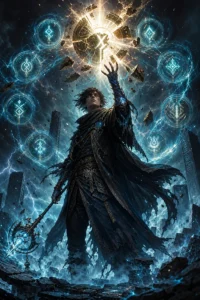
The plinth’s light sharpened. A projection unfolded above the token: eight runes, translucent and rotating in a sphere, each nested into the next like puzzle rings. Gasps fluttered through the hall. Commoners saw magic every day in street lamps and pump wards, but few ever saw the bones of it.
Kael saw more.
He saw where his copied Flame rune was slightly too proud at the lower tooth. He saw the Tide binding he had thickened to compensate for cheap wood grain. He saw the official inspection spell sliding over the surface, testing resonance, tasting the lie.
And he saw the hidden line.
It appeared only when the inspection spell touched the false sigil: a black thread looping behind the eight visible runes, connecting nothing to nothing, refusing to exist until the magic lied about what it was seeing.
Kael’s breath caught.
The thread pulsed once.
Not with power.
With recognition.
Jorren spoke louder. “When I examined the counterfeit, the accused interfered with my inspection rite and altered the collapse pattern.”
“Because your collapse pattern was wrong,” Kael muttered.
The hall heard him.
Jorren’s head turned slowly.
Thorn’s fingers stopped moving on the bench.
Kael felt his stomach drop through the floor.
There it is, he thought. The exact moment my mouth signs the death warrant before my hand can.
Thorn’s voice remained mild. “Explain.”
Kael said nothing.
Jorren barked, “Explain to the magistrate how a gutter forger knows imperial inspection forms are wrong.”
The copper manacles warmed against Kael’s wrists. The truth-hook stirred. A thin needle sensation pressed into the base of his skull. Not pain yet. A promise.
He could lie. He was good at lying. He had made a living arranging lies into shapes that lonely mothers and ambitious sons could hold in their hands.
But the manacles were listening.
And worse, so was the black thread in the air.
It had not faded. It hung behind the projected runes like a crack in glass, visible to him alone.
Kael wet his lips. “The inspection rite was built to look for failure in the wrong order.”
Someone whispered a prayer.
Jorren’s face flushed dark. “Careful.”
“It checks the outer resonance before the inner symmetry,” Kael continued, because apparently terror did not stop him once a mistake had offended him. “That works on bad forgeries. It fails on decent ones because the resonance shell can be faked if the geometry is close enough. You should collapse the Mind hook first. Then Tide. Then Flame. If you start with Flame, the whole thing buckles sideways and tells you nothing except that you enjoy wasting light.”
The silence after he finished was enormous.
Even the rain seemed to pause against the high windows.
Jorren’s baton whined in his grip. “Magistrate, this is rehearsed insolence. The accused has clearly obtained restricted theory from an academy source. Torture will reveal names.”
Kael’s skin went cold.
He had expected hanging. Hanging was simple. Brutal, yes, but simple.
Torture was a room with drains.
Thorn looked down at the projection. “Perform the collapse as he described.”
Jorren stiffened. “Magistrate?”
“You heard me.”
A muscle jumped in the inspector’s jaw. “The procedure is standardized.”
“Then it will withstand demonstration.”
Jorren hesitated long enough for the crowd to notice.
Then he touched his baton to the projection again.
The runes brightened. He adjusted the spell with curt, angry movements, forcing the inspection rite to bite inward toward the Mind hook first. Kael watched the visible geometry shiver. The black thread tightened.
Mind collapsed.
Tide followed.
Then Flame.
The counterfeit sigil did not explode into sparks as bad forgeries usually did. It peeled open like a flower made of light, exposing every false line in perfect sequence. Each flaw hung magnified in the air: cheap lacquer, wrong resonance depth, substituted binding oil, a microscopic tremor in Kael’s hand from when he had skipped supper.
The crowd erupted.
“Stars preserve—”
“He was right.”
“A commoner?”
“Shut up, shut up—”
Jorren ripped his baton away. The projection died.
Thorn’s gaze rested on Kael with new weight.
Not mercy.
Kael knew better than to mistake interest for mercy. A butcher was interested in a lamb with two heads.
The magistrate said, “Where did you study?”
“Print shops. Pawned manuals. Margins of confiscated pamphlets. Street shrine inscriptions. The underside of respectable society.”
“Who taught you rune collapse theory?”
“No one.”
The manacles flared hot.
Kael hissed as pain lanced up his arms. The truth-hook tested the statement. For one breath, two, three, it dug behind his eyes.
Then the heat faded.
Truth.
Murmurs rose again, sharper now. Thorn lifted his finger, and they died.
“No one,” the magistrate repeated.
“I read,” Kael said. Sweat trickled down his spine despite the cold. “I remember things.”
“Perfectly?”
Kael’s mouth flattened.
He did not like admitting that. Perfect recall made people greedy. Debt collectors wanted accounts reconstructed. Priests wanted genealogies. Gangs wanted witness statements. Master Pell had used it kindly at first, then desperately, then constantly.
“Close enough,” Kael said.
The manacles warmed in warning.
“Perfectly,” he corrected.
Thorn’s eyes gleamed.
Inspector Jorren stepped closer to the bench. “Magistrate, an unlicensed mnemonic talent combined with restricted rune aptitude makes him more dangerous, not less. The statute is clear. Fraud involving imperial magic carries death.”
The crowd liked that. Death made sense. Death restored the world to its proper shape. A commoner could cheat, but only until a noble noticed.
Thorn picked up a narrow slip of parchment. His sleeve whispered over the bench. “Kael Veyr, under imperial law, you have committed crimes punishable by hanging, branding, memory excision, or conscription to a breach battalion.”
Kael tried not to react at memory excision.
He failed.
His perfect recall was not just talent. It was the only property no bailiff had been able to seize. It held every book he had stolen glances at, every face of every child who had bought a false hope, the exact sound of Master Pell laughing before the debts broke his back, the lullaby he could not remember hearing but somehow knew in three incomplete lines.
Take his memories, and there would be nothing left but hunger in a body.
Thorn saw the flinch. Of course he did.
“However,” the magistrate continued, “the court recognizes useful irregularity.”
Useful.
The word landed worse than guilty.
A stir moved near the rear doors.
At first Kael thought another prisoner was being brought in. Then the crowd began parting without being asked. People drew back with the instinctive obedience reserved for plague carts, royal processions, and things with teeth.
A woman walked through the rotunda.
She wore academy black.
Not the polished black of noble uniforms trimmed in house colors, but matte war-cloth reinforced with rune-stitched leather at shoulder and throat. Rain silvered her cloak. Her hair, iron-gray though her face looked no older than forty, was braided back from sharp cheekbones. A thin scar crossed one brow and vanished into her hairline. At her left hip hung no sword, only a narrow case of carved bone. At her throat sat a spell-core the size of a raven’s egg, dark violet and veined with starlight.
Every visible rune on it was still.
That frightened Kael more than Jorren’s spinning ruby.
Power usually moved. It announced itself in heat, hum, glow, pressure. Her core did nothing. It sat against her skin like an eye pretending to sleep.
Inspector Jorren went pale.
Magistrate Thorn did not rise, but his fingers curled once against the bench.
“Professor Voss,” he said.
The name cracked across the hall in whispers.
“Maerith Voss.”
“The Ash Instructor.”
“She killed a breach prince.”
“Three.”
“My cousin said she failed half a class by sealing them in a mirror maze for two days.”
“My cousin said she failed them because only half came out.”
Kael watched her approach and decided at once that every rumor was probably too gentle.
Professor Maerith Voss stopped beside the evidence plinth. Her eyes were not violet like her core. They were gray, clear, and terribly awake.
She looked at the counterfeit sigil.
Then at Kael.
He had endured many kinds of inspection in his life. Bailiffs checking his pockets. Priests checking his lies. Customers checking whether hope looked real enough to buy. Voss looked at him as if skin, bone, fear, and sarcasm were all badly folded wrapping around a more interesting object.
“Stand,” she said.
The guard hauled him up.
Kael’s knees complained. He ignored them.
Voss reached toward the plinth. Jorren stepped in quickly. “Professor, this is an active judicial proceeding.”
She did not look at him. “Move your hand, Inspector.”
Jorren’s nostrils flared. “With respect—”
Voss looked at him then.
Nothing happened.
No flare of magic. No threat. No dramatic pressure crushing everyone to the floor.
Jorren moved his hand.
Kael made a note never to play cards with Professor Voss.
She lifted his forged sigil between two fingers. The cheap ashwood token looked embarrassed to be touched by her. Her thumb brushed its edge, and the eight runes Kael had carved flickered into visibility.
“Ugly,” she said.
Despite everything, Kael bristled. “The lacquer was poor.”
“The lacquer is the least of its sins.”
“I was underfunded.”
“You were imprecise.”
“I was hungry.”
That gave her pause. Not much. A hairline crack in the mask.
Then she said, “Hunger excuses theft. Not bad geometry.”
Kael stared at her.
Somewhere in the crowd, the young aspirant girl made a strangled sound that might have been laughter or despair.
Voss set the token back on the plinth. “Show me what he did.”
Jorren opened his mouth.
Thorn said, “Inspector.”
The inspector’s expression curdled, but he obeyed. He reconstructed the projection, then replayed Kael’s suggested collapse order with stiff precision. Mind. Tide. Flame. The false sigil unfolded its shame again for the entire hall.
Voss watched without blinking.
When it ended, she turned to Kael. “Why that order?”
Kael hesitated.
The manacles still listened. The magistrate listened. Jorren listened with murder in both eyes. The crowd listened with the hungry attention of people standing near a fire that might spread.
Because the hidden thread tightened when Mind lied to itself, he wanted to say.
Because there is a line behind the eight runes and it hates being ignored.
Because every official spell in this room has a missing tooth, and none of you seem to notice you are biting your own tongues.
Instead he said, “Because Mind was pretending to anchor the resonance.”
The manacles warmed.
Kael’s heart stopped.
The heat climbed. Not enough to burn. Enough to warn.
Voss’s eyes narrowed.
“Pretending,” she said.
Kael forced a shrug. “It looked stable from the outside. It wasn’t.”
The manacles cooled.
Truth, apparently, though shaved thin.
Voss stepped closer.
“What color was the flaw?”
The question struck him strangely.
Not where was the flaw. Not how did you infer it. Color.
Jorren stiffened.
Thorn’s face went blank.
Kael understood then that Professor Voss already knew too much.
His tongue stuck to the roof of his mouth. “Black.”
The manacles did not warm.
Voss’s still spell-core gave a single faint pulse beneath her collar.
All the lamps in the courthouse dimmed.
The crowd inhaled as one beast.
Jorren said, “Magistrate, this line of inquiry is not relevant to—”
“Quiet,” Voss said.
Jorren’s mouth snapped shut so hard his teeth clicked.
Kael looked from her to Thorn. “I take it black is a bad answer.”
“Black is not an answer available to the untrained,” Thorn said softly.
“Then perhaps I guessed.”
The manacles flashed white-hot.
Kael bit down on a scream. Pain drove him to his knees. His vision shattered into sparks. Somewhere distant, people shouted. The truth-hook speared into his skull, searching for the lie and finding it, grinding against thought.
Idiot.
Idiot, idiot, idiot.
Then Voss’s hand closed around the copper chain between the cuffs.
The pain vanished.
Not faded. Vanished, cut so cleanly that Kael gasped and nearly collapsed from the absence.
The copper manacles fell silent.
A thin curl of smoke rose from the truth-hook clasp.
Voss looked down at him. “Do not lie badly in front of tools designed by mediocre men. They take offense.”
Kael breathed hard through his teeth. “I’ll restrict myself to excellent lies.”
“See that you do.”
Thorn’s voice sharpened for the first time. “Professor Voss. You have damaged court property.”
“Add it to my account.”
“Your account is already extensive.”
“Then it will have company.”
Jorren found his courage in anger. “This prisoner is under imperial jurisdiction.”
Voss turned toward the magistrate, ignoring him again with surgical precision. “I claim provisional academy right.”



0 Comments