Chapter 3: The Crater Gate
by inkadminThe imperial prison-cart had no windows, but Kael knew the road by the sound of its wheels.
Iron-banded oak struck cobble in tight, angry clacks for the first quarter mile: the courthouse district, where even the gutters were swept clean and the watchmen wore polished helms. Then came the hollow boom of boards beneath them as they crossed Little Gallows Bridge, the Durn canal coughing up its usual stink of fish rot, lamp oil, and old blood. After that, the clatter softened into the sandy grind of the outer ring, where the city’s paving stones gave up in patches and the poor learned to walk around holes deep enough to swallow ankles.
Kael counted turns by the tilt of his stomach and the sway of the chain bolted around his wrists.
Left at the shrine with the cracked bell.
Right at the tanners’ lane, if the sudden sour reek meant anything.
Straight past the bread market, where morning loaves breathed warm yeast through the cart’s seams, cruel as a memory.
He had spent his life in the margins of ledgers, in the narrow spaces between fees, seals, signatures, and punishments. Every street of Lower Aster had a weight. Every sound had a shape. Every official stamp had a flaw, if one knew where to look.
And yet he had no idea where Professor Maerith Voss was taking him.
The woman sat opposite him in the dark, close enough that the silver caps on her boots caught the faintest leak of light from beneath the door. She had not spoken since she took custody of him from Magistrate Thorn. Not when the bailiff unlocked the execution irons and replaced them with transport cuffs. Not when the crowd outside the courthouse hissed and craned for a look at the forgery rat who had cheated noble sons. Not when someone threw a turnip that splattered against the cart and made the guards laugh.
She simply sat there, gloved hands folded over a black walking cane, as if silence were a blade she enjoyed sharpening.
Kael’s tongue lasted eleven minutes.
“If this is a private execution,” he said, “I should warn you I’ve always found secluded murders very inconsiderate. Terrible for public morale. Also, no witnesses means no one to admire your technique.”
The silver caps did not move.
“You mistake me for someone who requires admiration.”
Her voice was cool and low, with the faint northern clip of someone raised where winter taught consonants to bite.
“Everyone requires admiration,” Kael said. “Some of us are simply honest enough to beg for it with forged admission sigils.”
A pause.
“Honesty sits strangely on you.”
“I wear what I can afford.”
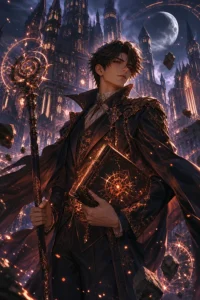
The cane shifted. A tiny blue-white rune pulsed beneath her thumb, illuminating her face for half a breath. Sharp cheekbones. Silver-threaded black hair coiled at the nape. Eyes like cut glass left in moonlight.
Professor Voss was not old, not in the stooped way the city’s wealthy became old behind velvet curtains. She was perhaps forty, perhaps a hundred if the rumors about Academy instructors were half true. Her skin held no softness, only the composed pallor of porcelain that had survived a fire.
Kael looked away first.
He hated that.
“Where are we going?” he asked.
“You know.”
“I know several unpleasant destinations. The quarry pits. The black cells under the palace. My aunt’s kitchen, if she has been informed I still owe her three copper sickles.”
“Asterfall Academy.”
The words struck harder than the turnip.
Kael had imagined them before, of course. Every guttersnipe with ink on his fingers had. Asterfall was less a school than a weather pattern hanging over the empire’s imagination. Its graduates commanded legions, negotiated with river spirits, burned plagues from flesh, carved fortresses from mountains. Noble houses sent heirs there wrapped in velvet and expectations. Merchant princes bankrupted cousins for a single auxiliary seat. Children in Lower Aster drew its seven towers in dust and pretended to cast fire from broken twigs.
Kael had forged six admission sigils bearing its crest.
He had never expected to see it except from the wrong end of a scaffold.
“That’s funny,” he said, because the alternative was letting his voice crack. “If I’d known fraud earned me a carriage ride to the Academy, I would’ve charged more.”
“It did not earn you anything.”
“I’m chained in a cart with an imperial professor. I must have done something impressive.”
“You did something impossible.”
The rune under her thumb brightened again. This time, light crawled across the cart’s inner walls. They were etched with containment script: hooked lines and interlocking circles burned into the wood, each stroke filled with powdered iron. Kael’s eyes caught the pattern automatically, following the sequence. Binding. Silence. Impact ward. A sleep trigger threaded through the door hinge.
And behind them, where no ink lay and no hand had carved, another line shimmered.
Not blue. Not gold. Not any color ink could hold.
A hairline absence. A flaw in the world’s skin.
It ran through the binding array like a whispered correction, bending the meaning of three runes without touching them. Kael’s breath caught before he could stop it.
Professor Voss watched him.
“There,” she said.
Kael pressed his manacled hands together to hide the sudden tremor in his fingers. “There what?”
“Do not insult me twice in one morning.”
“I insult everyone equally. It’s a civic service.”
“You saw the occluded stroke.”
“I saw a badly maintained cart.”
“You saw what the magistrate could not see. What his licensed rune-advocate could not see. What no uninitiated eye should have the capacity to perceive.”
The invisible line pulsed as the wheels struck a rut. For one instant it seemed less like a mark and more like an eyelid opening.
Kael looked down.
His wrists hurt. The cuffs were too tight. There was dried blood beneath his left thumbnail from where the bailiff had shoved him against the docket. Pain was easier than the memory of that hidden shimmer in the courtroom, the one sewn into the magistrate’s own oath seal. He had read it without meaning to. He had spoken the concealed clause aloud.
And the room had gone silent as a grave.
“I don’t know what I saw,” he said, and for once the words had no polish.
“Good.” Voss leaned back. “Ignorance is occasionally survivable. Arrogance rarely is.”
The cart tilted upward. The wheels left common road for something smoother, harder. Kael heard the change at once: a seamless surface under iron, no joints, no cobble chatter. A low hum gathered beneath the floorboards, vibrating through his boots into his bones.
“We’ve reached the ascent causeway,” Voss said.
Kael had heard stories of the Imperial Causeways, roads laid not over land but through anchored gravity, carrying sanctioned vehicles up the crater rim to Asterfall. He had assumed half of it was drunken invention. In Lower Aster, anything expensive enough became mythical.
The cart climbed.
His stomach sagged. The chains swayed toward his knees. Outside, the guards’ horses snorted and stamped, their hooves ringing on stone that was not stone. Wind rose, first as a thin whistle, then as a full-bodied howl. It shoved through gaps in the cart and carried scents that did not belong to the city: cold air, mineral dust, rain trapped in high places, and something metallic that prickled along Kael’s teeth.
A ward passed over him.
He felt it like a wet hand dragged through his skull.
Every memory in him flinched.
For an instant the cart vanished and he was seven years old under a table in the Scriptorium of Saints, listening to Master Orren cough blood into a rag while teaching him the thirty-four acceptable abbreviations for temple grain accounts. Then he was twelve, stealing lampblack from a printer’s stall. Then fifteen, copying a nobleman’s love letters while the man’s wife waited in the next room with a knife.
Then he was back in the cart, breathing too fast.
Professor Voss’s gaze sharpened. “What did you lose?”
Kael swallowed. “My patience.”
“Answer carefully.”
“Nothing.”
The word tasted uncertain. His mind was a library in perfect order; always had been. Give him a page once, a seal once, a face glimpsed through rain, and he could recall it line for line. It was the only wealth he had never been able to pawn.
He reached inward, testing shelves.
The temple grain abbreviations were still there. Orren’s cough. The printer’s stall. The shape of his own forged Asterfall sigils, each illegal curve.
Nothing missing.
Maybe.
Voss’s mouth tightened, not with relief. With calculation.
“Most unbonded applicants vomit at the outer ward,” she said. “Some faint. One heir of House Lyr swallowed his own tongue three years ago, though that was likely inbreeding rather than magic.”
Despite himself, Kael barked a laugh.
“There,” she said. “Not entirely brain-burned.”
“Comforting assessment from my kidnapper.”
“Custodian.”
“A polished word for kidnapper.”
“A precise word. Precision matters at Asterfall.”
The cart slowed.
Outside, voices rose. Not city voices. These were clipped, young, bright with confidence sharpened on tutors and dueling yards. Hooves clattered. Harness chains chimed. Somewhere, a creature that was not a horse shrieked like boiling glass.
Kael sat straighter despite the chains.
Asterfall.
The door opened.
Light stabbed in.
For a heartbeat he saw nothing but white and blue. Then the world resolved, and his breath forgot how to leave him.
The Academy floated over a wound in the earth.
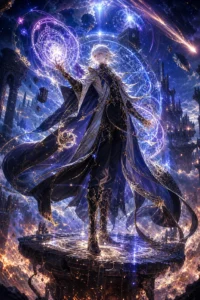
The crater spread below in the shape of an eight-pointed star, its black slopes descending into a central abyss so deep the morning could not reach the bottom. Cliffs of fused glass caught the sun in sheets of violet, green, and smoky gold. Ancient stone ribs jutted from the inner walls like the bones of a buried titan. Bridges arced from point to point, some carved from marble, others woven from light, several hanging unsupported over empty air.
Above it all rose Asterfall Academy.
Seven towers hung in a vast ring over the crater, each suspended by chains thicker than city streets. The chains did not connect to the ground. They vanished upward into rotating halos of runes that burned against the sky. Between the towers drifted courtyards, gardens, training platforms, libraries with buttressed windows, and long halls tethered by bridges of dark iron and luminous crystal. Waterfalls spilled from nowhere, broke into mist before reaching the abyss, then streamed upward again in glittering ribbons.
At the center of the ring, directly above the blackest part of the crater, stood a gate.
Not on land. Not supported by bridge or pillar.
A colossal arch of star-metal hung in open air, its surface pitted and dark, as if it had once fallen burning from the heavens. Eight runes blazed around its curve in imperial sequence: Stone, Flame, Tide, Gale, Thorn, Veil, Crown, and Void. Each was taller than a house. Each shed a different pressure into the air.
Kael felt them hammer his skin.
Stone pressed on his bones.
Flame dried his tongue.
Tide pulled at the water in his blood.
Gale tugged breath from his lungs.
Thorn pricked along his nerves.
Veil blurred the edge of thought.
Crown made him want to kneel and spit at the same time.
Void opened a silence behind his eyes.
And beneath them all, unseen by the jeweled carriages and laughing heirs gathered on the arrival platform, something else curved through the arch.
A ninth mark.
Not carved. Not shining. Not present.
It existed as a wrongness in the empty spaces between the eight, a shape made of missing meaning. Kael’s gaze snagged on it and pain lanced behind his right eye.
The hidden rune pulsed.
For one impossible instant, he felt it notice him.
LIAR.
Kael staggered.
A hand seized his collar before he could pitch forward off the cart step. Professor Voss held him with infuriating ease.
“Look away,” she murmured.
He did.
His pulse slammed against his throat. “Did you—”
“No.”
“You don’t know what I was going to ask.”
“Yes, I do.”
She released him and stepped down onto the arrival platform.
The platform itself was a disk of pale stone veined with silver, broad enough to hold a market square. Around its edge, waist-high wards shimmered faintly, the only barrier between hundreds of new students and the mile of empty air beneath. Wind worried at cloaks and banners. Above, the Academy towers moved slowly in their chains, each one turning by a different rhythm, as if the entire city were an astrolabe calculating the end of the world.
Kael descended with less grace, chains clinking.
Conversation died in ripples.
He became aware of himself the way one became aware of a stain on borrowed silk.
His shirt was prison-gray, torn at the shoulder. Dried mud crusted his boots. The transport cuffs around his wrists were marked with the magistrate’s seal. His hair, dark and too long, had been combed by courthouse fingers, which meant not at all. A purple bruise spread along his jaw where the bailiff’s ring had kissed him.
In front of him stood the sons and daughters of the empire.
They wore travel cloaks lined in foxfire silk and academy candidate uniforms cut to fit by private tailors. Spell-cores hung at their throats, wrists, brows, or breastbones: crystals set in gold, bone, moon-iron, pearl. Some glowed with ancestral bonds already awakened. Flames curled obediently around one boy’s fingers. A girl with white braids stood inside a halo of hovering frost petals. Another candidate’s shadow moved a half second after he did, bowing to no light.
They looked at Kael as if the prison-cart had delivered a dead rat to a banquet.
“Is that a servant?” someone whispered, badly enough to be heard.
“Servants are cleaner,” another replied.
A tall boy near the front laughed through his nose. He had copper skin, golden eyes, and hair braided with tiny red stones that flashed like banked embers. His uniform coat bore the sunburst and spear of House Draven: old war nobility, fire-bonded, famous for producing generals and widows.
“Professor Voss,” he called. “I thought the Academy had raised its standards this year, not emptied the gaols.”
A few students laughed. More watched to see whether laughing was safe.
Voss did not turn. “Name.”
The boy smiled with all his teeth. “Lord Cassian Draven, fifth flame of the Western March.”
“Lord Cassian Draven,” Voss said, “if you confuse admission with graduation again, I will have you cleaning molt from the griffin aerie before sunset.”
The laughter withered.
Cassian’s smile stayed in place by force. “Of course, Professor.”
Kael decided he liked her methods even if he distrusted everything else about her.
Then she glanced at him. “Close your mouth, Veyr. You look provincial.”
He shut it. He liked her less.
A procession of Academy officials waited beneath a floating canopy to one side of the platform. Scribes in blue-gray robes sat behind levitating desks. Each desk bore a brass basin filled with black water, a stack of blank admission slates, and a needle shaped like a thorn. Behind them stood older students in uniforms edged with silver, their expressions ranging from bored cruelty to practiced indifference.
A banner hung above the canopy, woven with moving letters that rearranged themselves as the wind touched them.
ASTERFALL ACADEMY ORIENTATION INTAKE
CANDIDATES WILL PRESENT BLOOD, CORE, AND HOUSE REGISTRY.
FALSE CLAIMS WILL BE PUNISHED BY MEMORY EXCISION.
Kael stared at the last line.
“Charming school motto,” he muttered.
“That is not the motto,” Voss said.
“There’s something worse?”
She did not answer.
The line moved forward.
One by one, the noble candidates approached the desks. They offered hands without flinching. The thorn-needles pricked fingers, drawing drops of blood that fell into the black basins. Water brightened, projecting names in luminous script.
LYSANDRA VAEL
HOUSE VAEL OF THE NORTHERN MIRRORS
SPELL-CORE: TIDE/VEIL DUAL INHERITANCE
INITIAL RANK: ASHEN THIRD
The girl with frost petals inclined her head, unsurprised.
ORREN HALCYN
HOUSE HALCYN OF THE GREEN REACH
SPELL-CORE: THORN ANCESTRAL GRAFT
INITIAL RANK: ASHEN SECOND
A broad-shouldered boy with vines braided into his sleeves grinned as the black water sprouted a white flower.
CASSIAN DRAVEN
HOUSE DRAVEN OF THE WESTERN MARCH
SPELL-CORE: FLAME WARHEART LINEAGE
INITIAL RANK: ASHEN FOURTH
Cassian’s basin burst into fire. Applause scattered through the crowd. He accepted it like tribute owed since birth.
Kael watched carefully.
Ashen Fourth. He had copied enough Academy documents to know the broad shape of advancement, though seeing it living before him made the ink feel thin. Students began as Ashen ranks, from First to Ninth, each step representing greater capacity to channel a rune through a spell-core without rupturing flesh, memory, or mind. Above Ashen came Cinder, Ember, Brand, Crucible, and the near-mythic Starforged—ranks sung about in patriotic ballads whenever the empire needed boys to die bravely.
Most common-born scholarship students, the few that existed, began Ashen First.
Most noble heirs began Second or Third.
Cassian Draven had arrived already at Fourth.
Kael had arrived in chains.
The line thinned. Whispers did not.
“That’s him, isn’t it?”
“The sigil forger.”
“My cousin said he sold six false recommendations.”
“I heard he copied a magistrate’s oath seal.”
“No, he forged a House Veyr pedigree.”
“There is no House Veyr.”
“Exactly.”
Kael kept his face arranged in a smirk because it was cheaper than armor. Inside, something old and hot coiled behind his ribs. Not shame exactly. Shame required surprise. He had been a charity brat, ink rat, alley scribe, fraud, liar, thief of letters, parasite with good penmanship. Criminal charity case was only a new ribbon tied around the same knife.
A girl near the desk turned to look at him longer than the others.
She was not the frost-petal noble or one of the jeweled peacocks. She wore an academy candidate coat that fit too tightly across the shoulders and had been let out at the cuffs. Her skin was deep brown, her black curls pinned back with practical bronze clips. A plain spell-core of smoky quartz hung at her throat on a leather cord. No house crest marked her chest, only the small brass pin of imperial sponsorship.
Her eyes flicked to his cuffs, then to his face.
Not pity. Calculation.
Kael preferred that.
“Name,” barked the intake scribe at the nearest desk.
The girl stepped forward. “Mira Sen.”
A few nobles went quiet with the particular interest reserved for unusual animals.
The thorn pricked her finger. Blood struck black water.
MIRA SEN
IMPERIAL SPONSORSHIP: THIRD GRANARY DISTRICT
SPELL-CORE: GALE ARTIFICIAL SEED
INITIAL RANK: ASHEN SECOND
The smoky quartz at her throat flickered. A small spiral of wind lifted her curls and sent two intake papers fluttering from the desk.
The scribe scowled. Mira caught both sheets before they flew away and placed them neatly back.
“Apologies,” she said.
Her tone suggested the wind should apologize, not her.
When she stepped aside, Cassian Draven murmured something to his friends. Kael caught only the phrase “granary witch.” Mira caught more. Her shoulders stiffened by a fraction, then relaxed. She did not look at him.
Kael filed that away.
His turn came last.
Of course it did.
Professor Voss produced a small key of black iron and unlocked his cuffs. The metal fell away from his wrists, leaving red grooves. The sudden absence of weight felt suspicious.
“Behave,” she said.
“I’m famous for it.”
“You are infamous for the opposite.”
“Still fame.”
Her eyes narrowed, but one corner of her mouth almost moved.
Kael approached the desk.
The intake scribe waiting for him was an elderly man whose nose had been broken so many times it resembled an argument settled badly. He looked Kael up and down, then glanced at a slate hovering beside him. The slate held Kael’s court record. Its list of charges scrolled for longer than Kael thought tasteful.
“Kael Veyr,” the scribe said.
“Present against all reasonable expectations.”
“Age?”
“Seventeen.”
“House registry?”
“None.”
“Bloodline attestation?”
“Also none.”
“Spell-core?”
Kael hesitated.
He had none. Every child in the empire knew magic required a core: a carved vessel to hold rune-pressure, either inherited through blood-bonded crystal or implanted by Academy rite. Without a core, raw magic did not obey. It ate.
“Cracked slate,” Professor Voss said from behind him.
A murmur moved through the platform.
The scribe’s brows rose. “You intend to register him on a training slate?”
“I intend many things Master Pell, most of which survive your approval.”
Master Pell grunted and reached under the desk.
He brought out a rectangle of dark gray stone no larger than Kael’s palm. It was thin, smooth, and split by a jagged crack running from one corner to the center. Three tiny runes had been carved along its surface, their grooves dulled by use: Stone, Gale, Veil. Beginner channels. Safe runes. Child runes, if the child’s family owned enough coin to risk them.
Kael recognized it from pawnshop windows and debt inventories.
A practice spell-core.
Discarded, damaged, barely worth stealing.
Cassian Draven laughed softly. “How generous. They gave the stray a paving tile.”
Kael smiled toward him. “Careful, my lord. Some of us learned to bite paving stones when hungry.”
Cassian’s golden eyes warmed. Flame licked over his knuckles.
Professor Voss tapped her cane once.
The flame vanished.
Cassian went very still.

0 Comments