Chapter 9: Blackwater Dreaming
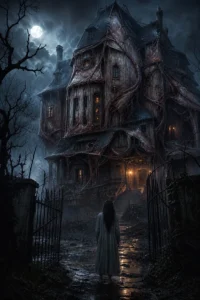
by inkadminThe body in the wall did not decay.
That was the first thing Mara understood after the first wave of revulsion passed and left her shivering on the floorboards, one hand clamped so hard over her mouth that her teeth bit into the meat of her palm.
Lime should have consumed it. Salt should have drawn it down into leather and collapse. Time should have done the rest. Yet the woman in the niche looked less dead than paused, as if the house had interrupted her between breaths and stored her away for later. Her face—Mara’s face—lay under a white crust of crystals like frost on window glass. The lashes had clumped with mineral dust. The lips were slightly parted. Beneath the torn blouse, the chest was still full, the skin taut where it should have sagged. Black hair, her exact black hair, had been braided back with meticulous care and bound in a ribbon gone brown with age.
The niche smelled of old plaster, wet pennies, and the cold medicinal tang of a laboratory sink.
Mara crawled backward until her shoulders struck the bed frame.
Rain tapped at the windows. Somewhere in the walls, something shifted with a soft internal groan, timber settling—or not timber. The room’s air pressed damp and close against her face. Her lantern shook so violently in her hand that the light stuttered over the corpse’s cheekbones, making shadows climb in and out of the sockets. For one impossible instant it looked as though the dead woman’s throat moved in a swallow.
“No,” Mara whispered.
The word came out raw and girlish, stripped of all authority. She had once stood on stages in front of lecture halls and spoken with clear, cool certainty about sleep architecture, memory consolidation, the pathology of dissociation. She had corrected senior men without apology. She had cut into the soft confidence of television hosts and smug panel moderators with a smile and a citation. Now she could not manage more than that one broken syllable.
Her gaze dropped to the corpse’s hands.
They were folded low over the abdomen. In the right hand, pinched between two rigid fingers, was a key.
Mara stared at it until her vision sharpened around the edges. It was small and brass-dark with age, with an oval bow stamped with three interlocking waves. Blackwater’s crest. Beneath the key lay a scrap of paper, crimped and yellowed, caught under the hand as if deliberately hidden.
Every instinct she had screamed at her to seal the niche, board it over, run from the room and keep running until the island ran out beneath her feet.
Instead she set the lantern down, because she had spent too long in the company of her own fear to mistake it for wisdom.
She came back to the wall on her knees.
At this distance the resemblance was worse. The left front tooth overlapped the right by the slightest fraction. A pale scar notched the brow where Mara had split her skin at eleven falling from a seawall in Bray. The earlobes were asymmetrical. Even the crescent freckle below the jaw was there. Not similar. Not uncanny. Exact.
Her fingers hovered above the dead hand. She could not make herself touch it.
This is a trick.
But tricks required an audience, and Blackwater House had never needed one. It performed for itself.
Mara hooked the paper with one nail and teased it free. Crystals crackled and fell like brittle sleet. The corpse’s hand shifted an inch. Mara flinched so hard she almost struck her head on the mantel.
The paper was lined, torn from a small notebook. The handwriting on it was hers.
Not similar. Exact.
The letters leaned slightly right when she wrote quickly, and these did. The t-bars were low. The loops of the y’s were narrow and mean.
Sedation failed when it recognized me.
Below that, in a darker, more jagged line:
If I am sealed, the root records remain below the west stairs. Do not let her go to sleep by the well.
Mara read it three times. The words did not become more sensible.
Recognized me.
Root records.
Her.
The key gleamed dully between the corpse’s fingers.
Mara swallowed against the taste of acid and reached again, forcing herself to touch skin that was not skin but a dry, cool membrane dusted with salt. The fingers resisted. Then, with a tiny grinding crack, they opened. The key came free.
At once, the smell in the niche changed.
The medicinal note deepened. Formalin. Wet cotton. Ether, or the memory of ether. Mara froze with the key in her hand and felt a pressure move across her scalp like a palm settling over her skull.
Not in the room.
In her head.
A bright white rectangle flashed behind her eyes. Stainless steel. The slap of rubber soles. Someone laughing too loudly in a corridor where laughter did not belong. Then the image was gone, leaving only a stabbing ache at the base of her neck.
“West stairs,” she said aloud, because the sound of a human voice was suddenly necessary. “Below the west stairs. Fine.”
She did not look at the body again as she stood. She shoved the note into her pocket, took the lantern, and left the master bedroom with the key cutting a crescent into her palm.
The corridor outside seemed longer than it had an hour before.
It was always hard to say with certainty in Blackwater. Distance here was moody, offended by scrutiny. Yet she knew that the turn toward the west wing should have been twelve paces from the bedroom threshold. Tonight it was at least twenty. Her lantern did little more than push a trembling yellow coin through the dark. Portraits breathed at the edge of sight. The wallpaper, once patterned with climbing roses, had taken on the water-stained look of organs seen through wax paper.
Mara walked fast, shoulders hunched against the house’s listening silence.
The west stairs were the old servants’ stairs, boxed narrow and steep behind a baize door whose green cloth had long since molded black. She found the door standing ajar. A strip of darkness yawned beyond it, carrying a current of cold air that smelled distinctly of tide pools and turned soil.
“Of course,” she muttered. “Why wouldn’t you be open?”
Her own voice sounded brittle, but familiar bitterness helped. Sarcasm was still a tool; it meant some part of her remained intact.
The lantern showed stairs slick with damp. Moisture had pearled on the rail. The plaster walls sweated. At the bottom, where the stairs kinked left into a storage recess, something pale protruded from the boards.
It was not until she crouched that she realized it was a finger bone.
Mara shut her eyes.
There had once been a place in her life for neat categories. Organic material. Inorganic contamination. Hallucination. Misattributed memory. Her profession had been the cultivation of boundaries, of naming what belonged to waking and what belonged to dream. Blackwater made taxonomy feel childish. Bone pushed through floorboard gaps beside old coal dust and snail shells. The house had no respect for sequence. It layered its truths like sediment.
The keyhole sat low behind a hanging strip of warped skirting board. She nearly missed it. When she pried the board away, wet wood fibers snapped under her nails and a square metal plate shone beneath, hidden flush with the wall.
The key fit.
It turned with a deep internal thunk.
Something released inside the wall. Then a panel no wider than a breadbox eased outward by a fraction of an inch.
Mara pulled it open.
Inside was a steel lockbox, old military gray, its handle wrapped in surgical tape gone amber. There were also three audio cassettes in waterproof sleeves, a stack of file folders bound with string, and a battery-powered microcassette recorder with a cracked speaker grill.
The sight of the recorder hit her with such force that she had to brace one hand on the stair.
Not because the object itself was strange, but because she knew its weight before she touched it. Knew the rough dip in the plastic near the stop button. Knew the failure in the left hinge of the cassette compartment. A proprietary familiarity rose in her body before memory did, like a reflex firing ahead of pain.
She picked it up. There was a label on the back in faded block capitals.
BV-7 / VOSS FIELD LOG
The lantern hissed softly. Rain hammered the western side of the house. Mara sat down hard on the third step and stared at the recorder lying in her lap. Her hands were slick and cold.
Years ago, she came to Blackwater as part of a covert study.
The thought did not arrive as language at first. It arrived as certainty, heavy and silent, from somewhere below conscious recall. Not discovery. Recognition.
“No,” she said again, and this time the word carried anger.
She pressed play.
Static flooded the stairwell, loud enough to make her flinch. Then a click, a burst of wind noise, and a woman’s voice.
Her voice.
“Field log seven,” it said, brisk and clipped, the accent flatter than she used now. “Blackwater sleep induction trial. Day four. Subjective conditions on the island remain severe—barometric instability, tidal noise, persistent architecture-related stressors among the local support staff. Dr. Ketter believes environmental pressure is a feature, not a bug.”
Mara’s mouth went dry.
The recording continued beneath the rush of distant surf and the occasional scrape of someone adjusting equipment.
“Subjects one through six reported identical dream imagery following acoustic stimulation from the lower chamber. Recurrent motifs include submerged domestic interiors, saltwater aspiration without distress, and what all six insist on describing as ‘a village turning over in its sleep.’ Neural activity remains anomalously synchronized during REM. We are either looking at an extraordinary case of suggestion contagion”—a short laugh, sharp and humorless—“or there is, in fact, a common source.”
Paper rustled. In the background, a man said, “You still recording, Voss?”
Another voice, amused and young: “Leave it. She likes narrating the apocalypse.”
Mara knew neither voice, and yet her stomach clenched around them as though around old poison.
The recorded Mara went on. “Note for private addendum: lower chamber acoustics do not correspond to blueprint volume. On tonight’s inspection I observed growths along the stonework resembling calcified root structures. Samples taken. Dr. Ketter wants deeper penetration before the spring tides. I have objected. The chamber appears to respond to light and—”
The tape jerked. Static swallowed a second. When the voice returned it was different: lower, slower, as if spoken by someone fighting sleep.
“It recognized me before I’d been introduced.”
Silence.
Then the click of the tape ending.
Mara did not move for a long time.
The house murmured around her. Water ticked inside the walls. Far overhead a door closed by itself with the small finished sound of a sentence.
She fed in the second cassette with fingers that had begun to tremble too badly for fine work.
This one started in the middle of an argument.
“—not a chamber, Elias, it’s a mouth,” said a woman she did not know. “You’re hearing resonance and calling it architecture because that lets you keep digging.”
“And you’re hearing superstition because the islanders got to you.” A man’s voice, tired and impatient. “We are within touching distance of a network phenomenon capable of shared dream-state induction across multiple brains. Do you understand what that means?”
“I understand what it’s already doing to her.”
A scrape. Then Mara’s own voice, from years ago and very far away: “I’m here.”
The room on the tape went still.
“How much did you hear?” the man asked.
“Enough.” A pause. “You need to stop using the word phenomenon as if it excuses you from ethics.”
“Ethics?” He laughed once. “After what your paper bought you in Edinburgh, I’d be careful with that tone.”
That landed like a slap even now, all these years later. Mara felt heat rise in her cheeks as if she stood in that room again, under fluorescent light, being judged by a man she had perhaps wanted to impress and certainly should have despised.
Her recorded voice went knife-cold. “Say what you mean, Elias.”
“Gladly. I mean you came here because your career was already smoking and because no university would officially fund this. I mean you signed every NDA we put in front of you because you needed results. And I mean if Blackwater has chosen a receptive substrate in you, then we proceed with the asset we have.”
There was a thud, as if something had been knocked over.
The other woman swore. “Jesus Christ.”
Mara heard herself say, very quietly, “If you call me an asset again, I will open your throat.”
The tape clicked off.
Mara let out a breath she had not realized she was holding.
The violence in her younger voice did not surprise her as much as the lack of surprise. There it was again: not discovery. Recognition. She had been at Blackwater before. Not as caretaker, not by accident, but under professional pretense and private desperation. She had come because scandal had already begun eating the edges of her life. Because she had needed a result miraculous enough to reverse humiliation. Because men like Elias Ketter knew how to smell that hunger and make use of it.
And something below the house had known how to smell her.
Mara opened the lockbox next.
Inside, protected in cloudy plastic sleeves, were photographs and patient charts. The first photograph showed the shoreline below Blackwater House under a white sun, a team of six in foul-weather gear standing around a hoisted tarpaulin. Behind them the cliff face had been blasted open to reveal a dark fracture descending into the rock. On the back, in her handwriting:
Initial breach. Low-tide window. Acoustic emission audible before visual contact.
The next photographs turned her blood to ice.
A bed under a hanging monitor. A sleeping woman with salt dried around her nostrils. Subject 3, according to the chart clipped to the image. Then Subject 4, a man with electrode leads on his temples and wet sand packed under his fingernails. Then Subject 5—face partially obscured by a breathing mask, but not enough. Mara knew him. His portrait hung in the downstairs gallery. A former owner of Blackwater House, dead for thirty years according to the brass plaque beneath the frame.
Her pulse lurched unevenly.
She turned pages too quickly, scanning dates, annotations, broken lines of observation.



0 Comments