Chapter 2: A Crack Beneath the Dead
by inkadminThe night after the Root Awakening Ceremony, Falling Reed Village shut its doors earlier than usual.
Not because of rain. The sky was clear, washed in a thin, cold moonlight that silvered the reeds and made the river look like a blade laid flat across the earth. Not because of bandits either. No horse bells rang from the western road, no smoke rose from the watchtower, no dogs barked at strangers.
The village slept early because shame had weight.
It pressed against paper windows. It crouched beneath eaves. It followed Shen Lian from the ancestral hall to the graveyard path, wearing the voices of those who had watched the testing stone remain dull beneath his palm.
“Not even a weed root.”
“At least a weed can drink rain.”
“A dead branch born from a grave-sweeper’s blood.”
“His father should be grateful. No sect will take him away to waste rice.”
They had laughed softly at first, the careful laughter people used near elders and incense tablets. Then one of the Xu clan boys—Xu Qing with his newly awakened Pale Jade Lotus root and his silk sash embroidered with cloud cranes—had lifted his chin and asked whether the testing stone had broken from touching something so filthy. That had made the hall erupt.
Lian had not answered.
He had stood there with one hand still numb from the cold surface of the stone, staring at the faint smudges left by other children’s palms. Fire. Lotus. Vine. Sword. A whole village of future servants, soldiers, concubines, talisman scribes, outer sect sweepers, and lowly herb garden disciples. Even the poorest orphan had coaxed a muddy yellow light from the stone.
Only he had left nothing.
Now he sat behind his father’s hut with a broken broom across his knees, watching grave candles gutter in the distance.
Falling Reed Village lay in a crescent between river and hill. In the day, its thatched roofs looked almost gentle, smoke lifting from kitchen stoves, ducks grumbling in the ditches, women scolding children over spilled millet. At night, it became a place of corners. The irrigation channels turned black. The willow shadows bent like old men. Beyond the last row of houses, the ancestral graveyard climbed the hill in uneven terraces, each mound marked by stone, wood, or sometimes nothing but a sun-bleached jar.
Behind those graves rose the forbidden burial mound.
No one in Falling Reed called it by its ancient name. If it had one, it had been scraped from memory by dynasties and worms. It was simply the Old Mound—a round, unnatural hill of packed black earth and stone slabs half swallowed by roots. No grass grew upon it. Birds avoided it. Even snow melted there first, turning into thin veins of dirty water that trickled down between the village graves like tears from something buried too shallow.
Children were warned not to climb it. Drunk men were warned not to piss on it. Women with newborns spat three times if their shadow crossed its foot.
Lian’s father swept the graves below it every morning and never looked up.
Tonight, Shen Mu did look up.
The old grave-sweeper stood at the doorway, one hand braced against the warped frame. Moonlight made his face hollower than usual. He had been thin for as long as Lian could remember, a man shaped by hunger and damp winters, with wrists like broom handles and eyes that always seemed to be listening for something underground.
“Come inside,” Shen Mu said.
His voice was rough from the cheap wine he had not drunk. He had poured a cup after they returned from the ceremony, lifted it, stared at the surface until the lamplight trembled, then set it before Lian instead. Neither of them had touched it.
“The candles aren’t finished,” Lian said.
“Let them burn.”
“If the wind turns, the Liu ancestor’s offering paper may catch.”
“Let it catch.”
Lian looked at him.
Shen Mu’s mouth tightened, as if the words had surprised him too. He stepped out from beneath the eave, bare feet sinking into the damp soil. “I said come inside.”
The command should have sent Lian moving. His father rarely spoke twice. But humiliation left strange splinters in a boy. Lian’s fingers tightened around the broom handle.
“Father,” he asked quietly, “what was Mother’s root?”
For a breath, the night seemed to lean closer.
Shen Mu’s face changed the way ashes changed when a coal stirred beneath them. Not brighter. More dangerous.
“Who spoke of her today?”
“No one.”
“Then why ask?”
Because when the testing stone had shown nothing, Elder Xu had looked at Shen Mu not with surprise, but with recognition. Because old women who had watched Lian since his first steps had turned their faces away too quickly. Because his father had once kept a strip of red cloth wrapped in oilpaper beneath his sleeping mat, and Lian had seen characters on it before Shen Mu snatched it away: not village script, not tax script, but curling strokes like vines and wounds.
Because the name Shen Lian had been given by a woman no one would mention.
He lowered his eyes. “I wanted to know whether I disappointed her too.”
The slap did not come. That was worse.
Shen Mu crossed the yard and crouched in front of him. He smelled of grave soil and old smoke. His hands, cracked and black beneath the nails, closed over Lian’s shoulders with a grip that trembled.
“Listen to me,” he said. “There are disappointments that keep a man alive.”
Lian frowned. “What does that mean?”
“It means you will not ask about roots again. You will not envy the children who shone today. You will sweep graves. You will eat when there is food. You will bow when men like Elder Xu pass. You will live quietly.”
“Like dust?” The words slipped out before he could swallow them.
His father’s hands went still.
Lian almost apologized. He should have. A grave-sweeper’s son did not speak like that, not to the man who had fed him watery congee through fever, who had carried him on his back during floods, who had patched his winter coat with pieces of his own. But the hall’s laughter still crawled beneath Lian’s skin. The testing stone’s silence still rang louder than any bell.
Shen Mu looked toward the Old Mound.
“Dust,” he said at last, “is blessed. Dust has no enemies.”
Before Lian could answer, the ground groaned.
It was not thunder. Thunder rolled through heaven; this sound dragged itself upward from beneath the soles, a vast stone beast turning in sleep. The broom jumped against Lian’s knees. The wine cup inside the hut tipped over and shattered. From the village came a chorus of startled cries as dogs began to howl.
The first tremor passed in a shudder.
Then the earth struck.
The yard heaved. Lian fell sideways, cheek hitting mud hard enough to fill his mouth with iron. The hut’s roof beams screamed. Clay jars burst. Somewhere down the slope, a wall collapsed with a cough of dust and tiles. Chickens shrieked. Men shouted names. Babies wailed as if their small bodies had sensed something older than fear.
Shen Mu threw himself over Lian just as the second tremor came.
The world buckled.
Gravestones tilted and snapped. Offerings spilled from altars. The grave candles flickered madly, each flame bending toward the hill as if pulled by an unseen breath. Lian clutched at his father’s sleeve. Beneath the thunder of cracking earth, he heard another sound—thin, wet, almost delicate.
Roots tearing.
He lifted his head.
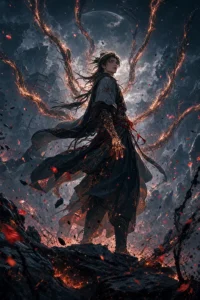
The Old Mound had split.
A black seam ran from its crown to its base, glowing faintly at the edges with a color that was not light. It was the pale underside of moonlit bone, the bruised gleam of fish belly, the last sheen in a dying eye. Soil poured into the crack. Stone slabs slid apart. The forbidden mound exhaled.
A wind swept down the grave terraces, but it carried no scent of fresh earth. It smelled of sealed jars, rotted silk, extinguished incense, and something bitter-sweet like medicine boiled from poisonous flowers.
Every candle in the graveyard went out.
Then, one by one, blue flames bloomed atop the graves.
Lian stopped breathing.
The flames were no bigger than thumb tips, wavering without wick or oil. They floated above burial stones and nameless mounds, casting no warmth. In their glow, carved ancestor names seemed to deepen, each stroke dark as fresh ink.
Shen Mu’s weight vanished from Lian’s back. His father had risen to his knees.
“No,” the old man whispered.
The word was not fear. It was recognition.
At the foot of the Old Mound, a section of hillside collapsed inward. Stones spun away into darkness. Beneath them appeared a stairway cut from black rock, descending at an angle impossible for any ordinary tomb. Cold mist poured up its steps.
From the village, someone screamed, “The dead are coming out!”
Another voice shouted, “Fetch Elder Xu!”
“Burn talismans!”
“Don’t look! Don’t look at the ghost fire!”
Doors slammed. A bronze gong began clanging near the ancestral hall, frantic and uneven. But Lian barely heard any of it.
Something in the crack had noticed him.
It was not a gaze. A gaze belonged to eyes, and eyes belonged to living things. This was deeper, colder, like the moment before sleep when the body jerked because it thinks it is falling. It touched the hollow place where the testing stone had found nothing. It pressed there gently.
And the hollow answered.
Lian’s bones turned to water. He staggered to his feet without meaning to.
Shen Mu seized his wrist. “Inside.”
“Father—”
“Now!”
The old man dragged him toward the hut. Another aftershock rippled through the ground. The doorway twisted. A roof tile fell and shattered inches from Lian’s foot. Up on the hill, the crack widened with a sigh.
Then a sound rose from below.
It was not loud. It did not need to be.
A single chime, pure as struck jade, rang from inside the tomb.
The blue flames leaned toward it.
Shen Mu froze.
His grip on Lian’s wrist became painful. The old grave-sweeper stared at the broken mound, and for the first time in Lian’s life, his father looked not poor, not tired, not beaten by mud and hunger—but hunted.
“It shouldn’t wake yet,” Shen Mu breathed.
Lian’s pulse slammed in his ears. “What shouldn’t?”
The chime rang again.
Shen Mu turned on him so suddenly Lian flinched. “Go to the cellar beneath the bed. Lift the third plank. There is a jar. Inside it is a bone whistle. Take it and run to the river shrine. Do not stop for me. Do not stop if someone calls your name. Do not stop if you hear your mother’s voice.”
Lian stared at him. “Mother’s voice?”
“Swear.”
“Father, what is happening?”
“Swear!”
The word cracked like a whip.
Lian had never heard his father shout that way. He swallowed mud and blood from his bitten cheek. “I swear.”
Shen Mu released him and shoved him toward the hut.
Lian stumbled inside. The single oil lamp had gone out, but moonlight entered through a split in the wall. Their home looked smaller broken. A stool lay on its side. The rice jar had cracked, spilling their remaining grain across the floor like pale teeth. His father’s sleeping mat had bunched against the wall.
He dropped to his knees and tore at the planks beneath the bed.
The first lifted with a squeal. The second stuck. His fingers slipped on splinters. Outside, men were shouting near the graveyard path. Elder Xu’s voice rose above them, sharp and commanding.
“No one approaches the mound! Form a line! Xu Qing, bring the warding flags from the hall! You idiots, stop crying and light torches!”
A woman sobbed, “My husband was on the hill—”
“Then your husband is already dead!” Elder Xu snapped. “Better one fool dies than the village follows him.”
Lian ripped up the third plank.
Beneath it sat a small black jar sealed with yellow wax. Characters covered its surface in tight red strokes. They looked like crawling insects. When his fingers touched the jar, the wax seal split by itself.
Cold air breathed out.
Inside lay a whistle carved from bone the length of Lian’s thumb. It was not white, but faintly golden, polished smooth by long handling. A red thread looped through its end.
Beneath the whistle was the strip of red cloth.
Lian hesitated.
Another chime rang from the mound.
The cloth stirred.
Not from wind. From within.
He snatched the whistle, shoved the cloth back down, and scrambled toward the door—only to stop at the threshold.
His father was walking toward the Old Mound.
Shen Mu held a hoe in one hand and an incense stick in the other. The incense was unlit. He moved with the stiff steps of a man walking into court to hear his sentence. Around him, villagers huddled behind broken walls and overturned carts, their faces gray in ghost-fire. Elder Xu stood at the graveyard gate in a dark robe thrown hastily over his sleeping clothes, white hair unbound, one hand gripping a peach-wood sword.
“Shen Mu!” Elder Xu barked. “Get back! This is not a place for grave filth.”
Shen Mu did not even look at him.
Elder Xu’s face flushed. “Are you deaf? I said—”
The old grave-sweeper lifted the unlit incense stick.
For a heartbeat, nothing happened. Then the blue flames across the graveyard bowed.
Every single one.
The villagers fell silent.
Elder Xu’s peach-wood sword trembled in his hand.
Lian’s throat tightened. Father?
Shen Mu planted the incense in the soil at the first grave terrace. It ignited with black smoke.
The smoke did not rise. It crawled forward, coiling along the ground toward the split mound.
Something inside the tomb answered with a low, amused hum.
Lian felt it in his teeth.
“Run,” Shen Mu said without turning.
He spoke softly. No one else should have heard.
Lian heard as if the word had been placed directly in his ear.
He stepped back.
His heel struck the broken rice jar.
The sound was tiny, but Shen Mu’s shoulders tensed.
Elder Xu’s head snapped toward the hut. His eyes narrowed when he saw the bone whistle in Lian’s fist.
Greed flashed across the old man’s face so quickly it might have been lightning.
“Boy,” Elder Xu said, voice suddenly gentle. “What are you holding?”
Lian’s fingers closed tighter.
Shen Mu turned at last. His face had gone bloodless. “Lian. Go.”
But the village path to the river shrine lay beyond Elder Xu and the graveyard gate.
Xu Qing emerged from behind his grandfather carrying a bundle of yellow flags. His silk sash was crooked, hair loose from sleep, yet his newly awakened lotus aura still clung to him faintly—a pale green radiance beneath the skin. He saw Lian and smiled with all the cruelty of a boy desperate to forget his own fear.
“Even the rootless trash wants treasure,” Xu Qing said. “Grandfather, that thing must belong to the village.”
Elder Xu extended his hand. “Shen Lian, bring it here. This old man will protect you.”
The tomb chimed for the fourth time.
The ground under the grave terraces split in thin lines.
Shen Mu moved.
He did not move like a starving old grave-sweeper. He crossed the space between himself and Elder Xu in three steps, hoe sweeping upward. The iron blade struck the peach-wood sword with a crack that sprayed sparks of blue fire.
Elder Xu staggered back, eyes wide. “You—!”
“Run!” Shen Mu roared.
Lian ran.
Not toward the river. He could not. Villagers blocked the lower path, and fear made them worse than walls. He bolted uphill between the graves, feet slipping on wet soil, the bone whistle bouncing against his palm. Behind him, voices exploded.
“Catch him!”
“Don’t let him near the crack!”
“Shen Mu is possessed!”
“Kill the grave-sweeper!”
Lian leapt over a fallen stone tablet. His knee struck another and pain burst white through his leg. He kept running. Blue flames flickered past on either side, cold enough to sting his skin. Names blurred. Liu. Han. Qiao. Xu. Dead farmers, dead midwives, dead children from plague years. He had swept their stones since he was old enough to hold a broom. Tonight their graves seemed to watch him pass.
The Old Mound loomed ahead, its cracked face breathing mist.
Lian knew he should turn. Every tale he had ever heard warned against the mound. Old Zhao had once claimed a hunter chased a fox onto it and returned three days later with white hair and no shadow. Auntie Meng swore she heard drums beneath it on the anniversary of the empire’s founding. His father had beaten him only once in his life: when he was six and dared place one foot on its lower stones.
But behind him came Xu Qing’s shout. “There! He’s going into the forbidden ground!”
A flash of green light cut past Lian’s ear and struck a grave marker ahead. The stone cracked, spraying chips across his face. Xu Qing had thrown a warding flag like a dart, its bamboo shaft quivering in the dirt.
“Stop, rootless dog!”
Another flag flew.
Lian ducked. It sliced through his sleeve and pinned cloth to a wooden grave post. He tore free, leaving fabric behind.
At the base of the Old Mound, the collapsed entrance gaped like a mouth.
Cold mist rolled around his ankles.
The sensible part of him—small, battered, trained by years of bowing and sweeping and making himself less visible—begged him to stop. Better Xu Qing’s fists. Better Elder Xu’s punishment. Better anything than the dark stairway that descended beneath the forbidden dead.
Then he glanced back.
Shen Mu was on one knee by the graveyard gate. Elder Xu stood over him, peach-wood sword pressed to his shoulder, its tip burning with yellow talisman light. Blood ran down Shen Mu’s arm. Villagers crowded behind, holding hoes, kitchen knives, torches, all staring not at the cracked mound, but at Lian.
At the whistle.
At the worthless boy who had suddenly become something worth chasing.
His father met his eyes across the graveyard.
Shen Mu’s lips moved.
This time Lian could not hear the word. He did not need to.
Live.
Xu Qing lunged up the slope.
Lian turned and plunged into the tomb.
The stairs swallowed moonlight after the fifth step.
By the tenth, the shouts above were muffled.
By the twentieth, the blue ghost-flames behind him shrank to distant stars.
By the thirtieth, the air changed.
It grew heavy, damp, thick with mineral cold. Water dripped somewhere far below in slow, patient intervals. The walls on either side were not rough earth as he expected, but smooth black stone carved with figures so worn they seemed to move when he passed. Men with crowns kneeling. Women with swords through their throats, smiling. Serpents biting moons. Trees growing downward into open mouths.
Lian’s breath came harsh. His injured knee throbbed. He kept one hand on the wall and the other around the bone whistle. Its surface had warmed in his grip.
“Father,” he whispered.
The tomb returned his voice in pieces.
Father… father… farther…
He nearly turned back.
Then pebbles rattled down the stairway above.
“I saw him go in!” Xu Qing’s voice echoed from the entrance, high and strained. “Grandfather, he went down!”
Elder Xu answered, too faint to make out.
“But the treasure—”
A slap cracked.
Silence followed.
Lian smiled despite terror. It was small and ugly and gone in an instant.
He descended.
The stairway ended at a bronze door lying broken inward. Not opened—broken. A single slab thicker than any village wall had been torn from its hinges and cast onto the floor like discarded bark. Its surface was covered with chains carved in relief, each link etched with talismanic script. Many of the characters had melted, running down the bronze in frozen streams.
Beyond the door stretched a hall of pillars.
Lian stepped inside and forgot to breathe.
The tomb was larger than Falling Reed Village.
Black pillars rose into darkness too high for his eyes to pierce. Between them stood rows of stone coffins, hundreds, perhaps thousands, arranged in perfect lines that vanished into mist. Each coffin was sealed with rusted chains. Each chain had a bell. Not one bell moved, yet a faint chiming filled the hall, as if memory itself had a sound.
The floor was carved from a single plane of dark jade veined with red. Those veins pulsed slowly.
Like buried arteries.
Lian took one step.
A whisper brushed the back of his neck.
He spun.
No one stood there.
Only the broken bronze door and the staircase climbing toward a world that no longer felt real.
Another whisper came, not from behind him this time, but from the coffins. From the pillars. From the red veins underfoot.


0 Comments