Chapter 5: The Mountain That Eats Names
by inkadminThe Cloud-Coffin Sect did not sit upon the mountain.
It pierced it.
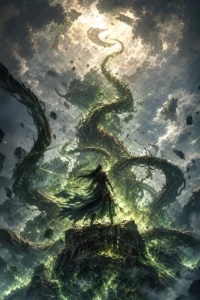
From the valley road, Shen Lian saw the mountain’s black ribs rising through a shawl of corpse-pale mist, each cliff face carved with terraces, tomb-mouths, hanging bridges, and halls whose roofs curled like the lids of ancient coffins. Pines grew sideways from sheer stone. White banners trailed from iron poles, their silk stained by rain and age until the sect’s cloud-and-coffin sigil looked less painted than bled into being.
Above the highest peak, a cloud did not move with the wind.
It lay there like a lid.
A vast rectangular mass of gray-white vapor pressed upon the summit, edges sharp as carved jade, corners bound by chains of glittering talisman light. Thunder rolled inside it with the muffled sound of fingernails scratching wood.
The servant youths fell silent when they saw it.
Even the village boys who had bragged for three days about how quickly they would climb the immortal path now lowered their eyes and clutched the rough hemp sacks containing all they owned. A girl from Reedbank began to cry quietly. Someone whispered a prayer to the Stove God, then stopped halfway, as if afraid the mountain might hear another name and swallow it too.
Shen Lian walked near the back of the line. His sandals were cracked from the road. Dust clung to the hem of his mourning-gray robe. He had not spoken since Elder Han’s flying shuttle descended at dawn and herded them toward the sect gates like goats bought cheap at market.
The black root around his soul had been quiet for most of the journey.
That frightened him more than its whispers.
When it spoke, he could fear it. When it slept, he could only wonder what it dreamed.
The sect’s outer gate emerged from the mist at the end of a stone causeway. It was not a gate so much as the lower jaw of some enormous beast—two pillars of black bone-like rock leaning inward, teeth of white jade hanging from the arch. On the left pillar, names were carved in thousands of tiny lines. On the right pillar, those same lines had been scraped away.
The erased side was smoother than river stone.
A bronze plaque hung under the arch.
Those who enter carry only their usefulness.
Beside the gate waited three Cloud-Coffin disciples in dark blue robes trimmed with white thread. Their belts bore jade tags. Their hair was bound neatly. Their eyes moved over the new arrivals with the bored calculation of butchers assessing bone weight.
Elder Han drifted down from the shuttle, his sleeves untouched by road dust. He was thin as a winter reed, with a scholar’s beard and eyes like ash under ice. During the recruitment, he had smiled at grieving parents, patted children’s heads, and accepted gifts with the serene mercy of an immortal. On the road he had spoken once, to tell them anyone who ran would have their legs refined into medicine paste.
Now he raised two fingers.
“Kneel.”
The youths dropped to the stone. Shen Lian followed, his knees striking cold rock. The mist smelled of wet pine, incense, and something older—dried blood sealed beneath lacquer.
One of the blue-robed disciples stepped forward holding a wooden tray. Upon it rested a brush, a bowl of cinnabar ink, and a narrow knife with a handle wrapped in yellowed silk.
“Listen carefully,” Elder Han said. “From this moment, the villages that birthed you are behind you. Your fathers’ houses, your mothers’ cooking fires, your ancestors’ graves—behind you. The Cloud-Coffin Sect feeds you, clothes you, teaches you, and may one day bury you with honor if you are not entirely useless.”
His gaze passed over them.
“Servant disciples do not use family names.”
A murmur shivered through the line.
The crying girl looked up. “Elder, my mother said—”
The disciple with the tray slapped her across the face before she finished. The sound cracked like a twig underfoot. She toppled sideways, one palm skidding on stone.
“Your mother is behind you,” Elder Han said gently. “Bring her forward in your heart again, and the mountain will make space for both of you.”
The girl crawled back into place, blood bright at her lip.
Shen Lian’s fingers curled against his thighs.
His father’s hands had smelled of grave soil and bitter tea. His mother’s name had been carved on a wooden tablet so worn the final stroke had nearly vanished. His own surname, Shen, was the only coin his father had ever given him without shame.
Now the mountain wanted it.
One by one, the youths were called.
“Liang Guo.”
A broad-shouldered boy stepped forward.
The disciple dipped the brush in cinnabar, wrote the name on a strip of thin white paper, then held the strip against the right pillar—the smooth pillar where names had been erased. The black stone rippled like water. The paper sank in. For a breath, the characters flared red.
Then they vanished.
The boy gasped as if struck in the chest.
“Guo is gone,” the disciple said. “Servant Liang. Next.”
The boy stumbled back, face gray. His lips moved soundlessly, shaping the lost syllable.
More names followed.
Zhou Mei became Servant Mei.
Han Tuo became Servant Tuo.
Fang Jishi became Servant Jishi, then was scolded because a servant had no courtesy name, and became Servant Shi.
Each time, the stone drank the paper. Each time, something faint and invisible left the child. Some merely shuddered. Some wept. One boy vomited into the mist, and a blue-robed disciple made him clean the stone with his sleeve.
When Shen Lian’s turn came, Elder Han looked at him a little longer than necessary.
“Name.”
“Shen Lian,” he said.
The brush paused above the paper.
“Speak louder.”
“Shen Lian.”
The disciple wrote it. Two characters. One family, one given. Cinnabar wet as fresh blood.
As the paper touched the pillar, the black root inside him stirred.
Not sharply. Not hungrily.
Slowly, like a snake lifting its head in darkness.
A name is a leash tied from the dead to the living.
The stone rippled.
The paper sank.
Red light flared.
Cold fingers reached through Shen Lian’s skin, past flesh, past bone, toward the place where his father’s voice still called him in the early mornings. For one terrible instant he smelled rain on grave grass. Saw his father squatting beside a cracked tombstone, scraping moss from the carved surname Shen with the back of a knife.
A man without a family name is a leaf in floodwater, Lian. Remember where your roots are.
The mountain pulled.
The black root tightened.
Cold met cold.
Something soundless tore.
Shen Lian bit the inside of his cheek until blood filled his mouth. The paper vanished into stone. The red characters faded.
The disciple frowned.
For a heartbeat, the pillar’s surface darkened. Not black like stone, but black like a hole beneath moonlight. Hairline cracks spread around the place where Shen Lian’s name had entered. They vanished before anyone but Elder Han could draw breath.
Elder Han’s eyes narrowed.
“Servant Lian,” the disciple announced.
Shen Lian bowed his head and stepped back.
Inside his soul, the root coiled around a small, stubborn ember.
Not the whole name.
Not completely.
Somewhere in him, buried beneath fear and hunger, the surname Shen remained like a seed between teeth.
Elder Han watched him until the last servant had been stripped and renamed. Then he turned toward the gate.
“Stand. Walk. Do not look back.”
They passed beneath the jade teeth.
As Shen Lian crossed the threshold, a pressure settled on his shoulders. The mountain weighed him. Measured him. Decided he was light enough to ignore.
Beyond the gate, the sect opened into layers.
The lowest terraces were carved into the mountain’s belly: gray courtyards, squat dormitories, kitchens steaming with thin rice gruel, laundry yards strung with blue robes, and training grounds where youths ran with stone weights until their knees buckled. Higher up, bridges threaded between cliffside halls wreathed in incense. Above those rose pill towers with bronze chimneys, scripture pavilions with windows of green glass, and mausoleum-like residences reserved for elders whose disciples floated past on paper cranes and sword lights.
Servants lived where the mountain’s shadow never moved.
Their dormitory was a long stone building half-swallowed by damp earth. Moss grew between roof tiles. The inside smelled of straw mats, sweat, mold, and old resentment. Wooden plaques above each sleeping alcove bore numbers instead of names.
A heavyset steward with a wart on his chin waited by the entrance, beating a bamboo tally stick against his palm.
“New meat,” he said, smiling without joy. “Good. Last batch thinned out during winter hauling.”
No one laughed.
“I am Steward Qi. You will obey me faster than you breathe. Wake at the fifth bell. Carry water, chop wood, tend spirit fields, clean latrines, sweep ash, feed furnace coals, sort bone dust, wash robes, and report for scripture recitation at night if your bodies have not embarrassed you by collapsing. Each ten-day, you receive one Qi Gathering Crumb.”
A boy raised his head. “Crumb?”
Steward Qi flicked his bamboo stick. The boy yelped as a red welt rose across his forehead.
“Crumb,” the steward repeated. “Outer disciples receive pills. Inner disciples receive refined pills. Core disciples receive things your dirty tongues are not fit to name. Servants receive crumbs, because servants leak qi like cracked chamber pots.”
He held up a clay jar. Inside, small gray pellets rattled.
Even from several steps away, Shen Lian sensed the faint spiritual energy inside them—thin, impure, smoky, like a cooking fire starved of air.
The black root stirred again.
Ashes from a feast are still food to the buried.
Shen Lian lowered his eyes.
Steward Qi assigned sleeping alcoves. Shen Lian received a mat near the rear wall, beneath a leaking seam in the stone. His neighbor was a narrow-faced boy called Tuo, formerly Han Tuo, who clutched his sack as if someone might steal the rags inside.
“You from Deer-Gate?” Tuo whispered when the steward moved away.
“Near there.”
“I heard your mound cracked open.”
Shen Lian unrolled his mat. “Many things crack after rain.”
Tuo blinked, uncertain whether that was an answer.
“My uncle said ancient ghosts come out of broken mounds.”
“Then your uncle should stay away from graves.”
Tuo shut his mouth.
Before the servants could settle, a bell rang outside—low, metallic, and mournful. Steward Qi barked orders, dividing them into work groups. Shen Lian was sent with six others up a narrow path to the pill terraces.
The path climbed along the cliff, slick with mist. To their left, the mountain dropped into a ravine filled with white fog. To their right, black stone walls sweated mineral water. Prayer strips fluttered from cracks, each inked with talismans against corpse insects and furnace explosions.
As they climbed, spiritual energy thickened.
It seeped from the stone like unseen spring water. It prickled along Shen Lian’s skin. In the villages below, qi was a rumor—felt during storms, births, deaths, and in the brief shiver before a candle went out. Here, even the moss seemed to breathe it.
The black root drank without moving.
Not greedily. Carefully.
A thread here. A drop there. Nothing any elder would notice.
Shen Lian felt each stolen wisp slide into the root and vanish. In return, a faint warmth spread through his meridians—so faint he might have mistaken it for blood returning to cold fingers.
The pill terraces were hotter than the lower dormitories. Bronze furnaces squatted beneath tiled shelters, each as large as a grain jar and carved with clouds, skulls, lotus petals, and sealed mouths. Apprentices in pale green robes hurried between them carrying trays of herbs, animal cores, mineral powders, and sealed boxes that clicked from within.
The air stung Shen Lian’s nose. Bitter ginseng. Charred bone. Honeyed resin. Vinegar-sharp venom. Under it all, the heavy sweetness of failed pills dumped into waste buckets.
A girl stood on a stool beside the largest furnace, arguing with a young man twice her height.
She looked about sixteen, though the soot on her cheeks and the sharpness of her gaze made age difficult to judge. Her green apprentice robe was hitched up at the sleeves and tied with practical knots. A lacquer hairpin held her hair in place, except for several rebellious strands plastered to her temple with sweat. One hand held a long iron stirring rod. The other pointed at a tray of pale yellow roots.
“If you put Sun-Drowning Reed in before the marrow salt, you deserve the explosion,” she snapped. “And if Elder Pei asks why Furnace Seven coughed black smoke again, I’ll tell him your skull is full of damp millet.”
The tall apprentice flushed. “Mu Qing, I refined pills before you knew how to read a furnace mark.”
“Then you’ve had years to become less stupid. How tragic that heaven denied you progress.”
A few nearby apprentices hid smiles.
The tall one grabbed the tray. “Who made you chief mouth of the pill terrace?”
Mu Qing hopped down from the stool, iron rod still in hand. “Your mother, when she forgot to make you a brain.”
The servants froze at the edge of the terrace, unsure whether to announce themselves or flee.
A thin elderly pill master emerged from a side room, eyebrows singed nearly off.
“Why,” he asked in a voice like dry leaves, “do I hear Mu Qing educating the dead again?”
Mu Qing immediately bowed. “Master Sun, Senior Apprentice Luo attempted to murder Furnace Seven through ignorance. I intervened for the good of the sect and the continued existence of our eyebrows.”
Senior Apprentice Luo opened his mouth.
Master Sun looked at the tray, sniffed once, and slapped Luo on the back of the head.
“Marrow salt first, idiot.”
Mu Qing’s lips twitched.
Master Sun turned his watery eyes toward the new servants. “You. Ash carriers?”
The older servant leading them bowed. “Yes, Master Sun.”
“Waste pits need clearing. Buckets by the wall. Do not touch red ash, blue ash, or anything that whispers. If something grows teeth, call Mu Qing. If something grows a face, call me. If it grows your face, jump into the ravine before it learns to speak.”
The servants bowed deeper.
Mu Qing’s gaze swept over them and stopped on Shen Lian for half a breath. Not because he looked impressive. In his patched robe, with dust on his jaw and silence wrapped around him, he looked like every other low-born boy dragged up the mountain.
But her eyes sharpened anyway.
“You,” she said. “Leaking-roof expression. What’s your name?”
Shen Lian hesitated.
“Lian.”
“Just Lian?”
“Servant Lian.”
“Mm.” She pointed toward a row of blackened buckets. “Carry those to the waste trench. Don’t breathe through your mouth unless you enjoy tasting yesterday’s failure. And if the ash clumps, don’t break it with your hands.”
Tuo whispered, “Why not?”
Mu Qing smiled sweetly. “Because hands are useful and stumps make poor chopsticks.”
The waste buckets were heavier than they looked. Shen Lian lifted two by the handles and felt heat seep through the iron. Inside lay pill ash in layers of gray, green, and dull gold. Spiritual energy clung to the residue—distorted, polluted, but real. To ordinary servants, it was trash. To the black root, it was a banquet left under a beggar’s window.
The root trembled.
Shen Lian’s grip tightened.
Not here.
Hunger that waits grows teeth.
Then grow quietly.
The answer surprised him. He had not meant to speak inwardly. The root gave no reply, but the faint pressure in his soul eased.
He carried the buckets to a trench cut into the cliffside. Below, a slurry of failed alchemy steamed and bubbled. Strange colors oozed through it. A lump of ash sprouted tiny white fingers that waved in the air before dissolving. Tuo gagged until tears ran down his cheeks.
“Don’t waste vomit,” Mu Qing called from behind them. “We use bile in two recipes.”
Shen Lian emptied his buckets. A thin stream of gray ash spilled out. As it fell, the black root flicked a hair-fine tendril through his palm—not into the visible world, but along the inner edge of his meridians. The ash’s lingering qi shivered.
A few sparks vanished before they hit the trench.
Warmth flowed into him.
This time it was stronger.
His tired shoulders loosened. The ache in his knees from kneeling at the gate faded. A tiny point in his lower abdomen pulsed once, like a coal under ash.
Shen Lian nearly dropped the bucket.
Mu Qing was watching.
Not directly. She stood by Furnace Seven, correcting another apprentice’s herb measurements, but her gaze had the habit of a knife—it seemed to cut sideways.
Shen Lian bent, pretending to cough from fumes.
Her eyes moved on.


0 Comments